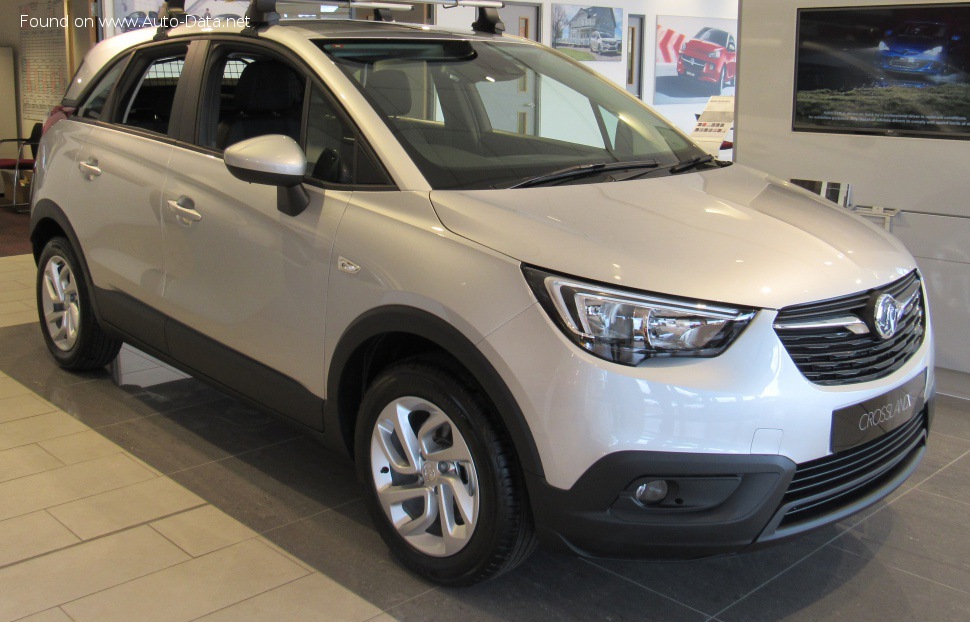
The Vauxhall Crossland X 1.2 Turbo (110 Hp) Automatic: A European Urban Crossover
The Vauxhall Crossland X 1.2 Turbo (110 Hp) Automatic represents a significant entry in the burgeoning subcompact SUV (or crossover) segment, primarily targeting the European market. Introduced in June 2017, the Crossland X, a rebadged version of the Opel Crossland X for the United Kingdom, marked Vauxhall’s strategic shift towards more SUV-oriented offerings. This particular variant, equipped with a 1.2-liter turbocharged engine and an automatic transmission, was positioned as a practical, efficient, and versatile vehicle designed to navigate the demands of urban living while offering sufficient capability for longer journeys. It competed in a fiercely contested segment, emphasizing practicality, connectivity, and a raised driving position over rugged off-road prowess, aligning with the preferences of modern European consumers.
The Crossland X generation was developed under Opel’s (and thus Vauxhall’s) partnership with PSA Group (now Stellantis) before the full acquisition, sharing its platform with vehicles like the Citroën C3 Aircross and Peugeot 2008. This collaboration allowed Vauxhall to quickly expand its SUV lineup, sitting below the larger Grandland X and offering a more family-friendly alternative to the Mokka X. Its production run for this specific 1.2 Turbo (110 Hp) Automatic variant spanned from June 2017 to May 2018, establishing its initial footprint in a crucial market segment.
Engine and Performance: The 1.2 Turbo (110 Hp) Automatic Powertrain
At the heart of the Vauxhall Crossland X 1.2 Turbo (110 Hp) Automatic lies a compact yet potent 1.2-liter (1199 cm3 or 73.17 cu. in.) inline three-cylinder engine, designated with the B12XHL code. This powerplant is a testament to modern engine downsizing, employing direct injection and a turbocharger with an intercooler to deliver a respectable 110 horsepower at 5500 rpm. The specific power output of 91.7 horsepower per liter highlights its efficiency and advanced engineering for its class.
More crucial for daily driving, especially in urban environments, is the engine’s torque output. It generates a robust 205 Nm (151.2 lb.-ft.) available from a low 1500 rpm. This broad torque band ensures responsive acceleration from a standstill and flexible in-gear performance, reducing the need for frequent downshifts and enhancing the driving experience. The engine’s front, transverse layout contributes to efficient packaging and maximizes interior space.
Power is delivered to the front wheels via a smooth-shifting 6-speed automatic transmission. This combination prioritizes ease of driving and fuel efficiency, making it an ideal choice for congested city traffic and longer highway cruises alike. The drivetrain architecture is straightforward front-wheel drive, consistent with its urban crossover role rather than an off-road utility vehicle.
In terms of fuel economy, the Crossland X 1.2 Turbo (110 Hp) Automatic demonstrates competitive figures for its segment. It achieves an urban fuel consumption of 36.2 US mpg (6.5 l/100 km), an impressive 49 US mpg (4.8 l/100 km) on extra-urban cycles, and a combined average of 43.6 US mpg (5.4 l/100 km). With CO2 emissions rated at 123 g/km, it met the Euro 6 emission standard, reflecting its commitment to environmental responsibility. The vehicle’s top speed is 116.2 mph (187 km/h), providing ample performance for highway travel.
Design and Features: Practicality Meets Contemporary Style
The Vauxhall Crossland X adopted a contemporary design language characterized by clean lines, a distinctive “floating roof” effect, and a bold front grille. As a 5-door SUV, it offered a higher riding position and easier ingress/egress compared to traditional hatchbacks, a key selling point for many consumers. Its dimensions—165.83 inches (4212 mm) in length, 69.49 inches (1765 mm) in width (77.8 inches or 1976 mm including mirrors), and 63.19 inches (1605 mm) in height—made it a compact and maneuverable vehicle suitable for tight European streets and parking spaces. The wheelbase of 102.52 inches (2604 mm) contributed to a stable ride and maximized interior volume.
Inside, the Crossland X prioritized practicality and user-friendliness. With seating for five occupants, it offered a versatile cabin with a minimum trunk space of 14.48 cu. ft. (410 liters), expandable to a generous 44.32 cu. ft. (1255 liters) with the rear seats folded down. This flexibility made it suitable for families, shopping trips, or transporting larger items. The fuel tank capacity of 11.89 US gallons (45 liters) provided a decent range given its fuel efficiency.
Safety features were standard for a modern vehicle of its era, including an Anti-lock Braking System (ABS) with ventilated discs at the front and disc brakes at the rear for confident stopping power. The electric power steering system, utilizing a steering rack and pinion, offered light and precise control, enhancing maneuverability, especially during low-speed parking. The vehicle was fitted with 215/50 R17 tires on 17-inch wheel rims, providing a balance of comfort and road grip.
While specific interior connectivity and convenience features are not detailed in the raw data, as a 2017 model, the Crossland X would typically include modern infotainment systems, climate control, and various driver-assistance technologies, depending on the trim level, all designed to enhance comfort and safety for its target audience.
Technical Specifications
| Category | Specification |
|---|---|
| General Information | |
| Brand | Vauxhall |
| Model | Crossland |
| Generation | Crossland X |
| Type (Engine) | 1.2 Turbo (110 Hp) Automatic |
| Start of Production | June, 2017 |
| End of Production | May, 2018 |
| Powertrain Architecture | Internal Combustion engine |
| Body Type | SUV |
| Seats | 5 |
| Doors | 5 |
| Performance Specs | |
| Fuel Consumption (Economy) – Urban | 6.5 l/100 km (36.2 US mpg) |
| Fuel Consumption (Economy) – Extra Urban | 4.8 l/100 km (49 US mpg) |
| Fuel Consumption (Economy) – Combined | 5.4 l/100 km (43.6 US mpg) |
| CO2 Emissions | 123 g/km |
| Fuel Type | Petrol (Gasoline) |
| Maximum Speed | 187 km/h (116.2 mph) |
| Emission Standard | Euro 6 |
| Engine Specs | |
| Power | 110 Hp @ 5500 rpm |
| Power per Liter | 91.7 Hp/l |
| Torque | 205 Nm @ 1500 rpm (151.2 lb.-ft. @ 1500 rpm) |
| Engine Layout | Front, Transverse |
| Engine Model/Code | B12XHL |
| Engine Displacement | 1199 cm3 (73.17 cu. in.) |
| Number of Cylinders | 3 |
| Engine Configuration | Inline |
| Number of Valves per Cylinder | 4 |
| Fuel Injection System | Direct injection |
| Engine Aspiration | Turbocharger, Intercooler |
| Engine Oil Capacity | 3.5 l (3.7 US qt) |
| Coolant Capacity | 5.7 l (6.02 US qt) |
| Space, Volume and Weights | |
| Trunk (Boot) Space – Minimum | 410 l (14.48 cu. ft.) |
| Trunk (Boot) Space – Maximum | 1255 l (44.32 cu. ft.) |
| Fuel Tank Capacity | 45 l (11.89 US gal) |
| Dimensions | |
| Length | 4212 mm (165.83 in.) |
| Width | 1765 mm (69.49 in.) |
| Width Including Mirrors | 1976 mm (77.8 in.) |
| Height | 1605 mm (63.19 in.) |
| Wheelbase | 2604 mm (102.52 in.) |
| Minimum Turning Circle (Turning Diameter) | 11.21 m (36.78 ft.) |
| Drivetrain, Brakes and Suspension Specs | |
| Drivetrain Architecture | Internal Combustion engine (ICE) drives the front wheels |
| Drive Wheel | Front wheel drive |
| Number of Gears and Type of Gearbox | 6 gears, automatic transmission |
| Front Brakes | Ventilated discs |
| Rear Brakes | Disc |
| Assisting Systems | ABS (Anti-lock braking system) |
| Steering Type | Steering rack and pinion |
| Power Steering | Electric Steering |
| Tires Size | 215/50 R17 |
| Wheel Rims Size | 17 inches |
Legacy and Market Impact of the Vauxhall Crossland X
The Vauxhall Crossland X 1.2 Turbo (110 Hp) Automatic, during its relatively short specific production run from 2017 to 2018, played a crucial role in Vauxhall’s strategy to capture a larger share of the booming European subcompact SUV market. As an alternative to the more rugged-looking Mokka X, the Crossland X was designed with a greater emphasis on interior space, family-friendliness, and practicality, effectively replacing the Meriva MPV in Vauxhall’s lineup. This repositioning was vital as consumer preferences rapidly shifted away from traditional minivans towards crossovers.
In its primary markets, particularly the United Kingdom, the Crossland X faced stiff competition from a multitude of rivals. Key competitors included the Nissan Juke, Renault Captur, Peugeot 2008 (with which it shared a platform), Ford EcoSport, and Volkswagen T-Roc. To stand out, Vauxhall highlighted the Crossland X’s generous cargo capacity, flexible interior, and efficient engines, such as the 1.2-liter turbo. Its elevated driving position and compact dimensions made it particularly appealing to urban families and older drivers seeking ease of entry and better visibility.
The Crossland X’s adoption of PSA Group’s platform technology allowed Vauxhall to offer a modern, competitive product quickly, leveraging shared engineering and components. This strategic move was instrumental in Vauxhall’s transition under new ownership. While not a groundbreaking performance vehicle, its strength lay in its sensible approach to everyday mobility, offering a comfortable ride, decent fuel economy, and a versatile cabin.
Its legacy is that of a practical, no-nonsense urban crossover that successfully navigated the evolving demands of the European automotive landscape. It helped solidify Vauxhall’s presence in a critical segment and laid the groundwork for future models. The Crossland X was eventually updated and simplified to just “Crossland” in 2020, dropping the “X” suffix and receiving a refreshed design, indicating the initial model’s success in establishing a viable product line.