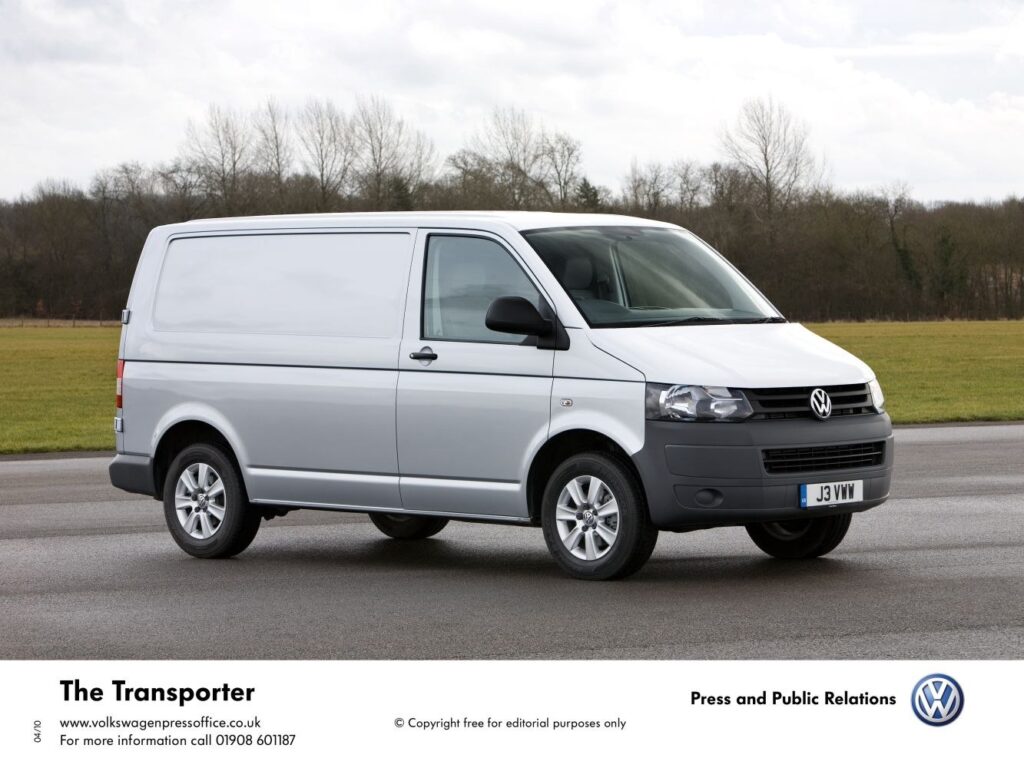
The Volkswagen Transporter (T5, facelift 2009) Panel Van: A European Workhorse
The Volkswagen Transporter, a name synonymous with commercial vehicle reliability and versatility across global markets, particularly in Europe, saw its fifth generation (T5) receive a significant facelift in 2009. This iteration, produced from 2012 to 2015, continued the Transporter’s legacy as a cornerstone of light commercial transport. The specific variant under review, the Volkswagen Transporter (T5, facelift 2009) Panel Van 2.0 TDI BMT (140 Hp) L1H2, represents a highly practical and efficient configuration designed for businesses prioritizing cargo capacity, operational economy, and robust performance. While not officially sold in the United States in this specific panel van configuration, the Transporter series is globally recognized, with its passenger variants sometimes finding their way into other international markets. This article will delve into the technical prowess and market impact of this crucial European commercial vehicle, highlighting its role as a dependable partner for countless trades and services.
Engine & Performance: The Efficient 2.0 TDI BlueMotion Technology
At the heart of the Volkswagen Transporter (T5, facelift 2009) Panel Van lies the highly regarded 2.0-liter TDI (Turbocharged Direct Injection) engine, specifically the BlueMotion Technology (BMT) variant. This powertrain, designated EA189 / CAAC, embodies Volkswagen’s commitment to combining robust performance with enhanced fuel efficiency and reduced emissions. Generating a healthy 140 horsepower at 3500 rpm and a substantial 250.77 lb.-ft. of torque across a broad range from 1750 to 2500 rpm, this inline four-cylinder diesel engine provides ample power for hauling significant loads while maintaining comfortable highway speeds. The engine’s advanced design features a DOHC valvetrain, common rail fuel injection, and a turbocharger with an intercooler, ensuring optimal combustion and responsiveness.
Power is efficiently transmitted to the front wheels via a precise 6-speed manual transmission, offering drivers excellent control over the vehicle’s output. This setup allows the Panel Van to accelerate from 0 to 60 mph in a respectable 11.7 seconds, with a top speed of 103.77 mph. These figures are impressive for a commercial vehicle of its size and payload capacity, demonstrating its capability to keep up with traffic flow on both urban streets and intercity routes.
The BlueMotion Technology package further distinguishes this Transporter. It incorporates features such as a Start & Stop system and a particulate filter, which are crucial for meeting stringent European emission standards. Adhering to Euro 5 regulations, the vehicle boasts combined fuel economy figures ranging from 32.7 to 34.1 US mpg, with CO2 emissions between 182-189 g/km. This emphasis on efficiency and environmental responsibility made the 2.0 TDI BMT an attractive option for businesses looking to minimize running costs and ecological footprint. The 80-liter (21.13 US gallon) fuel tank ensures a substantial operating range, reducing downtime for refueling.
Design & Features: Purpose-Built Utility and Practicality
The Volkswagen Transporter (T5, facelift 2009) Panel Van is a masterclass in functional design, specifically tailored for commercial applications. The L1H2 designation indicates its body dimensions: L1 signifies the standard length, while H2 denotes the medium-high roof configuration. This combination results in a vehicle that is 192.6 inches long and 85.67 inches high, providing an impressive maximum cargo volume of 236.61 cubic feet. Such generous dimensions allow for the transport of bulky items and significant quantities of goods, making it an indispensable tool for delivery services, tradesmen, and logistics operations.
The panel van body type, with its 4-5 doors (including rear access and often a sliding side door), facilitates easy loading and unloading. The interior is designed for practicality, typically featuring 2-3 seats in the cabin, prioritizing driver and passenger comfort for long working days. The robust construction is evident in its kerb weight, ranging from 3796.36 to 4713.48 lbs., and a maximum permissible weight of up to 7054.79 lbs., allowing for a substantial maximum payload of 2341.31 to 2376.58 lbs. Furthermore, the Transporter is a capable hauler, with a permitted trailer load of 5511.56 lbs. with brakes, underscoring its versatility for businesses requiring towing capabilities.
Underneath, the Transporter features an independent McPherson strut front suspension with a coil spring and anti-roll bar, paired with an independent coil spring rear suspension with a transverse stabilizer and trailing arms. This setup provides a comfortable ride and stable handling, even when fully loaded. Safety features include ventilated disc brakes both front and rear (308×29.5 mm front, 294×22 mm rear) and an Anti-lock Braking System (ABS) for enhanced stopping power and control. Hydraulic power steering, with a minimum turning circle of 39.04 feet, ensures maneuverability in tight urban environments, a critical factor for a commercial vehicle. With a ground clearance of 7.91 inches and respectable approach/departure angles, the Transporter is also capable of handling light off-road conditions or uneven job sites.
Technical Specifications of the Volkswagen Transporter (T5, facelift 2009) Panel Van 2.0 TDI BMT (140 Hp) L1H2
| Category | Specification |
|---|---|
| General Information | |
| Brand | Volkswagen |
| Model | Transporter |
| Generation | Transporter (T5, facelift 2009) Panel Van |
| Type (Engine) | 2.0 TDI BMT (140 Hp) L1H2 |
| Start of Production | 2012 year |
| End of Production | 2015 year |
| Powertrain Architecture | Internal Combustion engine |
| Body type | Van |
| Seats | 2-3 |
| Doors | 4-5 |
| Performance Specs | |
| Fuel consumption (urban NEDC) | 8.8-9.1 l/100 km (26.7 – 25.8 US mpg) |
| Fuel consumption (extra urban NEDC) | 5.8-6.1 l/100 km (40.6 – 38.6 US mpg) |
| Fuel consumption (combined NEDC) | 6.9-7.2 l/100 km (34.1 – 32.7 US mpg) |
| CO2 emissions (NEDC) | 182-189 g/km |
| Fuel Type | Diesel |
| Acceleration 0 – 60 mph | 11.7 sec |
| Maximum speed | 167 km/h (103.77 mph) |
| Emission standard | Euro 5 |
| Weight-to-power ratio | 12.3 kg/Hp (81.3 Hp/tonne) |
| Weight-to-torque ratio | 5.1 kg/Nm (197.4 Nm/tonne) |
| Engine Specs | |
| Power | 140 Hp @ 3500 rpm |
| Power per liter | 71.1 Hp/l |
| Torque | 340 Nm @ 1750-2500 rpm (250.77 lb.-ft.) |
| Engine layout | Front, Transverse |
| Engine Model/Code | EA189 / CAAC |
| Engine displacement | 1968 cm3 (120.09 cu. in.) |
| Number of cylinders | 4 |
| Engine configuration | Inline |
| Cylinder Bore | 81 mm (3.19 in.) |
| Piston Stroke | 95.5 mm (3.76 in.) |
| Compression ratio | 16.5:1 |
| Number of valves per cylinder | 4 |
| Fuel injection system | Diesel Commonrail |
| Engine aspiration | Turbocharger, Intercooler |
| Valvetrain | DOHC |
| Engine oil capacity | 7 l (7.4 US qt) |
| Coolant capacity | 11 l (11.62 US qt) |
| Engine systems | Start & Stop System, Particulate filter |
| Space, Volume and Weights | |
| Kerb Weight | 1722-2138 kg (3796.36 – 4713.48 lbs.) |
| Max. weight | 2800-3200 kg (6172.94 – 7054.79 lbs.) |
| Max load | 1062-1078 kg (2341.31 – 2376.58 lbs.) |
| Trunk (boot) space – maximum | 6700 l (236.61 cu. ft.) |
| Fuel tank capacity | 80 l (21.13 US gal) |
| Permitted trailer load with brakes (12%) | 2500 kg (5511.56 lbs.) |
| Permitted trailer load without brakes | 750 kg (1653.47 lbs.) |
| Permitted towbar download | 100 kg (220.46 lbs.) |
| Dimensions | |
| Length | 4892 mm (192.6 in.) |
| Width | 1904 mm (74.96 in.) |
| Width including mirrors | 2283 mm (89.88 in.) |
| Height | 2176 mm (85.67 in.) |
| Wheelbase | 3000 mm (118.11 in.) |
| Front overhang | 896 mm (35.28 in.) |
| Rear overhang | 996 mm (39.21 in.) |
| Ride height (ground clearance) | 201 mm (7.91 in.) |
| Minimum turning circle (turning diameter) | 11.9 m (39.04 ft.) |
| Approach angle | 21° |
| Departure angle | 17° |
| Ramp-over (brakeover) angle | 14° |
| Wading depth | 300 mm (11.81 in.) |
| Drivetrain, Brakes and Suspension Specs | |
| Drivetrain Architecture | Internal combustion engine drives the front wheels. |
| Drive wheel | Front wheel drive |
| Number of gears and type of gearbox | 6 gears, manual transmission |
| Front suspension | Independent, type McPherson with coil spring and anti-roll bar |
| Rear suspension | Independent coil spring, Transverse stabilizer, Trailing arm |
| Front brakes | Ventilated discs, 308×29.5 mm |
| Rear brakes | Ventilated discs, 294×22 mm |
| Assisting systems | ABS (Anti-lock braking system) |
| Steering type | Steering rack and pinion |
| Power steering | Hydraulic Steering |
| Tires size | 215/65 R16 |
| Wheel rims size | 6.5J x 16 |
Legacy & Market Impact: The Enduring Appeal of the Volkswagen Transporter (T5, facelift 2009) Panel Van
The Volkswagen Transporter series boasts an incredible heritage, tracing its roots back to the iconic Type 2 “Bus” of the 1950s. Each subsequent generation has built upon this legacy, evolving to meet the changing demands of commercial and private users worldwide. The T5, and particularly its facelifted version from 2009, cemented the Transporter’s reputation as a highly capable and exceptionally durable light commercial vehicle. In its primary markets, especially across Europe, the Volkswagen Transporter (T5, facelift 2009) Panel Van was a ubiquitous sight, serving as the backbone for countless small and large businesses, from plumbers and electricians to delivery services and florists.
Its market impact was significant due to a compelling combination of factors: Volkswagen’s renowned build quality and reliability, a diverse range of configurations (the L1H2 panel van being just one of many, including passenger vans, chassis cabs, and camper conversions), and the efficient yet powerful TDI engines. Competitors in the European market included established rivals such as the Ford Transit Custom, Mercedes-Benz Vito, Renault Trafic, and Peugeot Expert. However, the Transporter consistently held its own, often leading in terms of residual values and desirability due to its robust engineering and strong brand image.
The introduction of BlueMotion Technology in models like the 2.0 TDI BMT further enhanced its appeal, addressing the growing concerns over fuel costs and environmental regulations. For businesses, lower operating costs translated directly to improved profitability, while the Euro 5 emission compliance ensured future-proofing in increasingly regulated urban zones. The T5 facelift brought subtle but effective aesthetic updates and technological refinements, keeping the model competitive until the introduction of the T6 generation. Its widespread adoption underscores its historical significance as a benchmark in the light commercial vehicle segment, demonstrating how a well-engineered and versatile van can become an indispensable tool for economic activity. The T5 Transporter, particularly in its efficient panel van guise, remains a testament to Volkswagen’s ability to produce vehicles that are both highly practical and enduringly popular.