The Peugeot 207 SW 1.6 RC (174 Hp): A Compact Performer with Practicality
The Peugeot 207 SW 1.6 RC (174 Hp), produced between 2007 and 2009, represented a unique proposition in the European compact car segment. As a sport-oriented variant of the 207 SW (Station Wagon), it fused the practicality of a small estate car with the spirited performance typically found in a hot hatchback. While never officially sold in the United States, the 207 played a crucial role in Peugeot’s lineup across Europe and other international markets, succeeding the highly popular 206 model. The SW variant, in particular, catered to buyers seeking more cargo space and versatility without sacrificing the nimble handling and efficiency characteristic of Peugeot’s small cars. The 1.6 RC trim elevated this concept, offering a potent turbocharged engine and a more engaging driving experience to those who desired a blend of utility and excitement.
Engine and Performance: The Heart of the Peugeot 207 SW 1.6 RC
At the core of the Peugeot 207 SW 1.6 RC‘s appeal was its advanced powertrain. This model featured the 5FY EP6DTS engine, a 1.6-liter (1598 cm³ or 97.52 cu. in.) inline four-cylinder unit. This engine was part of the Prince family, a collaborative development between PSA Peugeot Citroën and BMW, renowned for its efficiency and performance capabilities. Equipped with a turbocharger and intercooler, along with direct fuel injection and DOHC-VVT (Double Overhead Camshaft with Variable Valve Timing), it delivered an impressive 174 horsepower at 6000 rpm. This translated to a robust power-per-liter figure of 108.9 Hp/l, showcasing its high-tech design for its era.
The engine’s torque output was equally impressive, peaking at 240 Nm (177.01 lb.-ft.) across a broad range from 1600 to 3500 rpm. This wide torque band ensured excellent responsiveness and flexibility in various driving conditions, from city commutes to spirited highway driving. Mated to a 5-speed manual transmission driving the front wheels, the 207 SW 1.6 RC could accelerate from 0 to 60 mph in a swift 7.2 seconds (calculated) and reach a top speed of 136.7 mph (220 km/h). These figures placed it firmly in the “warm hatch” category, even in its wagon guise. Despite its performance aspirations, the engine also aimed for reasonable fuel economy, with a combined rating of 31.8 US mpg (7.4 l/100 km) and CO2 emissions of 175 g/km, adhering to Euro 4 emission standards.
Design and Features: Practicality Meets Sportiness
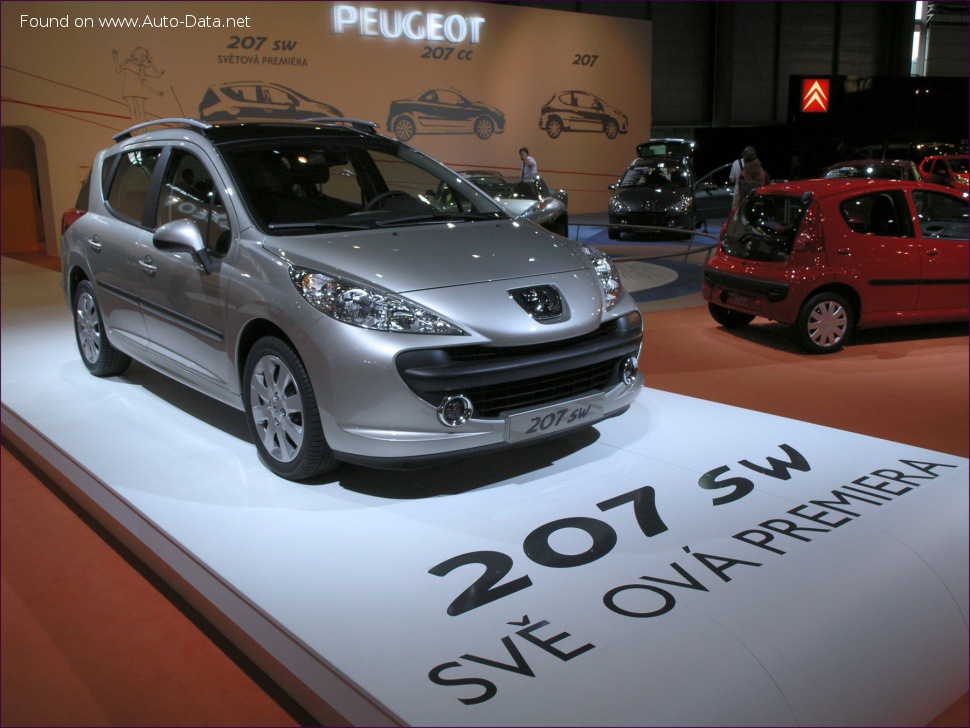
The Peugeot 207 SW adopted a sleek and modern design for a compact station wagon. With a length of 163.62 inches (4156 mm) and a width of 68.82 inches (1748 mm), it maintained a relatively compact footprint, making it agile in urban environments. The SW body style offered significant practical advantages over its hatchback sibling. While the minimum trunk space was 11.9 cu. ft. (337 liters), folding down the rear seats expanded this to a generous 44.43 cu. ft. (1258 liters), providing ample room for luggage, sports equipment, or larger purchases. This versatility was a key selling point for European families and individuals who needed more cargo capacity but preferred a smaller vehicle.
Visually, the 1.6 RC variant likely featured subtle cues to denote its sportier nature, such as specific alloy wheels (17-inch rims with 205/45 R17 tires), perhaps a unique grille, or interior trim. The car’s aerodynamic efficiency was respectable for its class, with a drag coefficient (Cd) of 0.3. Inside, the 207 SW offered seating for five, with a focus on ergonomic design and quality materials for its segment. Standard safety features for the era included ABS (Anti-lock Braking System), contributing to controlled braking performance. The steering system utilized a rack and pinion setup, promising direct and responsive handling, complemented by an independent McPherson front suspension and a semi-independent, coil spring rear suspension.
Technical Specifications: Peugeot 207 SW 1.6 RC (174 Hp)
| Category | Specification |
|---|---|
| General Information | |
| Brand | Peugeot |
| Model | 207 SW |
| Type (Engine) | 1.6 RC (174 Hp) |
| Start of Production | 2007 |
| End of Production | 2009 |
| Powertrain Architecture | Internal Combustion Engine |
| Body Type | Station Wagon (Estate) |
| Seats | 5 |
| Doors | 5 |
| Performance Specs | |
| Fuel Consumption (Urban) | 10.2 l/100 km (23.1 US mpg) |
| Fuel Consumption (Extra Urban) | 5.9 l/100 km (39.9 US mpg) |
| Fuel Consumption (Combined) | 7.4 l/100 km (31.8 US mpg) |
| CO2 Emissions | 175 g/km |
| Fuel Type | Petrol (Gasoline) |
| Acceleration 0-60 mph | 7.2 sec |
| Maximum Speed | 220 km/h (136.7 mph) |
| Emission Standard | Euro 4 |
| Weight-to-Power Ratio | 7.8 kg/Hp (128.6 Hp/tonne) |
| Weight-to-Torque Ratio | 5.6 kg/Nm (177.4 Nm/tonne) |
| Engine Specs | |
| Power | 174 Hp @ 6000 rpm |
| Power per Liter | 108.9 Hp/l |
| Torque | 240 Nm (177.01 lb.-ft.) @ 1600-3500 rpm |
| Engine Layout | Front, Transverse |
| Engine Model/Code | 5FY EP6DTS |
| Engine Displacement | 1598 cm³ (97.52 cu. in.) |
| Number of Cylinders | 4 |
| Engine Configuration | Inline |
| Cylinder Bore | 77 mm (3.03 in.) |
| Piston Stroke | 85.8 mm (3.38 in.) |
| Compression Ratio | 10.5:1 |
| Number of Valves per Cylinder | 4 |
| Fuel Injection System | Direct injection |
| Engine Aspiration | Turbocharger, Intercooler |
| Valvetrain | DOHC-VVT |
| Engine Oil Capacity | 4.25 l (4.49 US qt) |
| Coolant Capacity | 5.3 l (5.6 US qt) |
| Space, Volume, and Weights | |
| Kerb Weight | 1353 kg (2982.85 lbs.) |
| Trunk (Boot) Space – Minimum | 337 l (11.9 cu. ft.) |
| Trunk (Boot) Space – Maximum | 1258 l (44.43 cu. ft.) |
| Fuel Tank Capacity | 50 l (13.21 US gal) |
| Dimensions | |
| Length | 4156 mm (163.62 in.) |
| Width | 1748 mm (68.82 in.) |
| Width with mirrors folded | 1818 mm (71.57 in.) |
| Width including mirrors | 1972 mm (77.64 in.) |
| Height | 1527 mm (60.12 in.) |
| Wheelbase | 2540 mm (100 in.) |
| Front Track | 1467 mm (57.76 in.) |
| Rear Track | 1461 mm (57.52 in.) |
| Drag Coefficient (Cd) | 0.3 |
| Minimum Turning Circle | 10.8 m (35.43 ft.) |
| Drivetrain, Brakes, and Suspension Specs | |
| Drivetrain Architecture | Front-wheel drive, Internal Combustion Engine |
| Drive Wheel | Front wheel drive |
| Number of Gears and Type of Gearbox | 5 gears, manual transmission |
| Front Suspension | Independent type McPherson |
| Rear Suspension | Semi-independent, coil spring |
| Front Brakes | Ventilated discs |
| Rear Brakes | Disc |
| Assisting Systems | ABS (Anti-lock braking system) |
| Steering Type | Steering rack and pinion |
| Tires Size | 205/45 R17 |
| Wheel Rims Size | 17 inches |
Legacy and Market Impact
The Peugeot 207 SW 1.6 RC (174 Hp) carved out a niche for itself in the highly competitive European compact segment. While the standard 207 was a volume seller, the SW RC variant targeted a more discerning buyer who appreciated a blend of performance and practicality. It competed indirectly with other “warm” compact wagons or hatchbacks, such as the Skoda Fabia vRS (though often with a diesel engine option) or sportier versions of the Renault Clio Estate (Sport Tourer). Its unique selling proposition was the combination of a potent, BMW-engineered engine, respectable cargo capacity, and Peugeot’s characteristic engaging chassis tuning.
The 207 SW RC contributed to Peugeot’s reputation for producing fun-to-drive small cars, echoing the spirit of earlier performance models like the iconic 205 GTI. Its relatively short production run from 2007 to 2009 meant it was a somewhat exclusive model. Today, these vehicles are appreciated by enthusiasts in Europe for their spirited performance, practical body style, and the robust Prince engine, which has proven its mettle in various PSA and BMW Mini models. The 207 SW 1.6 RC stands as a testament to Peugeot’s ability to inject performance and excitement into even its most utilitarian offerings, providing a compelling option for those who wanted a family-friendly car that still offered a thrill behind the wheel.