The Seat Ibiza IV SC 1.2 TSI (105 Hp) DSG: A European Compact with Sporting Ambition
The Seat Ibiza IV SC 1.2 TSI (105 Hp) DSG represents a pivotal model within the fourth generation of Seat’s popular Ibiza lineup, specifically offered from April 2010 to 2012. As a product of the Spanish automaker Seat, a subsidiary of the Volkswagen Group, the Ibiza has consistently been a cornerstone of the highly competitive European supermini (B-segment) market. The “SC” designation, standing for “SportCoupe,” denoted a three-door variant designed with a more dynamic and youthful aesthetic compared to its five-door hatchback sibling. While Seat models are not officially sold in the United States, the Ibiza IV SC played a significant role in its primary European and select international markets, offering a compelling blend of sporty design, efficient powertrain technology, and agile handling, all built upon a robust Volkswagen Group platform.
This particular iteration, equipped with the 1.2 TSI turbocharged gasoline engine and a sophisticated DSG dual-clutch automatic transmission, was engineered to deliver an optimal balance of performance, fuel economy, and driving convenience. It catered to a demographic seeking a stylish and practical compact car for urban environments and longer journeys alike, embodying Seat’s brand philosophy of “auto emoción” – a commitment to emotional and engaging driving experiences.
Engine and Performance: The Heart of the Seat Ibiza IV SC
At the core of the Seat Ibiza IV SC 1.2 TSI (105 Hp) DSG was a technically advanced powertrain that exemplified the Volkswagen Group’s commitment to downsizing and turbocharging for improved efficiency and performance. The engine, designated with the model code CBZB, was a 1.2-liter (1197 cm3 or 73.05 cu. in.) inline four-cylinder unit. Despite its modest displacement, the inclusion of a turbocharger and intercooler, coupled with a direct fuel injection system, allowed it to punch well above its weight.
This compact powerhouse generated a respectable 105 horsepower at 5000 revolutions per minute, yielding an impressive power output of 87.7 horsepower per liter. More significantly for daily driving, the engine delivered a robust 129.07 lb.-ft. (175 Nm) of torque available from a remarkably low 1550 rpm. This broad and accessible torque band ensured responsive acceleration and minimized the need for frequent downshifts, contributing to a relaxed yet engaging driving experience.
Power was efficiently transmitted to the front wheels via a 7-speed DSG (Direct Shift Gearbox) automatic transmission. This advanced dual-clutch unit was a hallmark of Volkswagen Group engineering, renowned for its lightning-fast and smooth gear changes, which combined the efficiency of a manual gearbox with the convenience of an automatic. This pairing not only enhanced the car’s dynamic capabilities but also contributed to its fuel efficiency, helping the vehicle meet the stringent Euro 5 emission standards prevalent in Europe at the time. The engine’s layout was front, transverse, an industry standard for front-wheel-drive compact cars, optimizing space and weight distribution.
Design and Features: Sporty Aesthetics Meets Practicality
Exterior Design
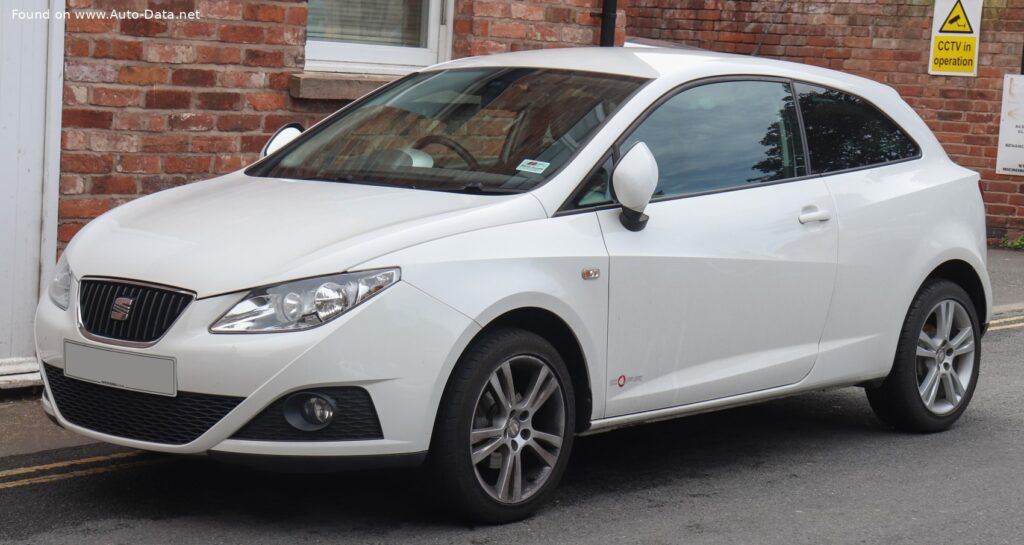
The Seat Ibiza IV SC stood out with its distinctive and sporty “SportCoupe” design. Penned by Luc Donckerwolke, the design language was characterized by sharp lines, aggressive headlights, and a sloping roofline that gave the three-door model a dynamic silhouette. Its compact dimensions – 159.17 inches in length, 66.65 inches in width, and 56.22 inches in height – made it highly maneuverable in congested urban environments, a crucial attribute for its European target market. The wheelbase of 97.2 inches provided a stable platform, while the optional wheel sizes ranging from 15 to 17 inches further accentuated its athletic stance.
Interior and Features
Inside, the Ibiza IV SC offered seating for five, a testament to its clever packaging despite the coupe body style. The interior design was functional and modern, with an emphasis on ergonomics. While not luxurious, the cabin was well-appointed for its segment, featuring logical controls and durable materials. Practicality was also considered, with a minimum trunk space of 10.03 cubic feet (284 liters), which could be expanded by folding down the rear seats, making it versatile for shopping or weekend trips.
In terms of chassis and safety, the Ibiza IV SC utilized an independent McPherson strut front suspension with coil springs and an anti-roll bar, paired with a trailing arm rear suspension. This setup provided a good balance of ride comfort and agile handling. Braking duties were handled by ventilated discs at the front and solid discs at the rear, supported by an Anti-lock Braking System (ABS) for enhanced safety during emergency stops. The hydraulic rack and pinion steering system offered precise feedback, making the car feel connected to the road, a desirable trait for a “SportCoupe.”
Technical Specifications
| Category | Specification | US Equivalent |
|---|---|---|
| Brand | Seat | |
| Model | Ibiza | |
| Generation | Ibiza IV SC | |
| Type (Engine) | 1.2 TSI (105 Hp) DSG | |
| Production Start | April, 2010 | |
| Production End | 2012 | |
| Powertrain Architecture | Internal Combustion engine | |
| Body Type | Coupe (3 Doors) | |
| Seats | 5 | |
| Fuel Type | Petrol (Gasoline) | |
| Emission Standard | Euro 5 | |
| Power | 105 Hp @ 5000 rpm | 105 Horsepower |
| Power per liter | 87.7 Hp/l | |
| Torque | 175 Nm @ 1550 rpm | 129.07 lb.-ft. @ 1550 rpm |
| Engine Layout | Front, Transverse | |
| Engine Model/Code | CBZB | |
| Engine Displacement | 1197 cm3 | 1.2 liters (73.05 cu. in.) |
| Number of Cylinders | 4 | |
| Engine Configuration | Inline | |
| Compression Ratio | 10:1 | |
| Valves per Cylinder | 2 | |
| Fuel Injection System | Direct injection | |
| Engine Aspiration | Turbocharger, Intercooler | |
| Engine Oil Capacity | 3.6 l | 3.8 US quarts |
| Coolant Capacity | 5.6 l | 5.92 US quarts |
| Trunk (boot) Space – Minimum | 284 l | 10.03 cu. ft. |
| Fuel Tank Capacity | 45 l | 11.89 US gallons |
| Length | 4043 mm | 159.17 in. |
| Width | 1693 mm | 66.65 in. |
| Height | 1428 mm | 56.22 in. |
| Wheelbase | 2469 mm | 97.2 in. |
| Front Track | 1465 mm | 57.68 in. |
| Rear Track | 1457 mm | 57.36 in. |
| Minimum Turning Circle | 10.48 m | 34.38 ft. |
| Drivetrain Architecture | Front wheel drive | |
| Drive Wheel | Front wheel drive | |
| Gearbox Type | 7 gears, automatic transmission (DSG) | |
| Front Suspension | Independent, McPherson with coil spring and anti-roll bar | |
| Rear Suspension | Trailing arm | |
| Front Brakes | Ventilated discs | |
| Rear Brakes | Disc | |
| Assisting Systems | ABS (Anti-lock braking system) | |
| Steering Type | Steering rack and pinion | |
| Power Steering | Hydraulic Steering | |
| Tire Sizes (Options) | 185/60 R15; 215/45 R16; 215/40 R17 | |
| Wheel Rims Sizes (Options) | 15; 16; 17 |
Legacy and Market Impact
The Seat Ibiza IV SC, particularly in its 1.2 TSI (105 Hp) DSG configuration, solidified the Ibiza’s reputation as a stylish, well-engineered, and fun-to-drive option in the European supermini segment. It successfully carved out a niche for Seat as the “sporty” brand within the Volkswagen Group, offering a more emotive alternative to its platform siblings like the Volkswagen Polo and Skoda Fabia. The SC variant, with its three-door coupe body, specifically targeted younger buyers or those seeking a more distinctive and less utilitarian compact car.
In the fiercely competitive European B-segment, the Ibiza IV SC faced stiff competition from established rivals such as the Ford Fiesta, Renault Clio, Peugeot 207, and Opel Corsa. What set the Ibiza apart was its sharp “Arrow Design” aesthetic, perceived superior build quality thanks to its VW Group underpinnings, and the availability of advanced powertrains like the 1.2 TSI and the DSG transmission. This combination offered a level of refinement and technological sophistication that was not always common in this price-sensitive segment.
The 1.2 TSI engine itself was a significant development, demonstrating that small displacement turbocharged engines could deliver both spirited performance and excellent fuel economy, a trend that would become pervasive across the automotive industry. Paired with the DSG, it offered a compelling package for urban driving and highway cruising, balancing efficiency with responsive power delivery. Its Euro 5 compliance highlighted its commitment to environmental responsibility, a growing concern in European markets.
Ultimately, the Seat Ibiza IV SC contributed to the Ibiza’s enduring success as one of Europe’s best-selling superminis. It reinforced Seat’s brand identity, showcasing its ability to blend Spanish passion with German engineering precision. While not a global vehicle, its impact within its intended markets was substantial, helping to shape consumer expectations for compact car design, performance, and technological integration in the early 2010s.