The Rover 400 (RT) 420 D (86 Hp): A Practical Contender in Europe’s Mid-Nineties Family Car Segment
The Rover 400 (RT) 420 D (86 Hp) represents a significant chapter in the history of the British automotive manufacturer, Rover. Produced from 1995 to 2000, the RT generation of the Rover 400 series was a compact family car, primarily targeted at the European market. It succeeded the popular R8 generation and marked Rover’s continued collaboration with Honda, sharing its platform with the Honda Civic and Domani. While the Rover 400 was not officially sold in the United States, it played a crucial role in its home market, offering a blend of traditional British styling, comfortable ride dynamics, and, in the case of the 420 D variant, impressive fuel efficiency for the era. This particular model, equipped with Rover’s robust L-series diesel engine, aimed to provide an economical and practical solution for families and business users navigating the demanding European road network.
Engine & Performance: The Economical Heart of the Rover 400 (RT)
At the core of the Rover 400 (RT) 420 D (86 Hp) was its 2.0-liter (1994 cm³) inline-four diesel engine, known internally as the L-series. This powerplant was a testament to Rover’s engineering capabilities, especially in diesel technology. Featuring an OHC (Overhead Camshaft) valvetrain with two valves per cylinder and a common rail fuel injection system, the engine was designed for both durability and efficiency. Crucially, it was boosted by a turbocharger, a key component in extracting more power and torque from a relatively small displacement diesel engine of its time.
The L-series diesel delivered a respectable 86 horsepower at 4500 revolutions per minute (rpm), making it a competitive offering in the mid-1990s diesel segment. More importantly for a diesel, it produced a healthy 125.39 lb.-ft. of torque at a low 2000 rpm. This ample low-end torque ensured responsive acceleration in urban driving conditions and comfortable cruising on highways, even with a full load of passengers and cargo.
Paired exclusively with a 5-speed manual transmission, the 420 D channeled its power to the front wheels. Performance figures, while not groundbreaking, were entirely adequate for a family sedan of its class. The car could accelerate from 0 to 60 miles per hour in approximately 13.3 seconds, and reach a maximum speed of 105.63 mph. Where the 420 D truly shone was in its fuel economy. Official figures indicated an impressive 58.8 US miles per gallon on the extra-urban cycle and 31.4 US miles per gallon in city driving, highlighting its role as a cost-effective vehicle for long-distance travel in Europe. With a 14.53 US gallon fuel tank, a considerable cruising range was achievable, a significant advantage for European drivers facing higher fuel costs.
Design & Features: Blending British Aesthetics with Practicality
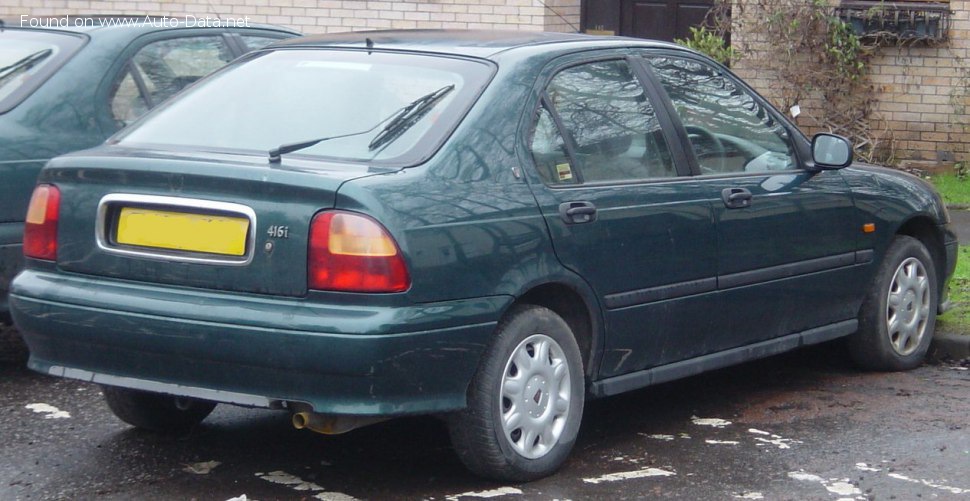
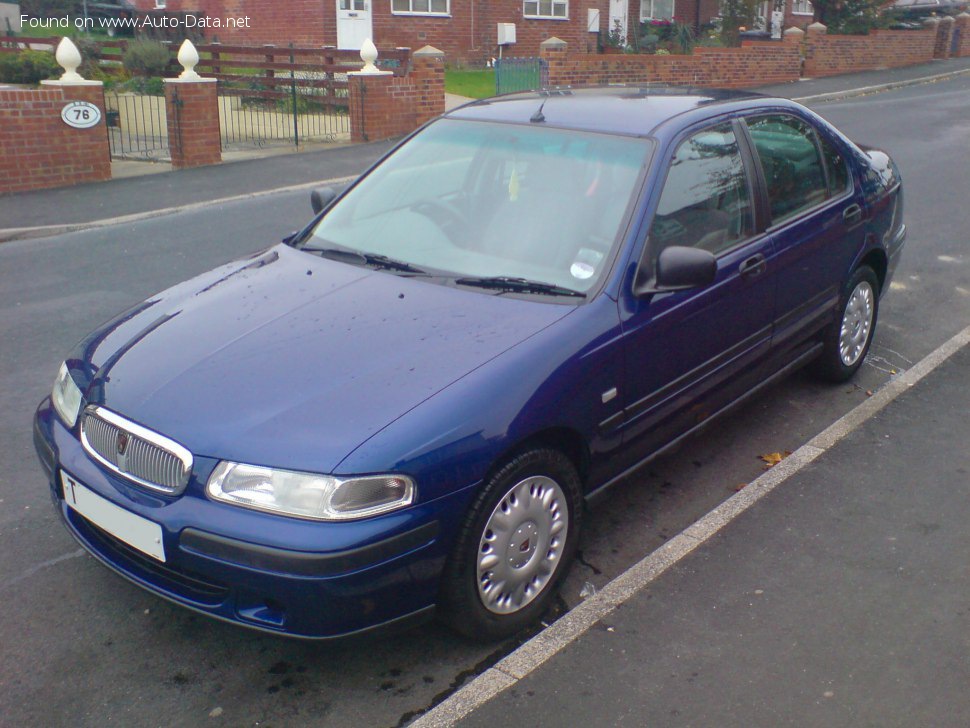
The Rover 400 (RT) adopted a classic four-door sedan body style, designed to appeal to families seeking a practical yet aesthetically pleasing vehicle. While sharing its underpinnings with Honda models, Rover ensured the RT had a distinct identity, characterized by its more traditional, rounded British styling cues, including the signature chrome grille and elegant headlamp design. The car measured 176.81 inches in length, 66.73 inches in width, and 54.53 inches in height, with a wheelbase of 103.23 inches, providing a comfortable footprint for both city maneuverability and highway stability.
Inside, the Rover 400 (RT) offered seating for five occupants. The interior was designed with a focus on comfort and practicality, typical of British cars of the era, often featuring plush fabrics and a warm, inviting cabin ambiance. The trunk space was generous for the segment, offering a minimum of 16.6 cubic feet, expandable to 28.6 cubic feet with the rear seats folded, making it suitable for family vacations or grocery runs.
In terms of chassis and safety, the 400 (RT) featured a common setup for its class. Both front and rear suspensions employed a Spring Strut design, balancing ride comfort with predictable handling. Braking duties were handled by disc brakes at the front and drum brakes at the rear, a standard configuration for non-performance-oriented cars of the time. Crucially, the 420 D came equipped with ABS (Anti-lock Braking System), a vital safety feature that was becoming increasingly standard in the mid-90s, enhancing vehicle control during emergency braking. The steering system was a hydraulic rack and pinion setup, providing direct feedback to the driver, and the car rode on 175/65 R14 tires.
Technical Specifications
| Category | Specification | US Equivalent |
|---|---|---|
| Brand | Rover | |
| Model | 400 | |
| Generation | 400 (RT) | |
| Type (Engine) | 420 D (86 Hp) | |
| Start of Production | 1995 year | |
| End of Production | 2000 year | |
| Powertrain Architecture | Internal Combustion engine | |
| Body type | Sedan | |
| Seats | 5 | |
| Doors | 4 | |
| Performance Specs | ||
| Fuel consumption (urban) | 7.5 l/100 km | 31.4 US mpg |
| Fuel consumption (extra urban) | 4 l/100 km | 58.8 US mpg |
| Fuel Type | Diesel | |
| Acceleration 0 – 60 mph | 13.3 sec | |
| Maximum speed | 170 km/h | 105.63 mph |
| Weight-to-power ratio | 14.4 kg/Hp | 69.4 Hp/tonne |
| Weight-to-torque ratio | 7.3 kg/Nm | 137.1 Nm/tonne |
| Engine Specs | ||
| Power | 86 Hp @ 4500 rpm | |
| Power per liter | 43.1 Hp/l | |
| Torque | 170 Nm @ 2000 rpm | 125.39 lb.-ft. @ 2000 rpm |
| Engine layout | Front, Transverse | |
| Engine Model/Code | L | |
| Engine displacement | 1994 cm³ | 121.68 cu. in. |
| Number of cylinders | 4 | |
| Engine configuration | Inline | |
| Cylinder Bore | 84.5 mm | 3.33 in. |
| Piston Stroke | 88.9 mm | 3.5 in. |
| Compression ratio | 19.5:1 | |
| Number of valves per cylinder | 2 | |
| Fuel injection system | Diesel Commonrail | |
| Engine aspiration | Turbocharger | |
| Valvetrain | OHC | |
| Engine oil capacity | 4.5 l | 4.76 US qt |
| Coolant | 7 l | 7.4 US qt |
| Space, Volume and Weights | ||
| Kerb Weight | 1240 kg | 2733.73 lbs. |
| Max. weight | 1690 kg | 3725.81 lbs. |
| Max load | 450 kg | 992.08 lbs. |
| Trunk (boot) space – minimum | 470 l | 16.6 cu. ft. |
| Trunk (boot) space – maximum | 810 l | 28.6 cu. ft. |
| Fuel tank capacity | 55 l | 14.53 US gal |
| Dimensions | ||
| Length | 4491 mm | 176.81 in. |
| Width | 1695 mm | 66.73 in. |
| Height | 1385 mm | 54.53 in. |
| Wheelbase | 2622 mm | 103.23 in. |
| Front track | 1475 mm | 58.07 in. |
| Rear (Back) track | 1465 mm | 57.68 in. |
| Drivetrain, Brakes and Suspension Specs | ||
| Drivetrain Architecture | Front wheel drive ICE | |
| Drive wheel | Front wheel drive | |
| Number of gears and type of gearbox | 5 gears, manual transmission | |
| Front suspension | Spring Strut | |
| Rear suspension | Spring Strut | |
| Front brakes | Disc | |
| Rear brakes | Drum | |
| Assisting systems | ABS (Anti-lock braking system) | |
| Steering type | Steering rack and pinion | |
| Power steering | Hydraulic Steering | |
| Tires size | 175/65 R14 | |
Legacy & Market Impact of the Rover 400 (RT)
The Rover 400 (RT) generation, and specifically the 420 D variant, arrived at a critical juncture for the Rover brand. It was the successor to a highly successful model, the R8, which had cemented Rover’s reputation for building well-engineered, attractive compact cars in collaboration with Honda. The RT continued this partnership, leveraging Honda’s robust platform technology while Rover applied its distinctive styling and, in the case of the 420 D, its independently developed L-series diesel engine.
In the fiercely competitive European C-segment (compact family car market), the Rover 400 (RT) faced formidable rivals. Key competitors included the Ford Escort and later the Ford Focus, the Vauxhall Astra (Opel Astra), Volkswagen Golf and Jetta, Peugeot 306, Citroën Xsara, and a host of Japanese competitors like the Toyota Corolla and Nissan Almera. Against these, the Rover 400 offered a more traditional, perhaps more “classic British” aesthetic, often appealing to buyers who appreciated its slightly more upscale feel compared to some of its more utilitarian rivals.
The 420 D variant played a crucial role in the model’s market strategy. In Europe, diesel engines were gaining significant traction due to their superior fuel economy and torque characteristics, especially for longer commutes and business use. The Rover L-series diesel was generally regarded as a solid, reliable, and efficient unit, helping the 420 D carve out a niche for itself as a sensible, low-running-cost option. Its blend of adequate performance, impressive fuel efficiency, and comfortable ride made it an attractive proposition for families and fleet operators alike.
Despite its merits, the Rover 400 (RT) operated within a period of increasing uncertainty for the Rover Group. While the Honda partnership provided a strong engineering foundation, the brand was struggling with perceptions of quality and reliability compared to its German and Japanese rivals. The RT generation was one of the last models to be developed under the full extent of the Honda collaboration before BMW’s more direct influence took hold, eventually leading to the Rover 45 and the ultimate demise of the Rover brand in the early 2000s.
Today, the Rover 400 (RT) 420 D (86 Hp) is remembered as a practical and economical family sedan that showcased Rover’s capabilities in diesel engine development. It represents a poignant moment in British automotive history, embodying the brand’s efforts to remain relevant in a globalized market, balancing its heritage with modern engineering principles, and offering a compelling package for the European consumer.