<!DOCTYPE html>
<html lang=”en”>
<head>
<meta charset=”UTF-8″>
<meta name=”viewport” content=”width=device-width, initial-scale=1.0″>
<title>Renault Megane II Coupe (Phase II, 2006) 1.6 16V (112 Hp)</title>
</head>
<body>
<h2>The Renault Megane II Coupe (Phase II, 2006) 1.6 16V (112 Hp): A Distinctive European Compact</h2>
<p>
The <strong>Renault Megane II Coupe (Phase II, 2006) 1.6 16V (112 Hp)</strong> represents a notable chapter in the history of Renault, one of Europe’s most prominent automotive manufacturers. Unveiled as part of the second generation of the Megane line, this particular variant, produced between 2006 and 2008, showcases the refreshed “Phase II” styling and engineering updates applied to the already distinctive Megane II platform. Positioned firmly within the compact car segment, often referred to as the C-segment in Europe, the Megane II Coupe was a bold design statement for its time, catering to buyers seeking a blend of practicality, style, and a spirited driving experience. While never officially imported or sold in the United States, the Megane II Coupe played a significant role in the highly competitive European market, embodying French design philosophy and technological innovation. Its unique silhouette and focus on safety and comfort made it a compelling choice for consumers across the continent.
</p>
<h2>Engineering and Performance of the Renault Megane II Coupe</h2>
<h3>Powertrain and Driving Dynamics</h3>
<p>
At the heart of the <strong>Renault Megane II Coupe (Phase II, 2006) 1.6 16V (112 Hp)</strong> lies a robust and efficient 1.6-liter (1598 cm<sup>3</sup>) naturally aspirated inline-four engine, designated by Renault as the K4M. This 16-valve unit, featuring a Double Overhead Camshaft (DOHC) valvetrain and multi-port manifold injection, was engineered to deliver a balanced performance for daily driving. It produced a respectable 112 horsepower at 6000 rpm, translating to a power-per-liter output of 70.1 HP/l, which was competitive for its class in the mid-2000s. Torque figures stood at 152 Nm (112.11 lb-ft) available at 4200 rpm, ensuring adequate pulling power across the rev range.
</p>
<p>
Paired with a five-speed manual transmission driving the front wheels, the Megane II Coupe offered an engaging and direct driving experience. This powertrain configuration allowed the vehicle to accelerate from 0 to 60 mph in a decent 10.4 seconds (or 0-100 km/h in 10.9 seconds), with a top speed reaching 119.3 mph (192 km/h). These figures positioned the 1.6 16V as a lively option within the Megane lineup, capable of handling both urban commuting and longer highway journeys with ease.
</p>
<p>
Fuel efficiency was a key consideration, especially in the European market. The Megane II Coupe 1.6 16V achieved a combined fuel economy of 6.9 liters per 100 kilometers, which translates to approximately 34.1 US miles per gallon. Urban consumption was rated at 9.1 l/100 km (25.8 US mpg), while extra-urban driving saw figures as low as 5.6 l/100 km (42 US mpg). Emissions were kept in check with CO2 output at 164 g/km, meeting the Euro 4 emission standard prevalent at the time, underscoring Renault’s commitment to environmental responsibility. The vehicle’s kerb weight of 2546.34 pounds (1155 kg) contributed to a favorable weight-to-power ratio of 10.3 kg/Hp (97 Hp/tonne), aiding its dynamic capabilities.
</p>
<h3>Chassis and Handling</h3>
<p>
The Megane II Coupe employed a conventional yet effective suspension setup, featuring an independent McPherson type at the front and a torsion beam axle at the rear. This combination provided a comfortable ride quality while maintaining predictable handling characteristics. Ventilated disc brakes up front and solid discs at the rear, complemented by an Anti-lock Braking System (ABS), ensured confident stopping power. Steering was managed by an electric power-assisted rack and pinion system, offering ease of maneuverability, particularly in city environments, with a minimum turning circle of 34.45 feet (10.5 meters). The car rode on 195/65 R15 tires mounted on 6.5J x 15-inch wheels, providing a good balance of grip and ride comfort.
</p>
<h2>Design and Features: The Distinctive Renault Megane II Coupe</h2>
<h3>Radical Styling and Practicality</h3>
<p>
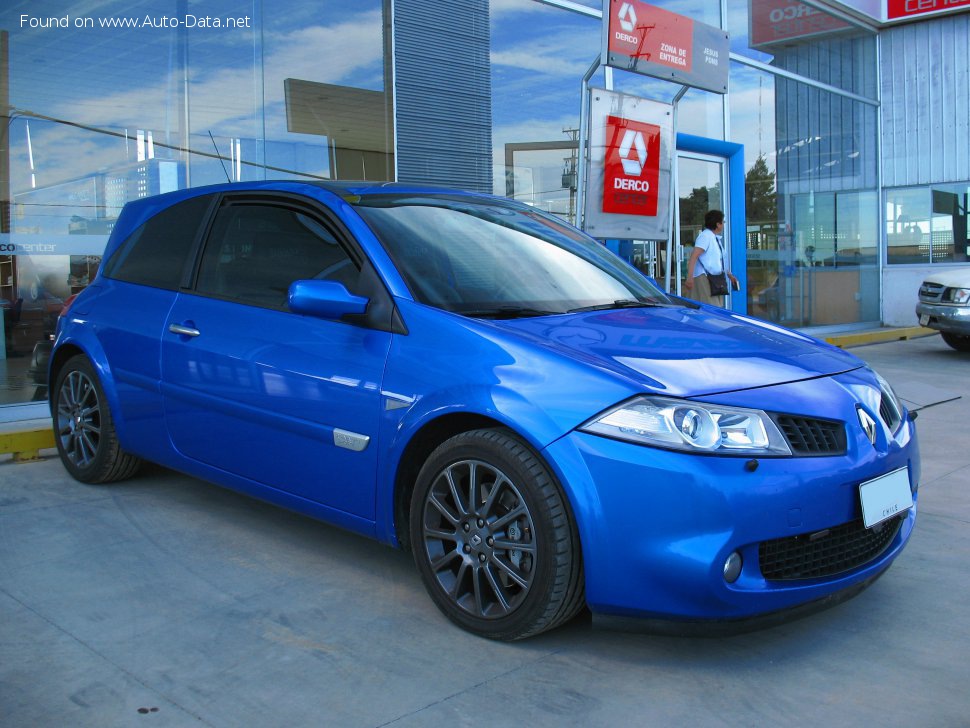
The <strong>Renault Megane II Coupe (Phase II, 2006)</strong> was instantly recognizable for its avant-garde design, a hallmark of its chief designer, Patrick Le Quément. The three-door coupe body style, measuring 165.71 inches (4209 mm) in length, 69.96 inches (1777 mm) in width (79.76 inches including mirrors), and 57.4 inches (1458 mm) in height, featured a distinctive “bubble butt” rear end. This design, while polarizing, gave the Megane II a unique identity on the road and contributed to its impressive 11.65 cubic feet (330 liters) of minimum trunk space, expandable to 42.02 cubic feet (1190 liters) with the rear seats folded down. The wheelbase of 103.35 inches (2625 mm) provided a stable platform and contributed to a spacious cabin for a compact coupe, accommodating five occupants comfortably.
</p>
<p>
The Phase II updates, introduced in 2006, brought subtle but effective refinements to the exterior, including revised headlamps, taillights, and bumpers, further enhancing its modern appeal. The drag coefficient (Cd) of 0.35 was respectable for a car of its shape, contributing to both fuel efficiency and reduced wind noise at higher speeds.
</p>
<h3>Interior and Safety Innovations</h3>
<p>
Inside, the Megane II Coupe offered a cabin that prioritized ergonomics and perceived quality. While specific feature lists would vary by trim level, the car typically featured a modern dashboard layout, comfortable seating, and a range of convenience options common for the era, such as air conditioning, power windows, and a decent audio system. Renault was a pioneer in automotive safety during this period, and the Megane II was no exception. It was one of the first cars in its class to achieve a five-star Euro NCAP safety rating, a testament to its robust construction and comprehensive passive safety features. While ABS was standard, other advanced safety features like electronic stability control (ESC) were often available, further enhancing driver confidence. The focus on occupant protection and innovative design made the Megane II Coupe a strong contender in its market.
</p>
<h2>Technical Specifications</h2>
<table border=”1″ cellpadding=”5″ cellspacing=”0″>
<thead>
<tr>
<th>Category</th>
<th>Specification</th>
</tr>
</thead>
<tbody>
<tr>
<td><strong>General Information</strong></td>
<td></td>
</tr>
<tr>
<td>Brand</td>
<td>Renault</td>
</tr>
<tr>
<td>Model</td>
<td>Megane</td>
</tr>
<tr>
<td>Generation</td>
<td>Megane II Coupe (Phase II, 2006)</td>
</tr>
<tr>
<td>Type (Engine)</td>
<td>1.6 16V (112 Hp)</td>
</tr>
<tr>
<td>Start of Production</td>
<td>2006 year</td>
</tr>
<tr>
<td>End of Production</td>
<td>2008 year</td>
</tr>
<tr>
<td>Powertrain Architecture</td>
<td>Internal Combustion engine</td>
</tr>
<tr>
<td>Body Type</td>
<td>Coupe</td>
</tr>
<tr>
<td>Seats</td>
<td>5</td>
</tr>
<tr>
<td>Doors</td>
<td>3</td>
</tr>
<tr>
<td><strong>Performance Specs</strong></td>
<td></td>
</tr>
<tr>
<td>Fuel Consumption (urban)</td>
<td>9.1 l/100 km (25.8 US mpg)</td>
</tr>
<tr>
<td>Fuel Consumption (extra urban)</td>
<td>5.6 l/100 km (42 US mpg)</td>
</tr>
<tr>
<td>Fuel Consumption (combined)</td>
<td>6.9 l/100 km (34.1 US mpg)</td>
</tr>
<tr>
<td>CO2 Emissions</td>
<td>164 g/km</td>
</tr>
<tr>
<td>Fuel Type</td>
<td>Petrol (Gasoline)</td>
</tr>
<tr>
<td>Acceleration 0-60 mph</td>
<td>10.4 sec</td>
</tr>
<tr>
<td>Acceleration 0-100 km/h</td>
<td>10.9 sec</td>
</tr>
<tr>
<td>Maximum Speed</td>
<td>192 km/h (119.3 mph)</td>
</tr>
<tr>
<td>Emission Standard</td>
<td>Euro 4</td>
</tr>
<tr>
<td>Weight-to-Power Ratio</td>
<td>10.3 kg/Hp (97 Hp/tonne)</td>
</tr>
<tr>
<td>Weight-to-Torque Ratio</td>
<td>7.6 kg/Nm (131.6 Nm/tonne)</td>
</tr>
<tr>
<td><strong>Engine Specs</strong></td>
<td></td>
</tr>
<tr>
<td>Power</td>
<td>112 Hp @ 6000 rpm</td>
</tr>
<tr>
<td>Power per Liter</td>
<td>70.1 Hp/l</td>
</tr>
<tr>
<td>Torque</td>
<td>152 Nm (112.11 lb-ft) @ 4200 rpm</td>
</tr>
<tr>
<td>Engine Layout</td>
<td>Front, Transverse</td>
</tr>
<tr>
<td>Engine Model/Code</td>
<td>K4M</td>
</tr>
<tr>
<td>Engine Displacement</td>
<td>1598 cm<sup>3</sup> (97.52 cu. in. / 1.6 l)</td>
</tr>
<tr>
<td>Number of Cylinders</td>
<td>4</td>
</tr>
<tr>
<td>Engine Configuration</td>
<td>Inline</td>
</tr>
<tr>
<td>Cylinder Bore</td>
<td>79.5 mm (3.13 in.)</td>
</tr>
<tr>
<td>Piston Stroke</td>
<td>80.5 mm (3.17 in.)</td>
</tr>
<tr>
<td>Compression Ratio</td>
<td>10:1</td>
</tr>
<tr>
<td>Number of Valves per Cylinder</td>
<td>4</td>
</tr>
<tr>
<td>Fuel Injection System</td>
<td>Multi-port manifold injection</td>
</tr>
<tr>
<td>Engine Aspiration</td>
<td>Naturally aspirated engine</td>
</tr>
<tr>
<td>Valvetrain</td>
<td>DOHC</td>
</tr>
<tr>
<td>Engine Oil Capacity</td>
<td>4.8 l (5.07 US qt)</td>
</tr>
<tr>
<td>Coolant Capacity</td>
<td>6.5 l (6.87 US qt)</td>
</tr>
<tr>
<td><strong>Space, Volume and Weights</strong></td>
<td></td>
</tr>
<tr>
<td>Kerb Weight</td>
<td>1155 kg (2546.34 lbs)</td>
</tr>
<tr>
<td>Max. Weight</td>
<td>1705 kg (3758.88 lbs)</td>
</tr>
<tr>
<td>Max Load</td>
<td>550 kg (1212.54 lbs)</td>
</tr>
<tr>
<td>Trunk (boot) Space – minimum</td>
<td>330 l (11.65 cu. ft.)</td>
</tr>
<tr>
<td>Trunk (boot) Space – maximum</td>
<td>1190 l (42.02 cu. ft.)</td>
</tr>
<tr>
<td>Fuel Tank Capacity</td>
<td>60 l (15.8