Introduction to the Peugeot 207 SW 1.6 VTi (120 Hp)
The Peugeot 207 SW 1.6 VTi (120 Hp) represents a significant offering in the European B-segment (subcompact) market, specifically targeting consumers seeking enhanced practicality and versatility over its hatchback sibling. Launched in 2007 as part of the 207 generation, the “SW” designation signifies its station wagon (or estate) body style, providing increased cargo capacity and a family-friendly appeal. Produced until 2009, this particular variant, equipped with the 1.6-liter VTi engine, was a popular choice for its balance of performance, fuel efficiency, and everyday usability in its primary European markets. Though never officially sold in the United States, the Peugeot 207 SW 1.6 VTi (120 Hp) exemplified Peugeot’s commitment to producing stylish yet functional vehicles tailored to European driving conditions and consumer preferences, offering a compelling package for small families and individuals needing more space than a conventional hatchback.
Engine & Performance of the Peugeot 207 SW 1.6 VTi (120 Hp)
At the heart of the Peugeot 207 SW 1.6 VTi (120 Hp) lies a modern and efficient powertrain, a testament to the collaboration between PSA Peugeot Citroën and BMW. This engine, designated EP6 (or 5FW), is part of the “Prince” engine family, renowned for its advanced engineering and performance characteristics for its era. It’s a naturally aspirated, 1.6-liter (1598 cm³ or 97.52 cubic inches) inline four-cylinder engine, featuring a Double Overhead Camshaft (DOHC) valvetrain with Variable Valve Timing (VVT). This sophisticated setup allows for optimized valve lift and timing, enhancing both power output and fuel efficiency across the rev range.
The engine produces a respectable 120 horsepower at 6000 rpm, translating to 75.1 HP per liter, a strong figure for a naturally aspirated engine of this displacement. Torque output stands at 160 Newton-meters, or approximately 118.01 lb.-ft., delivered at a relatively accessible 4250 rpm. This provides a broad power band, making the car responsive in city driving and capable on the highway. Power is sent to the front wheels via a smooth-shifting 5-speed manual transmission, a common and reliable choice for vehicles in this segment.
In terms of performance, the 207 SW 1.6 VTi (120 Hp) could accelerate from 0 to 60 mph in a brisk 9.1 seconds, with 0 to 100 km/h achieved in 9.6 seconds. Its maximum speed reached 200 km/h, or about 124.27 mph, which was more than adequate for European highways. Despite its performance, the vehicle maintained commendable fuel economy. The combined cycle fuel consumption was rated at 6.3 liters per 100 kilometers, equivalent to an impressive 37.3 US miles per gallon. Urban consumption stood at 8.6 l/100 km (27.4 US mpg), while extra-urban driving saw figures as low as 5 l/100 km (47 US mpg). With CO2 emissions of 150 g/km, the engine complied with the Euro 4 emission standard, reflecting its relatively clean operation for the mid-2000s. The engine’s layout is front-mounted and transverse, contributing to efficient packaging and front-wheel-drive architecture.
Design & Features of the Peugeot 207 SW
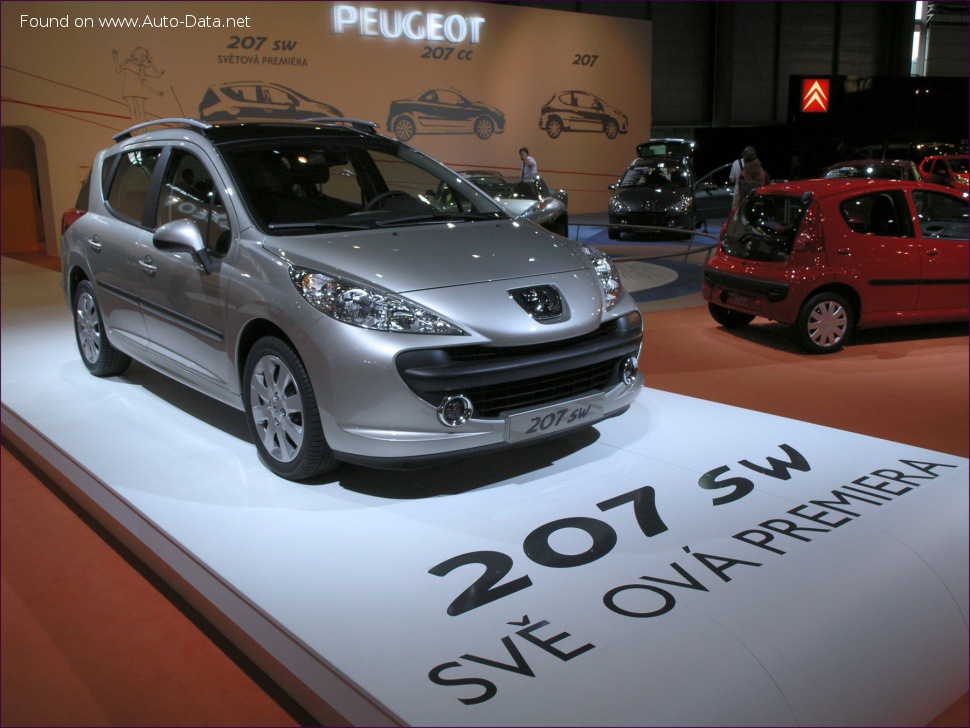
The Peugeot 207 SW distinguished itself from the standard 207 hatchback primarily through its extended roofline and redesigned rear section, creating a practical station wagon body. Measuring 163.62 inches in length, 68.82 inches in width (77.64 inches including mirrors), and 60.12 inches in height, the 207 SW maintained a compact footprint suitable for navigating narrow European city streets while maximizing interior volume. The wheelbase of 100 inches contributed to a stable ride and allowed for a relatively spacious cabin for its class.
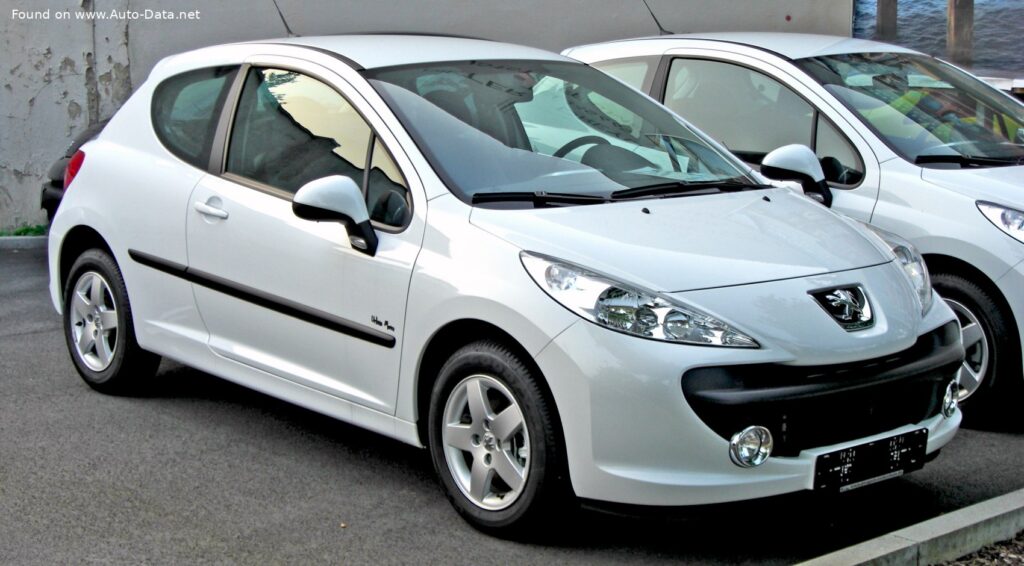
The design language of the 207 SW followed Peugeot’s contemporary aesthetic, characterized by a distinctive, large front grille, swept-back headlights, and a generally curvaceous profile. The SW variant added a more upright tailgate and larger rear windows, enhancing both cargo access and rear visibility. Its drag coefficient (Cd) of 0.3 was competitive, aiding in fuel efficiency and reducing wind noise.
Inside, the 207 SW offered seating for five occupants across two rows. The key advantage of the station wagon body was its versatile cargo space. With the rear seats in place, the trunk provided a useful 337 liters (11.9 cubic feet) of storage. When the rear seats were folded down, this expanded significantly to a maximum of 1258 liters (44.43 cubic feet), transforming the compact wagon into a highly capable hauler for luggage, groceries, or even larger items. This flexibility was crucial for families and individuals with active lifestyles.
Standard features for the 2007 model year typically included power steering with a rack and pinion system, front ventilated disc brakes and rear disc brakes, complemented by an Anti-lock Braking System (ABS) for enhanced safety. The suspension system comprised independent MacPherson struts at the front and a semi-independent setup with coil springs at the rear, designed to provide a comfortable ride characteristic of Peugeot vehicles. The car rode on 195/55 R16 tires fitted to 16-inch wheel rims, offering a good balance of grip and ride comfort. The 50-liter (13.21 US gallons) fuel tank provided a respectable cruising range.
Technical Specifications
| Category | Specification | Value |
|---|---|---|
General Information |
||
| Brand | Peugeot | |
| Model | 207 | |
| Generation | 207 SW | |
| Type (Engine) | 1.6 VTi (120 Hp) | |
| Start of Production | 2007 year | |
| End of Production | 2009 year | |
| Powertrain Architecture | Internal Combustion engine | |
| Body type | Station wagon (estate) | |
| Seats | 5 | |
| Doors | 5 | |
Performance Specs |
||
| Fuel consumption (economy) – urban | 8.6 l/100 km | 27.4 US mpg |
| Fuel consumption (economy) – extra urban | 5 l/100 km | 47 US mpg |
| Fuel consumption (economy) – combined | 6.3 l/100 km | 37.3 US mpg |
| CO2 emissions | 150 g/km | |
| Fuel Type | Petrol (Gasoline) | |
| Acceleration 0 – 60 mph | 9.1 sec | |
| Acceleration 0 – 100 km/h | 9.6 sec | |
| Maximum speed | 200 km/h | 124.27 mph |
| Emission standard | Euro 4 | |
| Weight-to-power ratio | 10.2 kg/Hp | 97.8 Hp/tonne |
| Weight-to-torque ratio | 7.7 kg/Nm | 130.4 Nm/tonne |
Engine Specs |
||
| Power | 120 Hp @ 6000 rpm | |
| Power per liter | 75.1 Hp/l | |
| Torque | 160 Nm @ 4250 rpm | 118.01 lb.-ft. @ 4250 rpm |
| Engine layout | Front, Transverse | |
| Engine Model/Code | 5FW EP6 | |
| Engine displacement | 1598 cm³ | 97.52 cu. in. |
| Number of cylinders | 4 | |
| Engine configuration | Inline | |
| Cylinder Bore | 77 mm | 3.03 in. |
| Piston Stroke | 85.8 mm | 3.38 in. |
| Compression ratio | 11:1 | |
| Number of valves per cylinder | 4 | |
| Fuel injection system | Multi-port manifold injection | |
| Engine aspiration | Naturally aspirated engine | |
| Valvetrain | DOHC-VVT | |
| Engine oil capacity | 4.25 l | 4.49 US qt |
| Coolant | 5.4 l | 5.71 US qt |
Space, Volume and Weights |
||
| Kerb Weight | 1227 kg | 2705.07 lbs. |
| Max. weight | 1705 kg | 3758.88 lbs. |
| Max load | 478 kg | 1053.81 lbs. |
| Trunk (boot) space – minimum | 337 l | 11.9 cu. ft. |
| Trunk (boot) space – maximum | 1258 l | 44.43 cu. ft. |
| Fuel tank capacity | 50 l | 13.21 US gal |
| Permitted trailer load with brakes (12%) | 1150 kg | 2535.32 lbs. |
| Permitted trailer load without brakes | 600 kg | 1322.77 lbs. |
Dimensions |
||
| Length | 4156 mm | 163.62 in. |
| Width | 1748 mm | 68.82 in. |
| Width with mirrors folded | 1818 mm | 71.57 in. |
| Width including mirrors | 1972 mm | 77.64 in. |
| Height | 1527 mm | 60.12 in. |
| Wheelbase | 2540 mm | 100 in. |
| Front track | 1467 mm | 57.76 in. |
| Rear (Back) track | 1461 mm | 57.52 in. |
| Drag coefficient (Cd) | 0.3 | |
| Minimum turning circle (turning diameter) | 10.8 m | 35.43 ft. |
Drivetrain, Brakes and Suspension Specs |
||
| Drivetrain Architecture | The Internal combustion engine (ICE) drives the front wheels of the vehicle. | |
| Drive wheel | Front wheel drive | |
| Number of gears and type of gearbox | 5 gears, manual transmission | |
| Front suspension | Independent type McPherson | |
| Rear suspension | Semi-independent, coil spring | |
| Front brakes | Ventilated discs | |
| Rear brakes | Disc | |
| Assisting systems | ABS (Anti-lock braking system) | |
| Steering type | Steering rack and pinion | |
| Tires size | 195/55 R16 | |
| Wheel rims size | 16 | |
Legacy & Market Impact of the Peugeot 207 SW 1.6 VTi (120 Hp)
The Peugeot 207 SW, particularly the 1.6 VTi (120 Hp) variant, carved out a distinct niche in the highly competitive European subcompact segment from 2007 to 2009. While the standard 207 hatchback was a volume seller, the SW model catered to a specific demographic – those who appreciated the compact dimensions for urban maneuverability but required the added practicality and cargo flexibility of a station wagon. This made it a strong contender for young families, active couples, or individuals needing extra utility without stepping up to a larger, more expensive compact segment vehicle.
In its primary markets, the 207 SW faced stiff competition from other European manufacturers. Key rivals included the Renault Clio Estate (Grandtour), Skoda Fabia Combi, and potentially some Opel/Vauxhall Astra or Ford Focus variants if buyers were willing to stretch their budget slightly. What set the Peugeot 207 SW apart was its distinctive French styling, often perceived as more elegant and sophisticated than some of its more utilitarian competitors. Its comfortable ride quality, a hallmark of Peugeot engineering, also contributed to its appeal, making it well-suited for varied road conditions across Europe.
The 1.6 VTi engine, a product of the PSA/BMW partnership, enhanced the car’s reputation, offering a good blend of lively performance and reasonable fuel economy. This engine proved to be a reliable and efficient unit, contributing to the 207 SW’s overall cost-effectiveness for ownership. Its Euro 4 compliance also positioned it favorably in an era of increasing environmental awareness and stricter emission regulations.
The legacy of the Peugeot 207 SW lies in its successful execution of the subcompact wagon concept. It demonstrated that a small car could still offer significant versatility and space, challenging the notion that practicality had to come at the expense of style or driving enjoyment. While it was eventually succeeded by the 208 and then the 2008 crossover, the 207 SW played a crucial role in Peugeot’s lineup, showcasing the brand’s ability to adapt to evolving consumer needs by offering a practical and well-rounded solution for European drivers. Its influence can be seen in the continued demand for compact, versatile vehicles that blend urban agility with family-friendly functionality.