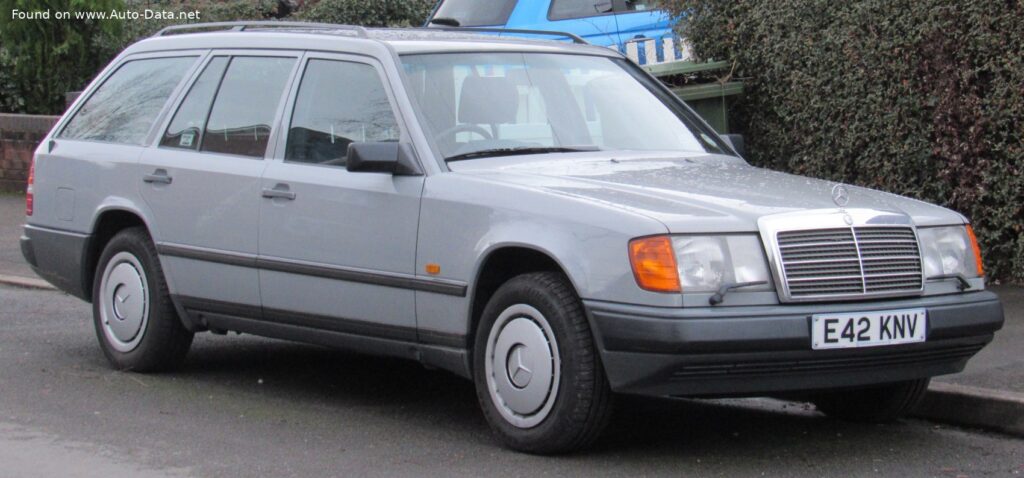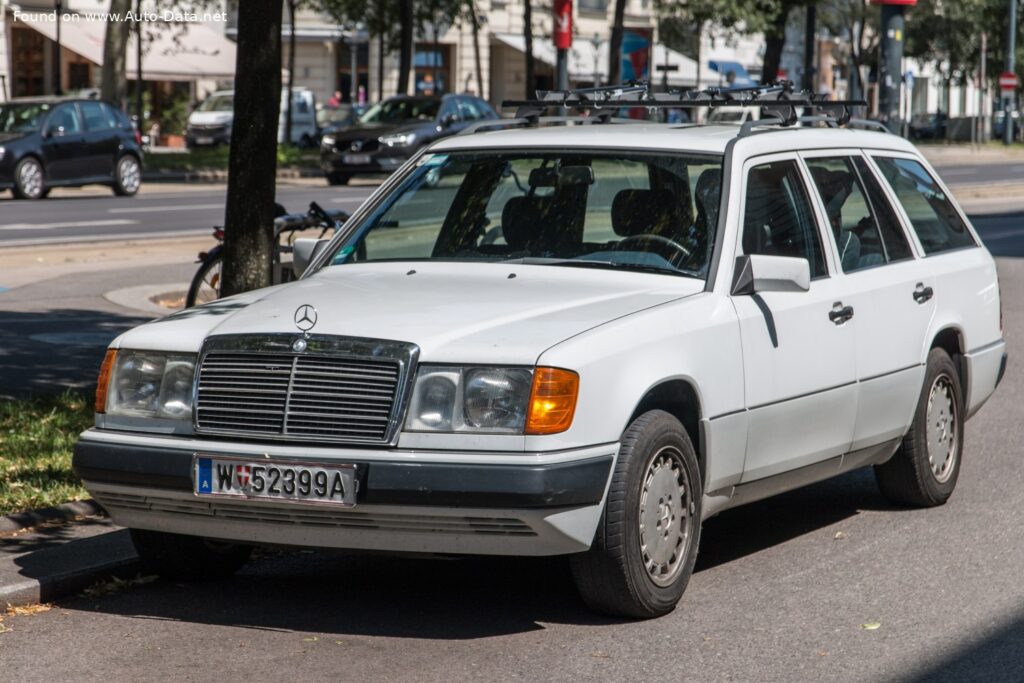
The Mercedes-Benz W124 series, produced from 1984 to 1996, stands as a testament to German engineering prowess, renowned for its exceptional build quality, durability, and timeless design. Within this esteemed lineup, the S124 designation refers to the station wagon (estate) variant, which offered unparalleled practicality and versatility while retaining the W124’s inherent strengths. The Mercedes-Benz S124 (facelift 1989) 200 TE represents a pivotal point in the model’s history, incorporating the significant updates introduced with the 1989 facelift, enhancing both aesthetics and mechanical refinement.
Launched in September 1989, this particular iteration of the S124 wagon was primarily targeted at the European market, where its blend of conservative styling, robust mechanics, and spacious interior made it a highly popular choice for families and professionals alike. Unlike its more powerful six-cylinder siblings often seen in the American market, the 200 TE served as a more accessible, yet still premium, entry point into Mercedes-Benz ownership. It combined the practicality of a five-door, five-seat station wagon with a dependable, naturally aspirated four-cylinder engine, embodying the brand’s commitment to longevity and functional elegance.
The Enduring Appeal of the Mercedes-Benz S124 (facelift 1989) 200 TE
The W124 chassis, and by extension the S124 wagon, is often considered one of the last “over-engineered” Mercedes-Benz models, a period when engineering integrity and material quality took precedence. The 1989 facelift brought subtle but meaningful changes, including body-colored side moldings, revised interior trim options, and updated engine choices across the range. For the Mercedes-Benz S124 (facelift 1989) 200 TE, these updates solidified its position as a highly capable and comfortable family hauler, perfectly suited for long European road trips or daily urban duties. Its production run from September 1989 to October 1992 marked a significant chapter for the W124, showcasing a blend of traditional Mercedes values with contemporary advancements.
Engine and Performance
Under the hood of the Mercedes-Benz S124 (facelift 1989) 200 TE lies the M 102 E 20 / 102.963 engine, a naturally aspirated 2.0-liter (121.8 cu. in.) inline-four cylinder unit. This powerplant, featuring a Single Overhead Camshaft (SOHC) valvetrain with two valves per cylinder, was designed for smooth operation and reliability rather than outright speed. It produced a respectable 118 horsepower at 5200 rpm and 126.86 lb.-ft. of torque at 3500 rpm. Power was delivered to the rear wheels via a standard four-speed manual transmission, a common setup for entry-level models in its segment.
While not a performance powerhouse, the 200 TE offered adequate motivation for its intended purpose. It could accelerate from 0 to 60 mph in a measured 12.3 seconds, reaching a maximum speed of 111.85 mph (180 km/h). Fuel economy, while not stellar by modern standards, was competitive for its era, with an extra-urban consumption rate of 30.9 US mpg (7.6 l/100 km). The engine’s multi-port manifold injection system ensured efficient fuel delivery and relatively clean emissions for the late 1980s. Its robust design and conservative tuning contributed significantly to the W124’s legendary reputation for mechanical longevity, making it a favorite among owners who valued dependability and ease of maintenance.
Design and Features
The S124’s design is a masterclass in understated elegance and functionalism. The station wagon body type, with its five doors and seating for five, offered immense practicality. Its exterior dimensions – 187.6 inches in length, 68.5 inches in width, and 58.62 inches in height – provided a substantial road presence without being overly cumbersome. The 110.24-inch wheelbase contributed to a stable ride and generous interior space, particularly for rear passengers and cargo.
Inside, the W124 continued Mercedes-Benz’s tradition of high-quality materials and ergonomic design. The facelift models often featured updated upholstery and trim, enhancing the cabin’s sophisticated ambiance. From a safety perspective, the Mercedes-Benz S124 (facelift 1989) 200 TE was well-equipped for its time, featuring disc brakes on all four wheels and an Anti-lock Braking System (ABS) as standard. The hydraulic power steering, utilizing a cone worm with recirculation balls, provided precise and comfortable control, a hallmark of Mercedes-Benz driving dynamics. The independent multi-link rear suspension, a revolutionary design for its time, ensured excellent ride comfort and handling stability, even when fully loaded. The vehicle rode on 195/65 R15 tires mounted on 6.5J x 15 wheel rims, offering a balanced combination of grip and comfort.
Technical Specifications
| Category | Specification |
|---|---|
| Brand | Mercedes-Benz |
| Model | W124 |
| Generation | S124 (facelift 1989) |
| Type (Engine) | 200 TE (118 Hp) |
| Start of Production | September, 1989 |
| End of Production | October, 1992 |
| Powertrain Architecture | Internal Combustion engine |
| Body type | Station wagon (estate) |
| Seats | 5 |
| Doors | 5 |
| Performance Specs | |
| Fuel consumption (economy) – urban | 19.3 US mpg (12.2 l/100 km) |
| Fuel consumption (economy) – extra urban | 30.9 US mpg (7.6 l/100 km) |
| Fuel Type | Petrol (Gasoline) |
| Acceleration 0 – 60 mph | 12.3 sec |
| Maximum speed | 111.85 mph (180 km/h) |
| Weight-to-power ratio | 12.4 kg/Hp, 80.8 Hp/tonne |
| Weight-to-torque ratio | 8.5 kg/Nm, 117.8 Nm/tonne |
| Engine Specs | |
| Power | 118 Hp @ 5200 rpm |
| Power per liter | 59.1 Hp/l |
| Torque | 126.86 lb.-ft. @ 3500 rpm (172 Nm) |
| Engine layout | Front, Longitudinal |
| Engine Model/Code | M 102 E 20 / 102.963 |
| Engine displacement | 121.8 cu. in. (1996 cm3) |
| Number of cylinders | 4 |
| Engine configuration | Inline |
| Cylinder Bore | 3.5 in. (89 mm) |
| Piston Stroke | 3.16 in. (80.19 mm) |
| Compression ratio | 9.1:1 |
| Number of valves per cylinder | 2 |
| Fuel injection system | Multi-port manifold injection |
| Engine aspiration | Naturally aspirated engine |
| Valvetrain | SOHC |
| Engine oil capacity | 5.28 US qt (5 l) |
| Coolant capacity | 8.98 US qt (8.5 l) |
| Space, Volume and Weights | |
| Kerb Weight | 3218.75 lbs. (1460 kg) |
| Max. weight | 4585.62 lbs. (2080 kg) |
| Max load | 1366.87 lbs. (620 kg) |
| Fuel tank capacity | 19.02 US gal (72 l) |
| Dimensions | |
| Length | 187.6 in. (4765 mm) |
| Width | 68.5 in. (1740 mm) |
| Height | 58.62 in. (1489 mm) |
| Wheelbase | 110.24 in. (2800 mm) |
| Front track | 58.94 in. (1497 mm) |
| Rear (Back) track | 58.94 in. (1497 mm) |
| Drivetrain, Brakes and Suspension Specs | |
| Drivetrain Architecture | The Internal combustion engine (ICE) drives the rear wheels of the vehicle. |
| Drive wheel | Rear wheel drive |
| Number of gears and type of gearbox | 4 gears, manual transmission |
| Front suspension | Wishbone |
| Rear suspension | Independent multi-link suspension |
| Front brakes | Disc |
| Rear brakes | Disc |
| Assisting systems | ABS (Anti-lock braking system) |
| Steering type | Cone worm with recirculation balls |
| Power steering | Hydraulic Steering |
| Tires size | Front: 195/65 R15, Rear: 195/65 R15 |
| Wheel rims size | Front: 6.5J x 15, Rear: 6.5J x 15 |
Legacy and Market Impact
The W124 series, including the S124 wagon, is widely regarded as one of the most successful and well-built vehicles ever produced by Mercedes-Benz. Its reputation for incredible durability and longevity has cemented its status as a highly sought-after classic, particularly in Europe, where models like the Mercedes-Benz S124 (facelift 1989) 200 TE are still commonly seen on the roads today. While the 200 TE variant was not officially imported to the United States – where Mercedes-Benz typically focused on higher-displacement models like the 300E/TE – its influence on the brand’s global image of quality and reliability was undeniable.
In its primary European market, the 200 TE competed against rivals such as the BMW 5-Series Touring (E34), Audi 100 Avant (C3/C4), and Volvo 740/940 wagons. While some competitors might have offered more spirited performance in certain trims, few could match the W124’s overall package of comfort, refinement, and almost legendary build quality. The S124’s substantial cargo capacity, combined with its comfortable ride and robust mechanicals, made it an ideal choice for families, tradespeople, and anyone needing a practical yet prestigious vehicle.
Today, the W124, and especially the S124 wagon, enjoys a strong enthusiast following. The 200 TE, with its efficient (for its time) four-cylinder engine and manual transmission, offers a more engaging and economical driving experience compared to its larger-engined automatic counterparts. Its mechanical simplicity (relative to later Mercedes models) makes it a favorite for DIY enthusiasts and those seeking a classic car that can still be used as a daily driver. The enduring legacy of the Mercedes-Benz S124 (facelift 1989) 200 TE is a testament to an era when Mercedes-Benz prioritized engineering excellence and long-term ownership satisfaction above all else, creating a vehicle that truly stood the test of time.