Volvo V50 (Facelift 2007) 1.6 (100 Hp): A Comprehensive Review
The Volvo V50, a compact executive car produced by the Swedish automaker Volvo Cars, represented a significant entry in the European premium compact segment. Introduced in 2004, the V50 was the station wagon counterpart to the S40 sedan, both built on Volvo’s P1 platform, which was shared with the Ford C1 platform (Ford Focus and Mazda 3). The model under review, the Volvo V50 (facelift 2007) 1.6 (100 Hp), received a mid-cycle refresh that brought subtle yet impactful updates, enhancing its aesthetic appeal and refining its features. Positioned as a practical and safe family vehicle, the V50 aimed to combine Volvo’s renowned safety credentials with a more dynamic driving experience and a compact footprint, catering primarily to the European market where smaller, efficient station wagons are highly valued.
This particular variant, equipped with a 1.6-liter gasoline engine producing 100 horsepower, served as an entry-level offering, focusing on fuel efficiency and everyday usability rather than outright performance. While the V50 was available in North America with larger engine options, this specific 1.6-liter petrol model was a staple in European markets, appealing to buyers seeking a balance of Volvo’s premium feel, practicality, and economical running costs. The facelifted V50, produced from 2007 to 2012, continued Volvo’s tradition of understated design and robust engineering in a segment increasingly populated by competitive offerings from German and Japanese manufacturers.
Engine & Performance of the Volvo V50 (Facelift 2007) 1.6 (100 Hp)
At the heart of this particular Volvo V50 (facelift 2007) 1.6 (100 Hp) variant is a naturally aspirated 1.6-liter (1596 cm³) inline four-cylinder petrol engine, designated as the B4164S3. This powertrain architecture, with its front, transverse layout, delivers 100 horsepower at 6000 rpm and a peak torque of 150 Nm (110.63 lb-ft) at a modest 4000 rpm. While these figures might not suggest a performance-oriented vehicle, they are perfectly adequate for the V50’s intended role as a practical and economical family station wagon.
The engine features a DOHC (Dual Overhead Camshaft) valvetrain with four valves per cylinder and a compression ratio of 11:1, utilizing a multi-port manifold injection system for fuel delivery. This configuration is known for its reliability and smooth power delivery, characteristic of Volvo’s engineering philosophy. Mated to a 5-speed manual transmission, power is sent to the front wheels, offering a direct and engaging driving experience typical of European compacts.
Performance figures for the 1.6-liter V50 reflect its focus on efficiency. The car accelerates from 0 to 60 mph in a respectable 11.4 seconds (0-100 km/h in 12 seconds), reaching a maximum speed of 114.95 mph (185 km/h). These numbers highlight its capability for comfortable highway cruising and confident urban maneuvering. Fuel economy, a crucial factor for European buyers, is a strong point. The combined NEDC cycle rating stands at 7.2 liters per 100 kilometers, which translates to an impressive 32.7 US mpg. Urban consumption is rated at 9.2 l/100 km (25.6 US mpg), while extra-urban driving yields 5.8 l/100 km (40.6 US mpg). With CO2 emissions of 169 g/km, the vehicle complies with Euro 4 emission standards, making it an environmentally conscious choice for its era.
Design & Features: The Practicality of the V50 Station Wagon
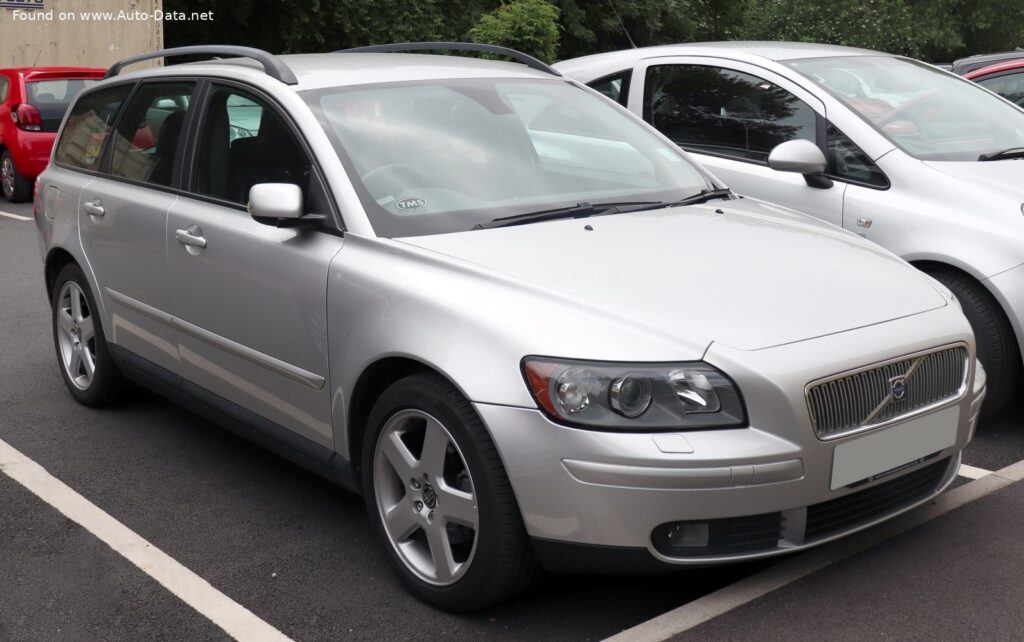
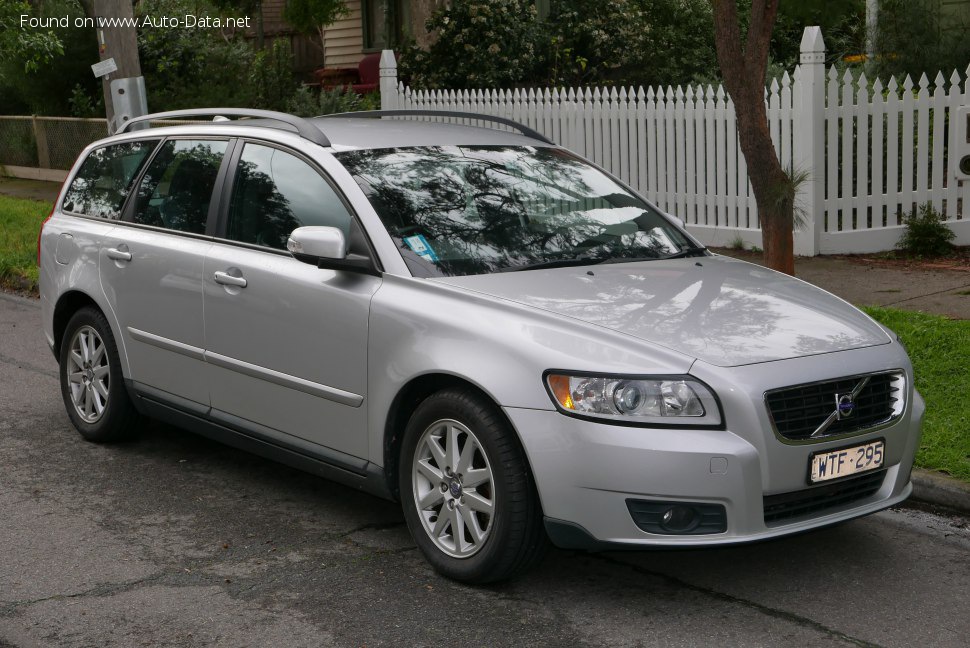
The Volvo V50 (facelift 2007) retained the elegant and understated design language of its pre-facelift predecessor, while introducing several subtle enhancements. As a five-door, five-seat station wagon (or estate, as it’s known in Europe), its body type emphasizes practicality and versatility. The facelift brought a revised front fascia, including a new grille, updated headlights, and more sculpted front bumper, giving it a slightly more assertive and contemporary look. The rear also saw changes, with new LED taillights and a redesigned bumper, contributing to a fresher appearance.
Inside, the V50 continued to offer Volvo’s signature Scandinavian design, characterized by clean lines, high-quality materials, and ergonomic functionality. The cabin features a “floating” center console, a design element first introduced in the larger S40/V50 models, which provides both aesthetic appeal and clever storage solutions. Despite its compact exterior dimensions, the V50 offers a surprisingly spacious interior for its class. The 417 liters (14.73 cu. ft.) of minimum trunk space is practical for daily use, expanding to a generous 1307 liters (46.16 cu. ft.) with the rear seats folded down, making it highly adaptable for carrying larger cargo. This cargo capacity, combined with a maximum roof load of 165.35 lbs (75 kg) and a substantial permitted trailer load of 2645.55 lbs (1200 kg) with brakes, underscores its utility.
Safety, a cornerstone of the Volvo brand, was paramount in the V50. Standard features included ABS (Anti-lock Braking System), alongside a robust body structure designed to absorb crash energy effectively. The independent McPherson strut front suspension and independent multi-link rear suspension, coupled with an electric power steering system, provided a comfortable yet composed ride and precise handling. The V50 offered various wheel and tire size options, from 195/65 R15 to 215/45 R18, allowing for customization of ride and handling characteristics.
Technical Specifications: Volvo V50 (Facelift 2007) 1.6 (100 Hp)
| Category | Specification |
|---|---|
| General Information | |
| Brand | Volvo |
| Model | V50 |
| Generation | V50 (facelift 2007) |
| Type (Engine) | 1.6 (100 Hp) |
| Start of production | 2007 year |
| End of production | 2012 year |
| Powertrain Architecture | Internal Combustion engine |
| Body type | Station wagon (estate) |
| Seats | 5 |
| Doors | 5 |
| Performance Specs | |
| Fuel consumption (economy) – urban (NEDC) | 9.2 l/100 km (25.6 US mpg) |
| Fuel consumption (economy) – extra urban (NEDC) | 5.8 l/100 km (40.6 US mpg) |
| Fuel consumption (economy) – combined (NEDC) | 7.2 l/100 km (32.7 US mpg) |
| CO2 emissions (NEDC) | 169 g/km |
| Fuel Type | Petrol (Gasoline) |
| Acceleration 0 – 100 km/h | 12 sec |
| Acceleration 0 – 60 mph | 11.4 sec |
| Maximum speed | 185 km/h (114.95 mph) |
| Emission standard | Euro 4 |
| Weight-to-power ratio | 12.5 kg/Hp (79.8 Hp/tonne) |
| Weight-to-torque ratio | 8.4 kg/Nm (119.7 Nm/tonne) |
| Engine Specs | |
| Power | 100 Hp @ 6000 rpm |
| Power per liter | 62.7 Hp/l |
| Torque | 150 Nm @ 4000 rpm (110.63 lb.-ft. @ 4000 rpm) |
| Engine layout | Front, Transverse |
| Engine Model/Code | B4164S3 |
| Engine displacement | 1596 cm³ (97.39 cu. in.) |
| Number of cylinders | 4 |
| Engine configuration | Inline |
| Cylinder Bore | 79 mm (3.11 in.) |
| Piston Stroke | 81.4 mm (3.2 in.) |
| Compression ratio | 11:1 |
| Number of valves per cylinder | 4 |
| Fuel injection system | Multi-port manifold injection |
| Engine aspiration | Naturally aspirated engine |
| Valvetrain | DOHC |
| Engine oil capacity | 4 l (4.23 US qt) |
| Coolant | 6.2 l (6.55 US qt) |
| Space, Volume and Weights | |
| Kerb Weight | 1253 kg (2762.39 lbs) |
| Max. weight | 1850 kg (4078.55 lbs) |
| Max load | 597 kg (1316.16 lbs) |
| Trunk (boot) space – minimum | 417 l (14.73 cu. ft.) |
| Trunk (boot) space – maximum | 1307 l (46.16 cu. ft.) |
| Fuel tank capacity | 55 l (14.53 US gal) |
| Max. roof load | 75 kg (165.35 lbs) |
| Permitted trailer load with brakes (12%) | 1200 kg (2645.55 lbs) |
| Permitted trailer load without brakes | 650 kg (1433 lbs) |
| Permitted towbar download | 75 kg (165.35 lbs) |
| Dimensions | |
| Length | 4522 mm (178.03 in.) |
| Width | 1770 mm (69.69 in.) |
| Width including mirrors | 2022 mm (79.61 in.) |
| Height | 1457 mm (57.36 in.) |
| Wheelbase | 2640 mm (103.94 in.) |
| Front track | 1535 mm (60.43 in.) |
| Rear (Back) track | 1531 mm (60.28 in.) |
| Minimum turning circle (turning diameter) | 10.6 m (34.78 ft.) |
| Drivetrain, Brakes and Suspension Specs | |
| Drivetrain Architecture | The Internal combustion engine (ICE) drives the front wheels of the vehicle. |
| Drive wheel | Front wheel drive |
| Number of gears and type of gearbox | 5 gears, manual transmission |
| Front suspension | Independent, type McPherson with coil spring and anti-roll bar |
| Rear suspension | Independent multi-link spring suspension with stabilizer |
| Front brakes | Ventilated discs |
| Rear brakes | Disc |
| Assisting systems | ABS (Anti-lock braking system) |
| Steering type | Steering rack and pinion |
| Power steering | Electric Steering |
| Tires size | 195/65 R15; 205/55 R16; 205/50 R17; 215/45 R18 |
| Wheel rims size | 6J x 15; 6.5J x 16; 7J x 17; 7.5J x 18 |
Legacy & Market Impact of the Volvo V50
The Volvo V50, particularly its facelifted version from 2007 to 2012, carved out a significant niche in the highly competitive European compact executive segment. While not a volume seller on the scale of some mainstream rivals, it successfully appealed to a discerning clientele who valued Volvo’s core tenets: safety, design, and practicality. In its primary markets, the Volvo V50 (facelift 2007) 1.6 (100 Hp) competed against a formidable array of vehicles, including the BMW 3 Series Touring, Audi A4 Avant, Mercedes-Benz C-Class Estate, and more mainstream but equally competent offerings like the Volkswagen Golf Variant and its platform sibling, the Ford Focus Estate.
What set the V50 apart was its distinctive Swedish identity. It offered a premium feel without being ostentatious, a safe and robust build without compromising on style, and a highly versatile interior. Its compact dimensions made it well-suited for European cities, while its station wagon body provided the cargo capacity demanded by families and active individuals. The 1.6-liter petrol engine, specifically, played a crucial role in expanding the V50’s market reach by offering an accessible entry point into the Volvo brand, balancing acquisition cost with commendable fuel efficiency and reasonable running costs, factors that are consistently top priorities for European consumers.
The V50’s legacy is intertwined with Volvo’s strategic shift in the early 2000s to broaden its appeal beyond its traditional, somewhat conservative image. By leveraging platform sharing with Ford, Volvo was able to develop a more agile and dynamically capable vehicle without sacrificing its brand values. The V50 contributed to Volvo’s reputation as a maker of stylish and modern vehicles that still prioritized occupant protection above all else. Its robust construction and reliable powertrains also ensured strong residual values and a loyal following, cementing its place as a practical and desirable choice in the used car market for years after its production ceased. The V50, and particularly efficient variants like the 1.6-liter petrol, exemplified Volvo’s commitment to providing safe, practical, and well-engineered vehicles tailored to the specific demands of its global, and especially European, customer base.