The Peugeot 207 SW 1.6 VTi (120 Hp) Automatic represents a practical and stylish offering from the French automaker Peugeot, designed primarily for the European market. Launched in 2007 as part of the 207 generation, the SW (Station Wagon) variant provided a more versatile and spacious alternative to the standard 207 hatchback. Positioned in the highly competitive European B-segment (subcompact) car market, the 207 SW aimed to combine the compact dimensions suitable for urban driving with enhanced cargo capacity and family-friendly features. While Peugeot withdrew from the North American market in the early 1990s, the 207 SW showcased the brand’s continued commitment to producing well-engineered, efficient, and aesthetically pleasing vehicles for its primary customer base. This specific model, featuring a 1.6-liter VTi engine paired with an automatic transmission, highlighted a balance of performance, fuel efficiency, and ease of use for everyday driving.
The Peugeot 207 SW 1.6 VTi (120 Hp) Automatic: A European Compact Wagon
The Peugeot 207 SW generation, produced from 2007 to 2009, was a key player in the European compact wagon segment. It built upon the success and styling of the 207 hatchback, which itself was a successor to the immensely popular Peugeot 206. The SW variant was specifically engineered to cater to families and individuals requiring more luggage space and rear passenger comfort than a traditional hatchback could offer, without moving into a larger, more expensive C-segment vehicle. Its design ethos was to blend practicality with an engaging driving experience, a hallmark of Peugeot vehicles. The addition of the 1.6 VTi engine, developed in collaboration with BMW (part of the “Prince” engine family), further underscored Peugeot’s focus on modern engine technology, offering a good blend of power and efficiency for its class.
Engine & Performance: The 1.6 VTi Powertrain
At the heart of the Peugeot 207 SW 1.6 VTi (120 Hp) Automatic is a sophisticated 1.6-liter naturally aspirated inline-four cylinder engine, designated as the EP6 (5FW). This powerplant, a product of the PSA Peugeot Citroën and BMW Group collaboration, was known for its advanced features, including Double Overhead Camshafts (DOHC) and Variable Valve Timing (VVT). These technologies allowed for optimized valve lift and timing, contributing to a broader torque curve and improved fuel efficiency across various engine speeds. The engine delivers a respectable 120 horsepower at 6000 rpm, which, for a vehicle of its size and segment, provides adequate motivation for both city driving and highway cruising.
Torque output stands at 160 Newton-meters (approximately 118.01 lb.-ft.) delivered at 4250 rpm. This mid-range torque peak ensures responsive acceleration in typical driving conditions. Mated to a 4-speed automatic transmission, the powertrain prioritizes smooth operation and ease of driving, particularly in congested urban environments. While a 4-speed automatic might seem modest by today’s standards, it was a common offering in the segment during its production years and provided a comfortable, albeit not overtly sporty, driving experience. The 207 SW 1.6 VTi Automatic accelerates from 0 to 60 mph in a reasonable 10.9 seconds, with a top speed of 121.17 mph (195 km/h). Fuel economy figures are commendable for its time, with a combined rating of 33.6 US mpg (7 l/100 km), and significantly better on the extra-urban cycle at 42.8 US mpg (5.5 l/100 km), making it an economical choice for daily commutes and longer journeys. Its Euro 4 emission standard compliance reflected its commitment to environmental responsibility for its era.
Design & Features of the Peugeot 207 SW
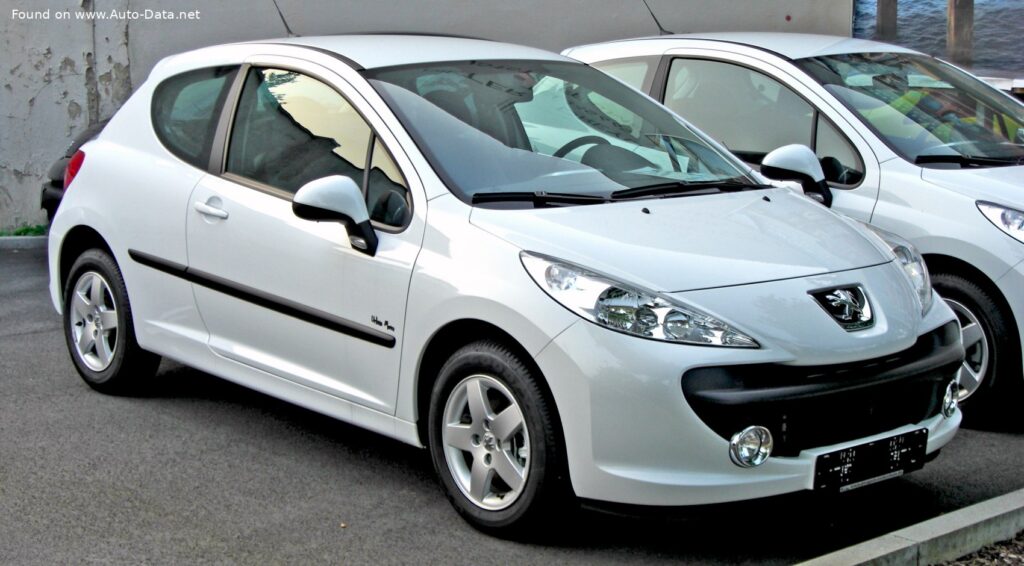
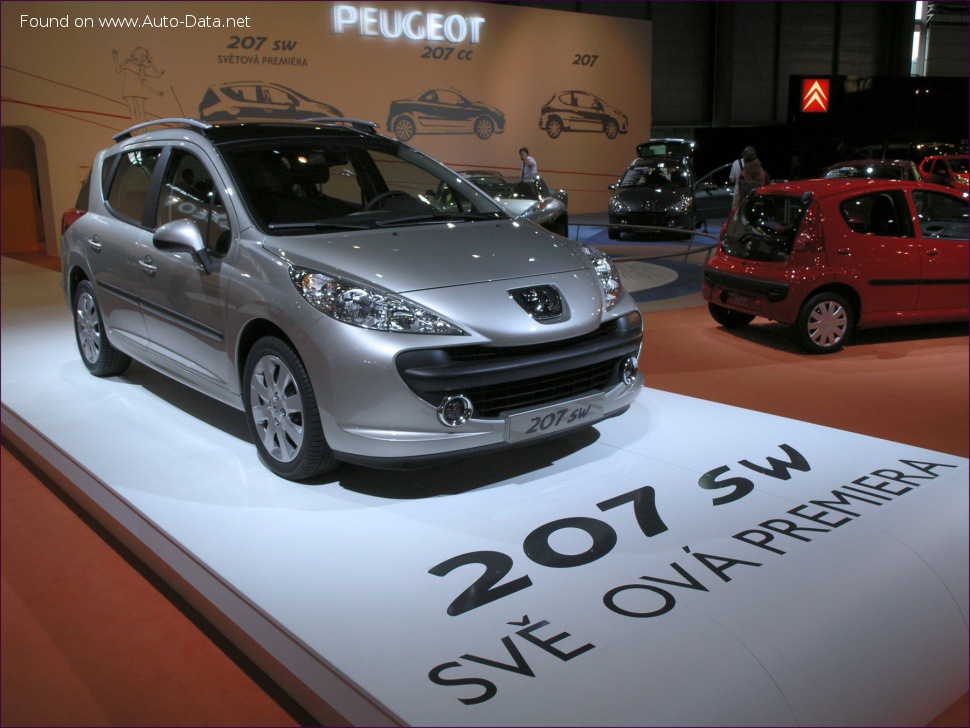
The Peugeot 207 SW 1.6 VTi (120 Hp) Automatic adopted the distinctive “smiley face” front-end styling of the 207 hatchback, characterized by its large headlights and prominent grille. However, its true differentiation came from its station wagon body type. The SW extended the roofline and rear overhang, creating a much larger and more practical cargo area. With five doors and five seats, it was designed for versatility. The overall length of 163.62 inches (4156 mm) made it compact enough to maneuver through tight European city streets, while its 68.82-inch (1748 mm) width contributed to a stable stance.
Inside, the 207 SW offered a well-appointed cabin, with materials and finishes that were competitive for its segment. The emphasis was on user-friendliness and comfort. The most significant advantage of the SW variant was its cargo capacity. With the rear seats in place, it offered a respectable 11.9 cubic feet (337 liters) of trunk space. When the rear seats were folded down, this expanded dramatically to 44.43 cubic feet (1258 liters), providing ample room for luggage, groceries, or sports equipment. This flexibility was a major selling point for families. Safety features for the 2007-2009 model year included standard Anti-lock Braking System (ABS), and depending on the trim level, multiple airbags, reflecting the increasing focus on passenger protection in modern vehicles. The car rode on 195/55 R16 tires and 16-inch wheel rims, providing a good balance between ride comfort and handling.
Technical Specifications
| Category | Specification |
|---|---|
| Brand | Peugeot |
| Model | 207 SW |
| Generation | 207 SW |
| Type (Engine) | 1.6 VTi (120 Hp) Automatic |
| Production Start | 2007 |
| Production End | 2009 |
| Body Type | Station wagon (estate) |
| Seats | 5 |
| Doors | 5 |
| Fuel Type | Petrol (Gasoline) |
| Fuel Consumption (Urban) | 9.8 l/100 km (24 US mpg) |
| Fuel Consumption (Extra Urban) | 5.5 l/100 km (42.8 US mpg) |
| Fuel Consumption (Combined) | 7 l/100 km (33.6 US mpg) |
| CO2 Emissions | 167 g/km |
| Emission Standard | Euro 4 |
| Acceleration 0-60 mph | 10.9 sec |
| Maximum Speed | 121.17 mph (195 km/h) |
| Power | 120 Hp @ 6000 rpm |
| Torque | 160 Nm (118.01 lb.-ft.) @ 4250 rpm |
| Engine Layout | Front, Transverse |
| Engine Model/Code | 5FW EP6 |
| Engine Displacement | 1598 cm³ (97.52 cu. in.) |
| Number of Cylinders | 4 |
| Engine Configuration | Inline |
| Valves per Cylinder | 4 |
| Compression Ratio | 11:1 |
| Fuel Injection System | Multi-port manifold injection |
| Engine Aspiration | Naturally aspirated |
| Valvetrain | DOHC-VVT |
| Engine Oil Capacity | 4.25 l (4.49 US qt) |
| Coolant Capacity | 5.4 l (5.71 US qt) |
| Kerb Weight | 1260 kg (2777.82 lbs.) |
| Maximum Weight | 1737 kg (3829.43 lbs.) |
| Maximum Load | 477 kg (1051.6 lbs.) |
| Trunk Space (Minimum) | 337 l (11.9 cu. ft.) |
| Trunk Space (Maximum) | 1258 l (44.43 cu. ft.) |
| Fuel Tank Capacity | 50 l (13.21 US gal) |
| Length | 4156 mm (163.62 in.) |
| Width | 1748 mm (68.82 in.) |
| Height | 1527 mm (60.12 in.) |
| Wheelbase | 2540 mm (100 in.) |
| Front Track | 1467 mm (57.76 in.) |
| Rear Track | 1461 mm (57.52 in.) |
| Drag Coefficient (Cd) | 0.3 |
| Minimum Turning Circle | 10.8 m (35.43 ft.) |
| Drive Wheel | Front-wheel drive |
| Gearbox Type | 4-speed automatic transmission |
| Front Suspension | Independent type McPherson |
| Rear Suspension | Semi-independent, coil spring |
| Front Brakes | Ventilated discs |
| Rear Brakes | Disc |
| Assisting Systems | ABS (Anti-lock braking system) |
| Steering Type | Steering rack and pinion |
| Tires Size | 195/55 R16 |
| Wheel Rims Size | 16 inches |
Legacy & Market Impact
The Peugeot 207 SW 1.6 VTi (120 Hp) Automatic played a significant role in Peugeot’s European lineup during its production years. It successfully carved out a niche for itself by offering a blend of compact dimensions, stylish design, and respectable practicality. In Europe, where station wagons, even in the subcompact class, have historically been popular, the 207 SW competed against a strong field of rivals. Key competitors included the Renault Clio Estate, Skoda Fabia Combi, and the smaller wagon variants of the Ford Fiesta and Opel Corsa. The 207 SW distinguished itself with its distinctive French design flair, comfortable ride, and the sophisticated VTi engine.
Its reputation was generally positive, with owners appreciating its versatility and urban maneuverability. The 1.6 VTi engine, known for its refinement and efficiency, contributed to a pleasant driving experience, especially when paired with the automatic transmission for city commutes. While perhaps not as dynamically engaging as some of its German rivals, the 207 SW offered a softer, more comfort-oriented ride that many European drivers preferred. Its strong safety ratings and practical interior made it an attractive option for young families or individuals needing extra space without opting for an SUV.
The 207 SW’s legacy is rooted in its contribution to the evolution of the compact station wagon segment, demonstrating that even smaller vehicles could offer substantial utility. It paved the way for future Peugeot compact wagons, influencing subsequent models like the 208 SW (though not directly marketed as such in all regions) and showcasing Peugeot’s ability to adapt its popular hatchback platforms into more versatile offerings. Today, the Peugeot 207 SW remains a capable and economical used car option in its primary markets, cherished for its blend of French charm, practicality, and efficient engineering.