Introduction: The Suzuki Grand Vitara II (Facelift 2008) 3 Door
The Suzuki Grand Vitara II (facelift 2008) 3 Door represents a significant chapter in the evolution of compact SUVs, particularly for markets outside of the United States where its unique blend of size, capability, and value resonated strongly. While the Grand Vitara nameplate was familiar to American consumers primarily through its larger 5-door variants, the 3-door model, especially this facelifted iteration produced from May 2010 to December 2012, carved out a distinct niche in international markets. This specific version, powered by a 2.4-liter engine delivering 166 horsepower and equipped with an automatic all-wheel-drive (AWD) system, offered a compelling package for buyers seeking a rugged yet manageable vehicle.
Positioned within the competitive compact SUV segment, the Grand Vitara II (facelift 2008) 3 Door continued Suzuki’s heritage of producing capable and durable four-wheel-drive vehicles. Its compact dimensions, coupled with genuine off-road credentials, made it a popular choice in regions where urban agility and weekend adventure were equally valued. This article delves into the specifics of this particular model, exploring its powertrain, design philosophy, technical specifications, and its lasting impact on the automotive landscape.
Engine & Performance: The Heart of the Suzuki Grand Vitara II (Facelift 2008) 3 Door
At the core of the Suzuki Grand Vitara II (facelift 2008) 3 Door lies the robust J24B engine, a naturally aspirated 2.4-liter (2393 cm³ or 146.03 cu. in.) inline-four gasoline unit. This powerplant was engineered to deliver a balance of usable power for daily driving and sufficient torque for light off-road excursions. It produced a respectable 166 horsepower at 6000 rpm, translating to a power-per-liter output of 69.4 horsepower. Torque figures stood at 225 Nm (165.95 lb.-ft.) at a relatively low 3800 rpm, providing accessible pulling power crucial for varied driving conditions.
The engine’s architecture featured a front, longitudinal layout, optimizing weight distribution and allowing for a more traditional 4×4 drivetrain setup. With a compression ratio of 10:1 and a multi-port manifold injection system, the J24B engine was designed for efficiency within its era. A key technological inclusion was Variable Valve Timing (VVT), enhancing both performance and fuel economy across the rev range, while also helping the vehicle meet Euro 5 emission standards. The engine oil capacity was 4.8 liters (5.07 US quarts), and coolant capacity was 7.3 liters (7.71 US quarts).
Power was transmitted to all four wheels via a permanent all-wheel-drive system, paired with a 4-speed automatic transmission. While a 4-speed automatic might seem dated by modern standards, it was a common and reliable choice for SUVs in this segment during its production run. This combination allowed the Grand Vitara II (facelift 2008) 3 Door to accelerate from 0 to 60 mph in a calculated 10.9 seconds (0-100 km/h in 11.5 seconds) and reach a maximum speed of 105.63 mph (170 km/h).
Fuel economy figures, measured under the NEDC cycle, were competitive for an AWD SUV of its size and era. Combined consumption was rated at 9.4 liters per 100 km (25 US mpg), with urban figures at 11.9 l/100 km (19.8 US mpg) and extra-urban at 8.0 l/100 km (29.4 US mpg). CO2 emissions were 219 g/km, reflecting its Euro 5 compliance. These figures underscored its role as a practical and reasonably efficient vehicle for its target markets.
Design & Features: Compact Utility and Rugged Aesthetics
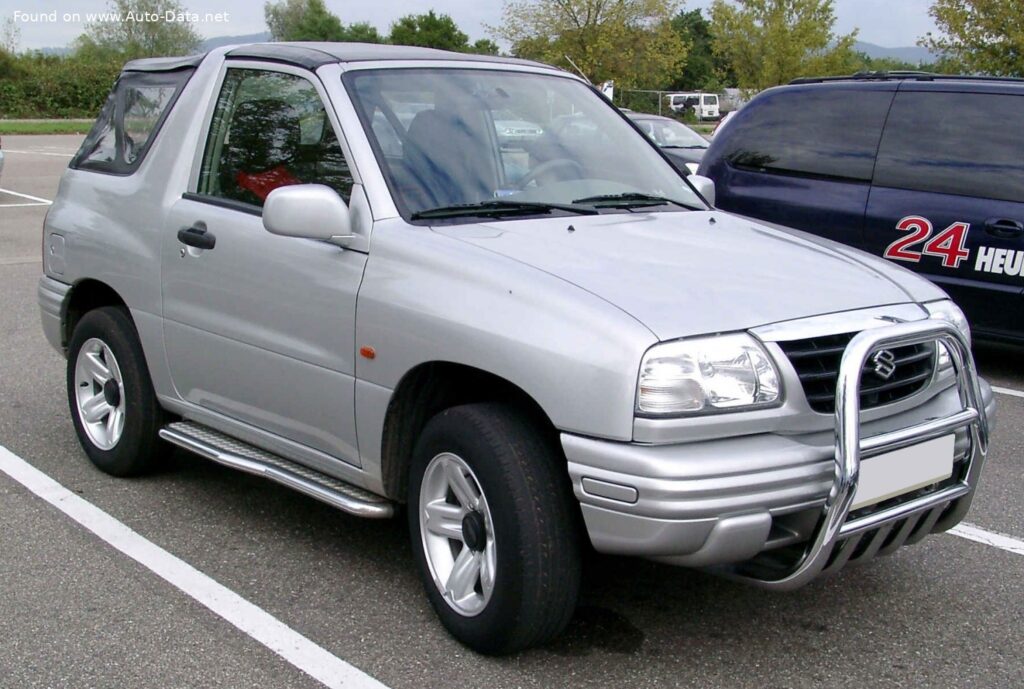
The Suzuki Grand Vitara II (facelift 2008) 3 Door maintained the model’s signature rugged aesthetic while incorporating subtle updates from the 2008 facelift. As a 3-door SUV, it offered a more compact footprint compared to its 5-door sibling, making it particularly agile in urban environments and more maneuverable on narrow trails. With a length of 163.39 inches (4150 mm), a width of 73.62 inches (1870 mm), and a height of 66.73 inches (1695 mm), it struck a balance between a commanding road presence and practical dimensions. The wheelbase measured 96.06 inches (2440 mm), contributing to its nimble turning circle of 33.46 feet (10.2 meters).
The body type, a traditional SUV, emphasized durability and utility. It featured seating for four occupants, designed for comfort during both short commutes and longer journeys. The exterior design showcased prominent wheel arches, a robust front grille, and clear-lens headlights, giving it a purposeful and adventurous look. Ground clearance of 8.07 inches (205 mm) further highlighted its off-road readiness, allowing it to tackle uneven terrain without undue concern.
Inside, the Grand Vitara II (facelift 2008) 3 Door offered a functional and straightforward cabin. While not luxurious, the interior was designed for durability and ease of use, reflecting its practical nature. Despite its compact exterior, the trunk space was surprisingly generous, offering a minimum of 18.22 cu. ft. (516 liters) and expanding to a maximum of 34.04 cu. ft. (964 liters) with the rear seats folded down. This flexibility made it suitable for carrying luggage, sports equipment, or groceries.
Safety features for the era included an Anti-lock Braking System (ABS), standard on all models, which provided enhanced control during emergency braking. The braking system utilized ventilated discs for both the front and rear axles, ensuring consistent stopping power. The suspension system comprised an independent McPherson strut setup at the front and an independent multi-link suspension at the rear, providing a comfortable ride on paved roads while maintaining capability off-road. Steering was handled by a rack-and-pinion system with electric power steering, offering light and responsive handling. Various tire sizes were available, including 215/70 R16, 225/70 R16, and 225/65 R17, mounted on 6.5J x 16 or 6.5J x 17 wheel rims.
Technical Specifications
| Category | Specification |
|---|---|
| Brand | Suzuki |
| Model | Grand Vitara |
| Generation | Grand Vitara II (facelift 2008) 3 Door |
| Type (Engine) | 2.4 (166 Hp) AWD Automatic |
| Production Start | May, 2010 |
| Production End | December, 2012 |
| Body Type | SUV |
| Seats | 4 |
| Doors | 3 |
| Fuel Type | Petrol (Gasoline) |
| Fuel Consumption (Urban) | 11.9 l/100 km (19.8 US mpg) |
| Fuel Consumption (Extra Urban) | 8.0 l/100 km (29.4 US mpg) |
| Fuel Consumption (Combined) | 9.4 l/100 km (25 US mpg) |
| CO2 Emissions (NEDC) | 219 g/km |
| Emission Standard | Euro 5 |
| Acceleration 0-60 mph | 10.9 sec |
| Maximum Speed | 105.63 mph (170 km/h) |
| Power | 166 Hp @ 6000 rpm |
| Torque | 225 Nm (165.95 lb.-ft.) @ 3800 rpm |
| Engine Layout | Front, Longitudinal |
| Engine Model/Code | J24B |
| Engine Displacement | 2393 cm³ (146.03 cu. in.) |
| Number of Cylinders | 4, Inline |
| Valvetrain | VVT |
| Fuel Injection System | Multi-port manifold injection |
| Engine Aspiration | Naturally aspirated |
| Compression Ratio | 10:1 |
| Engine Oil Capacity | 4.8 l (5.07 US qt) |
| Coolant Capacity | 7.3 l (7.71 US qt) |
| Kerb Weight | 3220.95 – 3359.84 lbs. (1461-1524 kg) |
| Max. Weight | 4166.74 lbs. (1890 kg) |
| Fuel Tank Capacity | 14.53 US gal (55 l) |
| Trunk Space (Min/Max) | 18.22 – 34.04 cu. ft. (516 – 964 l) |
| Length | 163.39 in. (4150 mm) |
| Width | 73.62 in. (1870 mm) |
| Height | 66.73 in. (1695 mm) |
| Wheelbase | 96.06 in. (2440 mm) |
| Ground Clearance | 8.07 in. (205 mm) |
| Minimum Turning Circle | 33.46 ft. (10.2 m) |
| Drivetrain | All-wheel drive (4×4) |
| Transmission | 4 gears, automatic transmission |
| Front Suspension | Independent type McPherson |
| Rear Suspension | Independent multi-link suspension |
| Front Brakes | Ventilated discs |
| Rear Brakes | Ventilated discs |
| Assisting Systems | ABS (Anti-lock braking system) |
| Power Steering | Electric Steering |
| Tire Sizes | 215/70 R16 99H; 225/70 R16 102S; 225/65 R17 101H |
| Wheel Rims Size | 6.5J x 16; 6.5J x 17 |
| Permitted Trailer Load (with brakes) | 3527.4 lbs. (1600 kg) |
| Permitted Trailer Load (without brakes) | 1212.54 lbs. (550 kg) |
Legacy & Market Impact of the Suzuki Grand Vitara II (Facelift 2008) 3 Door
The Suzuki Grand Vitara II (facelift 2008) 3 Door, particularly in its 2.4-liter AWD automatic configuration, cemented Suzuki’s reputation as a purveyor of capable and reliable compact SUVs in global markets. While the 5-door Grand Vitara had a more substantial presence in North America, the 3-door variant found its strongest footing in Europe, Asia, and Australasia, where its smaller dimensions and inherent ruggedness were highly valued. It appealed to a diverse demographic, from urban dwellers seeking a versatile vehicle for city driving and weekend getaways to those in more rural areas requiring genuine all-wheel-drive capability.
In its competitive landscape, the Grand Vitara 3 Door faced rivals such as the 3-door versions of the Toyota RAV4 (in markets where it was offered), the Mitsubishi Pajero Pinin (or Montero iO), and other compact crossovers like the Hyundai Tucson or Kia Sportage. What set the Grand Vitara apart was its traditional body-on-frame construction (in earlier iterations, though the second generation moved to an integrated ladder frame within a unibody structure for improved on-road manners while retaining off-road strength) and a robust AWD system, which often gave it an edge in terms of genuine off-road prowess compared to some of its more road-biased crossover competitors. Its minimum turning circle of 33.46 feet also highlighted its maneuverability, a key advantage in tight urban spaces or challenging off-road scenarios.
The 2008 facelift brought subtle but important updates, keeping the model fresh against newer rivals. The introduction of the 2.4-liter engine provided a welcome boost in power and refinement over previous smaller engines, making it more competitive in terms of performance and highway cruising. The Euro 5 emission compliance also ensured its longevity in increasingly regulated markets.
The legacy of the Grand Vitara, and specifically this 3-door model, lies in its embodiment of Suzuki’s core values: durability, capability, and value. It was not a vehicle that chased luxury or cutting-edge technology, but rather focused on delivering a dependable and practical solution for drivers who needed a versatile SUV. Its strong build quality, combined with Suzuki’s reputation for mechanical reliability, ensured that many of these vehicles continued to serve their owners faithfully for years after their production ceased. Today, the Suzuki Grand Vitara II (facelift 2008) 3 Door remains a testament to Suzuki’s expertise in the compact 4×4 segment, valued by enthusiasts and practical drivers alike for its blend of compact size and genuine all-terrain ability.