
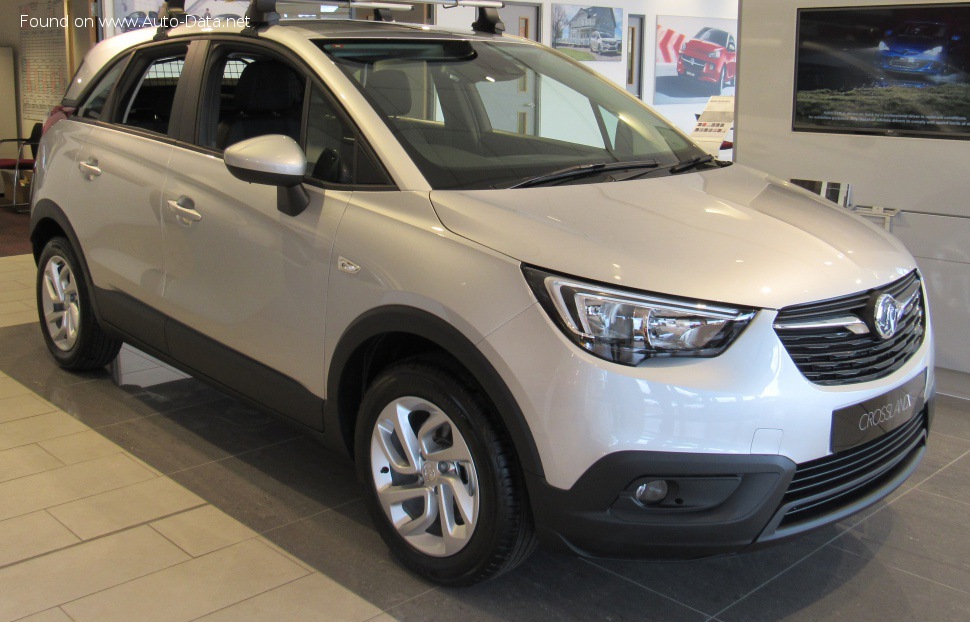
The Vauxhall Crossland X 1.5 Turbo D (102 Hp): A Compact Crossover for the European Market
The Vauxhall Crossland X, introduced in 2017, marked Vauxhall’s entry into the burgeoning compact crossover SUV segment in the United Kingdom, mirroring its Opel Crossland X counterpart across continental Europe. Positioned as a practical and family-friendly vehicle, it replaced the Vauxhall Meriva, signaling a shift in consumer preference from traditional Multi-Purpose Vehicles (MPVs) to more rugged, SUV-inspired designs. This particular variant, the Vauxhall Crossland X 1.5 Turbo D (102 Hp), produced from May 2018 to October 2020, represented a compelling option for European buyers seeking efficiency, reasonable performance, and versatility in a compact package. While never officially sold in the United States, the Crossland X played a significant role in Vauxhall’s strategy to capture a larger share of the highly competitive European B-segment SUV market, emphasizing modern technology and a focus on fuel economy, particularly with its diesel powertrain.
Engine & Performance of the Vauxhall Crossland X
Under the hood, the Vauxhall Crossland X 1.5 Turbo D (102 Hp) featured a robust and efficient 1.5-liter (1499 cm³ or 91.47 cu. in.) inline four-cylinder diesel engine, designated with the model code D15DT. This powertrain was engineered to deliver a balanced blend of performance and exceptional fuel economy, a critical factor for European consumers. The engine produced a respectable 102 horsepower at 3750 rpm, providing ample power for urban commuting and comfortable highway cruising. More notably, it generated a substantial 184.39 lb.-ft. of torque at a low 1750 rpm, characteristic of modern diesel engines. This strong low-end torque was instrumental in the vehicle’s responsive acceleration and effortless overtaking capabilities, even when carrying a full load.
The engine’s architecture included a DOHC (Double Overhead Camshaft) valvetrain with four valves per cylinder, optimizing airflow and combustion efficiency. A sophisticated diesel common rail fuel injection system ensured precise fuel delivery, contributing to both performance and reduced emissions. Further enhancing its capabilities was a turbocharger coupled with an intercooler, which boosted power output while maintaining efficiency.
Power was delivered to the front wheels via a smooth-shifting 6-speed manual transmission, offering drivers direct control and further aiding in maximizing fuel efficiency. Performance figures for this variant included an acceleration from 0 to 60 mph in 11 seconds and a top speed of 111.23 mph. These numbers underscored the Crossland X’s positioning as a practical rather than overtly sporty vehicle, perfectly suited for its intended market.
Environmental considerations were also paramount, with the 1.5 Turbo D engine complying with the stringent Euro 6d-TEMP emission standard. It incorporated advanced systems such as a Start & Stop System to minimize fuel consumption and emissions in city traffic, and a particulate filter to reduce harmful exhaust particles. The vehicle’s combined fuel consumption (WLTP) ranged from 4.6-4.9 liters per 100 km, translating to an impressive 51.1 – 48 US mpg, with CO2 emissions of 106 g/km, highlighting its eco-friendly credentials for the time.
Design & Features of the Vauxhall Crossland X
The Vauxhall Crossland X adopted a contemporary SUV body type, characterized by its elevated ride height, rugged cladding, and assertive front fascia, distinguishing it from traditional hatchbacks. Despite its compact footprint, measuring 165.83 inches in length, 69.49 inches in width (77.8 inches including mirrors), and 63.19 inches in height, it offered a surprisingly spacious interior. The wheelbase of 102.52 inches contributed to a stable ride and maximized cabin space for its five occupants.
Designed with practicality in mind, the Crossland X featured five doors, ensuring easy access to both front and rear seats. The interior was configurable, offering a minimum trunk (boot) space of 14.48 cu. ft. (410 liters), which could be expanded significantly to 44.32 cu. ft. (1255 liters) with the rear seats folded down, making it highly versatile for cargo. This flexibility was a key selling point for families and individuals with active lifestyles.
Key features included an electrically assisted steering rack and pinion system, providing light and responsive handling, particularly beneficial in urban environments where the minimum turning circle of 36.78 feet (11.21 m) proved advantageous. The front suspension utilized an independent McPherson strut setup with coil springs and an anti-roll bar, offering a comfortable and controlled ride, while the rear featured a dependent spring suspension. Braking was handled by disc brakes at both the front and rear, complemented by an Anti-lock Braking System (ABS) for enhanced safety.
The vehicle’s exterior design was further enhanced by tire size options of 195/60 R16 or 215/50 R17, mounted on corresponding 16-inch or 17-inch wheel rims, giving the Crossland X a confident stance. Its drag coefficient (Cd) of 0.31 was respectable for an SUV, contributing to its overall aerodynamic efficiency. The inclusion of a 45-liter (11.89 US gal) fuel tank and a 15-liter (3.96 US gal) AdBlue tank underscored its long-distance capability and adherence to modern diesel emission standards.
Technical Specifications
| Category | Specification |
|---|---|
| Brand | Vauxhall |
| Model | Crossland |
| Generation | Crossland X |
| Engine Type | 1.5 Turbo D (102 Hp) |
| Production Start | May, 2018 |
| Production End | October, 2020 |
| Body Type | SUV |
| Seats | 5 |
| Doors | 5 |
| Combined Fuel Consumption (WLTP) | 4.6-4.9 l/100 km (51.1 – 48 US mpg) |
| CO2 Emissions (NEDC) | 106 g/km |
| Fuel Type | Diesel |
| Acceleration 0 – 60 mph | 11 sec |
| Maximum Speed | 111.23 mph (179 km/h) |
| Emission Standard | Euro 6d-TEMP |
| Power | 102 Hp @ 3750 rpm |
| Power per liter | 68 Hp/l |
| Torque | 184.39 lb.-ft. @ 1750 rpm (250 Nm) |
| Engine Layout | Front, Transverse |
| Engine Model/Code | D15DT |
| Engine Displacement | 1499 cm³ (91.47 cu. in.) |
| Number of Cylinders | 4 |
| Engine Configuration | Inline |
| Number of Valves per Cylinder | 4 |
| Fuel Injection System | Diesel Commonrail |
| Engine Aspiration | Turbocharger, Intercooler |
| Valvetrain | DOHC |
| Engine Oil Capacity | 4 l (4.23 US qt) |
| Engine Systems | Start & Stop System, Particulate filter |
| Max. Weight | 4012.41 lbs. (1820 kg) |
| Trunk (boot) space – minimum | 14.48 cu. ft. (410 l) |
| Trunk (boot) space – maximum | 44.32 cu. ft. (1255 l) |
| Fuel Tank Capacity | 11.89 US gal (45 l) |
| AdBlue Tank | 3.96 US gal (15 l) |
| Permitted Trailer Load with Brakes (12%) | 1851.88 lbs. (840 kg) |
| Permitted Trailer Load without Brakes | 1366.87 lbs. (620 kg) |
| Length | 165.83 in. (4212 mm) |
| Width | 69.49 in. (1765 mm) |
| Width including mirrors | 77.8 in. (1976 mm) |
| Height | 63.19 in. (1605 mm) |
| Wheelbase | 102.52 in. (2604 mm) |
| Front Overhang | 35.28 in. (896 mm) |
| Rear Overhang | 28.03 in. (712 mm) |
| Drag Coefficient (Cd) | 0.31 |
| Minimum Turning Circle (turning diameter) | 36.78 ft. (11.21 m) |
| Drivetrain Architecture | Front-wheel drive, Internal Combustion Engine |
| Drive Wheel | Front wheel drive |
| Number of Gears and Type of Gearbox | 6 gears, manual transmission |
| Front Suspension | Independent, McPherson with coil spring and anti-roll bar |
| Rear Suspension | Dependent spring suspension |
| Front Brakes | Disc |
| Rear Brakes | Disc |
| Assisting Systems | ABS (Anti-lock braking system) |
| Steering Type | Steering rack and pinion |
| Power Steering | Electric Steering |
| Tires Size | 195/60 R16; 215/50 R17 |
| Wheel Rims Size | 16; 17 |
Legacy & Market Impact of the Vauxhall Crossland X
The Vauxhall Crossland X, particularly the efficient 1.5 Turbo D (102 Hp) variant, carved out a significant niche in the highly competitive European compact SUV market. Its primary competitors included established players like the Nissan Juke, Renault Captur, Peugeot 2008 (with which it shared a platform, as Vauxhall/Opel became part of Groupe PSA, now Stellantis), Ford EcoSport, Hyundai Kona, and Kia Stonic. In this crowded segment, the Crossland X distinguished itself through its emphasis on practicality, generous interior space for its class, respectable fuel economy, and comfortable ride quality.
Its reputation centered on being a sensible and reliable choice for families and urban dwellers who appreciated its elevated driving position, ease of entry and exit, and versatile cargo capacity. The diesel engine option, while seeing declining popularity in some markets, remained a strong draw for drivers covering longer distances or those prioritizing maximum fuel efficiency and low running costs, especially in countries with favorable diesel taxation. The 1.5 Turbo D model, with its strong torque and impressive miles per gallon, was particularly well-regarded for its economic performance.
Historically, the Crossland X represented a pivotal model in Vauxhall’s product lineup. It marked a clear strategic shift away from the traditional MPV segment, embodied by its predecessor, the Meriva, towards the booming SUV and crossover market. This transition was crucial for Vauxhall to remain relevant and competitive in a rapidly evolving automotive landscape where consumer demand for SUVs was consistently on the rise. Its introduction helped Vauxhall (and Opel) strengthen its presence in the B-segment, offering a more contemporary and appealing alternative to its previous offerings.
While the “X” suffix was eventually dropped in 2020 with a facelifted and updated model, simply becoming the Vauxhall Crossland, the initial Crossland X generation, particularly models like the 1.5 Turbo D, laid the groundwork for its continued success. It demonstrated Vauxhall’s commitment to producing vehicles that catered to the practical needs of modern European families, blending efficiency, comfort, and SUV styling in an accessible package. Its legacy is one of successful adaptation to market trends and a solid contribution to Vauxhall’s modern portfolio.

