The Toyota Corolla XII (E210) (USA) 1.8 (121 Hp) Hybrid CVTi: A Mainstream Electrified Sedan
The Toyota Corolla, a nameplate synonymous with reliability and value for decades, entered its twelfth generation (E210) in the United States market with a significant focus on modern technology, efficiency, and an enhanced driving experience. Among its most compelling offerings was the Toyota Corolla XII (E210) (USA) 1.8 (121 Hp) Hybrid CVTi sedan, produced from February 2019 to 2022. This variant marked a pivotal moment for the Corolla, bringing Toyota’s renowned full hybrid electric vehicle (FHEV) technology to its mainstream compact sedan, making advanced fuel economy and reduced emissions accessible to a broader audience. Positioned squarely in the competitive compact car segment, the Corolla Hybrid aimed to deliver an optimal blend of practicality, comfort, and environmental consciousness, solidifying its place as a smart choice for American consumers seeking an economical daily driver.
Engine and Performance: The Heart of the Toyota Corolla XII (E210) (USA) 1.8 (121 Hp) Hybrid CVTi
At the core of the Toyota Corolla XII (E210) (USA) 1.8 (121 Hp) Hybrid CVTi‘s appeal is its sophisticated FHEV powertrain. This system seamlessly integrates a highly efficient 1.8-liter (1798 cm³ or 109.72 cu. in.) 2ZR-FXE inline four-cylinder gasoline engine with an electric motor. The internal combustion engine, employing a naturally aspirated design with DOHC-VVT-i valvetrain and multi-port manifold injection, is engineered for optimal thermal efficiency, particularly through its Atkinson cycle operation. It generates a respectable 98 horsepower (Hp) and 105 lb.-ft. (142 Nm) of torque at 3600 rpm, which are figures for the gasoline engine component of the hybrid system.
Complementing the gasoline engine is a potent electric motor, delivering 72 Hp and a robust 120.22 lb.-ft. (163 Nm) of torque. This synchronous electric motor is cleverly integrated directly into the transmission, a continuously variable transmission (CVTi), which is a signature element of Toyota’s hybrid synergy drive system. The entire hybrid system, combining the power outputs of both the gasoline engine and the electric motor, achieves an impressive net system power of 121 Hp. This setup provides smooth, responsive acceleration and exceptional fuel efficiency.
The FHEV architecture allows the Corolla Hybrid to operate in various modes: pure electric (EV) mode at lower speeds, gasoline-only mode, or a combination of both for maximum power and efficiency. Power is exclusively sent to the front wheels, ensuring predictable handling. Fuel economy is a major highlight, with official EPA estimates reaching an outstanding 53.5 US mpg in urban driving and 52.3 US mpg on the highway, resulting in a combined rating of 52.3 US mpg (4.5 l/100 km). These figures were class-leading for a non-plug-in compact sedan, making the Corolla Hybrid one of the most economical vehicles on the market. Furthermore, its compliance with California LEV III emission standards underscores Toyota’s commitment to environmental responsibility. The hybrid system is powered by a durable 201.6V Nickel-metal hydride (NiMH) battery pack, strategically located under the rear seats to preserve trunk space and optimize weight distribution.
Design and Features: Practicality Meets Modern Aesthetics
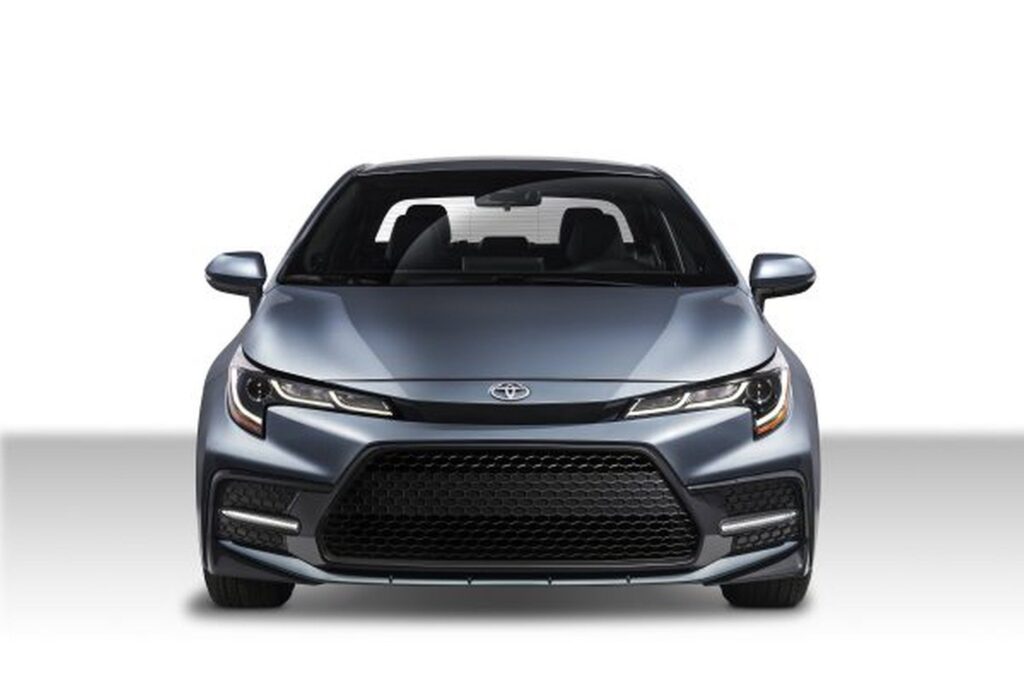
The twelfth-generation Toyota Corolla sedan, including its hybrid variant, adopted a more dynamic and contemporary design language compared to its predecessors. With a length of 182.28 inches (4630 mm), a width of 70.12 inches (1781 mm), and a height of 56.5 inches (1435 mm), the Corolla Hybrid maintained its compact footprint while offering a surprisingly spacious interior. The 106.3-inch (2700 mm) wheelbase contributed to a comfortable ride and stable handling characteristics.
As a four-door, five-seat sedan, the Corolla Hybrid prioritized functionality and passenger comfort. The interior was designed with user-friendliness in mind, featuring ergonomic controls and quality materials. While specific luxury features vary by trim, the hybrid model typically included a suite of modern amenities aimed at enhancing convenience and connectivity. Trunk space was a practical 13.1 cu. ft. (371 liters), sufficient for daily errands and weekend trips, without compromise due to the battery placement.
Underpinning the Corolla Hybrid’s ride quality and handling was a well-engineered suspension system. It featured an independent McPherson strut setup with coil springs and an anti-roll bar at the front, providing a comfortable yet responsive feel. The rear utilized a sophisticated double wishbone suspension, a significant upgrade that improved both ride comfort and dynamic stability, setting it apart from some competitors. Braking was handled by ventilated discs at the front (274 mm) and solid discs at the rear (259 mm), complemented by an Anti-lock Braking System (ABS) for enhanced safety. Electric power steering, a rack and pinion system, offered light and precise control, making urban maneuvers effortless. The vehicle rode on 195/65 R15 tires mounted on 6.5J x 15-inch wheel rims.
Technical Specifications
| Category | Specification | Value |
|---|---|---|
| General Information | ||
| Brand | Toyota | Corolla |
| Model | Generation | Corolla XII (E210) (USA) |
| Type (Engine) | 1.8 (121 Hp) Hybrid CVTi | |
| Start of production | February, 2019 | |
| End of production | 2022 | |
| Powertrain Architecture | FHEV (Full Hybrid Electric Vehicle) | |
| Body type | Sedan | |
| Seats | 5 | |
| Doors | 4 | |
| Performance Specs | ||
| Fuel consumption (urban) | 4.4 l/100 km (53.5 US mpg) | |
| Fuel consumption (extra urban) | 4.5 l/100 km (52.3 US mpg) | |
| Fuel consumption (combined) | 4.5 l/100 km (52.3 US mpg) | |
| Fuel Type | Petrol (Gasoline) | |
| Emission standard | California LEV III | |
| Weight-to-power ratio | 11.4 kg/Hp (87.5 Hp/tonne) | |
| Weight-to-torque ratio | 9.7 kg/Nm (102.7 Nm/tonne) | |
| Electric Cars and Hybrids Specs | ||
| Battery voltage | 201.6 V | |
| Battery technology | Nickel-metal hydride (NiMH) | |
| Battery location | Under the rear seats | |
| Electric motor 1 power | 72 Hp | |
| Electric motor 1 torque | 163 Nm (120.22 lb.-ft.) | |
| Electric motor location | Integrated into the transmission | |
| Electric motor type | Synchronous | |
| System power | 121 Hp | |
| Internal Combustion Engine Specs | ||
| Power | 121 Hp @ 5200 rpm (system power) | |
| Torque | 142 Nm (104.73 lb.-ft.) @ 3600 rpm (gasoline engine) | |
| Engine layout | Front, Transverse | |
| Engine Model/Code | 2ZR-FXE | |
| Engine displacement | 1798 cm³ (109.72 cu. in.) | |
| Number of cylinders | 4 | |
| Engine configuration | Inline | |
| Cylinder Bore | 80.5 mm (3.17 in.) | |
| Piston Stroke | 88.3 mm (3.48 in.) | |
| Compression ratio | 13:1 | |
| Number of valves per cylinder | 4 | |
| Fuel injection system | Multi-port manifold injection | |
| Engine aspiration | Naturally aspirated engine | |
| Valvetrain | DOHC-VVT-i | |
| Engine oil capacity | 4.2 l (4.44 US qt) | |
| Coolant | 5.6 l (5.92 US qt) | |
| Engine systems | Particulate filter | |
| Space, Volume and Weights | ||
| Kerb Weight | 1383 kg (3048.99 lbs.) | |
| Trunk (boot) space – minimum | 371 l (13.1 cu. ft.) | |
| Fuel tank capacity | 43 l (11.36 US gal) | |
| Dimensions | ||
| Length | 4630 mm (182.28 in.) | |
| Width | 1781 mm (70.12 in.) | |
| Height | 1435 mm (56.5 in.) | |
| Wheelbase | 2700 mm (106.3 in.) | |
| Front track | 1532 mm (60.31 in.) | |
| Rear (Back) track | 1534 mm (60.39 in.) | |
| Ride height (ground clearance) | 130 mm (5.12 in.) | |
| Minimum turning circle (turning diameter) | 10.4 m (34.12 ft.) | |
| Drivetrain, Brakes and Suspension Specs | ||
| Drivetrain Architecture | FHEV (Full Hybrid Electric Vehicle) – ICE and electric motor drive front wheels (full electric or mixed mode) | |
| Drive wheel | Front wheel drive | |
| Number of gears and type of gearbox | Automatic transmission CVTi | |
| Front suspension | Independent, type McPherson with coil spring and anti-roll bar | |
| Rear suspension | Double wishbone | |
| Front brakes | Ventilated discs, 274 mm | |
| Rear brakes | Disc, 259 mm | |
| Assisting systems | ABS (Anti-lock braking system) | |
| Steering type | Steering rack and pinion | |
| Power steering | Electric Steering | |
| Tires size | 195/65 R15 | |
| Wheel rims size | 6.5J x 15 | |
Legacy and Market Impact
The introduction of the Toyota Corolla XII (E210) (USA) 1.8 (121 Hp) Hybrid CVTi was a strategic move by Toyota to further democratize hybrid technology in the United States. For decades, the Corolla has been a benchmark for reliability, affordability, and low running costs. The hybrid variant amplified these attributes, offering fuel economy that rivaled or even surpassed some smaller, less practical vehicles, without sacrificing the Corolla’s renowned dependability or its established compact sedan utility.
In the highly competitive US compact sedan market, the Corolla Hybrid faced formidable rivals such as the Honda Civic, Hyundai Elantra, and Nissan Sentra. While some competitors offered their own hybrid variants or highly efficient gasoline engines, the Corolla Hybrid often stood out for its seamless integration of the hybrid system, proven reliability, and exceptional fuel efficiency. Its combined 52.3 US mpg rating was a significant selling point, appealing to environmentally conscious buyers and those looking to minimize their fuel expenses during a period of fluctuating gas prices.
The Corolla Hybrid’s success contributed significantly to Toyota’s overall leadership in hybrid vehicle sales. It demonstrated that hybrid powertrains were not just for specialty vehicles like the Prius, but could be effectively integrated into mainstream, high-volume models, further normalizing electrification in the automotive landscape. By offering a hybrid option in its best-selling model, Toyota reinforced its commitment to a diverse powertrain strategy, catering to a wide range of consumer needs and preferences. Its production run from 2019 to 2022 solidified its role as a key player in the transition towards more efficient and sustainable personal transportation in the American market, leaving a legacy of accessible hybrid technology and unwavering practicality.