The Opel Rekord E (facelift 1982): A European Mainstay
The Opel Rekord E (facelift 1982) 2.0 S (98 Hp) represents a significant chapter in Opel’s long and storied history, particularly within the European automotive landscape. As a product of General Motors’ German subsidiary, Opel, the Rekord series consistently served as a cornerstone of the mid-size to executive car segment across the continent for decades. The E-generation, launched in 1977, received a substantial facelift in 1982, bringing updated styling, improved aerodynamics, and refined powertrains to maintain its competitive edge against a rapidly evolving market. This specific variant, the 2.0 S, was a popular choice, offering a balanced blend of performance, economy, and practicality that resonated with a broad spectrum of European buyers.
Unlike its American counterparts from GM, the Opel Rekord was never officially sold in the United States, yet it played a crucial role in shaping the European automotive identity. It was renowned for its robust construction, straightforward engineering, and family-friendly attributes, embodying the practicality and reliability that German engineering was often associated with. The 1982 facelift model, produced until 1984, marked one of the final iterations of Opel’s traditional rear-wheel-drive mid-size sedans before the industry’s widespread shift towards front-wheel-drive architectures. Its legacy is one of a dependable workhorse, a comfortable family transporter, and a ubiquitous presence on European roads throughout the 1980s.
Engine and Performance: The Opel Rekord E (facelift 1982) 2.0 S Powertrain
Under the hood of the Opel Rekord E (facelift 1982) 2.0 S was a tried-and-true 2.0-liter (1979 cm³ or 120.77 cu. in.) inline four-cylinder engine, designated by the code 20S. This naturally aspirated unit featured a Single Overhead Camshaft (SOHC) valvetrain with two valves per cylinder, a common and reliable configuration for the era. Fuel delivery was handled by a carburetor, a technology that was still prevalent in the early 1980s before the widespread adoption of electronic fuel injection. With a compression ratio of 9:1, the engine produced a respectable 98 horsepower at 5400 rpm, translating to a power output of 49.5 horsepower per liter. Torque figures stood at 153 Newton-meters (112.85 lb.-ft.) at a relatively low 3800 rpm, indicating good mid-range pulling power suitable for daily driving and highway cruising.
Mated to a 5-speed manual transmission, the 2.0 S variant delivered performance that was competitive for its class and period. The Rekord could accelerate from 0 to 60 miles per hour in approximately 11.9 seconds (0-100 km/h in 12.5 seconds) and achieve a top speed of 111.85 mph (180 km/h). While these figures may seem modest by today’s standards, they provided ample capability for a family sedan in the 1980s, allowing for confident overtaking and comfortable long-distance travel on European autobahns and rural roads. The vehicle’s weight-to-power ratio was 11.6 kg/Hp, or 86.3 Hp/tonne, further highlighting its balanced performance characteristics.
Fuel economy was a significant consideration for European buyers, and the Rekord 2.0 S offered a combined fuel consumption of 10.8 liters per 100 kilometers, which translates to approximately 21.8 US miles per gallon. This efficiency, coupled with a generous 17.17 US gallon (65-liter) fuel tank capacity, provided a practical driving range, making it an economical choice for both commuters and families embarking on longer journeys. The engine’s robust design and straightforward maintenance requirements further contributed to its appeal as a dependable and cost-effective vehicle.
Design and Features: Practicality and Aerodynamics
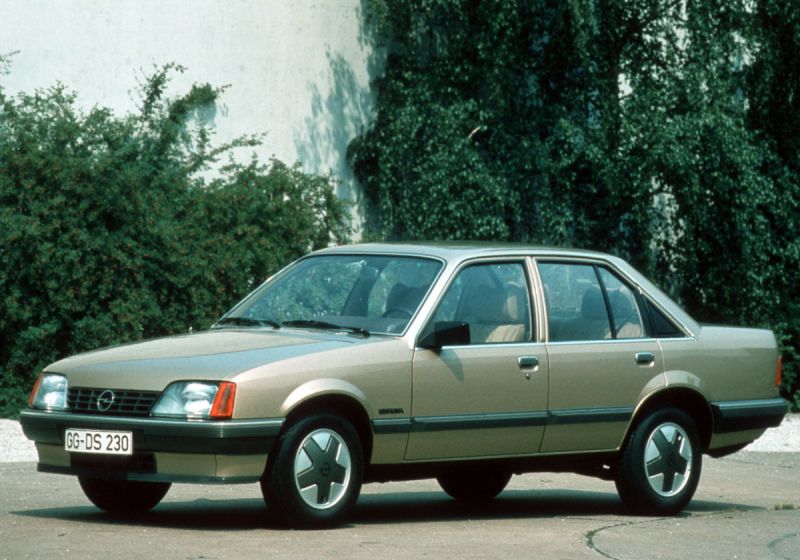
The Opel Rekord E (facelift 1982) maintained its classic sedan proportions, offering a timeless and functional design. As a 4-door sedan with seating for five, it prioritized interior space and comfort, making it a popular family car. The facelift introduced subtle but effective changes, particularly to the front and rear fascias, which softened some of the sharper lines of the pre-facelift model. Notably, the Rekord E’s drag coefficient (Cd) of 0.36 was quite respectable for an early 1980s sedan, showcasing Opel’s attention to aerodynamic efficiency at a time when fuel economy was becoming increasingly important. This relatively low Cd contributed to both fuel efficiency and reduced wind noise at higher speeds.
Dimensions-wise, the Rekord E measured 183.15 inches (4652 mm) in length, 67.95 inches (1726 mm) in width, and 55.91 inches (1420 mm) in height, with a wheelbase of 105.04 inches (2668 mm). These dimensions translated into a spacious cabin and a substantial trunk capacity of 17.3 cubic feet (490 liters), capable of accommodating luggage for a family vacation or a week’s worth of groceries. The kerb weight of the 2.0 S model was 2502.25 lbs (1135 kg), with a maximum permissible weight of 3714.79 lbs (1685 kg), allowing for a maximum load of 1212.54 lbs (550 kg).
In terms of features, the Rekord E (facelift 1982) focused on functionality and durability. While lacking the advanced electronic amenities of modern vehicles, it offered a comfortable and ergonomic interior for its time. Safety features were rudimentary by today’s standards but included essentials like seatbelts and a sturdy body structure. The drivetrain architecture was traditional rear-wheel drive, with the engine driving the rear wheels, a layout favored for its balanced handling characteristics and robustness. The braking system featured ventilated discs at the front and drum brakes at the rear, providing adequate stopping power. The minimum turning circle of 35.43 feet (10.8 meters) offered reasonable maneuverability in urban environments.
Technical Specifications
| Attribute | Value |
|---|---|
| Brand | Opel |
| Model | Rekord E (facelift 1982) 2.0 S (98 Hp) |
| Start of Production | 1982 |
| End of Production | 1984 |
| Powertrain Architecture | Internal Combustion engine |
| Body Type | Sedan |
| Seats | 5 |
| Doors | 4 |
| Fuel Type | Petrol (Gasoline) |
| Fuel Consumption (Combined) | 10.8 l/100 km (21.8 US mpg) |
| Acceleration 0-60 mph | 11.9 sec |
| Acceleration 0-100 km/h | 12.5 sec |
| Maximum Speed | 111.85 mph (180 km/h) |
| Power | 98 Hp @ 5400 rpm |
| Torque | 153 Nm (112.85 lb.-ft.) @ 3800 rpm |
| Engine Model/Code | 20S |
| Engine Displacement | 1979 cm³ (2.0 liters / 120.77 cu. in.) |
| Number of Cylinders | 4, Inline |
| Cylinder Bore | 95 mm (3.74 in.) |
| Piston Stroke | 69.8 mm (2.75 in.) |
| Compression Ratio | 9:1 |
| Valves per Cylinder | 2 |
| Fuel Injection System | Carburetor |
| Engine Aspiration | Naturally aspirated |
| Valvetrain | SOHC |
| Engine Oil Capacity | 3.8 l (4.02 US qt) |
| Coolant Capacity | 6.1 l (6.45 US qt) |
| Kerb Weight | 1135 kg (2502.25 lbs) |
| Max. Weight | 1685 kg (3714.79 lbs) |
| Max Load | 550 kg (1212.54 lbs) |
| Trunk (Boot) Space – Minimum | 490 l (17.3 cu. ft.) |
| Fuel Tank Capacity | 65 l (17.17 US gal) |
| Permitted Trailer Load (with brakes, 12%) | 1000 kg (2204.62 lbs) |
| Length | 4652 mm (183.15 in.) |
| Width | 1726 mm (67.95 in.) |
| Height | 1420 mm (55.91 in.) |
| Wheelbase | 2668 mm (105.04 in.) |
| Front Track | 1435 mm (56.5 in.) |
| Rear Track | 1412 mm (55.59 in.) |
| Ride Height (Ground Clearance) | 140 mm (5.51 in.) |
| Drag Coefficient (Cd) | 0.36 |
| Minimum Turning Circle | 10.8 m (35.43 ft.) |
| Drivetrain Architecture | Rear wheel drive |
| Number of Gears and Gearbox Type | 5 gears, manual transmission |
| Front Brakes | Ventilated discs |
| Rear Brakes | Drum |
Legacy and Market Impact
The Opel Rekord E (facelift 1982), particularly the 2.0 S variant, holds a significant place in European automotive history as one of the last bastions of Opel’s traditional, robust, rear-wheel-drive family sedans. Its reputation was built on unwavering reliability, ease of maintenance, and practical design, making it a favorite among families, business users, and even taxi operators across Germany and beyond. It was a car that simply got the job done, day in and day out, without fuss.
In its primary market, the Rekord E competed fiercely with other European mid-size offerings. Key rivals included the Ford Sierra (which arrived slightly later with more radical styling), the Volkswagen Passat (though often positioned slightly differently), the Peugeot 505, and the Renault 20/30. While some competitors leaned into more modern front-wheel-drive layouts or more adventurous styling, the Rekord held its ground with a reputation for solid engineering and value. It was often seen as a more conservative, but utterly dependable, choice compared to its contemporaries.
The Rekord E’s historical significance lies in its role as a transitional model. It represented the culmination of decades of Opel’s large rear-wheel-drive sedan philosophy, bridging the gap between the more ornate designs of the 1970s and the increasingly aerodynamic and front-wheel-drive focused models of the late 1980s. Its production run concluded in 1986, making way for the Opel Omega A, which continued the lineage but with a more modern aesthetic and improved technology, though still retaining a rear-wheel-drive platform for its initial generations. The Rekord E, particularly the facelifted 1982 model, is remembered fondly as a reliable, spacious, and efficient vehicle that perfectly encapsulated the pragmatic spirit of early 1980s European motoring. Its widespread presence ensured that it became a familiar and enduring icon of its time.