The Mercedes-Benz S124 (Facelift 1989) 200 TE: A European Workhorse of Enduring Quality
The Mercedes-Benz S124, specifically the facelifted 1989 generation, represents a pivotal era for the German automaker, embodying a blend of robust engineering, sophisticated design, and practical utility. The Mercedes-Benz S124 (facelift 1989) 200 TE, produced between July 1992 and July 1993, was a particularly significant variant within its European market, serving as a popular entry point into the premium executive station wagon segment. While the W124 chassis, known for its saloon, coupe, and convertible iterations, gained global acclaim, the 200 TE station wagon with its 2.0-liter engine was predominantly a European offering, catering to markets where fuel efficiency and taxation favored smaller displacement engines compared to the larger-engined variants typically sold in the United States. This model, often lauded as one of the last “over-engineered” Mercedes-Benz vehicles, combined stately presence with everyday functionality, setting a benchmark for reliability and build quality that resonates with enthusiasts and collectors to this day.
Engine & Performance: The M111 and Automatic Drivetrain
At the heart of the 1992-1993 Mercedes-Benz S124 200 TE lies the M111 E 20 (code 111.940) engine, a modern inline-four-cylinder unit for its time, featuring a dual overhead camshaft (DOHC) valvetrain with four valves per cylinder. This naturally aspirated, multi-port manifold injection petrol engine boasts a displacement of 1998 cubic centimeters (approximately 121.93 cubic inches). It delivers a respectable 136 horsepower at 5500 revolutions per minute, providing ample power for daily driving and comfortable cruising. Torque output stands at 190 Newton-meters (140.14 pound-feet) at 4000 rpm, ensuring a smooth and responsive power delivery characteristic of Mercedes-Benz engines.
Power is channeled to the rear wheels through a four-speed automatic transmission, a common and reliable choice for premium vehicles of this era. This drivetrain architecture, emphasizing rear-wheel drive, contributes to the car’s balanced handling and classic Mercedes-Benz driving feel. Despite its substantial kerb weight of 3240.8 pounds, the 200 TE manages a 0 to 60 mph acceleration time of 10.9 seconds, with a top speed of 113.71 mph. These figures, while not exhilarating by modern standards, were competitive for a family-oriented station wagon in the early 1990s, especially one prioritizing comfort and durability over outright speed.
Fuel economy, a significant consideration in its primary European markets, was rated at 19.6 US mpg in urban conditions and a more efficient 28.7 US mpg on the highway. With a generous 19.02 US gallon fuel tank capacity, the 200 TE offered a commendable cruising range, making it a capable long-distance tourer. The engine’s design, including its 9.6:1 compression ratio and efficient multi-port injection, contributed to its reputation for reliability and relatively low running costs for a premium vehicle.
Design & Features of the Mercedes-Benz S124 (Facelift 1989) 200 TE
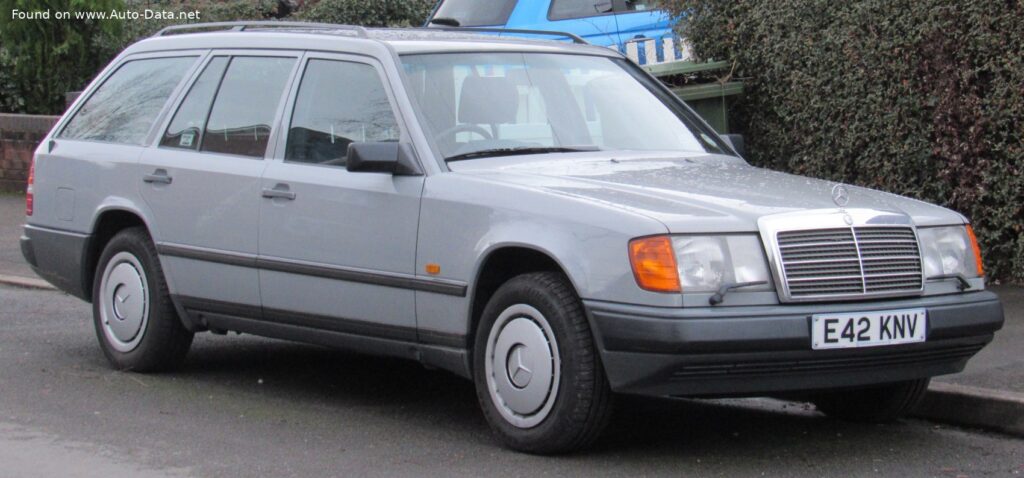
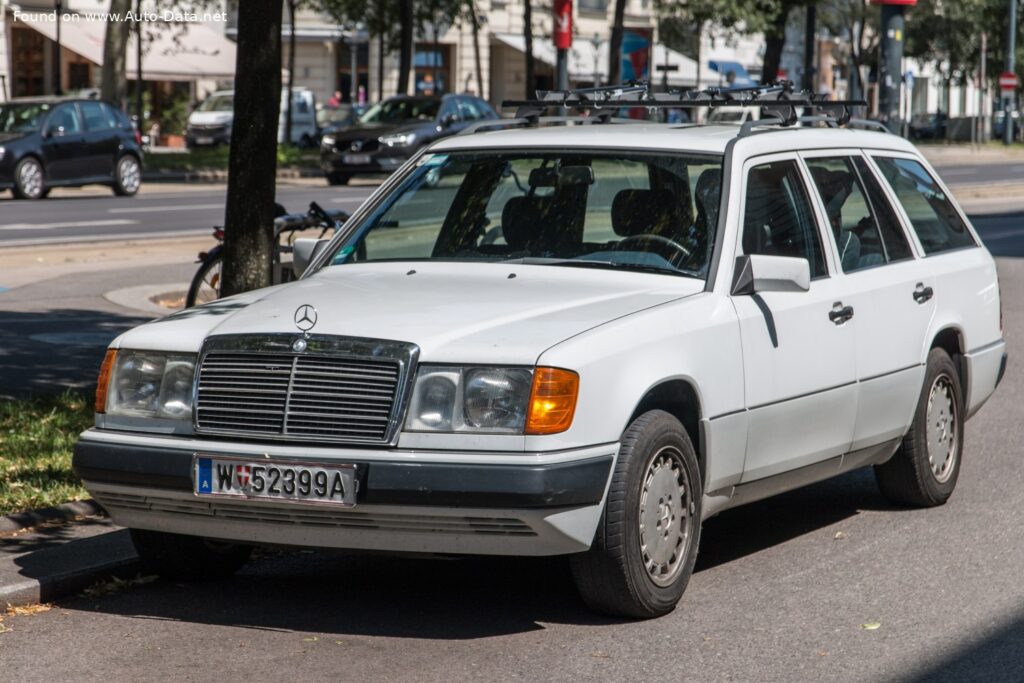
The W124 generation, introduced in the mid-1980s, was celebrated for its timeless design, robust construction, and advanced engineering. The S124 station wagon (or estate, as it’s known in Europe) variant, specifically the facelifted model from 1989 onwards, featured subtle but important updates, including body-colored side cladding, a revised grille, and updated interior trim. The Mercedes-Benz S124 (facelift 1989) 200 TE embodies this refined aesthetic, presenting a sleek yet functional five-door, five-seat body type that prioritizes practicality without compromising on elegance.
Measuring 187.6 inches in length, 68.5 inches in width, and 58.62 inches in height, with a substantial wheelbase of 110.24 inches, the S124 wagon offered generous interior space for both passengers and cargo. Its design was not merely aesthetic; it was highly functional, boasting excellent aerodynamics for its time, contributing to both fuel efficiency and reduced wind noise. The large cargo area, easily accessible via the rear tailgate, was a key selling point for families and professionals needing versatile transport.
Underneath its sophisticated exterior, the S124 featured an advanced suspension system for its era. The front utilized a wishbone setup, while the rear employed an independent multi-link suspension, a sophisticated design that provided an exceptional balance of ride comfort, stability, and handling precision. Braking power was supplied by ventilated discs at the front and solid discs at the rear, complemented by an Anti-lock Braking System (ABS) as a standard assisting system, a crucial safety feature for the time. Steering was a hydraulic power-assisted cone worm with recirculation balls system, offering precise feedback and ease of maneuverability. The vehicle rode on 195/65 R15 tires mounted on 6.5J x 15-inch wheel rims, a practical and comfortable setup suitable for various road conditions.
Technical Specifications: Mercedes-Benz S124 (facelift 1989) 200 TE (136 Hp) Automatic
| Category | Specification |
|---|---|
| General Information | |
| Brand | Mercedes-Benz |
| Model | W124 |
| Generation | S124 (facelift 1989) |
| Type (Engine) | 200 TE (136 Hp) Automatic |
| Production Start | July, 1992 |
| Production End | July, 1993 |
| Powertrain Architecture | Internal Combustion Engine |
| Body Type | Station wagon (estate) |
| Seats | 5 |
| Doors | 5 |
| Performance Specs | |
| Fuel Consumption (Urban) | 12 l/100 km (19.6 US mpg) |
| Fuel Consumption (Extra Urban) | 8.2 l/100 km (28.7 US mpg) |
| Fuel Type | Petrol (Gasoline) |
| Acceleration 0 – 60 mph | 10.9 sec |
| Maximum Speed | 183 km/h (113.71 mph) |
| Weight-to-Power Ratio | 10.8 kg/Hp (92.5 Hp/tonne) |
| Weight-to-Torque Ratio | 7.7 kg/Nm (129.3 Nm/tonne) |
| Engine Specs | |
| Power | 136 Hp @ 5500 rpm |
| Power per Liter | 68.1 Hp/l |
| Torque | 190 Nm @ 4000 rpm (140.14 lb.-ft. @ 4000 rpm) |
| Engine Layout | Front, Longitudinal |
| Engine Model/Code | M 111 E 20 / 111.940 |
| Engine Displacement | 1998 cm3 (121.93 cu. in.) |
| Number of Cylinders | 4 |
| Engine Configuration | Inline |
| Cylinder Bore | 89.9 mm (3.54 in.) |
| Piston Stroke | 78.7 mm (3.1 in.) |
| Compression Ratio | 9.6:1 |
| Valves per Cylinder | 4 |
| Fuel Injection System | Multi-port manifold injection |
| Engine Aspiration | Naturally aspirated |
| Valvetrain | DOHC |
| Engine Oil Capacity | 5.5 l (5.81 US qt) |
| Coolant Capacity | 8.5 l (8.98 US qt) |
| Space, Volume and Weights | |
| Kerb Weight | 1470 kg (3240.8 lbs.) |
| Max. Weight (Gross Vehicle Weight) | 2120 kg (4673.8 lbs.) |
| Max Load | 650 kg (1433 lbs.) |
| Fuel Tank Capacity | 72 l (19.02 US gal) |
| Dimensions | |
| Length | 4765 mm (187.6 in.) |
| Width | 1740 mm (68.5 in.) |
| Height | 1489 mm (58.62 in.) |
| Wheelbase | 2800 mm (110.24 in.) |
| Front Track | 1497 mm (58.94 in.) |
| Rear Track | 1497 mm (58.94 in.) |
| Drivetrain, Brakes and Suspension Specs | |
| Drivetrain Architecture | Rear-wheel drive (ICE drives rear wheels) |
| Drive Wheel | Rear wheel drive |
| Number of Gears & Type | 4 gears, automatic transmission |
| Front Suspension | Wishbone |
| Rear Suspension | Independent multi-link suspension |
| Front Brakes | Ventilated discs |
| Rear Brakes | Disc |
| Assisting Systems | ABS (Anti-lock braking system) |
| Steering Type | Cone worm with recirculation balls |
| Power Steering | Hydraulic Steering |
| Tire Size (Front/Rear) | 195/65 R15 |
| Wheel Rim Size (Front/Rear) | 6.5J x 15 |
Legacy & Market Impact of the Mercedes-Benz S124 (Facelift 1989) 200 TE
The Mercedes-Benz W124 series, and particularly the S124 station wagon, carved out a formidable reputation as a benchmark for quality, durability, and engineering excellence. The Mercedes-Benz S124 (facelift 1989) 200 TE, while not a high-performance variant, played a crucial role in the European market by offering the quintessential W124 experience in a more accessible and economical package. Its robust M111 engine, combined with the smooth automatic transmission, provided a reliable and comfortable driving experience, perfectly suited for the demands of European families and businesses.
In its primary markets, the 200 TE competed with other premium European executive wagons such as the BMW 5 Series Touring (E34), Audi 100 Avant (C4), and Volvo 940/960 Estate. While these competitors offered their own strengths, the W124 stood out for its legendary build quality, often cited as one of the last Mercedes-Benz models where engineering integrity took precedence over cost-cutting. This reputation for longevity meant that many W124s, including the 200 TE, remained on the road for decades, accumulating hundreds of thousands of miles with proper maintenance.
The W124’s design, penned by Bruno Sacco, is considered a timeless classic, blending functionalism with understated elegance. The S124 station wagon body style, in particular, maintained a graceful profile despite its utilitarian purpose, avoiding the boxiness often associated with wagons of the era. Its spacious and well-appointed interior, coupled with the advanced independent multi-link rear suspension, ensured a comfortable ride even when fully loaded, further cementing its appeal as a practical luxury vehicle.
Today, the W124 series is highly regarded in the classic car community, with well-preserved examples fetching increasing prices. The 200 TE, while less common in the US due to its European market focus, is a testament to Mercedes-Benz’s commitment to engineering excellence in the early 1990s. Its legacy is one of reliability, comfort, and a build quality that set it apart, earning it the affectionate moniker “the last great Mercedes.” For those seeking a practical classic that combines prestige with everyday usability, the S124 200 TE remains a compelling choice, representing a golden age of German automotive engineering.