The Renault Megane II Coupe (Phase II, 2006) GT 1.9 dCi (110 Hp) FAP: A European Diesel Sport-Compact
The Renault Megane II Coupe (Phase II, 2006) GT 1.9 dCi (110 Hp) FAP represents a compelling blend of distinctive design, practical efficiency, and a sporty demeanor within the highly competitive European C-segment. Launched in 2002, the second-generation Megane quickly became a design icon, particularly known for its unique rear styling. The Phase II refresh, introduced in 2006, subtly updated the model line, refining its aesthetics and enhancing its technological offerings. This specific variant, the GT 1.9 dCi, combined the more dynamic three-door coupe body style with a robust and fuel-efficient turbodiesel engine, positioning it as an attractive option for European drivers seeking both performance and economy. While never officially sold in the United States, the Megane II was a significant player in markets across Europe and beyond, showcasing Renault’s innovative approach to design and powertrain development.
Engine & Performance: The Heart of the Renault Megane II Coupe (Phase II, 2006) GT 1.9 dCi (110 Hp) FAP
Under the hood of the Renault Megane II Coupe GT lies a 1.9-liter (1870 cm³) F9Q Turbo dCi inline-four diesel engine. This powertrain was a cornerstone of Renault’s diesel offerings, renowned for its balance of power, torque, and exceptional fuel efficiency. Equipped with a common rail direct fuel injection system and a turbocharger with an intercooler, the engine produced a respectable 110 horsepower at 4000 rpm. More importantly for real-world driving, it generated a substantial 191.77 lb-ft (260 Nm) of torque, available at a low 2000 rpm. This characteristic torque delivery made the Megane GT 1.9 dCi feel responsive and capable in everyday scenarios, offering effortless acceleration from low speeds and confident highway cruising.
The performance figures for this diesel coupe were competitive for its class in 2006. It could accelerate from 0 to 60 mph in a brisk 10.2 seconds and reach a top speed of 116.82 mph (188 km/h). Paired with a precise six-speed manual transmission, the front-wheel-drive architecture ensured an engaging driving experience. Furthermore, the inclusion of a Diesel Particulate Filter (FAP) was a significant feature, demonstrating Renault’s commitment to reducing harmful emissions. This system helped the GT 1.9 dCi meet the Euro 4 emission standard, a crucial factor in European markets where environmental regulations were becoming increasingly stringent. The combined fuel economy of 42 US mpg (5.6 l/100 km) was a major selling point, providing long-distance touring capability with fewer stops at the pump, a highly valued attribute in Europe.
Design & Features: Sculpted for the European Road
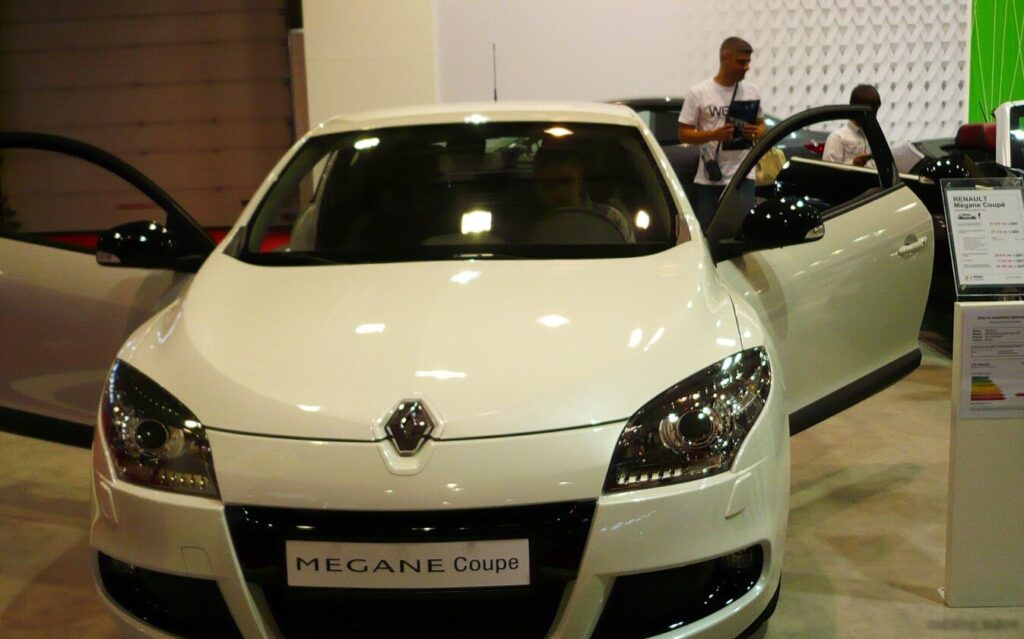
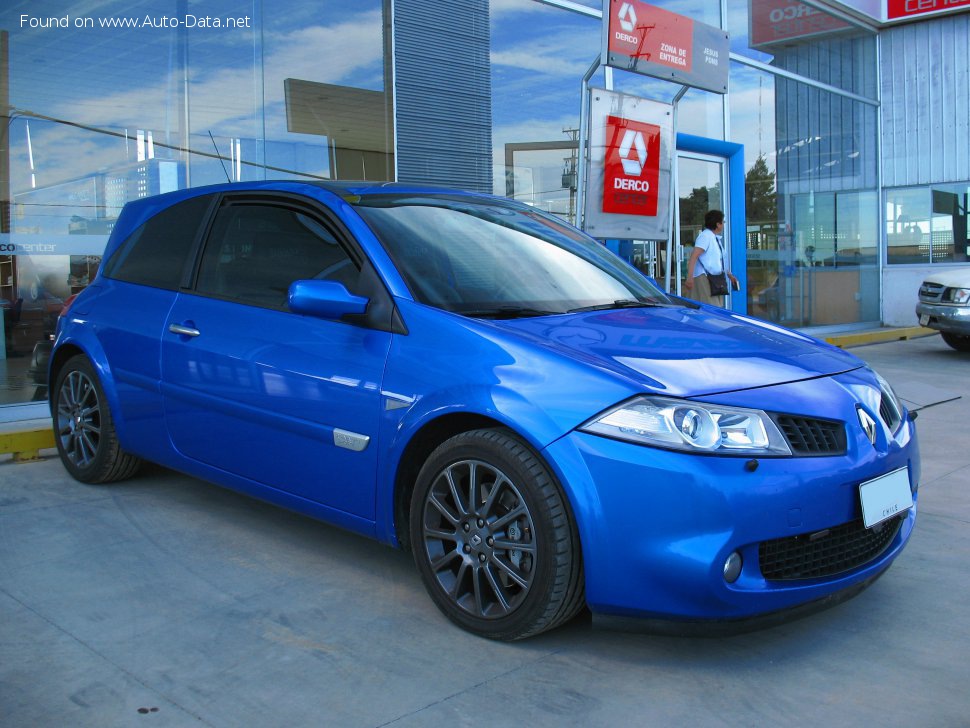
The Megane II’s design was a bold departure from its predecessor and the conventional styling of many competitors. The three-door coupe body type, in particular, accentuated its distinctive silhouette, characterized by a sloping roofline and the controversial yet iconic “bustle back” rear end. This design choice gave the Megane II a unique identity, polarizing opinions but ultimately contributing to its strong market presence. The Phase II updates introduced subtle refinements, including revised headlights and taillights, new bumper designs, and updated interior trim, keeping the car fresh and modern.
Inside, the Megane II Coupe offered a comfortable and ergonomically designed cabin for five occupants, despite its coupe designation. The front seats provided good support, and while rear access was typical for a three-door car, the space was adequate for shorter journeys. Practicality was also a consideration, with a trunk (boot) capacity ranging from 11.65 cubic feet (330 liters) to a generous 42.02 cubic feet (1190 liters) with the rear seats folded, making it surprisingly versatile for a compact coupe.
Key features for the 2006 model year included a focus on safety and driver convenience. Standard safety systems like ABS (Anti-lock Braking System) were integral, and the car’s strong performance in Euro NCAP crash tests further bolstered its reputation for occupant protection. Electric power steering provided light and precise control, enhancing maneuverability in urban environments and at higher speeds. The suspension setup, featuring independent coil springs at the front and a torsion beam at the rear, offered a comfortable ride quality while maintaining competent handling dynamics, particularly for the GT trim which often implied a slightly sportier setup. The car rode on 195/65 R15 tires with 6J x 15-inch wheel rims, a common specification for balancing ride comfort and grip.
Technical Specifications
| Category | Specification | US Equivalent (where applicable) |
|---|---|---|
| General Information | ||
| Brand | Renault | |
| Model | Megane | |
| Generation | Megane II Coupe (Phase II, 2006) | |
| Type (Engine) | GT 1.9 dCi (110 Hp) FAP | |
| Start of Production | 2006 | |
| End of Production | 2006 | |
| Powertrain Architecture | Internal Combustion Engine | |
| Body Type | Coupe | |
| Seats | 5 | |
| Doors | 3 | |
| Performance Specs | ||
| Fuel Consumption (Urban) | 7.1 l/100 km | 33.1 US mpg |
| Fuel Consumption (Extra Urban) | 4.8 l/100 km | 49 US mpg |
| Fuel Consumption (Combined) | 5.6 l/100 km | 42 US mpg |
| CO2 Emissions | 148 g/km | |
| Fuel Type | Diesel | |
| Acceleration 0 – 60 mph | 10.2 sec | |
| Acceleration 0 – 62 mph (100 km/h) | 10.7 sec | |
| Maximum Speed | 188 km/h | 116.82 mph |
| Emission Standard | Euro 4 | |
| Weight-to-Power Ratio | 11.4 kg/Hp | 25.13 lbs/Hp |
| Weight-to-Torque Ratio | 4.8 kg/Nm | 10.58 lbs/Nm |
| Engine Specs | ||
| Power | 110 Hp @ 4000 rpm | |
| Power per Liter | 58.8 Hp/l | |
| Torque | 260 Nm @ 2000 rpm | 191.77 lb.-ft. @ 2000 rpm |
| Engine Layout | Front, Transverse | |
| Engine Model/Code | F9Q Turbo | |
| Engine Displacement | 1870 cm³ | 1.9 Liters (114.11 cu. in.) |
| Number of Cylinders | 4 | |
| Engine Configuration | Inline | |
| Cylinder Bore | 80 mm | 3.15 in. |
| Piston Stroke | 93 mm | 3.66 in. |
| Compression Ratio | 19:1 | |
| Number of Valves per Cylinder | 2 | |
| Fuel Injection System | Diesel Commonrail | |
| Engine Aspiration | Turbocharger, Intercooler | |
| Valvetrain | OHC | |
| Engine Oil Capacity | 4.5 l | 4.76 US qt |
| Coolant Capacity | 7.9 l | 8.35 US qt |
| Engine Systems | Particulate Filter (FAP) | |
| Space, Volume and Weights | ||
| Kerb Weight | 1250 kg | 2755.78 lbs. |
| Max. Weight | 1800 kg | 3968.32 lbs. |
| Max Load | 550 kg | 1212.54 lbs. |
| Trunk (Boot) Space – Minimum | 330 l | 11.65 cu. ft. |
| Trunk (Boot) Space – Maximum | 1190 l | 42.02 cu. ft. |
| Fuel Tank Capacity | 60 l | 15.85 US gal |
| Max. Roof Load | 80 kg | 176.37 lbs. |
| Permitted Trailer Load with Brakes (12%) | 1300 kg | 2866.01 lbs. |
| Permitted Trailer Load without Brakes | 650 kg | 1433 lbs. |
| Permitted Towbar Download | 75 kg | 165.35 lbs. |
| Dimensions | ||
| Length | 4209 mm | 165.71 in. |
| Width | 1777 mm | 69.96 in. |
| Width Including Mirrors | 2026 mm | 79.76 in. |
| Height | 1458 mm | 57.4 in. |
| Wheelbase | 2625 mm | 103.35 in. |
| Front Track | 1518 mm | 59.76 in. |
| Rear Track | 1514 mm | 59.61 in. |
| Front Overhang | 842 mm | 33.15 in. |
| Rear Overhang | 742 mm | 29.21 in. |
| Drag Coefficient (Cd) | 0.35 | |
| Minimum Turning Circle | 10.5 m | 34.45 ft. |
| Drivetrain, Brakes and Suspension Specs | ||
| Drivetrain Architecture | Front-wheel drive, Internal Combustion Engine | |
| Drive Wheel | Front-wheel drive | |
| Number of Gears and Type of Gearbox | 6 gears, Manual Transmission | |
| Front Suspension | Independent coil spring | |
| Rear Suspension | Torsion beam | |
| Front Brakes | Ventilated discs | |
| Rear Brakes | Disc | |
| Assisting Systems | ABS (Anti-lock Braking System) | |
| Steering Type | Steering rack and pinion | |
| Power Steering | Electric Steering | |
| Tires Size | 195/65 R15 | |
| Wheel Rims Size | 6J x 15 | |
Legacy & Market Impact of the Renault Megane II Coupe GT 1.9 dCi (110 Hp) FAP
The Renault Megane II, and particularly its distinctive coupe variant, carved out a significant niche in the European automotive landscape. Its bold styling, a hallmark of Renault’s design direction under Patrick Le Quément, helped it stand out in a segment often criticized for conservative aesthetics. The Megane II was a critical and commercial success for Renault, winning the European Car of the Year award in 2003, a testament to its overall package.
In its primary European market, the Megane II Coupe GT 1.9 dCi faced stiff competition from established rivals such as the Volkswagen Golf (particularly the GT TDI models), Ford Focus, Opel Astra, and Peugeot 307. What set the Megane apart was its unique blend of avant-garde design, a strong emphasis on safety (it was one of the first cars in its class to achieve a 5-star Euro NCAP rating), and the availability of highly efficient diesel powertrains. The 1.9 dCi engine, in particular, solidified Renault’s reputation for producing refined and economical diesel engines, which were highly favored by European consumers due to lower fuel costs and often tax incentives. The GT trim, even with a diesel engine, appealed to those who desired a sportier visual and driving experience without sacrificing the economic benefits of diesel.
The inclusion of a Diesel Particulate Filter (FAP) in the 2006 model year was also forward-thinking, demonstrating Renault’s commitment to environmental responsibility ahead of widespread mandates. This positioned the Megane II as a modern and environmentally conscious choice for drivers. Its impact was not just in sales numbers but also in pushing design boundaries and demonstrating that a compact car could offer premium features and safety. The Megane II’s legacy is one of a car that dared to be different, offering a compelling alternative to its more conventionally styled competitors, and proving that a diesel engine could be a desirable and performance-oriented option in a sporty coupe package. It remains a recognizable and respected vehicle in the history of European compact cars.