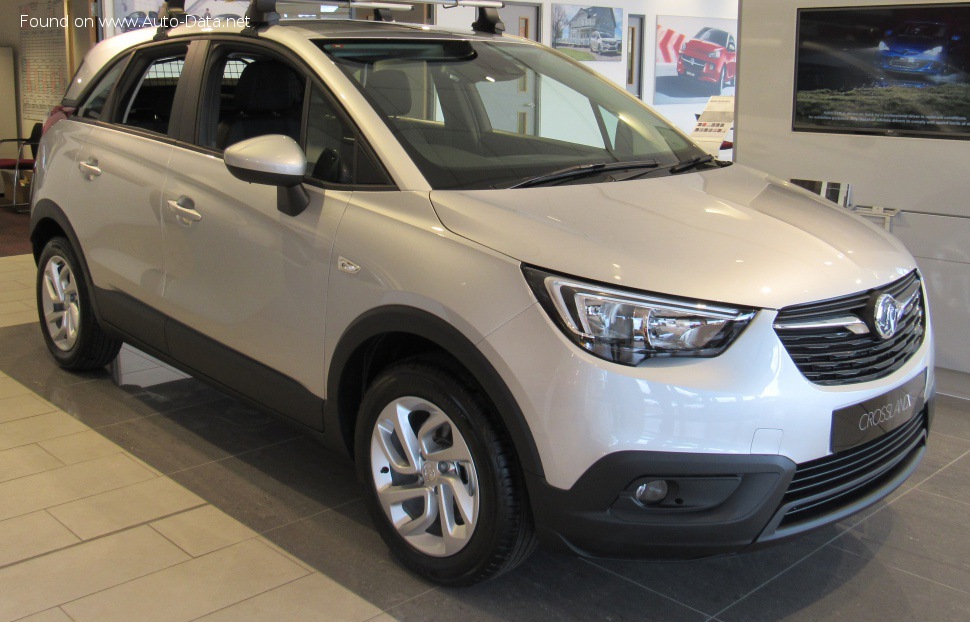
The Vauxhall Crossland X 1.6 ecoTEC (99 Hp): A European Urban Crossover Defined by Efficiency
The Vauxhall Crossland X, introduced in 2017, marked a significant entry for the British marque into the fiercely competitive subcompact crossover SUV segment. Positioned below the larger Mokka X, the Crossland X was designed as a direct replacement for the Meriva mini MPV, signaling a broader industry shift from multi-purpose vehicles to more rugged-styled SUVs. The specific variant, the Vauxhall Crossland X 1.6 ecoTEC (99 Hp), produced between June 2017 and May 2018, stood out as a highly efficient diesel option tailored for the discerning European market, where fuel economy and low emissions are paramount considerations for consumers. This model, a rebadged version of the Opel Crossland X sold across continental Europe, leveraged its compact dimensions and practical interior to appeal to families and urban dwellers seeking versatility without the bulk of a larger SUV.
Operating exclusively in markets outside of the United States, the Crossland X, particularly with its ecoTEC diesel powertrain, offered a compelling package of low running costs, respectable performance, and modern safety features. Its architecture, while designed before Vauxhall’s full integration into the PSA Group (now Stellantis), represented a collaboration with PSA, making it one of the first models to showcase this new strategic direction. This particular 1.6-liter diesel engine variant, with its focus on environmental compliance and economical operation, underscored Vauxhall’s commitment to meeting stringent European emission standards while providing a practical and family-friendly vehicle.
Engine and Performance: The Heart of the Vauxhall Crossland X 1.6 ecoTEC (99 Hp)
At the core of the Vauxhall Crossland X 1.6 ecoTEC (99 Hp) lies a robust and highly efficient 1.6-liter (1560 cm³) inline-four diesel engine, designated with the model code B16DT. This powertrain was engineered with a strong emphasis on fuel economy and reduced emissions, a critical factor for success in the European automotive landscape. Generating 99 horsepower at 3750 revolutions per minute, the engine delivers its power smoothly and controllably, making it well-suited for both city commuting and longer highway journeys. More impressive than its horsepower figure, however, is its torque output: a substantial 187.34 lb.-ft. (254 Nm) available from a low 1750 rpm. This characteristic low-end torque is a hallmark of modern diesel engines, providing excellent responsiveness off the line and effortless overtaking capability without constantly needing to downshift.
The 1.6 ecoTEC engine utilizes a sophisticated Diesel Commonrail fuel injection system, paired with a turbocharger and intercooler, to optimize combustion and maximize efficiency. This setup not only enhances performance but also helps the engine meet the strict Euro 6 emission standards, with CO2 emissions rated at a remarkably low 95 g/km. Fuel economy figures are particularly strong, reflecting the engine’s design intent: an urban rating of 56 US mpg, an extra-urban (highway) rating of 69.2 US mpg, and a combined cycle rating of 63.6 US mpg. These figures translate to significantly lower running costs compared to gasoline equivalents, a major draw for European buyers. Power is delivered to the front wheels via a precise 5-speed manual transmission, a common choice in Europe for its direct engagement and contribution to overall fuel efficiency. The vehicle’s top speed is rated at 111.85 mph (180 km/h), adequate for its segment and intended use.
Design and Features: Practicality Meets Modernity
The Vauxhall Crossland X adopts the popular SUV body type, characterized by its elevated driving position and more assertive styling compared to its MPV predecessor. Despite its “SUV” designation, it is fundamentally a compact crossover designed for urban environments, with front-wheel drive architecture rather than off-road capability. Its dimensions – 165.83 inches (4212 mm) in length, 69.49 inches (1765 mm) in width (77.8 inches / 1976 mm including mirrors), and 63.19 inches (1605 mm) in height – make it agile enough for tight city streets and parking spaces, yet spacious enough for five occupants. The wheelbase of 102.52 inches (2604 mm) contributes to a stable ride and maximized interior volume within its compact footprint.
Inside, the Crossland X offers a practical and versatile cabin. It features seating for five, with a focus on ease of access and comfortable ergonomics. The trunk space is generous for its class, offering a minimum of 14.48 cubic feet (410 liters) with all seats in place, expanding significantly to 44.32 cubic feet (1255 liters) when the rear seats are folded down. This flexibility allows for substantial cargo capacity, catering to varied family needs from grocery runs to weekend trips. Standard features for safety and driver assistance include an Anti-lock Braking System (ABS), ventilated disc brakes at the front, and disc brakes at the rear, ensuring confident stopping power. The electric power steering system provides light and responsive handling, ideal for urban maneuvering, with a minimum turning circle of 36.78 feet (11.21 m).
The exterior design incorporates contemporary Vauxhall styling cues, including a prominent grille and distinctive lighting signatures. The vehicle rides on 17-inch wheels shod with 215/50 R17 tires, balancing ride comfort with a stable stance. While not explicitly detailed in the provided data, a vehicle of this era and market segment would typically include modern connectivity features, such as infotainment systems with smartphone integration, further enhancing its appeal to a tech-savvy audience.
Technical Specifications
| Category | Specification |
|---|---|
| General Information | |
| Brand | Vauxhall |
| Model | Crossland |
| Generation | Crossland X |
| Type (Engine) | 1.6 ecoTEC (99 Hp) |
| Start of Production | June, 2017 |
| End of Production | May, 2018 |
| Powertrain Architecture | Internal Combustion engine |
| Body type | SUV |
| Seats | 5 |
| Doors | 5 |
| Performance Specs | |
| Fuel consumption (economy) – urban | 4.2 l/100 km (56 US mpg) |
| Fuel consumption (economy) – extra urban | 3.4 l/100 km (69.2 US mpg) |
| Fuel consumption (economy) – combined | 3.7 l/100 km (63.6 US mpg) |
| CO2 emissions | 95 g/km |
| Fuel Type | Diesel |
| Maximum speed | 111.85 mph (180 km/h) |
| Emission standard | Euro 6 |
| Engine Specs | |
| Power | 99 Hp @ 3750 rpm |
| Power per liter | 63.5 Hp/l |
| Torque | 187.34 lb.-ft. (254 Nm) @ 1750 rpm |
| Engine layout | Front, Transverse |
| Engine Model/Code | B16DT |
| Engine displacement | 1.6 liters (1560 cm³, 95.2 cu. in.) |
| Number of cylinders | 4 |
| Engine configuration | Inline |
| Number of valves per cylinder | 4 |
| Fuel injection system | Diesel Commonrail |
| Engine aspiration | Turbocharger, Intercooler |
| Engine oil capacity | 4.02 US qt (3.8 l) |
| Coolant | 5.6 US qt (5.3 l) |
| Engine systems | Particulate filter |
| Space, Volume and Weights | |
| Trunk (boot) space – minimum | 14.48 cu. ft. (410 l) |
| Trunk (boot) space – maximum | 44.32 cu. ft. (1255 l) |
| Fuel tank capacity | 11.89 US gal (45 l) |
| Dimensions | |
| Length | 165.83 in. (4212 mm) |
| Width | 69.49 in. (1765 mm) |
| Width including mirrors | 77.8 in. (1976 mm) |
| Height | 63.19 in. (1605 mm) |
| Wheelbase | 102.52 in. (2604 mm) |
| Minimum turning circle (turning diameter) | 36.78 ft. (11.21 m) |
| Drivetrain, Brakes and Suspension Specs | |
| Drivetrain Architecture | Internal combustion engine (ICE) drives the front wheels. |
| Drive wheel | Front wheel drive |
| Number of gears and type of gearbox | 5 gears, manual transmission |
| Front brakes | Ventilated discs |
| Rear brakes | Disc |
| Assisting systems | ABS (Anti-lock braking system) |
| Steering type | Steering rack and pinion |
| Power steering | Electric Steering |
| Tires size | 215/50 R17 |
| Wheel rims size | 17 inches |
Legacy and Market Impact
The Vauxhall Crossland X 1.6 ecoTEC (99 Hp) played a pivotal role in Vauxhall’s strategy to adapt to evolving consumer preferences in the European market. Its introduction coincided with a massive surge in demand for compact SUVs, effectively replacing the declining MPV segment. The Crossland X aimed to capture a significant share of this burgeoning market by offering a compelling blend of SUV aesthetics, practical interior space, and crucially, outstanding fuel economy, particularly with the 1.6 ecoTEC diesel engine.
In its primary markets, the Crossland X faced stiff competition from a multitude of established players in the subcompact crossover segment. Key rivals included models like the Renault Captur, Peugeot 2008 (with which it shared some underlying platform components due to the PSA Group collaboration), Nissan Juke, Ford EcoSport, Hyundai Kona, and Kia Stonic. The Crossland X differentiated itself through its focus on interior versatility, a comfortable ride, and its strong value proposition. For the Vauxhall brand, it provided a modern, family-friendly option that sat alongside the sportier Mokka X, offering consumers a choice based on their priorities – practicality and urban efficiency for the Crossland X, or a more dynamic, lifestyle-oriented feel for the Mokka X.
The specific 1.6 ecoTEC (99 Hp) variant, with its excellent fuel efficiency and low CO2 emissions, was particularly well-suited to European tax structures and consumer desires for economical motoring. Its relatively short production run for this specific engine (June 2017 to May 2018) is indicative of the rapid changes occurring within Vauxhall/Opel during its acquisition by the PSA Group. As PSA transitioned Opel/Vauxhall onto its own platforms and powertrains, many pre-existing GM-derived engine options, like this 1.6 ecoTEC, were phased out in favor of PSA’s equivalent units. This makes the 2017-2018 Crossland X 1.6 ecoTEC an interesting snapshot of a transitional period for the brand, representing a bridge between its former General Motors heritage and its new direction under Stellantis. Ultimately, the Crossland X proved to be a popular choice for European families, valued for its practicality, low running costs, and modern appeal, cementing its place as a significant vehicle in Vauxhall’s recent history.