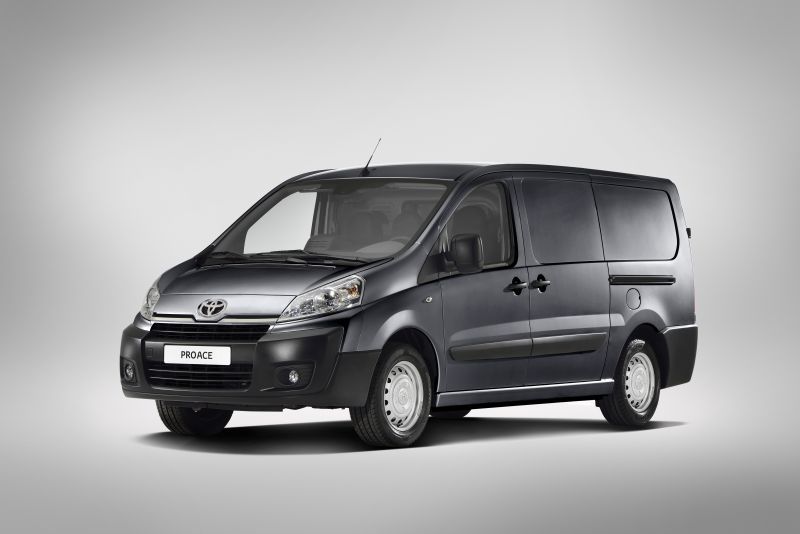
Introduction to the Toyota Proace Double Cabine 2.0 D4-D (128 Hp) L2H1
The Toyota Proace Double Cabine 2.0 D4-D (128 Hp) L2H1 represents Toyota’s strategic entry into the highly competitive European light commercial vehicle (LCV) market during its production run from 2013 to 2016. Unlike many of Toyota’s globally developed models, the Proace was a result of a collaboration with PSA Peugeot Citroën, essentially a rebadged version of the Citroën Jumpy/Peugeot Expert. This approach allowed Toyota to offer a robust and versatile commercial van without the extensive development costs, leveraging an established platform. The Double Cabine variant specifically targets businesses and individuals requiring a dual-purpose vehicle, capable of comfortably transporting both passengers and significant cargo. The L2H1 designation denotes a longer wheelbase (L2) and a standard roof height (H1), optimizing it for a balance of maneuverability and load capacity. While not sold in the United States, the Proace played a crucial role in expanding Toyota’s commercial vehicle footprint across Europe, providing a reliable and efficient option for a diverse range of professional applications, from tradespeople to delivery services.
Engine and Performance of the Toyota Proace Double Cabine
Under the hood, the Toyota Proace Double Cabine 2.0 D4-D (128 Hp) L2H1 is powered by a 2.0-liter (1997 cubic inches) inline four-cylinder D4-D diesel engine, designated with the model code 4WZ-FTV. This powerplant is a testament to the era’s focus on diesel efficiency and torque delivery, especially pertinent for a commercial vehicle. It generates a respectable 128 horsepower at 4000 rpm and a robust 236.02 lb.-ft. of torque at a low 2000 rpm. The engine features a common rail fuel injection system, a turbocharger, and an intercooler, ensuring optimal power output and fuel atomization for efficient combustion. A DOHC (Double Overhead Camshaft) valvetrain further enhances engine breathing and performance.
Paired with a 6-speed manual transmission, the front-wheel-drive architecture is standard for this class of van, offering predictable handling and maximizing interior space. Performance figures, while not the primary focus for a utility vehicle, are adequate for daily tasks. The Proace Double Cabine accelerates from 0 to 60 mph in a calculated 12.4 seconds and can reach a top speed of 105.63 mph (170 km/h).
Fuel economy is a strong suit for this diesel-powered van, crucial for reducing operating costs for businesses. The combined fuel consumption is rated at an impressive 33.1 US mpg (7.1 l/100 km). Urban driving yields approximately 28.7 US mpg (8.2 l/100 km), while extra-urban cruising can achieve up to 37.3 US mpg (6.3 l/100 km). These figures, combined with an 80-liter (21.13 US gallon) fuel tank, provide a substantial driving range between fill-ups. The engine also meets Euro 5 emission standards, with CO2 emissions of 183 g/km, reflecting its compliance with contemporary European environmental regulations. Its weight-to-power ratio stands at 14.7 kg/Hp (68.2 Hp/tonne), underscoring its capability to carry loads efficiently.
Design and Features
The Toyota Proace Double Cabine 2.0 D4-D (128 Hp) L2H1 adopts a practical and functional minivan body type, specifically configured as a double cab, making it a versatile workhorse. With five doors and seating for 3 to 6 occupants, it skillfully blends passenger transport with cargo hauling capabilities. The L2H1 designation signifies its dimensions: a length of 202.48 inches (5143 mm), a width of 74.61 inches (1895 mm), and a height of 77.95 inches (1980 mm). These dimensions, coupled with a generous wheelbase of 122.91 inches (3122 mm), contribute to a stable ride and a surprisingly tight turning circle of 41.34 feet (12.6 m) for a vehicle of its size, aiding maneuverability in urban environments.
The exterior design is characterized by its utilitarian nature, prioritizing practicality over aesthetics. Large side doors, including a sliding door (typical for vans in this segment), facilitate easy access for both passengers and cargo. The standard roof height (H1) ensures it can fit into most multi-story parking garages and tight spaces, a crucial consideration for commercial operators in European cities.
Inside, the double cab layout offers a practical solution for crews, allowing for a second row of seating while still retaining a substantial cargo area behind it. The kerb weight ranges from 4135.87 to 4345.31 lbs (1876-1971 kg), and with a maximum load capacity of 2004 to 2213.44 lbs (909-1004 kg), the Proace is designed to handle heavy payloads. It also boasts impressive towing capabilities, with a permitted trailer load of 4409.25 lbs (2000 kg) with brakes and 1653.47 lbs (750 kg) without brakes, further enhancing its utility.
Standard features for this era and segment typically included essential safety systems like ABS (Anti-lock Braking System) for controlled stopping power, ventilated disc brakes at the front, and disc brakes at the rear. The steering system utilizes a rack and pinion setup with electric power steering, providing ease of operation, particularly at low speeds during parking or maneuvering. The suspension system, featuring a double wishbone front and a semi-independent, coil spring rear, is tuned to balance ride comfort for passengers with the robustness required for heavy loads. The vehicle rides on 215/60 R16 tires mounted on 7J x 16 wheel rims, a common size offering a good balance of load-carrying capacity and comfort.
Technical Specifications
| Category | Specification | US Equivalent |
|---|---|---|
| General Information | ||
| Brand | Toyota | |
| Model | Proace Double Cabine | |
| Type (Engine) | 2.0 D4-D (128 Hp) L2H1 | |
| Production Start | 2013 | |
| Production End | 2016 | |
| Powertrain Architecture | Internal Combustion engine | |
| Body Type | Minivan | |
| Seats | 3-6 | |
| Doors | 5 | |
| Performance Specs | ||
| Fuel Consumption (Urban) | 8.2 l/100 km | 28.7 US mpg |
| Fuel Consumption (Extra Urban) | 6.3 l/100 km | 37.3 US mpg |
| Fuel Consumption (Combined) | 7.1 l/100 km | 33.1 US mpg |
| CO2 Emissions | 183 g/km | |
| Fuel Type | Diesel | |
| Acceleration 0-60 mph | 12.4 sec | |
| Maximum Speed | 170 km/h | 105.63 mph |
| Emission Standard | Euro 5 | |
| Weight-to-Power Ratio | 14.7 kg/Hp | |
| Weight-to-Torque Ratio | 5.9 kg/Nm | |
| Engine Specs | ||
| Power | 128 Hp @ 4000 rpm | |
| Power per liter | 64.1 Hp/l | |
| Torque | 320 Nm @ 2000 rpm | 236.02 lb.-ft. @ 2000 rpm |
| Engine Layout | Front, Transverse | |
| Engine Model/Code | 4WZ-FTV | |
| Engine Displacement | 1997 cm3 | 121.86 cu. in. (2.0 Liters) |
| Number of Cylinders | 4 | |
| Engine Configuration | Inline | |
| Cylinder Bore | 85 mm | 3.35 in. |
| Piston Stroke | 88 mm | 3.46 in. |
| Compression Ratio | 16:1 | |
| Fuel Injection System | Diesel Commonrail | |
| Engine Aspiration | Turbocharger, Intercooler | |
| Valvetrain | DOHC | |
| Engine Oil Capacity | 5 l | 5.28 US qt |
| Engine Systems | Particulate filter | |
| Space, Volume and Weights | ||
| Kerb Weight | 1876-1971 kg | 4135.87 – 4345.31 lbs. |
| Max. Weight (GVWR) | 2880 kg | 6349.31 lbs. |
| Max Load | 909-1004 kg | 2004 – 2213.44 lbs. |
| Fuel Tank Capacity | 80 l | 21.13 US gal |
| Max. Roof Load | 80 kg | 176.37 lbs. |
| Permitted Trailer Load (with brakes) | 2000 kg | 4409.25 lbs. |
| Permitted Trailer Load (without brakes) | 750 kg | 1653.47 lbs. |
| Dimensions | ||
| Length | 5143 mm | 202.48 in. |
| Width | 1895 mm | 74.61 in. |
| Height | 1980 mm | 77.95 in. |
| Wheelbase | 3122 mm | 122.91 in. |
| Front Track | 1570 mm | 61.81 in. |
| Rear Track | 1604 mm | 63.15 in. |
| Minimum Turning Circle | 12.6 m | 41.34 ft. |
| Drivetrain, Brakes and Suspension | ||
| Drivetrain Architecture | Front-wheel drive, Internal Combustion Engine | |
| Drive Wheel | Front wheel drive | |
| Gearbox | 6 gears, manual transmission | |
| Front Suspension | Double wishbone | |
| Rear Suspension | Semi-independent, coil spring | |
| Front Brakes | Ventilated discs | |
| Rear Brakes | Disc | |
| Assisting Systems | ABS (Anti-lock braking system) | |
| Steering Type | Steering rack and pinion | |
| Power Steering | Electric Steering | |
| Tire Size | 215/60 R16 | |
| Wheel Rims Size | 7J x 16 |
Legacy and Market Impact
The Toyota Proace Double Cabine in the European Market
The Toyota Proace Double Cabine 2.0 D4-D (128 Hp) L2H1 played a significant role in Toyota’s strategy to bolster its presence in the European light commercial vehicle sector. By partnering with PSA Peugeot Citroën, Toyota gained immediate access to a proven, well-regarded platform, allowing it to offer a competitive product without the lengthy and costly development cycles typically associated with new vehicle introductions. This first-generation Proace, specifically the Double Cabine variant, carved out a niche for itself among businesses that required both crew transport and cargo capacity, such as construction companies, service technicians, and event organizers.
In its primary market, the Proace faced stiff competition from established players like the Ford Transit Custom, Volkswagen Transporter, Mercedes-Benz Vito, and its platform siblings, the Citroën Jumpy and Peugeot Expert. What set the Proace apart, however, was the inherent Toyota brand reputation for reliability and durability. Even though it shared much of its mechanicals and body with its PSA counterparts, Toyota’s stringent quality control and after-sales service provided an attractive proposition to buyers who valued long-term dependability and lower running costs.
The vehicle’s L2H1 configuration, denoting its medium length and standard roof height, made it particularly appealing for urban and suburban operations. It offered a practical balance of interior volume for cargo and passengers, while still being manageable in terms of size for navigating congested city streets and fitting into standard parking spaces. The efficient 2.0-liter D4-D diesel engine, with its strong torque output and commendable fuel economy, was perfectly suited to the demands of commercial use, where carrying capacity and operational efficiency are paramount.
While its tenure from 2013 to 2016 was relatively short for this generation before the introduction of an all-new model in 2016, the Proace successfully established Toyota as a serious contender in the European van segment. It demonstrated Toyota’s adaptability and willingness to collaborate to meet specific regional market needs. The legacy of this first-generation Proace laid the groundwork for subsequent, more integrated Toyota LCV offerings, solidifying the brand’s position beyond passenger cars in key international markets. Its impact can be seen in the continued success of the Proace line, which remains a popular choice for businesses seeking a reliable, versatile, and cost-effective commercial vehicle solution.