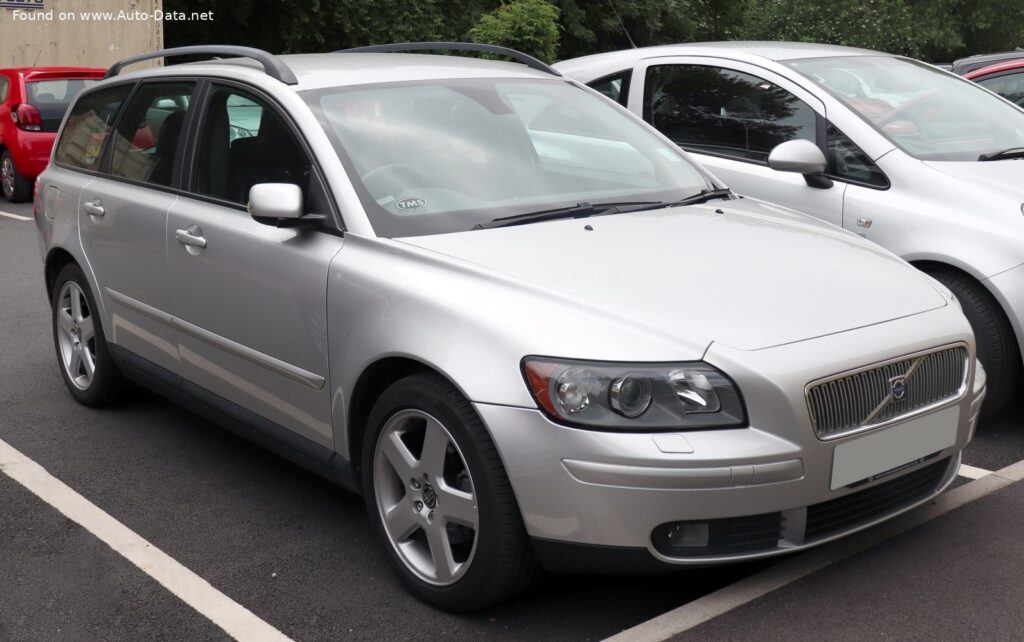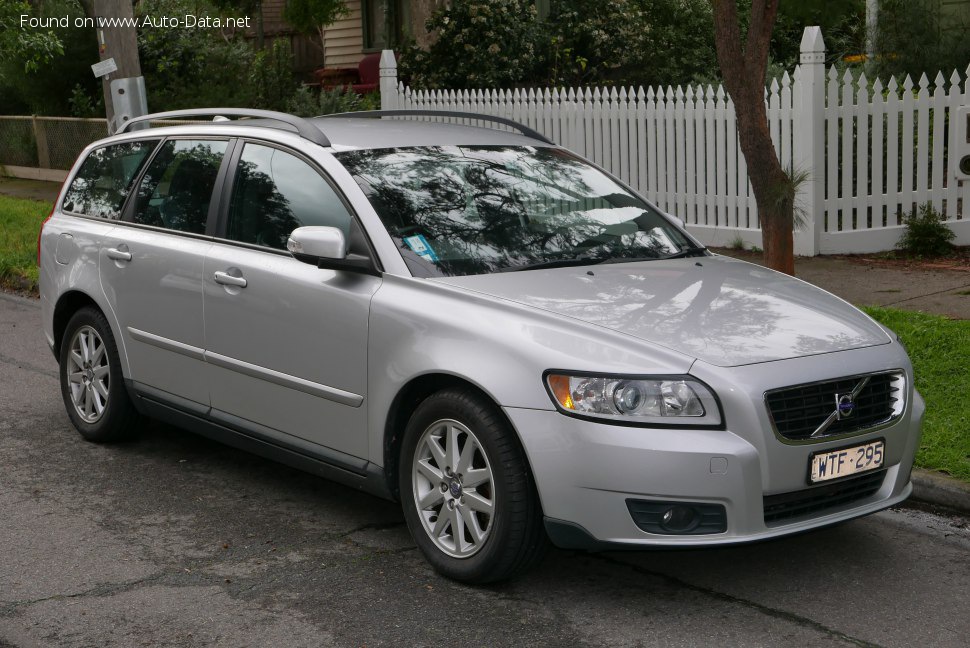
Introduction to the Volvo V50 (facelift 2007)
The Volvo V50, a compact executive car, represented Volvo’s strong presence in the premium compact segment, particularly in its estate (wagon) body style. Introduced in 2004, the V50 shared its underpinnings with the Ford C1 platform, a robust architecture also utilized by the Ford Focus and Mazda 3. This strategic collaboration allowed Volvo to leverage shared engineering while maintaining its distinct brand identity centered on safety, understated Scandinavian design, and practical luxury. The model under consideration is the Volvo V50 (facelift 2007), specifically the 2.0 F (145 Hp) Flex Fuel variant, produced between 2009 and 2012. This particular iteration benefited from the mid-cycle refresh introduced in 2007, which brought subtle exterior enhancements, updated interior features, and refined powertrain options.
The V50 was designed to appeal to buyers seeking the versatility of a station wagon combined with the driving dynamics and premium feel typically associated with larger, more expensive sedans. Its compact footprint made it highly suitable for European urban environments, while its spacious interior and cargo capacity catered to families and individuals with active lifestyles. The inclusion of a Flex Fuel engine option, capable of running on E85 ethanol blend or conventional gasoline, highlighted Volvo’s commitment to exploring alternative fuels and offering more environmentally conscious choices to its European clientele, albeit within the context of a developing E85 infrastructure. The Volvo V50 (facelift 2007) 2.0 F Flex Fuel stood as a testament to Volvo’s ability to blend practicality, safety, and a touch of eco-consciousness into a compelling package.
Powertrain and Performance of the Volvo V50 (facelift 2007)
The 2.0 F Flex Fuel Engine
At the heart of this particular Volvo V50 variant is a 2.0-liter (1999 cm3 or 121.99 cu. in.) naturally aspirated inline-four engine, designated by Volvo as the B4204S3. This robust powerplant delivers a respectable 145 horsepower at 6000 rpm, providing ample motivation for the compact wagon. Torque output stands at 136.45 lb-ft (185 Nm) at 4500 rpm, ensuring a responsive feel across the mid-range. The engine features a DOHC (Double Overhead Camshaft) valvetrain with four valves per cylinder, optimizing airflow for efficient combustion. Fuel is delivered via a multi-port manifold injection system, a proven and reliable technology. With a compression ratio of 10.8:1, the engine is tuned for a balance of performance and efficiency.
A key characteristic of this engine is its Flex Fuel capability, allowing it to operate on either gasoline or E85 ethanol fuel, or any mixture of the two. E85, an ethanol blend containing up to 85% ethanol and 15% gasoline, offers the potential for reduced greenhouse gas emissions compared to conventional gasoline. While E85 generally provides a slight boost in octane, it also has a lower energy density, meaning fuel economy typically decreases when running on E85. The stated combined fuel economy for this V50 is 30.5 US mpg (7.7 l/100 km), which would typically be achieved when running on gasoline. When utilizing E85, drivers could expect a noticeable reduction in mpg. This Flex Fuel option was particularly relevant in markets where E85 was promoted as an alternative fuel, reflecting Volvo’s broader environmental strategy.
Driving Dynamics
Power from the 2.0 F engine is transmitted to the front wheels via a precise 5-speed manual transmission, offering an engaging driving experience for those who prefer to select their own gears. The front-wheel-drive architecture contributes to predictable handling and traction, especially in adverse weather conditions. Performance figures for the V50 2.0 F Flex Fuel are solid for its class: it accelerates from 0 to 60 mph in a brisk 9.1 seconds (0-100 km/h in 9.6 seconds) and can reach a top speed of 130.49 mph (210 km/h).
The V50’s handling characteristics are a direct benefit of its C1 platform origins. It features an independent McPherson strut front suspension with coil springs and an anti-roll bar, providing responsive steering and good body control. At the rear, an independent multi-link spring suspension with a stabilizer bar further enhances ride comfort and stability. This sophisticated suspension setup ensures a refined ride quality while maintaining agile handling. Braking is handled by ventilated discs at the front and solid discs at the rear, complemented by an Anti-lock Braking System (ABS) for enhanced stopping power and control. The electric power steering system offers precise feedback and easy maneuverability, especially at lower speeds, making urban driving a less strenuous affair.
Design, Ergonomics, and Features
Exterior and Interior Design
The Volvo V50 (facelift 2007) embodies Volvo’s characteristic Scandinavian design philosophy – clean, elegant, and functional. As a station wagon (often referred to as an “estate” in Europe), its five-door body style is inherently practical, offering easy access to both passenger and cargo areas. The 2007 facelift brought subtle refinements to the V50’s exterior, including revised front and rear bumpers, updated grille, and new headlamp and taillight designs, giving it a fresher, more contemporary look without straying from its established aesthetic. With a length of 178.03 inches, a width of 69.69 inches (79.61 inches including mirrors), and a height of 57.36 inches, the V50 strikes an excellent balance between a compact footprint and substantial interior space.
Inside, the V50 continued Volvo’s tradition of ergonomic excellence and high-quality materials. The five-seat cabin is thoughtfully designed, prioritizing comfort and intuitive controls. A standout feature was the slim, “floating” center console, a design element that debuted in the larger S40/V50 models and became a signature Volvo interior characteristic. This console freed up space behind it for additional storage, enhancing practicality. Cargo capacity is a strong suit for any wagon, and the V50 delivers with a minimum trunk space of 14.73 cubic feet (417 liters), which expands significantly to 46.16 cubic feet (1307 liters) with the rear seats folded down. This versatility made the V50 an ideal choice for hauling luggage, sports equipment, or everyday groceries.
Safety and Technology
Volvo has long been synonymous with automotive safety, and the V50 is no exception. Built upon the robust C1 platform, the V50 features a strong safety cell designed to protect occupants in the event of a collision. Standard safety equipment includes a comprehensive array of airbags, anti-lock brakes (ABS), and a sophisticated body structure engineered to absorb and dissipate crash forces effectively. While the V50 was produced before the widespread adoption of advanced driver-assistance systems (ADAS) like autonomous emergency braking or lane-keeping assist, it offered the state-of-the-art passive safety features for its era, ensuring a high level of occupant protection.
Beyond its foundational safety, the V50 offered a range of convenience and comfort features. Electric power steering made for effortless maneuvering, and the overall interior ambiance was one of quiet competence. The sound system, climate control, and other interfaces were designed for ease of use, reflecting Volvo’s user-centric approach. The availability of various tire and wheel sizes (from 195/65 R15 to 215/45 R18) allowed buyers to customize the vehicle’s aesthetics and handling characteristics to their preference.
Technical Specifications: Volvo V50 (facelift 2007) 2.0 F Flex Fuel
| Category | Specification | Value (US Units) |
|---|---|---|
| General Information | ||
| Brand | Volvo | N/A |
| Model | V50 | N/A |
| Generation | V50 (facelift 2007) | N/A |
| Type (Engine) | 2.0 F (145 Hp) Flex Fuel | N/A |
| Start of production | 2009 year | N/A |
| End of production | 2012 year | N/A |
| Powertrain Architecture | Internal Combustion engine | N/A |
| Body type | Station wagon (estate) | N/A |
| Seats | 5 | N/A |
| Doors | 5 | N/A |
| Performance Specs | ||
| Fuel consumption (economy) – urban (NEDC) | 10.9 l/100 km | 21.6 US mpg |
| Fuel consumption (economy) – extra urban (NEDC) | 5.8 l/100 km | 40.6 US mpg |
| Fuel consumption (economy) – combined (NEDC) | 7.7 l/100 km | 30.5 US mpg |
| CO2 emissions (NEDC) | 183 g/km | N/A |
| Fuel Type | Petrol / Ethanol – E85 | N/A |
| Acceleration 0 – 60 mph | 9.1 sec | N/A |
| Maximum speed | 210 km/h | 130.49 mph |
| Emission standard | Euro 4 | N/A |
| Weight-to-power ratio | 8.9 kg/Hp | 112 Hp/tonne |
| Weight-to-torque ratio | 7 kg/Nm | 142.9 Nm/tonne |
| Engine Specs | ||
| Power | 145 Hp @ 6000 rpm | N/A |
| Power per liter | 72.5 Hp/l | N/A |
| Torque | 185 Nm @ 4500 rpm | 136.45 lb.-ft. @ 4500 rpm |
| Engine layout | Front, Transverse | N/A |
| Engine Model/Code | B4204S3 | N/A |
| Engine displacement | 1999 cm3 | 121.99 cu. in. |
| Number of cylinders | 4 | N/A |
| Engine configuration | Inline | N/A |
| Cylinder Bore | 87.5 mm | 3.44 in. |
| Piston Stroke | 83.1 mm | 3.27 in. |
| Compression ratio | 10.8:1 | N/A |
| Number of valves per cylinder | 4 | N/A |
| Fuel injection system | Multi-port manifold injection | N/A |
| Engine aspiration | Naturally aspirated engine | N/A |
| Valvetrain | DOHC | N/A |
| Engine oil capacity | 4.3 l | 4.54 US qt |
| Coolant | 7.5 l | 7.93 US qt |
| Space, Volume and Weights | ||
| Kerb Weight | 1295 kg | 2854.99 lbs. |
| Max. weight | 1890 kg | 4166.74 lbs. |
| Max load | 595 kg | 1311.75 lbs. |
| Trunk (boot) space – minimum | 417 l | 14.73 cu. ft. |
| Trunk (boot) space – maximum | 1307 l | 46.16 cu. ft. |
| Fuel tank capacity | 62 l | 16.38 US gal |
| Max. roof load | 75 kg | 165.35 lbs. |
| Permitted trailer load with brakes (12%) | 1350 kg | 2976.24 lbs. |
| Permitted trailer load without brakes | 650 kg | 1433 lbs. |
| Permitted towbar download | 75 kg | 165.35 lbs. |
| Dimensions | ||
| Length | 4522 mm | 178.03 in. |
| Width | 1770 mm | 69.69 in. |
| Width including mirrors | 2022 mm | 79.61 in. |
| Height | 1457 mm | 57.36 in. |
| Wheelbase | 2640 mm | 103.94 in. |
| Front track | 1535 mm | 60.43 in. |
| Rear (Back) track | 1531 mm | 60.28 in. |
| Minimum turning circle (turning diameter) | 10.6 m | 34.78 ft. |
| Drivetrain, Brakes and Suspension Specs | ||
| Drivetrain Architecture | The Internal combustion engine (ICE) drives the front wheels of the vehicle. | |
| Drive wheel | Front wheel drive | N/A |
| Number of gears and type of gearbox | 5 gears, manual transmission | N/A |
| Front suspension | Independent, type McPherson with coil spring and anti-roll bar | |
| Rear suspension | Independent multi-link spring suspension with stabilizer | |
| Front brakes | Ventilated discs | N/A |
| Rear brakes | Disc | N/A |
| Assisting systems | ABS (Anti-lock braking system) | N/A |
| Steering type | Steering rack and pinion | N/A |
| Power steering | Electric Steering | N/A |
| Tires size | 195/65 R15; 205/55 R16; 205/50 R17; 215/45 R18 | |
| Wheel rims size | 6J x 15; 6.5J x 16; 7J x 17; 7.5J x 18 | |
Legacy and Market Impact of the Volvo V50
A Niche in the Premium Compact Segment
The Volvo V50 carved out