<!DOCTYPE html>
<html lang=”en”>
<head>
<meta charset=”UTF-8″>
<meta name=”viewport” content=”width=device-width, initial-scale=1.0″>
<title>Peugeot 207 SW (facelift 2009) 1.6 HDi (90 Hp)</title>
<style>
body { font-family: Arial, sans-serif; line-height: 1.6; margin: 20px; }
h2, h3 { color: #333; }
table { width: 100%; border-collapse: collapse; margin-top: 20px; }
th, td { border: 1px solid #ddd; padding: 8px; text-align: left; }
th { background-color: #f2f2f2; }
</style>
</head>
<body>
<h2>The Peugeot 207 SW (facelift 2009) 1.6 HDi (90 Hp): A Practical European Compact</h2>
<p>
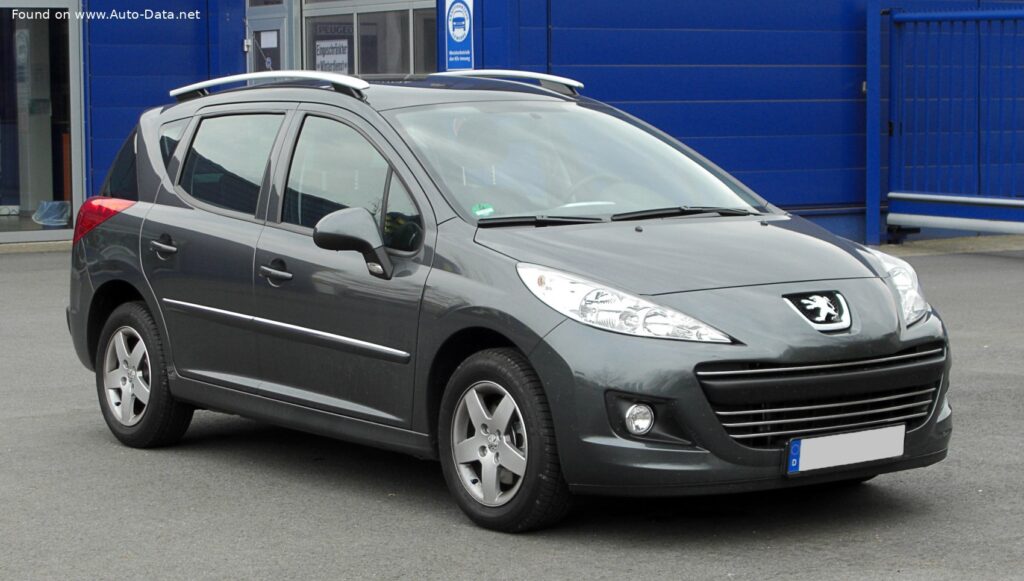
The <strong>Peugeot 207 SW (facelift 2009) 1.6 HDi (90 Hp)</strong> represents a key offering in the European compact segment, specifically designed to blend the agility of a small car with the enhanced practicality of a station wagon body style. Introduced in 2009 as a refreshed version of the popular 207 generation, this model targeted families and individuals seeking a versatile, fuel-efficient vehicle for urban and highway driving. While never officially sold in the United States, the 207 SW played a significant role in Peugeot’s strategy to capture market share in Europe, where compact station wagons, often referred to as “estates,” are highly valued for their utility and modest footprint. The 2009 facelift brought subtle enhancements, keeping the 207 SW competitive until its production concluded in 2013. This particular variant, powered by the 1.6-liter HDi diesel engine, exemplified the European preference for economical and torquey diesel powertrains.
</p>
<h3>Engine and Performance: The Efficient 1.6 HDi</h3>
<p>
At the heart of the <strong>Peugeot 207 SW (facelift 2009)</strong> lies the venerable 1.6 HDi diesel engine, a powerplant renowned in Europe for its balance of efficiency and usable performance. This inline four-cylinder, 1.6-liter (1560 cm³ or 95.2 cu. in.) unit utilizes a DOHC valvetrain with four valves per cylinder, ensuring efficient air intake and exhaust. Its high-pressure common rail fuel injection system, combined with a turbocharger and intercooler, delivers a robust 90 horsepower at 4000 rpm. More importantly for daily driving, the engine produces a substantial 158.58 lb.-ft. (215 Nm) of torque, available at a low 1750 rpm. This characteristic low-end torque is a hallmark of modern diesel engines, providing strong acceleration from a standstill and effortless cruising, even when the vehicle is loaded.
</p>
<p>
Mated to a 5-speed manual transmission, the 1.6 HDi engine channels its power to the front wheels, a common and effective drivetrain architecture for compact vehicles. Performance figures reflect its practical orientation rather than outright speed; the <strong>Peugeot 207 SW (facelift 2009)</strong> accelerates from 0 to 60 mph in a respectable 11.2 seconds, with a top speed of 113.09 mph (182 km/h). Where this powertrain truly shines, however, is in its fuel economy. With an impressive combined fuel consumption rating of 52.3 US mpg (4.5 l/100 km), it offered remarkable efficiency, especially on longer journeys, where the extra-urban figure could reach up to 60.3 US mpg (3.9 l/100 km). This made it an economically appealing choice for European consumers facing higher fuel prices. Furthermore, its CO2 emissions of 119 g/km and Euro 4 emission standard compliance underscored Peugeot’s commitment to environmental considerations within the context of its time.
</p>
<h3>Design and Features: Practicality Meets French Flair</h3>
<p>
The <strong>Peugeot 207 SW (facelift 2009)</strong> adopted a 5-door station wagon body type, distinguishing itself from the standard 207 hatchback by offering significantly increased cargo capacity and rear passenger comfort. Its overall length of 163.94 inches (4164 mm), width of 68.82 inches (1748 mm), and height of 60.12 inches (1527 mm) provided a compact yet spacious footprint. The 2009 facelift typically involved subtle exterior revisions, such as updated front fascias with redesigned grilles and bumper elements, new headlight and taillight graphics, and potentially refreshed wheel designs, all aimed at giving the car a more contemporary look without altering its fundamental structure.
</p<
<p>
Inside, the 207 SW offered seating for five occupants, with a focus on practicality and user-friendliness. The true benefit of the station wagon design was evident in its cargo versatility. With the rear seats in place, the trunk provided a useful 11.9 cubic feet (337 liters) of space. Folding the rear seats down dramatically expanded this to a cavernous 44.43 cubic feet (1258 liters), making it capable of accommodating larger items or luggage for extended trips. This flexibility was a key selling point in markets where space efficiency is paramount.
</p>
<p>
From a chassis and safety perspective, the 207 SW was well-equipped for its class. It featured an independent McPherson strut front suspension and a semi-independent, coil spring rear suspension, providing a comfortable and stable ride characteristic of French cars. Braking was handled by ventilated discs at the front and solid discs at the rear, augmented by an Anti-lock Braking System (ABS) for enhanced stopping power and control. Electric power steering offered light and responsive handling, particularly beneficial in urban environments with its tight minimum turning circle of 34.78 feet (10.6 meters). The car rode on 195/55 R16 tires mounted on 16-inch wheel rims, striking a good balance between ride comfort and road holding. While specific luxury features varied by trim, typical amenities for this segment and era included air conditioning, power windows, and a decent audio system, all contributing to a pleasant driving experience.
</p>
<h3>Technical Specifications</h3>
<table>
<thead>
<tr>
<th>Category</th>
<th>Specification</th>
</tr>
</thead>
<tbody>
<tr><td colspan=”2″><strong>General Information</strong></td></tr>
<tr><td>Brand</td><td>Peugeot</td></tr>
<tr><td>Model</td><td>207 SW (facelift 2009)</td></tr>
<tr><td>Engine Type</td><td>1.6 HDi (90 Hp)</td></tr>
<tr><td>Production Start</td><td>2009 year</td></tr>
<tr><td>Production End</td><td>2013 year</td></tr>
<tr><td>Body Type</td><td>Station wagon (estate)</td></tr>
<tr><td>Seats / Doors</td><td>5 / 5</td></tr>
<tr><td colspan=”2″><strong>Performance Specs</strong></td></tr>
<tr><td>Fuel Consumption (Urban)</td><td>41.3 US mpg (5.7 l/100 km)</td></tr>
<tr><td>Fuel Consumption (Extra Urban)</td><td>60.3 US mpg (3.9 l/100 km)</td></tr>
<tr><td>Fuel Consumption (Combined)</td><td>52.3 US mpg (4.5 l/100 km)</td></tr>
<tr><td>CO2 Emissions</td><td>119 g/km</td></tr>
<tr><td>Fuel Type</td><td>Diesel</td></tr>
<tr><td>Acceleration 0-60 mph</td><td>11.2 sec</td></tr>
<tr><td>Maximum Speed</td><td>113.09 mph (182 km/h)</td></tr>
<tr><td>Emission Standard</td><td>Euro 4</td></tr>
<tr><td>Weight-to-Power Ratio</td><td>14 kg/Hp, 71.2 Hp/tonne</td></tr>
<tr><td colspan=”2″><strong>Engine Specs</strong></td></tr>
<tr><td>Power</td><td>90 Hp @ 4000 rpm</td></tr>
<tr><td>Torque</td><td>158.58 lb.-ft. (215 Nm) @ 1750 rpm</td></tr>
<tr><td>Engine Layout</td><td>Front, Transverse</td></tr>
<tr><td>Engine Displacement</td><td>1.6 Liters (1560 cm³ / 95.2 cu. in.)</td></tr>
<tr><td>Number of Cylinders</td><td>4, Inline</td></tr>
<tr><td>Cylinder Bore</td><td>2.95 in. (75 mm)</td></tr>
<tr><td>Piston Stroke</td><td>3.48 in. (88.3 mm)</td></tr>
<tr><td>Compression Ratio</td><td>17.6:1</td></tr>
<tr><td>Valves per Cylinder</td><td>4</td></tr>
<tr><td>Fuel Injection System</td><td>Diesel Commonrail</td></tr>
<tr><td>Engine Aspiration</td><td>Turbocharger, Intercooler</td></tr>
<tr><td>Valvetrain</td><td>DOHC</td></tr>
<tr><td>Engine Oil Capacity</td><td>3.96 US qt (3.75 l)</td></tr>
<tr><td>Coolant Capacity</td><td>5.92 US qt (5.6 l)</td></tr>
<tr><td colspan=”2″><strong>Dimensions, Space, and Weights</strong></td></tr>
<tr><td>Length</td><td>163.94 in. (4164 mm)</td></tr>
<tr><td>Width</td><td>68.82 in. (1748 mm)</td></tr>
<tr><td>Height</td><td>60.12 in. (1527 mm)</td></tr>
<tr><td>Wheelbase</td><td>100 in. (2540 mm)</td></tr>
<tr><td>Front Track</td><td>57.76 in. (1467 mm)</td></tr>
<tr><td>Rear Track</td><td>57.52 in. (1461 mm)</td></tr>
<tr><td>Kerb Weight</td><td>2786.64 lbs. (1264 kg)</td></tr>
<tr><td>Maximum Weight</td><td>3814 lbs. (1730 kg)</td></tr>
<tr><td>Maximum Load</td><td>1027.35 lbs. (466 kg)</td></tr>
<tr><td>Trunk Space (Min/Max)</td><td>11.9 – 44.43 cu. ft. (337 – 1258 l)</td></tr>
<tr><td>Fuel Tank Capacity</td><td>13.21 US gal (50 l)</td></tr>
<tr><td>Permitted Trailer Load (with/without brakes)</td><td>2535.32 lbs. (1150 kg) / 1322.77 lbs. (600 kg)</td></tr>
<tr><td>Drag Coefficient (Cd)</td><td>0.3</td></tr>
<tr><td>Minimum Turning Circle</td><td>34.78 ft. (10.6 m)</td>&