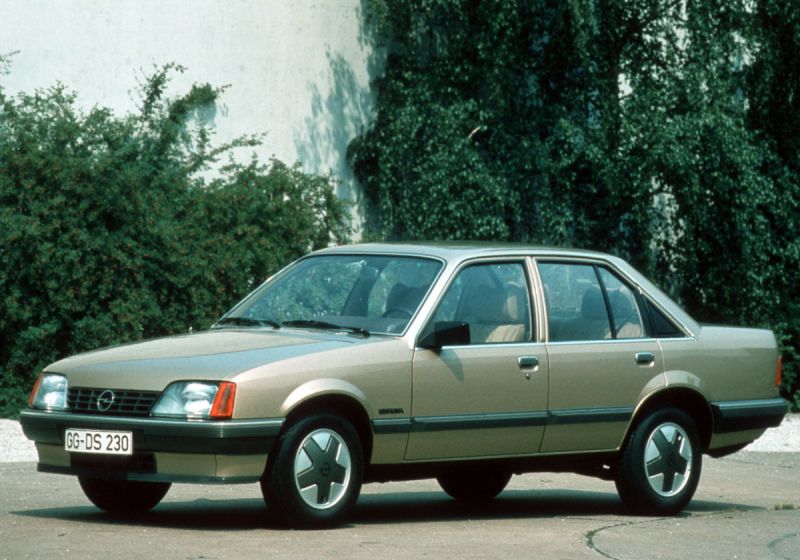
The Opel Rekord E (facelift 1982) 2.2 E (115 Hp): A European Workhorse of the Mid-Eighties
The Opel Rekord E, particularly its facelifted version introduced in 1982, represents a significant chapter in European automotive history. As a cornerstone of Opel’s lineup, a brand under the General Motors (GM) umbrella, the Rekord served as a robust, mid-size family car, a staple on European roads for decades. The specific variant, the Rekord E (facelift 1982) 2.2 E (115 Hp), was produced from September 1984 to August 1986. This iteration, a four-door sedan, embodies the conventional yet reliable engineering philosophy that defined Opel during this era. While never officially sold in the United States, the Rekord was a hugely popular and recognizable vehicle across Europe, offering a blend of practical space, dependable performance, and traditional rear-wheel-drive dynamics that appealed to a broad customer base, from families to business users.
Engine and Performance: The Heart of the Opel Rekord E (facelift 1982)
At the core of the Opel Rekord E (facelift 1982) 2.2 E lies its 2.2-liter (2197 cm3) inline-four gasoline engine, designated by the code 22E. This naturally aspirated unit was a testament to Opel’s commitment to delivering a balance of power and efficiency for its mainstream models. With a single overhead camshaft (SOHC) valvetrain and two valves per cylinder, the engine produced a respectable 115 horsepower at 4800 rpm. This power output, combined with a healthy torque figure of 134.24 lb.-ft. available at a relatively low 2800 rpm, provided ample grunt for daily driving and highway cruising. The multi-port manifold injection system was a modern touch for the mid-1980s, contributing to smoother power delivery and improved fuel efficiency compared to earlier carbureted versions.
Power was channeled to the rear wheels via a five-speed manual transmission, a configuration that offered an engaging driving experience and good control over the vehicle’s performance. The Rekord E 2.2 E could accelerate from 0 to 60 mph in a brisk 10 seconds, reaching a maximum speed of 116.2 mph. These figures were competitive for a family sedan of its time, demonstrating its capability to handle both urban commutes and longer journeys with confidence. Fuel economy was also a strong point for its class, with a combined rating of 28.3 US mpg, making it an economical choice for European drivers facing rising fuel costs. The Rekord E’s powertrain architecture, featuring a front, longitudinal engine layout and rear-wheel drive, underscored its traditional engineering, offering predictable handling characteristics that many drivers appreciated.
Design and Features: Practicality Meets Mid-Eighties Style
The Opel Rekord E (facelift 1982) presented a design that was both functional and aesthetically aligned with the automotive trends of the early to mid-1980s. As a four-door sedan, it prioritized interior space and practicality for up to five occupants. The facelift brought about a more aerodynamic and contemporary appearance, characterized by smoother lines and a drag coefficient (Cd) of 0.36 – a commendable figure for a vehicle of its size and era, contributing to both fuel efficiency and reduced wind noise at higher speeds. Its dimensions, measuring 183.15 inches in length, 67.95 inches in width, and 55.91 inches in height, with a generous 105.04-inch wheelbase, ensured a substantial road presence and a stable ride.
Inside, the Rekord E offered a straightforward and ergonomic cabin. The focus was on durability and ease of use, with controls logically placed. The trunk space was a generous 17.3 cubic feet, making the Rekord a practical choice for families requiring ample cargo capacity for vacations or shopping. From a mechanical standpoint, the Rekord E featured an independent McPherson strut front suspension, providing a good balance of comfort and handling precision. The rear suspension utilized coil springs, a reliable setup for absorbing road imperfections. Braking duties were handled by ventilated discs at the front, offering effective stopping power, while traditional drum brakes were employed at the rear. A significant safety feature for its time was the availability of an Anti-lock Braking System (ABS), which greatly enhanced vehicle control during emergency braking situations. Hydraulic power steering made maneuvering the Rekord E effortless, especially in urban environments with its respectable minimum turning circle of 35.43 feet.
Technical Specifications
| Category | Specification |
|---|---|
| Brand | Opel |
| Model | Rekord E (facelift 1982) |
| Type (Engine) | 2.2 E (115 Hp) |
| Production Start | September, 1984 |
| Production End | August, 1986 |
| Body Type | Sedan |
| Seats | 5 |
| Doors | 4 |
| Fuel Type | Petrol (Gasoline) |
| Fuel Consumption (Combined) | 8.3 l/100 km (28.3 US mpg) |
| Acceleration 0-60 mph | 10 seconds |
| Maximum Speed | 187 km/h (116.2 mph) |
| Power | 115 Hp @ 4800 rpm |
| Torque | 182 Nm (134.24 lb.-ft.) @ 2800 rpm |
| Engine Layout | Front, Longitudinal |
| Engine Model/Code | 22E |
| Engine Displacement | 2197 cm3 (134.07 cu. in.) |
| Number of Cylinders | 4, Inline |
| Compression Ratio | 9.4:1 |
| Valves per Cylinder | 2 |
| Fuel Injection System | Multi-port manifold injection |
| Engine Aspiration | Naturally aspirated |
| Valvetrain | SOHC |
| Engine Oil Capacity | 3.8 l (4.02 US qt) |
| Coolant Capacity | 10 l (10.57 US qt) |
| Kerb Weight | 1125 kg (2480.2 lbs) |
| Max. Weight | 1685 kg (3714.79 lbs) |
| Max Load | 560 kg (1234.59 lbs) |
| Trunk (Boot) Space – Minimum | 490 l (17.3 cu. ft.) |
| Fuel Tank Capacity | 65 l (17.17 US gal) |
| Length | 4652 mm (183.15 in.) |
| Width | 1726 mm (67.95 in.) |
| Height | 1420 mm (55.91 in.) |
| Wheelbase | 2668 mm (105.04 in.) |
| Front Track | 1435 mm (56.5 in.) |
| Rear Track | 1412 mm (55.59 in.) |
| Ride Height (Ground Clearance) | 140 mm (5.51 in.) |
| Drag Coefficient (Cd) | 0.36 |
| Minimum Turning Circle | 10.8 m (35.43 ft.) |
| Drivetrain Architecture | Internal Combustion engine drives the rear wheels |
| Drive Wheel | Rear wheel drive |
| Gearbox Type | 5 gears, manual transmission |
| Front Suspension | Independent type McPherson |
| Rear Suspension | Coil spring |
| Front Brakes | Ventilated discs |
| Rear Brakes | Drum |
| Assisting Systems | ABS (Anti-lock braking system) |
| Power Steering | Hydraulic Steering |
Legacy and Market Impact of the Opel Rekord E (facelift 1982)
The Opel Rekord E (facelift 1982) 2.2 E (115 Hp) holds a significant place in the narrative of European automotive history, representing the twilight of a long-standing tradition for Opel. The Rekord series, through its many generations, was renowned for its robustness, reliability, and straightforward engineering. This particular E-generation facelift, especially its 2.2 E variant, was praised for its refined engine, decent performance, and improved aerodynamics, which kept it competitive in a rapidly evolving market.
In its primary European market, the Rekord E faced stiff competition from a diverse array of rivals. Key competitors included other mainstream European family sedans like the Ford Sierra, which introduced more radical aerodynamic styling, and the Volkswagen Passat, known for its practicality and front-wheel-drive architecture. French contenders such as the Peugeot 505 and Renault 20/25 also vied for market share, offering different takes on comfort and style. While not directly competing with premium German brands like BMW (3-Series E30, 5-Series E28) or Mercedes-Benz (190E W201), the Rekord did offer a more affordable, yet still competent, alternative for buyers who valued traditional rear-wheel-drive dynamics and solid build quality without the premium price tag.
The Rekord E was the last of its lineage to feature a conventional rear-wheel-drive layout. Its successor, the Opel Omega, introduced in 1986, marked a significant shift to a more modern design philosophy, including a more aerodynamic body and, eventually, the option of front-wheel drive in some configurations (though the Omega A retained RWD). This makes the Rekord E a classic example of a transitional vehicle, bridging the gap between Opel’s traditional, rugged past and its more contemporary, efficient future. Its enduring reputation for dependability ensured that many Rekord E models remained on European roads for decades after their production ceased, serving as a testament to their solid construction and practical design. Today, the Opel Rekord E is remembered fondly as a workhorse that capably served millions of European families and businesses, embodying the honest, no-frills automotive engineering of its era.