Introduction to the Peugeot 207 SW (facelift 2009) 1.6 HDi (92 Hp)
The Peugeot 207 SW (facelift 2009) 1.6 HDi (92 Hp) represents a significant offering in the highly competitive European compact segment, specifically targeting the practical-minded consumer. Introduced as part of the 207’s mid-cycle refresh in 2009, this station wagon variant, known as an “estate” in Europe, built upon the success of the popular 207 hatchback by offering enhanced cargo capacity and versatility without significantly increasing its footprint. Produced from 2009 to 2013, this particular iteration featured Peugeot’s widely utilized and efficient 1.6-liter HDi (High-Pressure Direct Injection) diesel engine, delivering 92 horsepower.
In its primary European market, the 207 SW was positioned as an accessible and economical family car, ideal for navigating both congested city streets and longer highway journeys. Its powertrain architecture, based on an internal combustion engine driving the front wheels, combined with a manual transmission, emphasized fuel efficiency and ease of maintenance—key attributes for its target demographic. The facelift brought subtle but effective styling updates and minor interior refinements, keeping the 207 SW fresh against a backdrop of evolving competition. This model exemplifies Peugeot’s long-standing commitment to producing practical, stylish, and efficient vehicles for the masses, particularly excelling in the compact car category where diesel engines often hold a dominant position due to their superior fuel economy.
Engine and Performance of the Peugeot 207 SW (facelift 2009) 1.6 HDi (92 Hp)
At the heart of the Peugeot 207 SW (facelift 2009) 1.6 HDi (92 Hp) lies a robust and well-regarded 1.6-liter (1560 cm3 or 95.2 cu. in.) inline four-cylinder diesel engine. Codenamed 9HP DV6DTED, this powerplant is a testament to Peugeot’s expertise in diesel technology, featuring a common rail fuel injection system, a turbocharger, and an intercooler. These technologies work in concert to optimize combustion efficiency and power delivery, making it a highly practical choice for everyday driving.
Powertrain Architecture and Drivetrain
The engine produces a respectable 92 horsepower at 4000 revolutions per minute (rpm), providing adequate motivation for the compact station wagon. More critically for a diesel, it generates a substantial 230 Nm (169.64 lb.-ft.) of torque at a low 1750 rpm. This ample low-end torque is crucial for effortless acceleration from a standstill, confident overtaking maneuvers, and comfortable cruising, especially when the vehicle is laden with passengers or cargo. The power is efficiently transmitted to the front wheels via a smooth-shifting 5-speed manual transmission, a common and reliable setup for vehicles in this segment.
Performance figures reflect its utilitarian purpose: the 207 SW 1.6 HDi accelerates from 0 to 60 mph in a calculated 11.7 seconds, with 0-100 km/h taking 12.3 seconds. Its maximum speed is 113.09 mph (182 km/h). While not a performance car, these figures are perfectly adequate for typical European driving conditions. The vehicle’s weight-to-power ratio stands at 13.6 kg/Hp (73.8 Hp/tonne), and its weight-to-torque ratio is an impressive 5.4 kg/Nm (184.4 Nm/tonne), underscoring the diesel engine’s inherent strength.
Fuel Efficiency and Emissions
One of the standout features of this powertrain is its exceptional fuel economy. The 207 SW 1.6 HDi achieves a combined fuel consumption of 4.4 liters per 100 km, translating to an impressive 53.5 US mpg. Urban driving yields 5.5 l/100 km (42.8 US mpg), while extra-urban cycles see consumption drop to just 3.7 l/100 km (63.6 US mpg). These figures highlight the economic benefits of diesel power, particularly in markets where diesel fuel is prevalent. Furthermore, with CO2 emissions of 114 g/km, the vehicle met the stringent Euro 5 emission standard, reflecting its relatively clean operation for its era, aided by a standard particulate filter. This combination of robust performance, outstanding fuel economy, and compliance with environmental standards made the 207 SW 1.6 HDi a highly attractive proposition for cost-conscious and environmentally aware buyers in Europe.
Design and Features of the Peugeot 207 SW (facelift 2009)
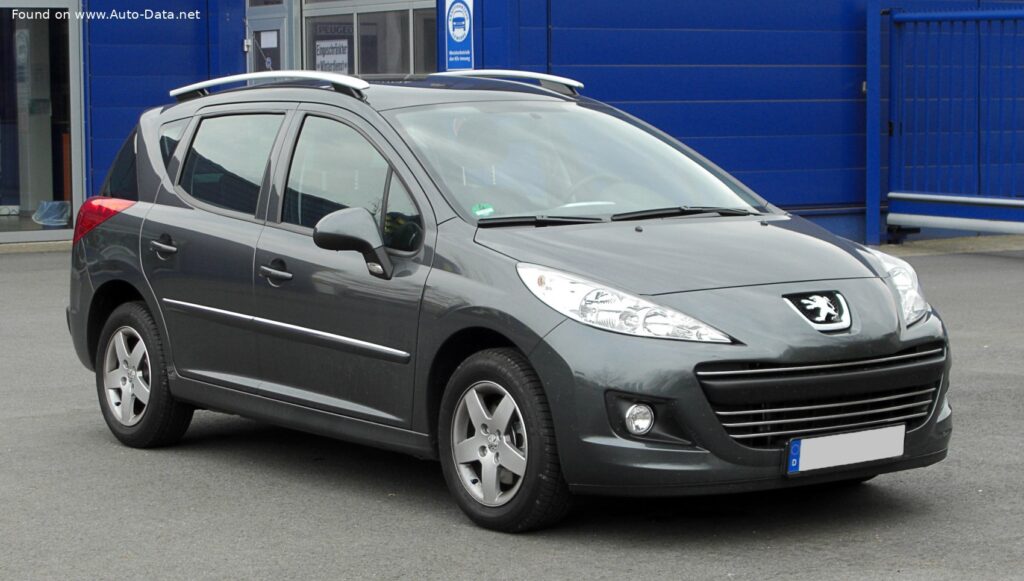
The Peugeot 207 SW (facelift 2009) maintained the distinctive styling cues of the 207 range while incorporating the practical advantages of a station wagon body. Its design, characterized by a rounded, friendly front fascia and a more elongated rear profile, was well-suited to the European aesthetic, blending functionality with a touch of French flair.
Exterior Styling and Practicality
As a 5-door station wagon, the 207 SW was designed with practicality at its forefront. The facelift in 2009 brought subtle enhancements, typically including revised front grilles, updated headlamps and taillamps, and new wheel designs, all aimed at giving the car a fresher, more contemporary look without straying from its established identity. Measuring 163.94 inches (4164 mm) in length, 68.82 inches (1748 mm) in width (77.64 inches or 1972 mm including mirrors), and 60.12 inches (1527 mm) in height, the 207 SW remained compact enough to be agile in urban environments. Its 100-inch (2540 mm) wheelbase contributed to a stable ride, while a minimum turning circle of 34.78 feet (10.6 meters) ensured excellent maneuverability in tight spaces. The vehicle rode on 195/55 R16 tires, mounted on 16-inch wheel rims, providing a good balance of comfort and grip.
Interior and Cargo Versatility
Inside, the 207 SW provided comfortable seating for five occupants. The interior design of the facelifted model typically saw minor upgrades to materials and trim, enhancing the perceived quality and ergonomics. However, the true strength of the SW variant lay in its cargo capacity. With the rear seats in place, the trunk offered a respectable 11.9 cubic feet (337 liters) of space. When the rear seats were folded down, this expanded significantly to a generous 44.43 cubic feet (1258 liters), transforming the compact wagon into a highly capable hauler. This versatility made it an attractive option for families, individuals with active lifestyles, or those who frequently transported larger items.
Standard features for the era included essential safety systems such as ABS (Anti-lock Braking System) and a front-wheel-drive architecture. The vehicle utilized an independent McPherson type front suspension and a semi-independent, coil spring rear suspension, designed to provide a comfortable ride and predictable handling. Braking was handled by ventilated discs at the front and disc brakes at the rear. Electric power steering, a rack and pinion system, offered light and responsive steering, further aiding urban driving. With a curb weight of 2749.16 lbs (1247 kg) and a maximum permissible weight of 3902.18 lbs (1770 kg), the 207 SW also boasted a respectable maximum load capacity of 1153.02 lbs (523 kg), and could tow a trailer with brakes up to 2535.32 lbs (1150 kg), further cementing its practical credentials.
Technical Specifications
| Category | Specification |
|---|---|
| General Information | |
| Brand | Peugeot |
| Model | 207 |
| Generation | 207 SW (facelift 2009) |
| Type (Engine) | 1.6 HDi (92 Hp) |
| Start of Production | 2009 year |
| End of Production | 2013 year |
| Powertrain Architecture | Internal Combustion engine |
| Body type | Station wagon (estate) |
| Seats | 5 |
| Doors | 5 |
| Performance Specs | |
| Fuel consumption (economy) – urban | 5.5 l/100 km (42.8 US mpg) |
| Fuel consumption (economy) – extra urban | 3.7 l/100 km (63.6 US mpg) |
| Fuel consumption (economy) – combined | 4.4 l/100 km (53.5 US mpg) |
| CO2 emissions | 114 g/km |
| Fuel Type | Diesel |
| Acceleration 0 – 60 mph | 11.7 sec |
| Acceleration 0 – 100 km/h | 12.3 sec |
| Maximum speed | 113.09 mph (182 km/h) |
| Emission standard | Euro 5 |
| Weight-to-power ratio | 13.6 kg/Hp, 73.8 Hp/tonne |
| Weight-to-torque ratio | 5.4 kg/Nm, 184.4 Nm/tonne |
| Engine Specs | |
| Power | 92 Hp @ 4000 rpm |
| Power per liter | 59 Hp/l |
| Torque | 230 Nm (169.64 lb.-ft.) @ 1750 rpm |
| Engine layout | Front, Transverse |
| Engine Model/Code | 9HP DV6DTED |
| Engine displacement | 1560 cm3 (95.2 cu. in.) |
| Number of cylinders | 4 |
| Engine configuration | Inline |
| Cylinder Bore | 75 mm (2.95 in.) |
| Piston Stroke | 88.3 mm (3.48 in.) |
| Compression ratio | 18:1 |
| Number of valves per cylinder | 2 |
| Fuel injection system | Diesel Commonrail |
| Engine aspiration | Turbocharger, Intercooler |
| Valvetrain | SOHC |
| Engine oil capacity | 3.75 l (3.96 US qt) |
| Coolant | 5.6 l (5.92 US qt) |
| Engine systems | Particulate filter |
| Space, Volume and Weights | |
| Kerb Weight | 1247 kg (2749.16 lbs) |
| Max. weight | 1770 kg (3902.18 lbs) |
| Max load | 523 kg (1153.02 lbs) |
| Trunk (boot) space – minimum | 337 l (11.9 cu. ft.) |
| Trunk (boot) space – maximum | 1258 l (44.43 cu. ft.) |
| Fuel tank capacity | 50 l (13.21 US gal) |
| Permitted trailer load with brakes (12%) | 1150 kg (2535.32 lbs) |
| Permitted trailer load without brakes | 600 kg (1322.77 lbs) |
| Dimensions | |
| Length | 4164 mm (163.94 in.) |
| Width | 1748 mm (68.82 in.) |
| Width with mirrors folded | 1818 mm (71.57 in.) |
| Width including mirrors | 1972 mm (77.64 in.) |
| Height | 1527 mm (60.12 in.) |
| Wheelbase | 2540 mm (100 in.) |
| Front track | 1467 mm (57.76 in.) |
| Rear (Back) track | 1461 mm (57.52 in.) |
| Minimum turning circle (turning diameter) | 10.6 m (34.78 ft) |
| Drivetrain, Brakes and Suspension Specs | |
| Drivetrain Architecture | The Internal combustion engine (ICE) drives the front wheels of the vehicle. |
| Drive wheel | Front wheel drive |
| Number of gears and type of gearbox | 5 gears, manual transmission |
| Front suspension | Independent type McPherson |
| Rear suspension | Semi-independent, coil spring |
| Front brakes | Ventilated discs |
| Rear brakes | Disc |
| Assisting systems | ABS (Anti-lock braking system) |
| Steering type | Steering rack and pinion |
| Power steering | Electric Steering |
| Tires size | 195/55 R16 |
| Wheel rims size | 16 |
Legacy and Market Impact in Europe
The Peugeot 207 SW (facelift 2009) 1.6 HDi (92 Hp) carved out a significant niche for itself in the highly competitive European compact segment. While never officially sold in the United States, its design and engineering principles resonated strongly with European consumers who prioritized practicality, fuel efficiency, and compact dimensions. Peugeot, with its long history of producing small and medium-sized vehicles, understood the nuances of this market better than most, and the 207 SW was a direct reflection of those insights.
The 207 SW’s reputation was built on its blend of utility and economy. Its station wagon body style offered a compelling alternative to larger, more expensive SUVs, providing comparable cargo volume in a more fuel-efficient and maneuverable package. For young families, urban dwellers needing versatile transport, or those seeking a cost-effective daily driver with ample space, the 207 SW proved to be an excellent choice. The 1.6 HDi diesel engine was particularly lauded for its outstanding fuel economy, a critical factor in European markets where fuel prices are consistently higher than in the U.S. and diesel powertrains are widely accepted and encouraged for their efficiency. Its Euro 5 compliance also positioned it as a relatively environmentally conscious option for the time.
In terms of competition, the 207 SW faced a formidable lineup of rivals in Europe. Key competitors included the Renault Clio Estate, Skoda Fabia Combi, and the wagon variants of the Ford Fiesta (European market) and Volkswagen Polo. Each offered similar propositions, but the 207 SW differentiated itself with its distinctive French styling, comfortable ride, and Peugeot’s established reputation for reliable diesel engines. Its robust build quality and practical features helped it maintain strong sales figures throughout its production run, contributing significantly to Peugeot’s overall market share in the compact segment.
The historical significance of the 207 SW lies in its role as a bridge between traditional compact hatchbacks and larger family vehicles. It successfully demonstrated that a compact car could offer substantial versatility without compromising on efficiency or ease of use. Its legacy is one of a practical, no-nonsense vehicle that fulfilled the diverse needs of European consumers, solidifying Peugeot’s position as a leader in innovative and accessible automotive solutions. Even after its production ceased in 2013, the principles embodied by the 207 SW—compact dimensions, flexible interior, and economical powertrains—continued to influence subsequent models in Peugeot’s lineup, ensuring its impact endures in the broader automotive landscape.