The Skoda Octavia III Combi (facelift 2017): A European Mainstay
The Skoda Octavia, a cornerstone of the Czech automaker’s lineup, has long been celebrated for its blend of practicality, value, and robust engineering, largely thanks to its integration within the Volkswagen Group. The third-generation Octavia, known internally as Typ 5E, received a significant facelift in 2017, further solidifying its position in the highly competitive European compact segment. This article focuses on the Skoda Octavia III Combi (facelift 2017) 1.0 TSI (116 Hp), a variant that exemplifies the modern trend towards efficient, downsized powertrains without compromising everyday usability. Produced from 2017 to 2019, this model, particularly in its versatile Combi (station wagon) form, became a popular choice for families and fleet operators across Europe, offering substantial interior space, advanced technology, and impressive fuel economy. While Skoda models are not officially sold in the United States, the Octavia represents a prime example of European automotive design and engineering, showcasing how a compact car can deliver comfort, performance, and utility in a sophisticated package.
Powertrain and Performance Dynamics
At the heart of the Skoda Octavia III Combi (facelift 2017) 1.0 TSI (116 Hp) is a modern and highly efficient 1.0-liter turbocharged inline-three gasoline engine, designated by the code CHZD. This compact powerplant produces a respectable 116 horsepower, a significant output for its displacement, translating to a power-per-liter ratio of 116.1 Hp/l. The engine’s advanced design incorporates direct fuel injection and an intercooler-equipped turbocharger, ensuring optimal combustion and responsiveness. More impressively, it generates 147.51 lb.-ft. of torque, available across a broad rev range from 2000 to 3500 rpm. This wide torque band contributes to the vehicle’s flexible driving characteristics, making it adept at both city commuting and highway cruising.
Power is delivered to the front wheels via a smooth and precise 6-speed manual transmission, a common and favored choice in the European market for its driver engagement and efficiency. This setup allows the Octavia Combi to achieve a 0-60 mph acceleration time of 9.6 seconds, with 0-62 mph (0-100 km/h) taking 10.1 seconds. The top speed is rated at 124.9 mph (201 km/h), demonstrating that despite its small engine, the car is perfectly capable on autobahns and other high-speed European roads.
Fuel efficiency is a key strength of this 1.0 TSI engine. The combined fuel economy is an impressive 49 US mpg (4.8 l/100 km), with urban driving yielding 39.9 US mpg (5.9 l/100 km) and extra-urban figures reaching an outstanding 56 US mpg (4.2 l/100 km). These figures, coupled with CO2 emissions of 110 g/km, underline the vehicle’s compliance with strict Euro 6 emission standards, making it an environmentally conscious choice in its segment. The engine’s lightweight construction also contributes to a favorable weight-to-power ratio of 10.1 kg/Hp, enhancing overall agility and handling.
Refined Design and Practical Features
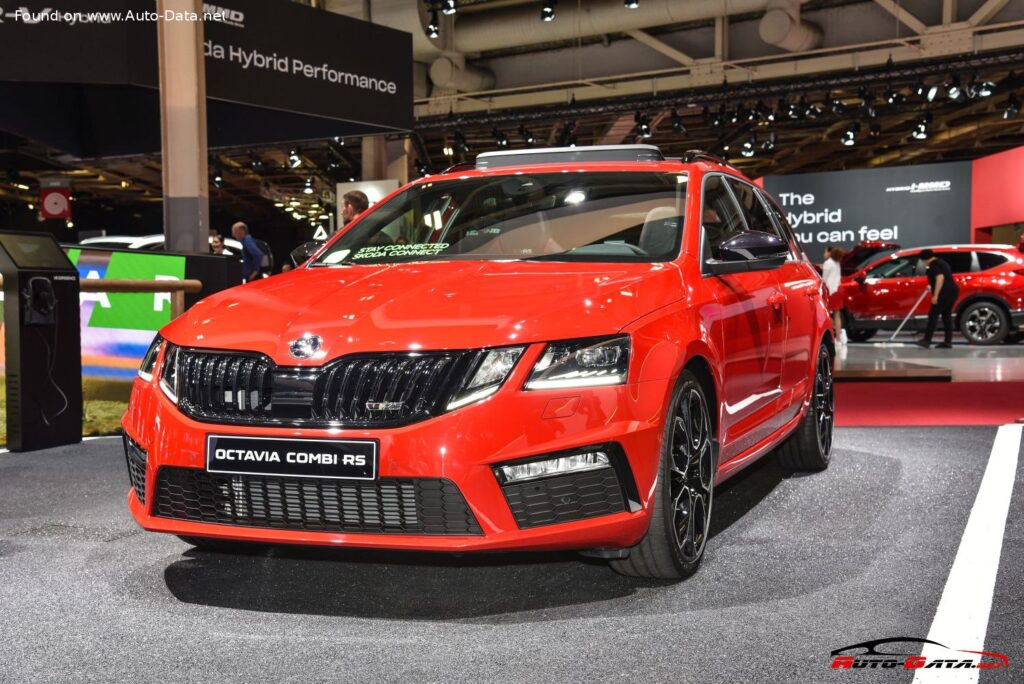
The 2017 facelift brought several visual and technological enhancements to the Skoda Octavia, giving it a sharper and more contemporary appearance. The most distinctive change was the split headlight design, which, while initially polarizing, quickly became a recognizable feature. This was complemented by a wider grille and redesigned bumpers, contributing to a more assertive front fascia. The Combi (station wagon) body type maintains its elegant profile, emphasizing its core mission as a highly practical family vehicle. With a length of 183.74 inches (4667 mm), a width of 71.42 inches (1814 mm), and a height of 57.68 inches (1465 mm), the Octavia Combi strikes an excellent balance between exterior compactness and interior spaciousness. Its 105.75-inch (2686 mm) wheelbase ensures a comfortable ride and generous legroom for all five occupants.
Inside, the Octavia III Combi truly shines with its focus on usability and thoughtful features. The cabin is well-appointed, with a logical layout and quality materials that belie its accessible price point. The facelift also introduced updated infotainment systems with larger touchscreens and improved connectivity options, including smartphone integration through Apple CarPlay and Android Auto, depending on the trim level. Practicality is paramount, highlighted by the cavernous trunk space. With the rear seats in place, the Octavia Combi offers a generous 21.54 cu. ft. (610 liters) of cargo volume. Folding the rear seats flat expands this to an immense 61.45 cu. ft. (1740 liters), making it one of the most capacious vehicles in its class and ideal for hauling luggage, groceries, or even larger items.
Safety features are comprehensive, as expected from a modern European vehicle. Standard equipment includes an Anti-lock Braking System (ABS) with ventilated discs at the front and solid discs at the rear, ensuring confident stopping power. Electric power steering provides precise control and ease of maneuverability, particularly in urban environments, further aided by a tight minimum turning circle of 34.81 feet (10.61 meters). While not explicitly detailed in the provided data, the 2017 Octavia would typically offer a suite of passive and active safety systems, including multiple airbags, electronic stability control (ESC), and potentially advanced driver-assistance systems (ADAS) like adaptive cruise control, lane-keeping assist, and front assist, depending on the specification.
Technical Specifications of the Skoda Octavia III Combi (facelift 2017)
| Category | Specification | US Equivalent |
|---|---|---|
| General Information | ||
| Brand | Skoda | |
| Model | Octavia | |
| Generation | Octavia III Combi (facelift 2017) | |
| Type (Engine) | 1.0 TSI (116 Hp) | |
| Start of production | 2017 year | |
| End of production | 2019 year | |
| Powertrain Architecture | Internal Combustion engine | |
| Body type | Station wagon (estate) | |
| Seats | 5 | |
| Doors | 5 | |
| Performance Specs | ||
| Fuel consumption (economy) – urban | 5.9 l/100 km | 39.9 US mpg |
| Fuel consumption (economy) – extra urban | 4.2 l/100 km | 56 US mpg |
| Fuel consumption (economy) – combined | 4.8 l/100 km | 49 US mpg |
| CO2 emissions | 110 g/km | |
| Fuel Type | Petrol (Gasoline) | |
| Acceleration 0 – 60 mph | 9.6 sec | |
| Acceleration 0 – 100 km/h | 10.1 sec | |
| Maximum speed | 201 km/h | 124.9 mph |
| Emission standard | Euro 6 | |
| Weight-to-power ratio | 10.1 kg/Hp | 99 Hp/tonne |
| Weight-to-torque ratio | 5.9 kg/Nm | 170.6 Nm/tonne |
| Engine Specs | ||
| Power | 116 Hp | |
| Power per liter | 116.1 Hp/l | |
| Torque | 200 Nm @ 2000-3500 rpm. | 147.51 lb.-ft. @ 2000-3500 rpm. |
| Engine layout | Front, Transverse | |
| Engine Model/Code | CHZD | |
| Engine displacement | 999 cm3 | 1.0 liters / 60.96 cu. in. |
| Number of cylinders | 3 | |
| Engine configuration | Inline | |
| Cylinder Bore | 74.5 mm | 2.93 in. |
| Piston Stroke | 76.4 mm | 3.01 in. |
| Compression ratio | 10.3:1 | |
| Number of valves per cylinder | 4 | |
| Fuel injection system | Direct injection | |
| Engine aspiration | Turbocharger, Intercooler | |
| Engine oil capacity | 4 l | 4.23 US qt |
| Space, Volume and Weights | ||
| Kerb Weight | 1172 kg | 2583.82 lbs. |
| Max. weight | 1817 kg | 4005.8 lbs. |
| Max load | 645 kg | 1421.98 lbs. |
| Trunk (boot) space – minimum | 610 l | 21.54 cu. ft. |
| Trunk (boot) space – maximum | 1740 l | 61.45 cu. ft. |
| Fuel tank capacity | 50 l | 13.21 US gal |
| Max. roof load | 75 kg | 165.35 lbs. |
| Permitted trailer load with brakes (12%) | 1300 kg | 2866.01 lbs. |
| Permitted trailer load without brakes | 620 kg | 1366.87 lbs. |
| Dimensions | ||
| Length | 4667 mm | 183.74 in. |
| Width | 1814 mm | 71.42 in. |
| Height | 1465 mm | 57.68 in. |
| Wheelbase | 2686 mm | 105.75 in. |
| Front track | 1549 mm | 60.98 in. |
| Rear (Back) track | 1540 mm | 60.63 in. |
| Minimum turning circle (turning diameter) | 10.61 m | 34.81 ft. |
| Drivetrain, Brakes and Suspension Specs | ||
| Drivetrain Architecture | The Internal combustion engine (ICE) drives the front wheels of the vehicle. | |
| Drive wheel | Front wheel drive | |
| Number of gears and type of gearbox | 6 gears, manual transmission | |
| Front brakes | Ventilated discs | |
| Rear brakes | Disc | |
| Assisting systems | ABS (Anti-lock braking system) | |
| Steering type | Steering rack and pinion | |
| Power steering | Electric Steering | |
| Tires size | 205/55 R16 | |
| Wheel rims size | 16 | |
Market Position and Enduring Legacy
The Skoda Octavia III Combi (facelift 2017) 1.0 TSI (116 Hp) played a crucial role in Skoda’s strategy to offer highly competitive vehicles that combine Volkswagen Group engineering with Skoda’s renowned emphasis on practicality and value. In its primary European markets, the Octavia Combi was a formidable contender in the compact family car segment. Its competitors included well-established models such as the Ford Focus Estate, Opel Astra Sports Tourer, Renault Megane Sport Tourer, Hyundai i30 Wagon, and Kia Ceed Sportswagon. Internally, it also competed with the Volkswagen Golf Variant, though the Octavia often offered more interior space and a slightly more budget-friendly price point for comparable features.
The Octavia’s reputation for reliability, low running costs, and spaciousness made it a favorite among private buyers and fleet managers alike. The introduction of the 1.0 TSI engine further enhanced its appeal by offering excellent fuel economy and meeting stringent emission standards, aligning with the growing demand for greener and more efficient vehicles. This downsizing trend, where smaller turbocharged engines deliver performance comparable to larger naturally aspirated units, was a key technological advancement embraced by Skoda.
The legacy of the Octavia III Combi, particularly the facelifted version, is one of continued success and reinforcement of Skoda’s brand identity. It demonstrated that a car could be practical, efficient, and well-equipped without needing a premium price tag. Its blend of thoughtful design, robust build quality, and a highly efficient powertrain ensured its popularity throughout its production run. Even after its discontinuation in 2019 to make way for the fourth-generation model, the 2017-2019 Octavia III Combi remains a highly regarded used vehicle, valued for its enduring utility and smart engineering. It stands as a testament to Skoda’s journey from a niche Eastern European brand to a respected global player within the Volkswagen Group, celebrated for its “Simply Clever” solutions and no-nonsense approach to automotive excellence.