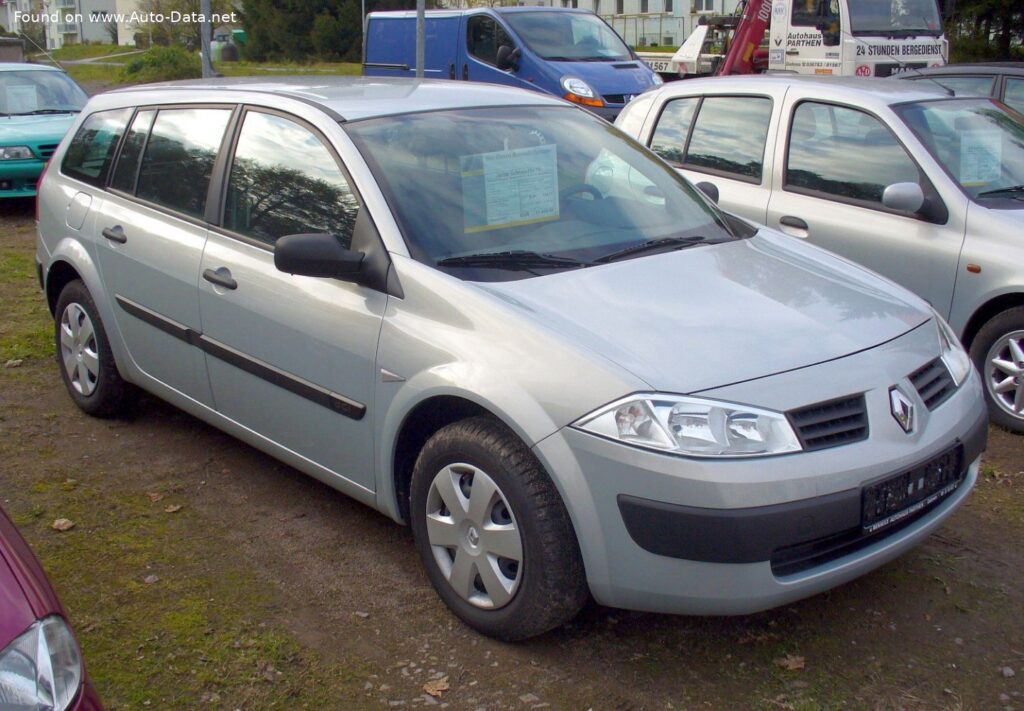
The Renault Megane II Grandtour 1.5 dCi (101 Hp): A European Workhorse
The Renault Megane II Grandtour 1.5 dCi (101 Hp), produced between 2004 and 2005, represents a significant offering in the highly competitive European C-segment.
As a station wagon (known as an estate in Europe), this particular variant of the second-generation Megane was designed to blend practicality, fuel efficiency, and a comfortable driving experience for families and professionals alike.
While never officially sold in the United States, the Megane II Grandtour played a crucial role in Renault’s strategy to dominate the compact family car market across Europe,
offering a compelling alternative to rivals with its distinctive styling and a strong emphasis on diesel powertrain technology, a hallmark of European automotive preferences during this era.
This model specifically highlights the widespread adoption of efficient, small-displacement diesel engines that were becoming increasingly sophisticated and powerful.
Engine & Performance of the Renault Megane II Grandtour 1.5 dCi (101 Hp)
At the heart of the Renault Megane II Grandtour 1.5 dCi (101 Hp) lies Renault’s venerable K9K engine, a 1.5-liter (1461 cm³ or 89.16 cu. in.) inline-four turbodiesel unit.
This powertrain architecture, featuring a front, transverse engine layout and front-wheel drive, was engineered for optimal packaging and efficiency.
The engine delivers a respectable 101 horsepower at 4000 rpm, which, when considering its displacement, translates to a healthy 69.1 horsepower per liter.
More critically for a diesel, it generates a robust 200 Newton meters (147.51 lb.-ft.) of torque at a low 1900 rpm. This ample low-end torque is characteristic of diesel engines and is vital for strong acceleration and effortless cruising, particularly when the vehicle is loaded or towing.
The K9K engine employs a common rail direct fuel injection system, coupled with a turbocharger and intercooler, to maximize combustion efficiency and power output while adhering to Euro 3 emission standards.
With two valves per cylinder and an OHC (Overhead Camshaft) valvetrain, the engine prioritized reliability and fuel economy.
Performance figures include an acceleration time from 0 to 60 mph in a calculated 12.4 seconds (0-100 km/h in 13.1 seconds) and a top speed of 110.6 mph (178 km/h).
These figures positioned the Megane II Grandtour 1.5 dCi as a capable, if not overtly sporty, performer within its segment, perfectly adequate for the demands of European highways and urban environments.
Fuel efficiency was a major selling point for this diesel variant. The combined fuel consumption is rated at an impressive 4.6 liters per 100 kilometers, equating to approximately 51.1 US mpg.
In urban driving, it achieved 5.6 l/100 km (42 US mpg), and on the extra-urban cycle, it excelled with 4.1 l/100 km (57.4 US mpg).
These figures, combined with CO2 emissions of 121 g/km, underscored the Megane’s environmental credentials and cost-effectiveness for European drivers facing high fuel prices and emissions-based taxation.
The 60-liter (15.85 US gallon) fuel tank provided an excellent cruising range, further enhancing its appeal as a long-distance family vehicle.
Design & Features of the Megane II Grandtour
The Megane II Grandtour, like its hatchback sibling, featured a distinctive and somewhat polarizing design for its time.
Its bold, angular styling, particularly the prominent “bustle-back” rear on the hatchback, was toned down for the Grandtour station wagon, which adopted a more conventional but still elegant profile.
The five-door, five-seat body type provided ample practicality, a primary requirement for a family-oriented vehicle.
Measuring 177.17 inches (4500 mm) in length, 69.96 inches (1777 mm) in width (79.76 inches or 2026 mm including mirrors), and 57.76 inches (1467 mm) in height, the Grandtour offered a substantial footprint for its segment.
The generous 105.75-inch (2686 mm) wheelbase contributed to a stable ride and a spacious cabin.
Inside, the Megane II Grandtour boasted a comfortable and well-appointed interior for its class.
The primary draw of the Grandtour body style was its cargo capacity. With a minimum trunk space of 520 liters (18.36 cu. ft.), it could easily accommodate family luggage or shopping.
Folding the rear seats expanded this volume significantly to a maximum of 1600 liters (56.5 cu. ft.), rivaling much larger vehicles.
The kerb weight of 2722.71 lbs (1235 kg) and a maximum permissible weight of 4001.39 lbs (1815 kg) highlighted its robust construction and payload capability of 1278.68 lbs (580 kg).
Furthermore, it offered practical towing capabilities, with a permitted trailer load of 2866.01 lbs (1300 kg) with brakes.
Safety features for the era included standard ABS (Anti-lock Braking System), which was becoming increasingly common.
The vehicle utilized ventilated disc brakes at the front and solid disc brakes at the rear, ensuring effective stopping power.
The suspension system comprised an independent McPherson setup at the front and a torsion beam at the rear, a common and cost-effective configuration for front-wheel-drive compact cars, balancing comfort and handling.
Steering was managed by an electric power-assisted rack and pinion system, offering ease of maneuverability, particularly in urban settings, with a minimum turning circle of 36.09 feet (11 meters).
The car was equipped with 205/50 R17 tires mounted on 6.5J X 17 wheel rims, providing a good balance of grip and ride comfort.
Technical Specifications
| Category | Specification |
|---|---|
| General Information | |
| Brand | Renault |
| Model | Megane |
| Generation | Megane II Grandtour |
| Type (Engine) | 1.5 dCi (101 Hp) |
| Start of Production | 2004 year |
| End of Production | 2005 year |
| Powertrain Architecture | Internal Combustion Engine |
| Body type | Station wagon (estate) |
| Seats | 5 |
| Doors | 5 |
| Performance Specs | |
| Fuel consumption (economy) – urban | 5.6 l/100 km (42 US mpg) |
| Fuel consumption (economy) – extra urban | 4.1 l/100 km (57.4 US mpg) |
| Fuel consumption (economy) – combined | 4.6 l/100 km (51.1 US mpg) |
| CO2 emissions | 121 g/km |
| Fuel Type | Diesel |
| Acceleration 0 – 60 mph | 12.4 sec (Calculated) |
| Acceleration 0 – 100 km/h | 13.1 sec |
| Maximum speed | 178 km/h (110.6 mph) |
| Emission standard | Euro 3 |
| Weight-to-power ratio | 12.2 kg/Hp (81.8 Hp/tonne) |
| Weight-to-torque ratio | 6.2 kg/Nm (161.9 Nm/tonne) |
| Engine Specs | |
| Power | 101 Hp @ 4000 rpm |
| Power per liter | 69.1 Hp/l |
| Torque | 200 Nm (147.51 lb.-ft.) @ 1900 rpm |
| Engine layout | Front, Transverse |
| Engine Model/Code | K9K |
| Engine displacement | 1461 cm³ (89.16 cu. in.) |
| Number of cylinders | 4 |
| Engine configuration | Inline |
| Cylinder Bore | 76 mm (2.99 in.) |
| Piston Stroke | 80.5 mm (3.17 in.) |
| Compression ratio | 18.8:1 |
| Number of valves per cylinder | 2 |
| Fuel injection system | Diesel Commonrail |
| Engine aspiration | Turbocharger, Intercooler |
| Valvetrain | OHC |
| Engine oil capacity | 4.5 l (4.76 US qt) |
| Coolant | 6.5 l (6.87 US qt) |
| Space, Volume and Weights | |
| Kerb Weight | 1235 kg (2722.71 lbs) |
| Max. weight | 1815 kg (4001.39 lbs) |
| Max load | 580 kg (1278.68 lbs) |
| Trunk (boot) space – minimum | 520 l (18.36 cu. ft.) |
| Trunk (boot) space – maximum | 1600 l (56.5 cu. ft.) |
| Fuel tank capacity | 60 l (15.85 US gal) |
| Max. roof load | 80 kg (176.37 lbs) |
| Permitted trailer load with brakes (12%) | 1300 kg (2866.01 lbs) |
| Permitted trailer load without brakes | 650 kg (1433 lbs) |
| Permitted towbar download | 75 kg (165.35 lbs) |
| Dimensions | |
| Length | 4500 mm (177.17 in.) |
| Width | 1777 mm (69.96 in.) |
| Width including mirrors | 2026 mm (79.76 in.) |
| Height | 1467 mm (57.76 in.) |
| Wheelbase | 2686 mm (105.75 in.) |
| Front track | 1518 mm (59.76 in.) |
| Rear (Back) track | 1514 mm (59.61 in.) |
| Front overhang | 842 mm (33.15 in.) |
| Rear overhang | 972 mm (38.27 in.) |
| Minimum turning circle (turning diameter) | 11 m (36.09 ft.) |
| Drivetrain, Brakes and Suspension Specs | |
| Drivetrain Architecture | The Internal combustion engine (ICE) drives the front wheels of the vehicle. |
| Drive wheel | Front wheel drive |
| Number of gears and type of gearbox | 5 gears, manual transmission |
| Front suspension | Independent type McPherson |
| Rear suspension | Torsion |
| Front brakes | Ventilated discs |
| Rear brakes | Disc |
| Assisting systems | ABS (Anti-lock braking system) |
| Steering type | Steering rack and pinion |
| Power steering | Electric Steering |
| Tires size | 205/50 R17 |
| Wheel rims size | 6.5J X 17 |
Legacy & Market Impact of the Renault Megane II Grandtour
The Renault Megane II Grandtour 1.5 dCi (101 Hp) carved out a significant niche in the European compact segment during its short production run of 2004-2005.
Its primary market was undeniably Europe, where station wagons, particularly those with efficient diesel powertrains, were and remain highly popular for their blend of utility, low running costs, and suitability for long-distance travel.
The Megane II generation, in general, was a bold statement from Renault, moving away from the more conservative styling of its predecessor and embracing a distinct, avant-garde aesthetic that influenced many of its competitors.
In its competitive landscape, the Megane II Grandtour went head-to-head with established players like the Volkswagen Golf Variant (Jetta SportWagen in the US), Opel Astra Caravan, Ford Focus Turnier, Peugeot 307 SW, and the Citroën C4 Estate.
What set the Megane apart was its combination of distinctive styling, a strong emphasis on passive and active safety (earning high marks in Euro NCAP crash tests for other Megane II variants), and the widespread availability of highly efficient dCi diesel engines.
The 1.5 dCi, in particular, was lauded for its exceptional fuel economy, making it a favorite among budget-conscious buyers and fleet operators.
The Megane II Grandtour’s legacy is rooted in its demonstration of how a compact car could offer substantial practicality without sacrificing style or modern features.
It contributed to the trend of making station wagons more appealing to a broader audience, moving them beyond their purely utilitarian image.
For Renault, the Megane II generation was a commercial success, and the Grandtour played a vital role in broadening its appeal, showcasing the brand’s commitment to innovation in design and powertrain technology.
Its efficiency, spaciousness, and comfortable ride ensured its reputation as a reliable and economical choice for European families, solidifying Renault’s position as a leader in the compact segment.
Even today, these models are a testament to the era when diesel engines were at their peak of popularity in Europe, offering an unbeatable combination of torque, fuel economy, and durability for everyday driving.