The Opel Rekord E (facelift 1982) 2.3 D (65 Hp): A European Workhorse of the Early 1980s
The Opel Rekord E, particularly the facelifted model introduced in September 1982, represents a significant chapter in Opel’s history as a prominent European automaker. Positioned in the competitive mid-size to executive car segment, the Rekord E was a staple on European roads, known for its practicality, robust engineering, and conservative styling. The variant under scrutiny, the Opel Rekord E (facelift 1982) 2.3 D (65 Hp), embodies the era’s focus on fuel efficiency and durability, especially crucial during a period of fluctuating oil prices. This model, produced for a relatively short period from September 1982 to July 1983, served as a reliable family sedan and a preferred choice for fleet operators and business users across the continent. While never officially sold in the United States, the Rekord E’s design and mechanical philosophy reflect the broader automotive trends of its time, emphasizing spaciousness, comfort, and economical operation, particularly with its diesel powertrain.
Engine and Performance: The Dependable Diesel Heart
At the core of the Opel Rekord E (facelift 1982) 2.3 D (65 Hp) lay its naturally aspirated 2.3-liter (2260 cm³ or 137.91 cu. in.) inline four-cylinder diesel engine, designated as the 23D. This powerplant was engineered for longevity and fuel economy rather than outright speed, a characteristic highly valued in its primary European markets. It produced a modest 65 horsepower at 4200 revolutions per minute, a figure that, while seemingly low by today’s standards, was considered adequate for its class and intended purpose in the early 1980s. Torque output stood at 127 Newton-meters (93.67 lb.-ft.) at a low 2500 rpm, providing accessible pulling power for daily driving and highway cruising.
The engine featured a SOHC (Single Overhead Camshaft) valvetrain with two valves per cylinder, a common and reliable configuration for diesel engines of that era. Its precombustion chamber injection system was a hallmark of diesel technology at the time, contributing to smoother, albeit less refined, operation compared to later direct injection systems. With a high compression ratio of 22:1, the engine was designed for efficient combustion of diesel fuel.
Power was delivered to the rear wheels via a five-speed manual transmission, a choice that offered a good balance of highway economy and urban tractability. Performance figures underscored the Rekord 2.3 D’s pragmatic nature: acceleration from 0 to 60 miles per hour took a leisurely 21.4 seconds, with a top speed of 96.31 mph (155 km/h). However, its true strength lay in its fuel economy, boasting a combined consumption figure of 34.6 US mpg (6.8 l/100 km), an impressive metric for a vehicle of its size and weight at the time. This efficiency, combined with a generous 17.17 US gallon (65-liter) fuel tank, provided a substantial cruising range, making it a favorite for long-distance travel. The vehicle’s weight-to-power ratio of 19.2 kg/Hp (52 Hp/tonne) further illustrates its focus on utility over raw performance.
Design and Features: Practicality and Enduring Form
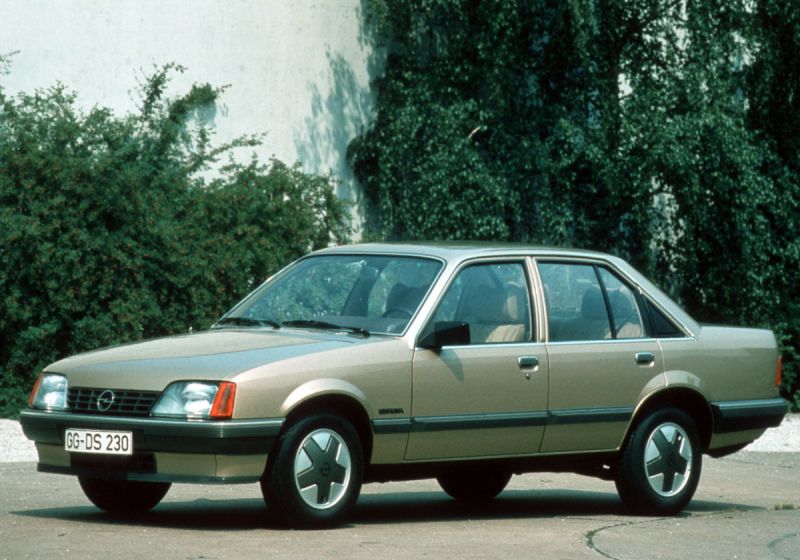
The Opel Rekord E (facelift 1982) maintained the classic sedan body type, offering four doors and comfortable seating for five occupants. The facelift introduced subtle refinements to the Rekord E’s exterior, updating its aesthetic to align with early 1980s design trends without radically altering its familiar silhouette. These changes typically involved revised grille designs, updated lighting elements, and minor trim modifications, aiming to keep the model fresh against newer competitors.
Measuring 183.15 inches (4652 mm) in length, 67.95 inches (1726 mm) in width, and 55.91 inches (1420 mm) in height, with a wheelbase of 105.04 inches (2668 mm), the Rekord E was a substantial vehicle for its class. Its dimensions translated into a spacious interior, providing ample legroom and headroom for passengers. The trunk offered a respectable 17.3 cubic feet (490 liters) of cargo space, making it highly practical for family vacations or business needs.
In terms of driving dynamics, the Rekord E featured a conventional setup for its era: ventilated disc brakes at the front and drum brakes at the rear, a proven combination for reliable stopping power. The rear-wheel-drive architecture, a hallmark of many European executive cars of the period, contributed to a balanced driving feel. The turning circle of 35.43 feet (10.8 meters) was relatively tight for a car of its size, aiding maneuverability in urban environments. An aerodynamic drag coefficient (Cd) of 0.36 was respectable for an early 1980s sedan, indicating some attention to fuel efficiency through design. The vehicle’s kerb weight stood at 2755.78 pounds (1250 kg), and it could carry a maximum load of 1168.45 pounds (530 kg), highlighting its robust construction and utility.
Technical Specifications
| Category | Specification |
|---|---|
| Brand | Opel |
| Model | Rekord |
| Generation | Rekord E (facelift 1982) |
| Type (Engine) | 2.3 D (65 Hp) |
| Start of Production | September, 1982 year |
| End of Production | July, 1983 year |
| Powertrain Architecture | Internal Combustion engine |
| Body type | Sedan |
| Seats | 5 |
| Doors | 4 |
| Performance Specs | |
| Fuel consumption (combined) | 6.8 l/100 km (34.6 US mpg) |
| Fuel Type | Diesel |
| Acceleration 0 – 60 mph | 21.4 sec |
| Maximum speed | 96.31 mph (155 km/h) |
| Weight-to-power ratio | 19.2 kg/Hp (52 Hp/tonne) |
| Weight-to-torque ratio | 9.8 kg/Nm (101.6 Nm/tonne) |
| Engine Specs | |
| Power | 65 Hp @ 4200 rpm |
| Power per liter | 28.8 Hp/l |
| Torque | 127 Nm @ 2500 rpm (93.67 lb.-ft.) |
| Engine Model/Code | 23D |
| Engine displacement | 2260 cm³ (137.91 cu. in.) |
| Number of cylinders | 4 |
| Engine configuration | Inline |
| Cylinder Bore | 92 mm (3.62 in.) |
| Piston Stroke | 85 mm (3.35 in.) |
| Compression ratio | 22:1 |
| Number of valves per cylinder | 2 |
| Fuel injection system | Precombustion chamber injection |
| Engine aspiration | Naturally aspirated engine |
| Valvetrain | SOHC |
| Engine oil capacity | 5.5 l (5.81 US qt) |
| Coolant capacity | 11.5 l (12.15 US qt) |
| Space, Volume and Weights | |
| Kerb Weight | 1250 kg (2755.78 lbs.) |
| Max. weight | 1780 kg (3924.23 lbs.) |
| Max load | 530 kg (1168.45 lbs.) |
| Trunk (boot) space – minimum | 490 l (17.3 cu. ft.) |
| Fuel tank capacity | 65 l (17.17 US gal) |
| Permitted trailer load with brakes (12%) | 1100 kg (2425.08 lbs.) |
| Dimensions | |
| Length | 4652 mm (183.15 in.) |
| Width | 1726 mm (67.95 in.) |
| Height | 1420 mm (55.91 in.) |
| Wheelbase | 2668 mm (105.04 in.) |
| Front track | 1435 mm (56.5 in.) |
| Rear (Back) track | 1412 mm (55.59 in.) |
| Ride height (ground clearance) | 140 mm (5.51 in.) |
| Drag coefficient (Cd) | 0.36 |
| Minimum turning circle (turning diameter) | 10.8 m (35.43 ft.) |
| Drivetrain, Brakes and Suspension Specs | |
| Drivetrain Architecture | The Internal combustion engine (ICE) drives the rear wheels of the vehicle. |
| Drive wheel | Rear wheel drive |
| Number of gears and type of gearbox | 5 gears, manual transmission |
| Front brakes | Ventilated discs |
| Rear brakes | Drum |
Legacy and Market Impact in Europe
The Opel Rekord E, particularly its diesel variants like the 2.3 D (65 Hp), carved out a significant niche in the European automotive landscape. It was a direct competitor to other popular mid-size sedans of its era, including the Ford Granada, Peugeot 505, and even entry-level diesel versions of premium offerings like the Mercedes-Benz W123 and BMW 5-Series (E28). While it lacked the prestige of its German luxury rivals, the Rekord offered a compelling package of affordability, practicality, and dependable performance, making it a common sight across Germany, the Benelux countries, and Scandinavia.
The 2.3 D model cemented the Rekord’s reputation as a workhorse. Its robust diesel engine was renowned for its longevity and low running costs, especially important for taxi fleets and company cars where high mileage was the norm. While its acceleration was modest, its strong torque at lower RPMs made it capable of comfortably hauling loads and negotiating varied European terrain. The five-speed manual transmission was also a key selling point, offering better fuel economy on highways compared to the four-speed units common in many competitors.
Historically, the Rekord E was the final iteration to bear the “Rekord” nameplate, a lineage that dated back to 1953. It represented a transitional period for Opel, bridging the gap between its more traditional, somewhat conservative designs and the more modern, aerodynamically styled vehicles that would follow. Its direct successor, the Opel Omega, introduced in 1986, would continue Opel’s presence in the executive segment with a fresh design language and advanced technology.
Today, the Opel Rekord E 2.3 D (65 Hp) is appreciated by classic car enthusiasts in Europe for its robust construction, ease of maintenance, and nostalgic appeal. It stands as a testament to an era when cars were built with a clear focus on utility, durability, and economical operation, embodying the practical spirit of European motoring in the early 1980s. Its legacy is that of a reliable, unpretentious, and highly effective family and business sedan that played a crucial role in mobilizing millions across the continent.