The Seat Ibiza IV SC (facelift 2012) 1.2 12V (70 Hp): A European Compact Contender
The Seat Ibiza IV SC (facelift 2012) 1.2 12V (70 Hp) represents a significant iteration of SEAT’s popular subcompact car, an essential player in the highly competitive European B-segment. Produced by the Spanish automaker SEAT, a subsidiary of the Volkswagen Group, the fourth-generation Ibiza, internally known as the 6J, received a mid-cycle refresh in 2012 to keep it competitive and align its styling with the brand’s evolving design language. The “SC” designation, standing for SportCoupé, specifically refers to the three-door variant, emphasizing a sportier and more dynamic aesthetic compared to its five-door hatchback counterpart. This particular model, equipped with a 1.2-liter 12-valve gasoline engine delivering 70 horsepower, was positioned as an economical and agile option, primarily targeting urban drivers and those seeking an accessible entry into the European new car market between its production years of 2012 and 2015.
While SEAT vehicles are not typically sold in the United States, the brand holds a crucial position within the European automotive landscape, often serving as the Volkswagen Group’s more youthful and emotionally charged offering. The Ibiza, sharing its platform with the Volkswagen Polo and Skoda Fabia, benefited from robust engineering while carving out its own identity through distinctive styling and a focus on driving engagement. The 2012 facelift brought subtle yet impactful changes, refining its exterior appearance and enhancing interior quality and features, ensuring the Ibiza remained an attractive proposition in a segment dominated by strong contenders like the Ford Fiesta, Renault Clio, and Peugeot 208.
Powertrain and Efficiency
At the heart of the Seat Ibiza IV SC (facelift 2012) 1.2 12V (70 Hp) lies a compact and efficient 1.2-liter naturally aspirated three-cylinder gasoline engine. This powerplant, identified by engine codes CGPA and CJLB, was engineered to deliver reliable performance with a strong emphasis on fuel economy and low emissions, a critical factor for European buyers. The engine produces a modest 70 horsepower at 5400 rpm and 82.61 lb.-ft. of torque at 3000 rpm. While these figures do not suggest a performance-oriented vehicle, they are perfectly adequate for the car’s intended purpose as an urban commuter and occasional highway cruiser.
Power is transmitted to the front wheels via a smooth-shifting 5-speed manual transmission, a common and cost-effective choice for vehicles in this segment. This drivetrain architecture contributes to the car’s commendable fuel efficiency. The official fuel consumption figures highlight its economical nature: 33.1 US mpg in urban settings, an impressive 53.5 US mpg on the extra-urban cycle, and a combined rating of 43.6 US mpg. These figures, coupled with CO2 emissions of 125 g/km, allowed the Ibiza to meet the Euro 5 emission standard, making it an environmentally conscious choice for its time.
Performance metrics, while not blistering, are respectable for a vehicle of this class and engine size. The Ibiza SC 1.2 12V can accelerate from 0 to 60 mph in a calculated 13.2 seconds, reaching a maximum speed of 101.28 mph. The three-cylinder configuration, known for its characteristic thrum, offers a lightweight solution that contributes to the car’s agile handling and helps keep the overall curb weight down to 2312.65 lbs. The engine utilizes a multi-port manifold injection system and has a compression ratio of 10.5:1, with four valves per cylinder, optimizing combustion for efficiency. Its compact design and naturally aspirated nature underline its role as a straightforward, dependable, and economical engine option within the Ibiza lineup.
Design Philosophy and Interior Comfort
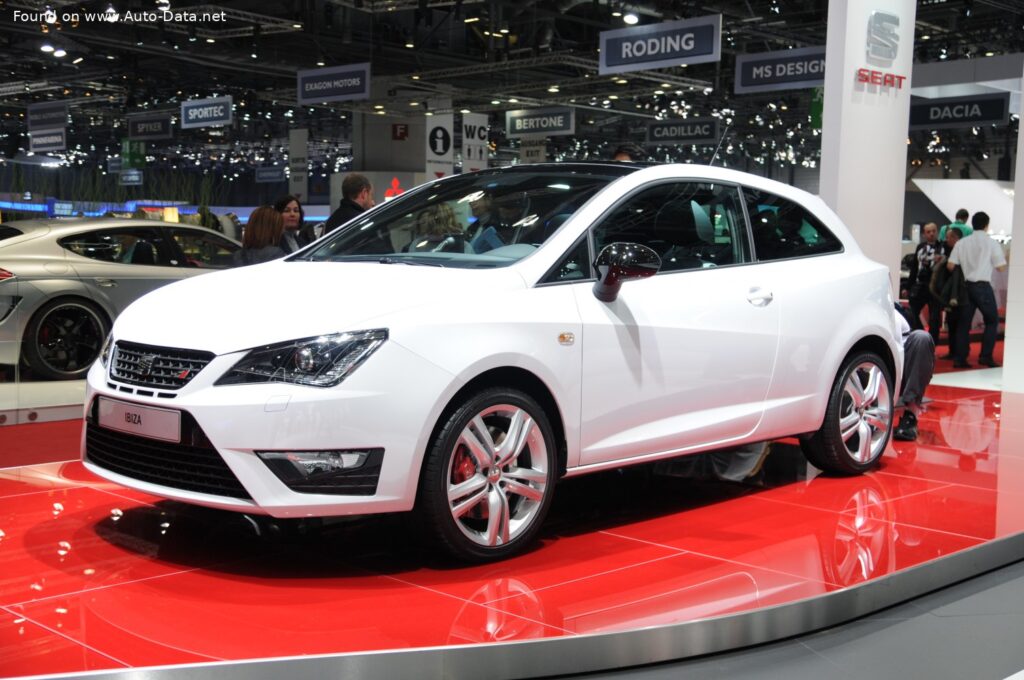
The Seat Ibiza IV SC (facelift 2012) 1.2 12V (70 Hp) truly distinguished itself with its “SC” or SportCoupé body type. This three-door configuration presented a more dynamic and athletic profile compared to the more utilitarian five-door hatchback. The 2012 facelift refined the already sharp lines of the Ibiza, introducing a more aggressive front fascia with redesigned headlights featuring LED daytime running lights (where equipped), a revised grille, and sportier bumper designs. These updates gave the Ibiza SC a more modern and assertive presence on the road, embodying SEAT’s “auto emoción” philosophy.
Measuring 159.17 inches in length, 66.65 inches in width, and 56.22 inches in height, with a wheelbase of 97.2 inches, the Ibiza SC maintained its compact dimensions, making it highly maneuverable in congested urban environments. The exterior design was characterized by crisp creases, a distinctive “Línea Dinámica” (dynamic line) running along the side, and a tapering roofline that accentuated its coupe-like stance. Wheel options ranged from 15-inch to 17-inch alloy rims, allowing for personalization and further enhancing its sporty appeal.
Inside, the Ibiza SC offered seating for five, though the rear seats, typical for a three-door subcompact, were better suited for two adults on shorter journeys or children. The 2012 facelift also brought subtle improvements to the interior, including updated materials, instrument cluster graphics, and available infotainment systems, enhancing the overall cabin ambiance and user experience. Despite its compact exterior, the trunk space provided a practical 10.03 cubic feet, expandable by folding the rear seats, making it versatile enough for daily errands or weekend trips. Key features included electric power steering for effortless maneuverability, and an Anti-lock Braking System (ABS) as standard, underpinning its commitment to safety in the European market. The suspension system, featuring independent McPherson struts with coil springs and an anti-roll bar at the front and a trailing arm setup at the rear, was tuned to strike a balance between comfortable ride quality and responsive handling, characteristic of its Volkswagen Group underpinnings.
Technical Specifications Overview
Below is a detailed breakdown of the technical specifications for the Seat Ibiza IV SC (facelift 2012) 1.2 12V (70 Hp):
| Category | Specification | US Equivalent |
|---|---|---|
| General Information | ||
| Brand | Seat | |
| Model | Ibiza | |
| Generation | Ibiza IV SC (facelift 2012) | |
| Type (Engine) | 1.2 12V (70 Hp) | |
| Start of Production | 2012 year | |
| End of Production | 2015 year | |
| Powertrain Architecture | Internal Combustion engine | |
| Body type | Coupe | |
| Seats | 5 | |
| Doors | 3 | |
| Performance Specs | ||
| Fuel consumption (economy) – urban | 7.1 l/100 km | 33.1 US mpg |
| Fuel consumption (economy) – extra urban | 4.4 l/100 km | 53.5 US mpg |
| Fuel consumption (economy) – combined | 5.4 l/100 km | 43.6 US mpg |
| CO2 emissions | 125 g/km | |
| Fuel Type | Petrol (Gasoline) | |
| Acceleration 0 – 100 km/h | 13.9 sec | |
| Acceleration 0 – 62 mph | 13.9 sec | |
| Acceleration 0 – 60 mph (Calculated) | 13.2 sec | |
| Maximum speed | 163 km/h | 101.28 mph |
| Emission standard | Euro 5 | |
| Weight-to-power ratio | 15 kg/Hp | 66.7 Hp/tonne |
| Weight-to-torque ratio | 9.4 kg/Nm | 106.8 Nm/tonne |
| Engine Specs | ||
| Power | 70 Hp @ 5400 rpm | |
| Power per liter | 58.4 Hp/l | |
| Torque | 112 Nm @ 3000 rpm | 82.61 lb.-ft. @ 3000 rpm |
| Engine layout | Front, Transverse | |
| Engine Model/Code | CGPA, CJLB | |
| Engine displacement | 1198 cm3 | 73.11 cu. in. |
| Number of cylinders | 3 | |
| Engine configuration | Inline | |
| Cylinder Bore | 76.5 mm | 3.01 in. |
| Piston Stroke | 86.9 mm | 3.42 in. |
| Compression ratio | 10.5:1 | |
| Number of valves per cylinder | 4 | |
| Fuel injection system | Multi-port manifold injection | |
| Engine aspiration | Naturally aspirated engine | |
| Engine oil capacity | 3 l | 3.17 US qt |
| Coolant | 5.6 l | 5.92 US qt |
| Space, Volume and Weights | ||
| Kerb Weight | 1049 kg | 2312.65 lbs. |
| Max. weight | 1540 kg | 3395.12 lbs. |
| Max load | 491 kg | 1082.47 lbs. |
| Trunk (boot) space – minimum | 284 l | 10.03 cu. ft. |
| Fuel tank capacity | 45 l | 11.89 US gal |
| Dimensions | ||
| Length | 4043 mm | 159.17 in. |
| Width | 1693 mm | 66.65 in. |
| Height | 1428 mm | 56.22 in. |
| Wheelbase | 2469 mm | 97.2 in. |
| Front track | 1465 mm | 57.68 in. |
| Rear (Back) track | 1457 mm | 57.36 in. |
| Minimum turning circle (turning diameter) | 10.48 m | 34.38 ft. |
| Drivetrain, Brakes and Suspension Specs | ||
| Drivetrain Architecture | The Internal combustion engine (ICE) drives the front wheels of the vehicle. | |
| Drive wheel | Front wheel drive | |
| Number of gears and type of gearbox | 5 gears, manual transmission | |
| Front suspension | Independent, type McPherson with coil spring and anti-roll bar | |
| Rear suspension | Trailing arm | |
| Front brakes | Ventilated discs | |
| Rear brakes | Drum | |
| Assisting systems | ABS (Anti-lock braking system) | |
| Steering type | Steering rack and pinion | |
| Power steering | Electric Steering | |
| Tires size | 185/60 R15; 215/45 R16; 215/40 R17 | |
| Wheel rims size | 6J x 15; 7J x 16; 7J x 17 | |
Market Positioning and Enduring Legacy
The Seat Ibiza IV SC (facelift 2012) 1.2 12V (70 Hp) played a vital role in SEAT’s strategy to capture a significant share of the European B-segment. This segment is characterized by fierce competition, with manufacturers vying for buyers seeking economical, practical, and stylish compact cars. The Ibiza SC’s key competitors included segment stalwarts like the Ford Fiesta, Renault Clio, Opel Corsa (Vauxhall Corsa in the UK), Peugeot 208, and its platform mates, the Volkswagen Polo and Skoda Fabia. Within this crowded field, the Ibiza carved out its niche by offering the proven reliability and engineering prowess of the Volkswagen Group, combined with a distinctly Spanish flair and a sportier, more youthful image.
SEAT’s brand identity, often summarized as “auto emoción,” was clearly reflected in the Ibiza SC. Its sharp styling, particularly in the three-door “SportCoupé” guise, appealed to younger buyers or those who prioritized aesthetics and a dynamic appearance over maximum practicality. The 2012 facelift helped to maintain its contemporary appeal, ensuring it remained fresh against newer rivals entering the market. Its strong emphasis on fuel efficiency, low emissions, and affordable running costs made it an attractive proposition for first-time car buyers, urban dwellers, and budget-conscious consumers across Europe.
The Ibiza’s legacy is one of consistent success for SEAT. It has historically been one of the brand’s best-selling models, acting as a crucial entry point for many customers into the SEAT family. The fourth generation, with its 2012 refresh, solidified its reputation as a well-rounded package that offered a compelling blend of style, efficiency, and driving enjoyment. While the 1.2-liter 70 HP engine was not the most powerful option available, it was arguably one of the most sensible, perfectly balancing everyday usability with economic operation. Its contribution to SEAT’s sales volume and brand image in Europe cannot be overstated, establishing the Ibiza as an iconic and enduring model within the compact car landscape, long after its production concluded in 2015.