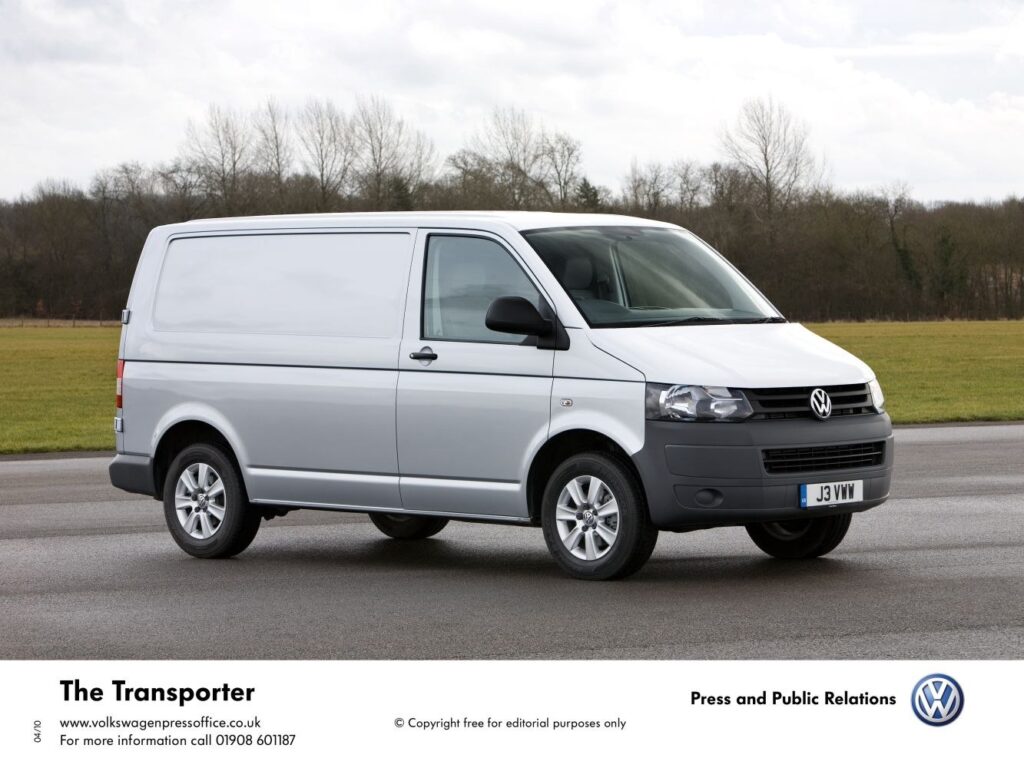
The Volkswagen Transporter (T5, facelift 2009) Panel Van: A European Workhorse
The Volkswagen Transporter, specifically the T5 generation with its 2009 facelift, represents a cornerstone in the global commercial vehicle market, particularly in Europe and other international territories where it has long been a dominant force. The variant under review, the Volkswagen Transporter (T5, facelift 2009) Panel Van 2.0 TDI BMT (180 Hp) 4MOTION L2H2, produced between 2013 and 2015, exemplifies Volkswagen’s commitment to combining robust utility with advanced engineering. While the Transporter series is not typically sold in the United States in its commercial panel van guise, its influence and engineering principles are recognized worldwide. This model, characterized by its long wheelbase (L2) and high roof (H2) configuration, along with a potent 2.0-liter BiTurbo Diesel engine and 4MOTION all-wheel drive, was designed to tackle demanding tasks, offering superior cargo capacity, all-weather capability, and impressive fuel efficiency for its class.
The T5 generation, introduced in 2003, built upon the legendary heritage of its predecessors, evolving the iconic “Bus” into a thoroughly modern and versatile platform. The 2009 facelift brought a host of improvements, including updated styling, enhanced powertrains, and new technologies, ensuring its competitiveness through the mid-2010s. This specific Panel Van variant was engineered to serve as a reliable and capable partner for businesses, tradespeople, and service providers requiring a spacious, durable, and efficient vehicle for transporting goods.
Engine & Performance: Powering the Volkswagen Transporter (T5, facelift 2009)
At the heart of this particular Transporter T5 facelift model lies a sophisticated 2.0-liter TDI (Turbocharged Direct Injection) engine, designated as the EA189 / CFCA. This inline four-cylinder diesel powerplant is a testament to Volkswagen’s engineering prowess, featuring a BiTurbo setup and common rail fuel injection system. This advanced configuration allows the engine to deliver a robust 180 horsepower at 4000 rpm, which is a considerable output for a commercial van of this displacement. More critically for a utility vehicle, the engine produces a substantial 295.02 lb.-ft. of torque, available across a broad and usable range from 1500 to 2000 rpm. This low-end torque is crucial for hauling heavy loads and providing strong acceleration, even when the vehicle is fully laden.
The BiTurbo system, featuring two turbochargers working in sequence, ensures a broad powerband and minimizes turbo lag, providing immediate response across the rev range. Coupled with an intercooler, this design optimizes combustion efficiency and power delivery. The common rail injection system precisely meters fuel, contributing to both performance and the impressive fuel economy figures for a vehicle of its size and capability. The engine’s DOHC (Double Overhead Camshaft) valvetrain with four valves per cylinder further enhances breathing and efficiency.
Power is transmitted to all four wheels via Volkswagen’s renowned 4MOTION all-wheel-drive system, paired with a six-speed manual transmission. The 4MOTION system in this configuration primarily drives the front wheels but can seamlessly engage the rear wheels through an electrically or mechanically operated clutch when additional traction is required, making it highly capable in adverse weather conditions or on challenging terrains. This drivetrain architecture, combined with the powerful TDI engine, allows the Transporter to accelerate from 0 to 60 mph in approximately 10 seconds and reach a top speed of 113.09 mph, figures that are highly respectable for a commercial van. Furthermore, the vehicle adheres to Euro 5 emission standards, incorporating a particulate filter and a Start & Stop system to enhance fuel efficiency and reduce environmental impact.
Design & Features: The L2H2 Panel Van Configuration
The Volkswagen Transporter (T5, facelift 2009) Panel Van 2.0 TDI BMT (180 Hp) 4MOTION L2H2 is a purpose-built commercial vehicle, designed with practicality and utility at its core. The L2H2 designation signifies its long wheelbase (L2) and high roof (H2) configuration, maximizing interior cargo volume. With an overall length of 208.35 inches, a width of 74.96 inches (89.88 inches including mirrors), and a towering height of 85.67 inches, this van offers an impressive 275.45 cubic feet of maximum trunk (cargo) space. This vast capacity allows for the transportation of substantial goods, equipment, or tools, making it an indispensable asset for various businesses.
The body style is a classic panel van, typically featuring unglazed side panels for security and privacy, along with large rear doors and often a sliding side door for easy loading and unloading. The robust construction is evident in its kerb weight, ranging from 4279.17 to 5198.5 lbs., and a maximum permissible gross weight of 6613.87 to 7054.79 lbs., allowing for a substantial maximum payload of 1856.29 to 2334.7 lbs. The vehicle accommodates 2-3 occupants in the cabin, prioritizing cargo space over passenger capacity.
Key features for this era and segment include a robust suspension system, with an independent McPherson strut setup at the front and an independent coil spring with trailing arm at the rear, both equipped with anti-roll bars for improved handling and stability under load. Braking is handled by large ventilated discs on both the front (340×32.5 mm) and rear (294×22 mm) axles, complemented by an Anti-lock Braking System (ABS) for enhanced safety. The hydraulic power steering system ensures manageable maneuverability despite the van’s size, with a minimum turning circle of 43.31 feet. The design also incorporates practical considerations for commercial use, such as a generous ground clearance of 7.91 inches and respectable approach, departure, and ramp-over angles, indicating its capability to navigate varied terrains and loading ramps.
Technical Specifications
| Category | Specification | US Equivalent / Notes |
|---|---|---|
General Information |
||
| Brand | Volkswagen | |
| Model | Transporter | |
| Generation | Transporter (T5, facelift 2009) Panel Van | |
| Type (Engine) | 2.0 TDI BMT (180 Hp) 4MOTION L2H2 | |
| Start of production | 2013 year | |
| End of production | 2015 year | |
| Powertrain Architecture | Internal Combustion engine | |
| Body type | Van | |
| Seats | 2-3 | |
| Doors | 4-5 | |
Performance Specifications |
||
| Fuel consumption (urban NEDC) | 9.3-9.6 l/100 km | 25.3 – 24.5 US mpg |
| Fuel consumption (extra urban NEDC) | 6.6-6.9 l/100 km | 35.6 – 34.1 US mpg |
| Fuel consumption (combined NEDC) | 7.6-7.9 l/100 km | 30.9 – 29.8 US mpg |
| CO2 emissions (NEDC) | 199-208 g/km | |
| Fuel Type | Diesel | |
| Acceleration 0 – 100 km/h | 10.5 sec | |
| Acceleration 0 – 60 mph (Calculated) | 10 sec | |
| Maximum speed | 182 km/h | 113.09 mph |
| Emission standard | Euro 5 | |
| Weight-to-power ratio | 10.8 kg/Hp | 92.7 Hp/tonne |
| Weight-to-torque ratio | 4.9 kg/Nm | 206.1 Nm/tonne |
Engine Specifications |
||
| Power | 180 Hp @ 4000 rpm. | |
| Power per liter | 91.5 Hp/l | |
| Torque | 400 Nm @ 1500-2000 rpm. | 295.02 lb.-ft. @ 1500-2000 rpm. |
| Engine layout | Front, Transverse | |
| Engine Model/Code | EA189 / CFCA | |
| Engine displacement | 1968 cm3 | 120.09 cu. in. |
| Number of cylinders | 4 | |
| Engine configuration | Inline | |
| Cylinder Bore | 81 mm | 3.19 in. |
| Piston Stroke | 95.5 mm | 3.76 in. |
| Compression ratio | 16.5:1 | |
| Number of valves per cylinder | 4 | |
| Fuel injection system | Diesel Commonrail | |
| Engine aspiration | BiTurbo, Intercooler | |
| Valvetrain | DOHC | |
| Engine oil capacity | 7 l | 7.4 US qt |
| Coolant | 11 l | 11.62 US qt |
| Engine systems | Start & Stop System, Particulate filter | |
Space, Volume and Weights |
||
| Kerb Weight | 1941-2358 kg | 4279.17 – 5198.5 lbs. |
| Max. weight | 3000-3200 kg | 6613.87 – 7054.79 lbs. |
| Max load | 842-1059 kg | 1856.29 – 2334.7 lbs. |
| Trunk (boot) space – maximum | 7800 l | 275.45 cu. ft. |
| Fuel tank capacity | 80 l | 21.13 US gal |
| Permitted trailer load with brakes (12%) | 2500 kg | 5511.56 lbs. |
| Permitted trailer load without brakes | 750 kg | 1653.47 lbs. |
| Permitted towbar download | 100 kg | 220.46 lbs. |
Dimensions |
||
| Length | 5292 mm | 208.35 in. |
| Width | 1904 mm | 74.96 in. |
| Width including mirrors | 2283 mm | 89.88 in. |
| Height | 2176 mm | 85.67 in. |
| Wheelbase | 3400 mm | 133.86 in. |
| Front overhang | 896 mm | 35.28 in. |
| Rear overhang | 996 mm | 39.21 in. |
| Ride height (ground clearance) | 201 mm | 7.91 in. |
| Minimum turning circle (turning diameter) | 13.2 m | 43.31 ft. |
| Approach angle | 21° | |
| Departure angle | 17° | |
| Ramp-over (brakeover) angle | 12° | |
Drivetrain, Brakes and Suspension Specifications |
||
| Drivetrain Architecture | ICE drives front wheels permanently, rear wheels driven via clutch if necessary. | |
| Drive wheel | All wheel drive (4×4) | |
| Number of gears and type of gearbox | 6 gears, manual transmission | |
| Front suspension | Independent, type McPherson with coil spring and anti-roll bar | |
| Rear suspension | Independent coil spring, Transverse stabilizer, Trailing arm | |
| Front brakes | Ventilated discs, 340×32.5 mm | |
| Rear brakes | Ventilated discs, 294×22 mm | |
| Assisting systems | ABS (Anti-lock braking system) | |
| Steering type | Steering rack and pinion | |
| Power steering | Hydraulic Steering | |
| Tires size | 215/60 R17; 235/55 R17; 255/45 R18 | |
| Wheel rims size | 7J x 17; 8J x 18 | |
Legacy & Market Impact of the Volkswagen Transporter (T5, facelift 2009)
The Volkswagen Transporter series holds an almost mythical status in automotive history, tracing its lineage back to the iconic Type 2, affectionately known as the “Bus” or “Microbus” in the United States. The T5 generation, and particularly its facelifted version from 2009, proudly carried this torch forward, cementing its reputation as one of the most versatile, reliable, and popular commercial vehicles in its segment globally. While not a direct competitor in the North American market where full-size vans like the Ford Transit and Ram ProMaster dominate, the Transporter (T5) was a formidable player in Europe, Asia, and Australia.
In its primary markets, the Volkswagen Transporter (T5, facelift 2009) Panel Van faced stiff competition from rivals such as the Ford Transit Custom, Mercedes-Benz Vito, Renault Trafic, and Opel Vivaro. However, the T5 consistently distinguished itself through a combination of factors: its robust build quality, the efficiency and power of its TDI engines, the optional but highly effective 4MOTION all-wheel-drive system, and its reputation for strong resale value. The facelifted T5, with its updated aesthetics and refined powertrains, allowed Volkswagen to maintain a strong market share, appealing to a diverse customer base ranging from small businesses to large fleets.
The availability of multiple body configurations, including the L2H2 panel van, shuttle, kombi, and various camper versions (like the California), showcased the platform’s inherent flexibility. This particular 2.0 TDI BMT (180 Hp) 4MOTION L2H2 variant was especially prized for its ability to combine substantial cargo capacity with the added security and traction of all-wheel drive, making it ideal for trades operating in rural areas, construction sites, or regions with challenging weather conditions. Its relatively compact exterior dimensions compared to larger European counterparts, combined with a car-like driving experience, further enhanced its appeal.
The T5 Transporter’s legacy is defined by its unwavering utility and reliability. It became a benchmark for commercial vans, influencing design and engineering trends across the segment. Its advanced diesel technology, particularly the BiTurbo TDI, set new standards for performance and fuel economy in a commercial application. Even after the introduction of the T6 generation, the T5 facelift models remain highly sought after in the used vehicle market, a testament to their enduring quality and functionality. The Volkswagen Transporter (T5, facelift 2009) Panel Van stands as a powerful symbol of German engineering, perfectly balancing the demands of commercial practicality with advanced automotive technology.