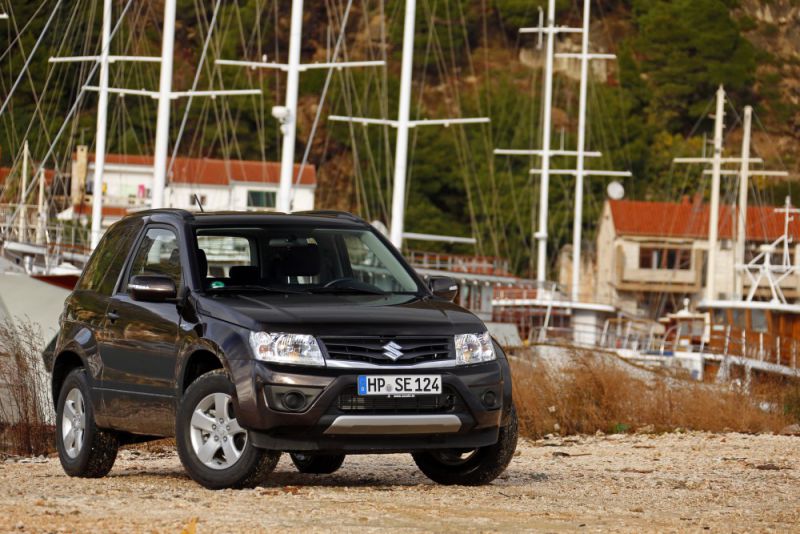
The Suzuki Grand Vitara II (facelift 2012) 3 Door 2.4 (166 Hp) 4×4 Automatic: A Global Compact SUV
The Suzuki Grand Vitara, known for its robust construction and genuine off-road capabilities, received a significant facelift in 2012, marking the latter half of its second generation (JT series). While the Grand Vitara nameplate has a history spanning several decades and generations, the 2012 facelifted model, particularly in its three-door configuration with the 2.4-liter engine and automatic transmission, represented a compelling offering in compact SUV markets outside of North America. This specific variant, produced from 2012 to 2015, continued Suzuki’s tradition of blending everyday usability with impressive trail-tackling prowess. In regions like Europe, Australia, and various Asian markets, the three-door Grand Vitara carved out a niche for consumers seeking a more compact, agile, and adventurous SUV alternative to the increasingly road-biased crossovers.
Unlike its larger five-door sibling which saw limited sales in the United States until its discontinuation after the 2013 model year, the three-door Grand Vitara was not officially sold in the U.S. market during this period. Instead, it thrived in international markets where its smaller footprint, combined with a sophisticated all-wheel-drive system and a dependable naturally aspirated engine, resonated with buyers. The 2012 facelift brought subtle yet effective styling updates, enhancing its modern appeal while retaining its rugged DNA. This article delves into the technical specifications, design philosophies, and market positioning of this distinctive Suzuki Grand Vitara II (facelift 2012) 3 Door 2.4 (166 Hp) 4×4 Automatic variant.
Engine & Performance: Powering the Suzuki Grand Vitara II (facelift 2012) 3 Door
At the heart of this particular Grand Vitara lies a durable 2.4-liter (2393 cm3 or 146.03 cubic inches) inline-four gasoline engine, internally designated as the J24B. This naturally aspirated powerplant is engineered for reliability and a linear power delivery, characteristic of Suzuki’s philosophy for its utility vehicles. It generates a respectable 166 horsepower at 6000 rpm, providing ample motivation for the compact SUV. Torque peaks at 165.95 lb-ft (225 Nm) at 3800 rpm, ensuring sufficient pulling power for off-road excursions and confident highway cruising.
The engine’s design features a DOHC (Double Overhead Camshaft) valvetrain with Variable Valve Timing (VVT-i), optimizing both performance and fuel efficiency across the rev range. Fuel is delivered via a multi-port manifold injection system, a proven and reliable setup. Power is channeled through a conventional but robust four-speed automatic transmission, which, while perhaps not cutting-edge in 2012, was well-matched to the engine’s torque curve and the vehicle’s intended purpose, especially in challenging off-road scenarios where predictable gearing is often preferred.
Performance figures for the Suzuki Grand Vitara II (facelift 2012) 3 Door 2.4 (166 Hp) 4×4 Automatic are competitive for its class and era. It accelerates from 0 to 60 mph in a computed 10.9 seconds (0-100 km/h in 11.5 seconds) and reaches a maximum speed of 105.63 mph (170 km/h). Fuel economy, while not segment-leading by modern standards, was reasonable for a full-time 4×4 SUV of its time: an estimated 20.6 US mpg in urban driving, 29.8 US mpg on the highway, and a combined average of 25.6 US mpg. With CO2 emissions of 213 g/km, it met the Euro 5 emission standard, reflecting its compliance with European environmental regulations.
Design & Features: Compact Utility with Rugged Appeal
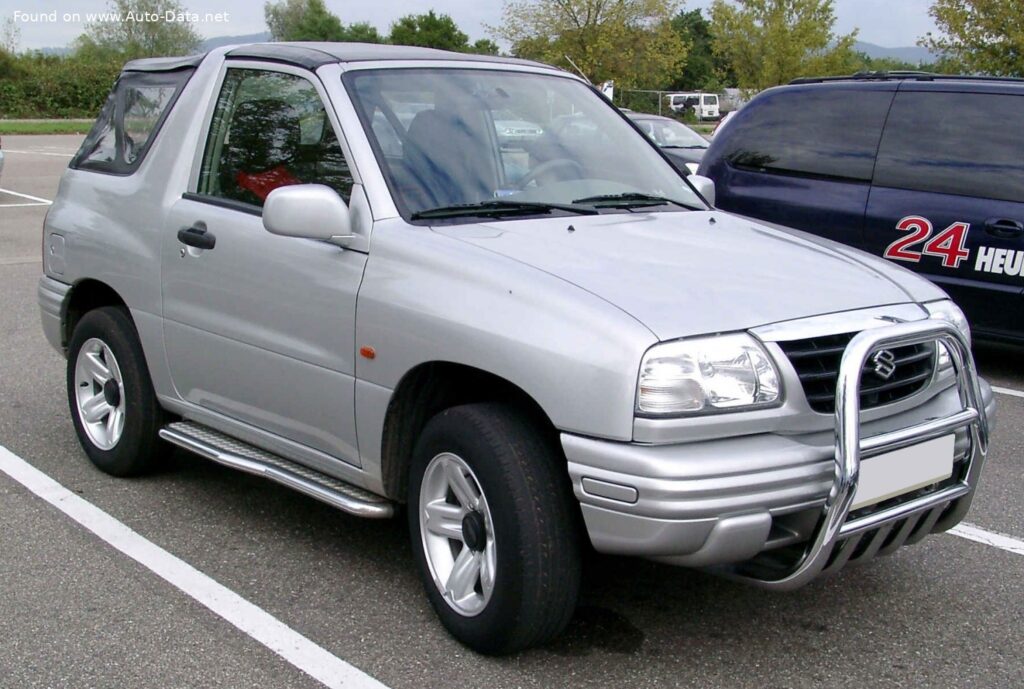
The 2012 facelift of the Suzuki Grand Vitara II 3 Door brought refreshed styling cues that gave it a more contemporary look without compromising its inherent toughness. As an SUV with a dedicated body-on-frame platform (though often presented as a unibody with an integrated ladder frame for increased rigidity), it stood apart from many car-based crossovers. The three-door body type, measuring 159.84 inches in length, 71.26 inches in width, and 66.73 inches in height, provided a compact footprint, making it agile in urban environments and maneuverable on tight trails. Its 96.06-inch wheelbase contributed to its off-road articulation and stability.
Externally, the facelift introduced a redesigned front grille, updated headlights, and new bumper designs, lending it a sharper, more aggressive appearance. The prominent wheel arches housed 225/70 R16 tires on 6.5J x 16-inch wheel rims, emphasizing its capable stance. With a ground clearance of 8.07 inches, the Grand Vitara was well-equipped to tackle uneven terrain.
Inside, the Suzuki Grand Vitara II (facelift 2012) 3 Door offered seating for four occupants. While the rear seats in a three-door configuration might be snug, they provided adequate space for shorter journeys or children. Cargo capacity was modest with the rear seats in use, offering 6.5 cubic feet (184 liters) of trunk space, but it expanded to a more usable 18.22 cubic feet (516 liters) with the rear seats folded, demonstrating reasonable practicality for a vehicle of its size. Standard features for the era included power windows, air conditioning, and a basic audio system, with higher trims offering more amenities. Safety was addressed with the inclusion of ABS (Anti-lock Braking System) as standard, a crucial feature for maintaining control during emergency braking on varied surfaces. The robust chassis and comprehensive airbag systems (market dependent) further contributed to occupant protection.
Technical Specifications
| Category | Specification |
|---|---|
| Brand | Suzuki |
| Model | Grand Vitara |
| Generation | Grand Vitara II (facelift 2012) 3 Door |
| Type (Engine) | 2.4 (166 Hp) 4×4 Automatic |
| Start of production | 2012 year |
| End of production | 2015 year |
| Powertrain Architecture | Internal Combustion engine |
| Body type | SUV |
| Seats | 4 |
| Doors | 3 |
| Performance Specs | |
| Fuel consumption (economy) – urban | 11.4 l/100 km (20.6 US mpg) |
| Fuel consumption (economy) – extra urban | 7.9 l/100 km (29.8 US mpg) |
| Fuel consumption (economy) – combined | 9.2 l/100 km (25.6 US mpg) |
| CO2 emissions | 213 g/km |
| Fuel Type | Petrol (Gasoline) |
| Acceleration 0 – 100 km/h | 11.5 sec |
| Acceleration 0 – 62 mph | 11.5 sec |
| Acceleration 0 – 60 mph (Calculated) | 10.9 sec |
| Maximum speed | 170 km/h (105.63 mph) |
| Emission standard | Euro 5 |
| Weight-to-power ratio | 9.3 kg/Hp (108.1 Hp/tonne) |
| Weight-to-torque ratio | 6.8 kg/Nm (146.5 Nm/tonne) |
| Engine Specs | |
| Power | 166 Hp @ 6000 rpm |
| Power per litre | 69.4 Hp/l |
| Torque | 225 Nm @ 3800 rpm (165.95 lb.-ft. @ 3800 rpm) |
| Engine layout | Front, Longitudinal |
| Engine Model/Code | J24B |
| Engine displacement | 2393 cm3 (2.4 l / 146.03 cu. in.) |
| Number of cylinders | 4 |
| Engine configuration | Inline |
| Cylinder Bore | 92 mm (3.62 in.) |
| Piston Stroke | 90 mm (3.54 in.) |
| Compression ratio | 10:1 |
| Number of valves per cylinder | 4 |
| Fuel injection system | Multi-port manifold injection |
| Engine aspiration | Naturally aspirated engine |
| Valvetrain | DOHC – VVT-i |
| Engine oil capacity | 4.8 l (5.07 US qt) |
| Coolant | 7.3 l (7.71 US qt) |
| Space, Volume and Weights | |
| Kerb Weight | 1536 kg (3386.3 lbs) |
| Max. weight | 1890 kg (4166.74 lbs) |
| Max load | 354 kg (780.44 lbs) |
| Trunk (boot) space – minimum | 184 l (6.5 cu. ft.) |
| Trunk (boot) space – maximum | 516 l (18.22 cu. ft.) |
| Fuel tank capacity | 55 l (14.53 US gal) |
| Dimensions | |
| Length | 4060 mm (159.84 in.) |
| Width | 1810 mm (71.26 in.) |
| Height | 1695 mm (66.73 in.) |
| Wheelbase | 2440 mm (96.06 in.) |
| Front track | 1540 mm (60.63 in.) |
| Rear (Back) track | 1570 mm (61.81 in.) |
| Ride height (ground clearance) | 205 mm (8.07 in.) |
| Minimum turning circle (turning diameter) | 10.2 m (33.46 ft.) |
| Drivetrain, Brakes and Suspension Specs | |
| Drive wheel | All wheel drive (4×4) |
| Number of gears and type of gearbox | 4 gears, automatic transmission |
| Front suspension | Independent, type McPherson with coil spring and anti-roll bar |
| Rear suspension | Independent multi-link suspension |
| Front brakes | Ventilated discs |
| Rear brakes | Ventilated discs |
| Assisting systems | ABS (Anti-lock braking system) |
| Steering type | Steering rack and pinion |
| Tires size | 225/70 R16 102S |
| Wheel rims size | 6.5J x 16 |
Legacy & Market Impact of the Suzuki Grand Vitara II (facelift 2012) 3 Door
The Suzuki Grand Vitara series, and particularly the second generation, holds a significant place in the global automotive landscape as one of the last true compact SUVs that didn’t fully succumb to the crossover trend. The 2012 facelifted three-door model, though not widely known in the North American market, reinforced Suzuki’s reputation for building reliable, capable, and value-oriented 4×4 vehicles in other parts of the world. Its robust, all-wheel-drive (4×4) architecture, featuring a proper low-range transfer case in some markets (though not explicitly listed for this specific automatic variant, it was a hallmark of the Grand Vitara), set it apart from rivals that were increasingly adopting simpler, on-demand AWD systems.
In its primary markets, the Suzuki Grand Vitara II (facelift 2012) 3 Door 2.4 (166 Hp) 4×4 Automatic competed against a diverse range of vehicles. Its direct competitors included other compact SUVs with some off-road pretense, such as the Mitsubishi ASX (Outlander Sport in the US), Nissan Qashqai (Rogue Sport in the US), and potentially even the Subaru Forester, though the Grand Vitara often offered a more rugged, less road-focused driving experience. Its compact dimensions made it particularly appealing in European and Asian cities where larger SUVs were impractical, yet consumers still desired the commanding driving position and versatility of an SUV.
The Grand Vitara’s legacy is rooted in its ability to offer a compelling blend of daily drivability and genuine off-road capability in a relatively affordable package. Its simple yet effective mechanicals, including the naturally aspirated J24B engine and robust suspension setup (independent McPherson strut front and multi-link rear), contributed to its reliability and ease of maintenance, factors highly valued by consumers globally. While Suzuki eventually exited the North American car market and shifted its global focus, the Grand Vitara remains a testament to its engineering prowess and commitment to producing vehicles that could truly venture off the beaten path. The 2012-2015 facelifted three-door model, in particular, represents a refined iteration of this capable and enduring compact SUV, continuing to be a desirable choice for enthusiasts and practical buyers alike in secondary markets.