Skoda Octavia III Combi (facelift 2017) 1.4 G-TEC (110 Hp) CNG DSG: An In-Depth Analysis
The Skoda Octavia III Combi (facelift 2017) 1.4 G-TEC (110 Hp) CNG DSG represents a compelling proposition within the European compact segment, particularly for those prioritizing efficiency, practicality, and reduced running costs. As a product of the Czech automaker Skoda, a subsidiary of the Volkswagen Group, the Octavia has long been lauded for its exceptional value, robust engineering, and cavernous interior space. The third generation, introduced in 2013 and subsequently updated with a significant facelift in 2017, further solidified its position as a segment leader. This particular variant, the 1.4 G-TEC, stands out due to its innovative bi-fuel powertrain, capable of running on both gasoline and compressed natural gas (CNG), paired with a smooth-shifting DSG automatic transmission. While never officially sold in the United States, the Octavia Combi played a crucial role in Europe, offering a family-friendly station wagon body style that resonated strongly with consumers seeking versatility without compromising on fuel economy or environmental performance.
Engineering and Performance of the Skoda Octavia III Combi (facelift 2017) 1.4 G-TEC (110 Hp) CNG DSG
At the heart of the Skoda Octavia III Combi (facelift 2017) 1.4 G-TEC (110 Hp) CNG DSG lies a sophisticated 1.4-liter turbocharged inline-four engine, designated with the internal code CPWA. This powertrain is a prime example of modern Volkswagen Group engineering, designed for both efficiency and responsiveness. The engine produces a respectable 110 horsepower, delivered at an unspecified RPM, and a robust 147.51 lb.-ft. of torque available across a broad range from 1500 to 3500 rpm. This wide torque band ensures flexible driving performance, making the Octavia G-TEC adept at both urban commuting and longer highway journeys.
The distinguishing feature of this variant is its bi-fuel capability. Operating primarily on compressed natural gas (CNG), the vehicle seamlessly switches to gasoline when the CNG supply is depleted. This setup offers significant advantages in terms of environmental impact and running costs, especially in European markets where CNG infrastructure is more developed and natural gas prices are often lower than gasoline or diesel. When running on CNG, the Octavia G-TEC boasts remarkably low CO2 emissions of just 99 g/km, meeting the stringent Euro 6 emission standard. Even on gasoline, emissions are a competitive 126 g/km. Fuel economy figures are impressive, with a combined rating of 42.8 US mpg (5.5 l/100 km) on gasoline, which is further enhanced when running on CNG due to its energy density and lower carbon content.
Power is delivered to the front wheels via a 7-speed DSG (Direct Shift Gearbox) automatic transmission. This dual-clutch unit is renowned for its rapid and smooth gear changes, contributing to both driving comfort and efficiency. While not a performance-oriented vehicle, the Octavia G-TEC offers adequate acceleration for its segment, reaching 60 mph from a standstill in an estimated 10.5 seconds and achieving a top speed of nearly 120 mph (193 km/h). The weight-to-power ratio stands at 12.4 kg/Hp, indicating a balanced approach to performance and economy.
Design & Features
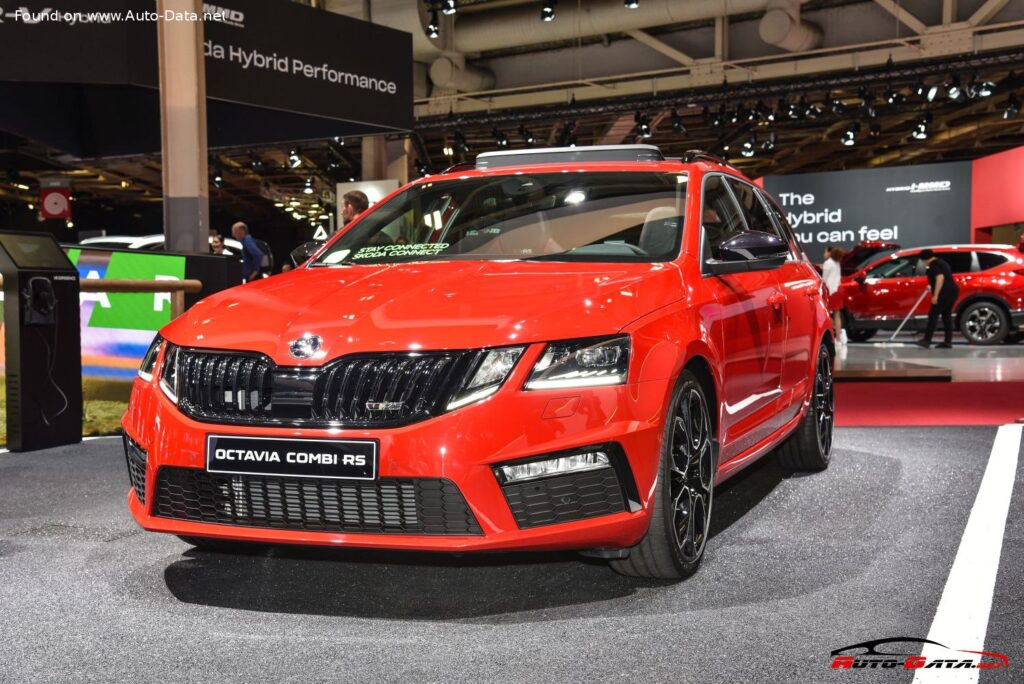
The Skoda Octavia III Combi, in its facelifted 2017 iteration, maintains the brand’s reputation for understated elegance and functional design. The “Combi” designation refers to its station wagon (or estate) body style, which is immensely popular in Europe for its practicality and cargo capacity. The 2017 facelift brought several notable exterior changes, most controversially the split headlight design, which gave the Octavia a more distinctive, albeit polarizing, front fascia. Other updates included revised bumpers, new alloy wheel designs, and subtle tweaks to the rear lights, enhancing its contemporary appeal.
Inside, the Octavia Combi is a masterclass in ergonomic design and spaciousness. It comfortably accommodates five occupants, offering generous head and legroom for both front and rear passengers. The dashboard layout is logical and intuitive, featuring high-quality materials for its class. The 2017 facelift also introduced updated infotainment systems, often with larger touchscreens and improved connectivity options, including Apple CarPlay and Android Auto integration, depending on the trim level. Practicality is a core tenet of the Octavia, evident in its vast cargo area. With the rear seats in place, the trunk offers a minimum of 21.54 cubic feet (610 liters) of space, which expands to an enormous 61.45 cubic feet (1740 liters) with the rear seats folded down. This class-leading capacity makes it an ideal choice for families, active lifestyles, or those needing significant hauling capability.
Safety features for the 2017 model year included standard ABS (Anti-lock Braking System), with options for advanced driver-assistance systems such as adaptive cruise control, front assist with predictive pedestrian protection, and blind-spot detection, reflecting the growing emphasis on active safety in modern vehicles. The steering system, an electric power-assisted rack and pinion, provided a comfortable and predictable driving experience.
Technical Specifications
| Specification | Value |
|---|---|
| General Information | |
| Brand | Skoda |
| Model | Octavia |
| Generation | Octavia III Combi (facelift 2017) |
| Type (Engine) | 1.4 G-TEC (110 Hp) CNG DSG |
| Start of Production | 2017 year |
| End of Production | 2018 year |
| Powertrain Architecture | Internal Combustion engine |
| Body type | Station wagon (estate) |
| Seats | 5 |
| Doors | 5 |
| Performance Specs | |
| Fuel consumption (economy) – urban | 6.8 l/100 km (34.6 US mpg) |
| Fuel consumption (economy) – extra urban | 4.8 l/100 km (49 US mpg) |
| Fuel consumption (economy) – combined | 5.5 l/100 km (42.8 US mpg) |
| CO2 emissions | 126 g/km |
| CO2 emissions (CNG) | 99 g/km |
| Fuel Type | Petrol / CNG |
| Acceleration 0 – 60 mph | 10.5 sec |
| Maximum speed | 193 km/h (119.92 mph) |
| Emission standard | Euro 6 |
| Weight-to-power ratio | 12.4 kg/Hp (80.5 Hp/tonne) |
| Weight-to-torque ratio | 6.8 kg/Nm (146.4 Nm/tonne) |
| Engine Specs | |
| Power | 110 Hp |
| Power per liter | 78.9 Hp/l |
| Torque | 200 Nm (147.51 lb.-ft.) @ 1500-3500 rpm |
| Engine layout | Front, Transverse |
| Engine Model/Code | CPWA |
| Engine displacement | 1395 cm3 (85.13 cu. in.) |
| Number of cylinders | 4 |
| Engine configuration | Inline |
| Cylinder Bore | 74.5 mm (2.93 in.) |
| Piston Stroke | 80 mm (3.15 in.) |
| Number of valves per cylinder | 4 |
| Fuel injection system | Direct injection |
| Engine aspiration | Turbocharger |
| Engine oil capacity | 4 l (4.23 US qt) |
| Space, Volume and Weights | |
| Kerb Weight | 1366 kg (3011.51 lbs.) |
| Max. weight | 1879 kg (4142.49 lbs.) |
| Max load | 513 kg (1130.97 lbs.) |
| Trunk (boot) space – minimum | 610 l (21.54 cu. ft.) |
| Trunk (boot) space – maximum | 1740 l (61.45 cu. ft.) |
| Fuel tank capacity | 50 l (13.21 US gal) |
| CNG cylinder capacity | 15 kg |
| Max. roof load | 75 kg (165.35 lbs.) |
| Dimensions | |
| Length | 4667 mm (183.74 in.) |
| Width | 1814 mm (71.42 in.) |
| Height | 1462 mm (57.56 in.) |
| Wheelbase | 2680 mm (105.51 in.) |
| Front track | 1543 mm (60.75 in.) |
| Rear (Back) track | 1549 mm (60.98 in.) |
| Minimum turning circle (turning diameter) | 10.59 m (34.74 ft.) |
| Drivetrain, Brakes and Suspension Specs | |
| Drivetrain Architecture | Front-wheel drive, Internal Combustion engine |
| Drive wheel | Front wheel drive |
| Number of gears and type of gearbox | 7 gears, automatic transmission DSG |
| Front brakes | Ventilated discs |
| Rear brakes | Disc |
| Assisting systems | ABS (Anti-lock braking system) |
| Steering type | Steering rack and pinion |
| Power steering | Electric Steering |
| Tires size | 205/55 R16 |
| Wheel rims size | 16 inches |
Legacy & Market Impact
The Skoda Octavia, particularly in its Combi form, has carved out a significant niche in the European automotive landscape. It is widely regarded as a benchmark for practicality, value, and robust engineering within the compact segment. For many European families and fleet operators, the Octavia represented a smart, no-nonsense choice that offered Volkswagen Group quality and technology at a more accessible price point than its Volkswagen Golf Variant sibling, while providing superior space. Its reputation for reliability and low running costs further enhanced its appeal.
The 1.4 G-TEC variant, specifically, played an important role in Skoda’s strategy to offer environmentally conscious options. In countries like Germany, Italy, Austria, and Sweden, where CNG refueling infrastructure is more prevalent, the G-TEC models provided a compelling alternative to traditional gasoline or diesel powertrains. The lower CO2 emissions and reduced fuel costs associated with CNG made it an attractive choice for eco-conscious buyers and those looking to minimize their environmental footprint and operational expenses. Its primary competitors in the European market included other C-segment station wagons such as the Volkswagen Golf Variant, Ford Focus Estate, Opel Astra Sports Tourer, and Peugeot 308 SW. The Octavia consistently stood out due to its superior cargo volume and perceived value.
While the Skoda brand and the Octavia model were never sold in the United States, their impact in Europe is undeniable. The Octavia helped solidify Skoda’s transformation from a former Eastern Bloc manufacturer into a respected, modern automotive brand known for its “Simply Clever” solutions and high-quality vehicles. The third-generation Combi, especially with its efficient and eco-friendly G-TEC powertrain, remains a testament to Skoda’s commitment to delivering practical, well-engineered cars that meet the evolving demands of the European market, balancing performance, comfort, and environmental responsibility.