The Renault Clio IV RS 1.6 (200 Hp) EDC S&S: A European Hot Hatch Icon
The Renault Clio, a name synonymous with the supermini segment in Europe, has consistently offered a compelling blend of practicality, style, and driving enjoyment since its introduction in 1990. Among its various iterations, the performance-oriented Renault Sport (RS) variants have carved out a formidable reputation, embodying the spirit of accessible high-performance for enthusiasts. The subject of this expert analysis is the Renault Clio IV RS 1.6 (200 Hp) EDC S&S, specifically the Phase II model introduced in 2016. This generation, produced from 2016 to 2018, represented a significant evolution for the Clio RS, embracing modern powertrain technology and a more refined approach to the hot hatch formula. While this particular model was not officially sold in the United States market, its influence and engineering prowess are recognized globally, showcasing Renault Sport’s commitment to dynamic excellence within the fiercely competitive European B-segment hot hatch landscape.
The Clio IV RS Phase II built upon the foundation of the initial Clio IV RS, which had already introduced a turbocharged engine and an automatic-only transmission – a departure from the naturally aspirated, manual-only tradition of previous RS models. The 2016 update brought subtle but impactful refinements to the styling, chassis, and interior, aiming to sharpen its appeal and address initial feedback. Positioned as a direct competitor to other European pocket rockets like the Ford Fiesta ST and the Volkswagen Polo GTI, the Clio IV RS 1.6 (200 Hp) EDC S&S offered a distinctive French flair, combining everyday usability with genuine track capability, thanks to its sophisticated powertrain and Renault Sport’s meticulous tuning.
Engine and Performance of the Renault Clio IV RS 1.6 (200 Hp) EDC S&S
At the heart of the Renault Clio IV RS 1.6 (200 Hp) EDC S&S lies a potent 1.6-liter turbocharged inline-four engine, designated by the code M5M 400. This unit is a testament to modern engine design, featuring direct injection, a turbocharger, and an intercooler to maximize both power output and efficiency. It generates a robust 200 horsepower at 6050 revolutions per minute, delivering a specific output of 123.6 horsepower per liter – an impressive figure for an engine of its size. Torque is equally significant, with 191.77 lb.-ft. (260 Nm) available from a low 2000 rpm, ensuring strong acceleration across a broad rev range and excellent responsiveness.
Power is channeled to the front wheels through a sophisticated 6-speed EDC (Efficient Dual Clutch) automatic transmission. This gearbox, a key feature differentiating it from its manual-transmission predecessors, offers rapid gear changes and the convenience of automatic operation, while also providing manual control via paddle shifters. The inclusion of a Start & Stop system further enhances fuel efficiency, particularly in urban driving conditions, contributing to its Euro 6b emission standard compliance.
The performance figures underscore the Clio RS’s sporting credentials: an acceleration time of 0 to 60 mph (0-97 km/h) in a swift 6.4 seconds, and a top speed of 142.92 mph (230 km/h). Despite its performance focus, the Clio IV RS 1.6 (200 Hp) EDC S&S achieves commendable fuel economy for a hot hatch, with a combined rating of 39.9 US mpg (5.9 l/100 km). Urban driving yields approximately 30.9 US mpg (7.6 l/100 km), while extra-urban cruising can see figures as high as 46.1 US mpg (5.1 l/100 km). These metrics, alongside its CO2 emissions of 133 g/km, highlight a balanced approach to performance and environmental considerations, making it an attractive proposition for the discerning European buyer.
Design and Features
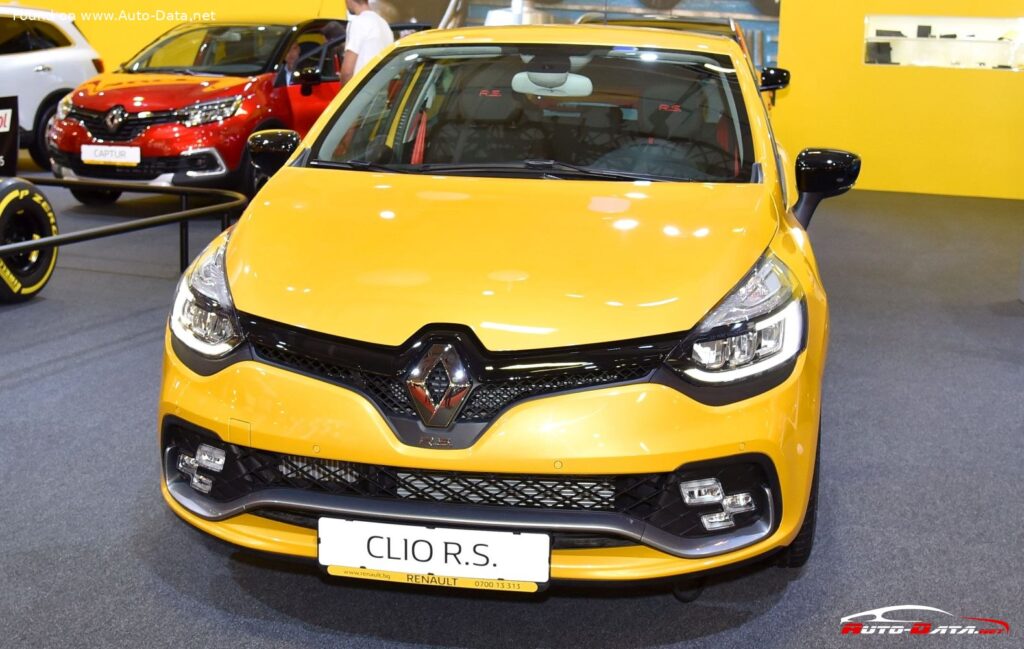
The Renault Clio IV RS 1.6 (200 Hp) EDC S&S maintains the sleek and dynamic five-door hatchback body style of the standard Clio, but with a host of aggressive enhancements typical of Renault Sport models. The Phase II update introduced subtle styling revisions, including updated LED lighting signatures, a revised front bumper, and more prominent RS badging. Its aggressive stance is accentuated by unique alloy wheels, with 17-inch as standard and 18-inch options available, wrapped in performance-oriented tires (205/45 R17 or 205/40 R18).
Dimensionally, the Clio RS is a compact and agile vehicle, measuring 159.92 inches (4062 mm) in length, 68.15 inches (1731 mm) in width (76.57 inches or 1945 mm including mirrors), and 57.01 inches (1448 mm) in height. Its 101.93-inch (2589 mm) wheelbase contributes to its stable yet nimble handling characteristics. The curb weight of 2654.37 lbs (1204 kg) ensures a favorable weight-to-power ratio of 6 kg/Hp (166.1 Hp/tonne), aiding its spirited performance.
Inside, the Clio RS boasts a driver-focused cockpit with sport seats, RS-specific trim, and instrumentation designed to enhance the driving experience. While exact interior feature lists can vary by market and option packages, standard safety features include ABS (Anti-lock Braking System) and a comprehensive airbag system. The steering system utilizes a rack and pinion setup, engineered for precise feedback and responsiveness. Braking performance is handled by ventilated discs at the front and solid discs at the rear, providing ample stopping power for a car of its caliber. The overall design emphasizes a blend of everyday practicality with the unmistakable visual cues of a high-performance hot hatch.
Technical Specifications
| Category | Specification | Metric Value | US Customary / Equivalent |
|---|---|---|---|
General Information |
|||
| Brand | Renault | ||
| Model | Clio | ||
| Generation | Clio IV (Phase II, 2016) | ||
| Engine Type | RS 1.6 (200 Hp) EDC S&S | ||
| Production Start | 2016 | ||
| Production End | 2018 | ||
| Powertrain Architecture | Internal Combustion engine | ||
| Body type | Hatchback | ||
| Seats | 5 | ||
| Doors | 5 | ||
Performance Specs |
|||
| Fuel consumption (economy) – urban | 7.6 l/100 km | 30.9 US mpg | |
| Fuel consumption (economy) – extra urban | 5.1 l/100 km | 46.1 US mpg | |
| Fuel consumption (economy) – combined | 5.9 l/100 km | 39.9 US mpg | |
| CO2 emissions | 133 g/km | ||
| Fuel Type | Petrol (Gasoline) | ||
| Acceleration 0 – 60 mph (Calculated) | 6.4 sec | ||
| Acceleration 0 – 100 km/h | 6.7 sec | ||
| Maximum speed | 230 km/h | 142.92 mph | |
| Emission standard | Euro 6 b | ||
| Weight-to-power ratio | 6 kg/Hp | 166.1 Hp/tonne | |
| Weight-to-torque ratio | 4.6 kg/Nm | 215.9 Nm/tonne | |
Engine Specs |
|||
| Power | 200 Hp @ 6050 rpm | ||
| Power per liter | 123.6 Hp/l | ||
| Torque | 260 Nm @ 2000 rpm | 191.77 lb.-ft. @ 2000 rpm | |
| Engine layout | Front, Transverse | ||
| Engine Model/Code | M5M 400 | ||
| Engine displacement | 1618 cm3 | 1.6 Liters (98.74 cu. in.) | |
| Number of cylinders | 4 | Inline | |
| Number of valves per cylinder | 4 | ||
| Fuel injection system | Direct injection | ||
| Engine aspiration | Turbocharger, Intercooler | ||
| Engine oil capacity | 4.5 l | 4.76 US qt | |
| Engine oil specification | (Data not provided) | ||
| Coolant capacity | 8 l | 8.45 US qt | |
| Engine systems | Start & Stop System | ||
Space, Volume and Weights |
|||
| Kerb Weight | 1204 kg | 2654.37 lbs. | |
| Max. weight | 1711 kg | 3772.11 lbs. | |
| Max load | 507 kg | 1117.74 lbs. | |
Dimensions |
|||
| Length | 4062 mm | 159.92 in. | |
| Width | 1731 mm | 68.15 in. | |
| Width including mirrors | 1945 mm | 76.57 in. | |
| Height | 1448 mm | 57.01 in. | |
| Wheelbase | 2589 mm | 101.93 in. | |
| Front track | 1506 mm | 59.29 in. | |
| Rear (Back) track | 1506 mm | 59.29 in. | |
| Front overhang | 851 mm | 33.5 in. | |
| Rear overhang | 622 mm | 24.49 in. | |
| Ride height (ground clearance) | 120 mm | 4.72 in. | |
Drivetrain, Brakes and Suspension Specs |
|||
| Drivetrain Architecture | Internal combustion engine (ICE) drives the front wheels. | ||
| Drive wheel | Front wheel drive | ||
| Number of gears and type of gearbox | 6 gears, automatic transmission | ||
| Front brakes | Ventilated discs | ||
| Rear brakes | Disc | ||
| Assisting systems | ABS (Anti-lock braking system) | ||
| Steering type | Steering rack and pinion | ||
| Tires size | 205/45 R17; 205/40 R18 | ||
| Wheel rims size | 17; 18 | ||
Legacy and Market Impact
The Renault Clio IV RS 1.6 (200 Hp) EDC S&S holds a significant place in the lineage of Renault Sport vehicles, representing a pivotal moment in the brand’s evolution. It marked a clear shift towards a more technologically integrated and less raw driving experience compared to its naturally aspirated, manual-only predecessors. This change, while initially polarizing among some purist enthusiasts, broadened its appeal to a wider audience seeking a sophisticated yet potent daily driver.
In the highly competitive European hot hatch segment, the Clio IV RS faced stiff competition from formidable rivals such as the Ford Fiesta ST, renowned for its engaging chassis and communicative steering; the Peugeot 208 GTi, offering its own unique French take on performance; and the Volkswagen Polo GTI, which emphasized refinement and everyday usability. The Clio RS distinguished itself with its distinctive styling, the advanced EDC gearbox, and Renault Sport’s reputation for engineering some of the best-handling front-wheel-drive cars in the world. Its chassis, often praised for its balance and agility, provided a compelling blend of compliance for daily driving and firmness for spirited B-road antics or track days.
The Phase II update in 2016 helped to solidify its market position by introducing subtle refinements that enhanced its overall package. While some critics noted a slight reduction in the “analog” feel that characterized older RS models, the Clio IV RS 1.6 (200 Hp) EDC S&S still delivered a highly capable and enjoyable driving experience. Its strong turbocharged engine, quick-shifting dual-clutch transmission, and well-tuned suspension made it a formidable performer, capable of challenging more expensive sports cars on twisty roads. The car’s balance of efficiency and performance, combined with its five-door practicality, made it a compelling choice for those who needed a versatile vehicle without sacrificing driving thrills.
Ultimately, the Renault Clio IV RS 1.6 (200 Hp) EDC S&S contributed to Renault Sport’s enduring legacy as a builder of exceptional performance cars. It showcased Renault’s ability to adapt to changing market demands and technological advancements while retaining the core values of dynamic excellence and driver engagement. Though not a common sight on American roads, its technical specifications and performance capabilities underscore its significance as a benchmark in the global hot hatchback arena, proving that small cars can indeed deliver big thrills.