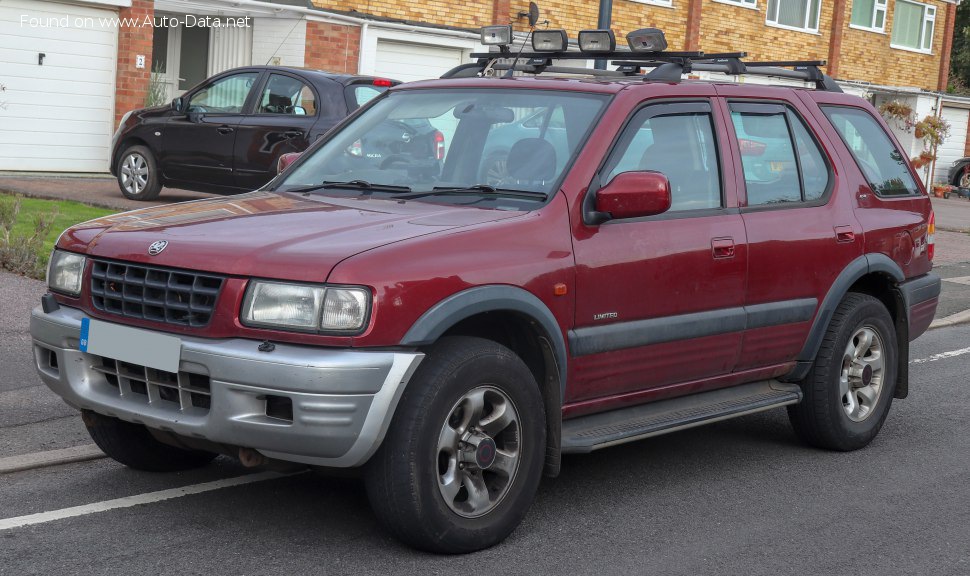
The Vauxhall Frontera 2.4i: A British Take on Global Utility
The Vauxhall Frontera 2.4i, produced from 1992 to 1995, represented a significant entry for the British marque Vauxhall into the burgeoning Sport Utility Vehicle (SUV) market in Europe and the United Kingdom. While never officially sold in the United States under the Vauxhall badge, the Frontera was a rebadged version of the Isuzu MU (Mysterious Utility) or Isuzu Wizard/Rodeo, a testament to General Motors’ global platform sharing strategy. This first-generation Frontera, positioned as a rugged, family-friendly off-roader, offered a blend of practical utility, robust construction, and a more car-like driving experience than traditional utilitarian 4x4s of the era. The 2.4i variant, equipped with a four-cylinder gasoline engine, was a popular choice, providing a balance of performance and efficiency for the demanding European market. Its introduction marked Vauxhall’s commitment to diversifying its lineup beyond conventional sedans and hatchbacks, tapping into the growing consumer demand for versatile, go-anywhere vehicles.
Engine and Performance of the Vauxhall Frontera 2.4i
At the heart of the Vauxhall Frontera 2.4i was the C24NE engine, a naturally aspirated, inline four-cylinder gasoline (petrol) unit. This powerplant, with a displacement of 2,410 cubic centimeters (approximately 2.4 liters or 147.07 cubic inches), was designed for durability and a broad torque curve, characteristic of engines intended for utility vehicles. It featured a multi-port manifold injection system, a relatively modern fuel delivery method for its time, which contributed to more precise fuel metering and improved emissions compared to older carburetor setups.
The engine produced a respectable 125 horsepower at 4,800 revolutions per minute (rpm), making it a competitive offering within its segment. More importantly for an SUV, it generated 195 Newton-meters (143.82 lb.-ft.) of torque at a relatively low 2,400 rpm. This low-end torque was crucial for off-road capability, towing, and carrying heavy loads, allowing the vehicle to pull away confidently without excessive revving. The power-to-liter ratio stood at 51.9 horsepower per liter, indicating a solid, workhorse design rather than a high-revving performance engine.
Mated to a 5-speed manual transmission, the Frontera 2.4i directed its power to an all-wheel-drive (4×4) system, providing enhanced traction and capability across various terrains. While its acceleration figures might seem modest by today’s standards—0 to 60 mph in a calculated 15.7 seconds and a top speed of 95.07 mph—these metrics were considered adequate for a mid-size SUV of the early 1990s, where outright speed was secondary to utility and ruggedness. Fuel economy, while not a primary selling point for SUVs, was an important consideration. The Frontera 2.4i achieved an estimated 20.1 US mpg combined, with 17.7 US mpg in urban driving and 27 US mpg on the extra-urban cycle, reflecting the compromises inherent in its weight and 4×4 drivetrain.
Design and Features
The Vauxhall Frontera was offered as a five-door SUV, designed to be both functional and visually appealing to a broader family audience. Its body-on-frame construction provided the robustness expected of an off-road capable vehicle, ensuring durability under challenging conditions. With a length of 176.38 inches, a width of 68.11 inches, and a height of 67.52 inches, the Frontera was a substantial vehicle for its class, offering a commanding road presence. The wheelbase measured 108.66 inches, contributing to a stable ride and generous interior space.
Inside, the Frontera provided seating for five occupants, making it a practical choice for families. Cargo capacity was a significant advantage, with a minimum trunk space of 430 liters (15.19 cubic feet), expandable to an impressive 1,570 liters (55.44 cubic feet) with the rear seats folded. This versatility allowed it to accommodate everything from weekly groceries to camping gear or sports equipment, a key selling point for the burgeoning SUV lifestyle.
From a safety and handling perspective, the Frontera 2.4i featured ventilated disc brakes at the front and drum brakes at the rear, a common setup for SUVs of its era. It also incorporated an Anti-lock Braking System (ABS), a significant safety feature for the early 1990s, improving stopping performance and control in adverse conditions. The vehicle rode on 235/70 R16 tires mounted on 7J x 16-inch wheel rims, providing a good balance of on-road comfort and off-road traction. The worm-reduction unit steering type, while not as precise as modern rack-and-pinion systems, was robust and reliable, suitable for the vehicle’s intended utility.
Technical Specifications
| General Information | |
| Brand | Vauxhall |
| Model | Frontera |
| Generation | Frontera |
| Type (Engine) | 2.4i (125 Hp) |
| Start of Production | 1992 year |
| End of Production | 1995 year |
| Powertrain Architecture | Internal Combustion engine |
| Body Type | SUV |
| Seats | 5 |
| Doors | 5 |
| Performance Specs | |
| Fuel Consumption (Economy) – Urban | 13.3 l/100 km (17.7 US mpg) |
| Fuel Consumption (Economy) – Extra Urban | 8.7 l/100 km (27 US mpg) |
| Fuel Consumption (Economy) – Combined | 11.7 l/100 km (20.1 US mpg) |
| Fuel Type | Petrol (Gasoline) |
| Acceleration 0 – 60 mph | 15.7 sec |
| Maximum Speed | 153 km/h (95.07 mph) |
| Weight-to-Power Ratio | 13.8 kg/Hp (72.5 Hp/tonne) |
| Weight-to-Torque Ratio | 8.8 kg/Nm (113 Nm/tonne) |
| Engine Specs | |
| Power | 125 Hp @ 4800 rpm |
| Power per Liter | 51.9 Hp/l |
| Torque | 195 Nm @ 2400 rpm (143.82 lb.-ft. @ 2400 rpm) |
| Engine Layout | Front, Longitudinal |
| Engine Model/Code | C24NE |
| Engine Displacement | 2410 cm3 (147.07 cu. in.) |
| Number of Cylinders | 4 |
| Engine Configuration | Inline |
| Cylinder Bore | 95 mm (3.74 in.) |
| Piston Stroke | 85 mm (3.35 in.) |
| Compression Ratio | 9.2:1 |
| Number of Valves per Cylinder | 2 |
| Fuel Injection System | Multi-port manifold injection |
| Engine Aspiration | Naturally aspirated engine |
| Engine Oil Capacity | 5.5 l (5.81 US qt) |
| Coolant Capacity | 8.3 l (8.77 US qt) |
| Space, Volume and Weights | |
| Kerb Weight | 1725 kg (3802.97 lbs.) |
| Max. Weight | 2400 kg (5291.09 lbs.) |
| Max Load | 675 kg (1488.12 lbs.) |
| Trunk (Boot) Space – Minimum | 430 l (15.19 cu. ft.) |
| Trunk (Boot) Space – Maximum | 1570 l (55.44 cu. ft.) |
| Fuel Tank Capacity | 80 l (21.13 US gal) |
| Dimensions | |
| Length | 4480 mm (176.38 in.) |
| Width | 1730 mm (68.11 in.) |
| Height | 1715 mm (67.52 in.) |
| Wheelbase | 2760 mm (108.66 in.) |
| Front Track | 1440 mm (56.69 in.) |
| Rear (Back) Track | 1445 mm (56.89 in.) |
| Drivetrain, Brakes and Suspension Specs | |
| Drive Wheel | All-wheel drive (4×4) |
| Number of Gears and Type of Gearbox | 5 gears, manual transmission |
| Front Brakes | Ventilated discs |
| Rear Brakes | Drum |
| Assisting Systems | ABS (Anti-lock braking system) |
| Steering Type | Worm-reduction unit |
| Tires Size | 235/70 R16 |
| Wheel Rims Size | 7J x 16 |
Legacy and Market Impact of the Vauxhall Frontera
The Vauxhall Frontera, particularly the 2.4i variant, played a pivotal role in establishing Vauxhall (and its sister brand Opel on the European continent) in the rapidly expanding SUV market of the early to mid-1990s. Prior to its arrival, the SUV segment in Europe was largely dominated by more traditional, rugged off-roaders like the Land Rover Discovery, Mitsubishi Shogun (Pajero), and Nissan Terrano II. The Frontera, being a rebadged Isuzu, benefited from Isuzu’s strong reputation for building durable and capable 4×4 vehicles, giving it an immediate credibility in a segment where robustness was key.
Its market impact was significant. The Frontera offered a more affordable and accessible entry point into the SUV lifestyle for many European consumers who might have found the Land Rover Discovery too expensive or the Japanese imports less familiar. Its five-door configuration and generous cargo space made it a practical family vehicle, capable of handling both urban commutes and weekend adventures. The inclusion of features like ABS, while standard on many passenger cars, was a welcome addition to an SUV, enhancing its appeal to safety-conscious buyers.
The Frontera competed directly with vehicles such as the aforementioned Land Rover Discovery, the Mitsubishi Shogun Sport (Challenger in some markets), the Nissan Terrano II, and later, the first-generation Honda CR-V and Toyota RAV4, though the latter two were more car-like crossovers. The Frontera distinguished itself with its more traditional body-on-frame construction, offering superior off-road capability and towing prowess compared to the emerging unibody SUVs. Its straightforward mechanicals and the C24NE engine’s reputation for reliability further cemented its appeal.
Over its production run from 1992 to 1995, the first-generation Frontera helped define the modern SUV segment in Europe. While it was eventually replaced by a second-generation model, the 2.4i variant remains a notable example of early 1990s SUV engineering, blending international design and mechanicals with local market branding. It served as a practical, dependable, and capable vehicle for families and adventurers alike, leaving a legacy as one of the pioneering mass-market SUVs in the UK and European automotive landscape.