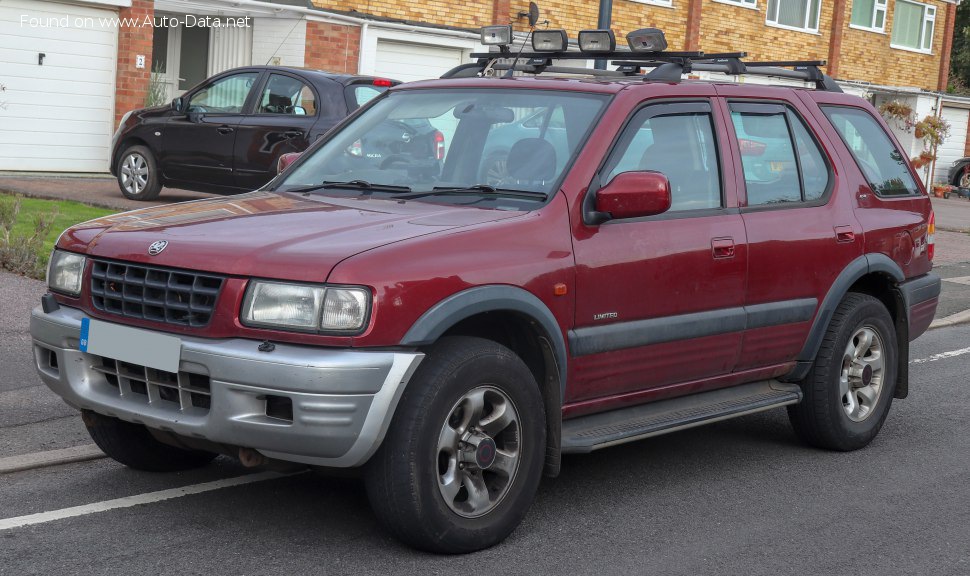
The Vauxhall Frontera 2.5 TDS: A European Utility Vehicle of the Late 1990s
The Vauxhall Frontera 2.5 TDS represents a significant chapter in the European utility vehicle market during the mid to late 1990s. Produced by Vauxhall, General Motors’ British subsidiary, the Frontera was essentially a rebadged version of the Isuzu MU (Mysterious Utility) or Isuzu Rodeo/Wizard, tailored for the European market. The model discussed here, specifically the 2.5 TDS variant with 115 horsepower, was part of the first generation Frontera’s production run from 1996 to 1998. It carved out a niche as a practical, rugged, and relatively affordable SUV, offering five doors and seating for five, designed to tackle both urban environments and light off-road adventures. While the Vauxhall brand itself was not present in the United States, its Isuzu twin, the Rodeo, enjoyed a similar market position stateside, making the Frontera’s underlying architecture familiar to a global audience interested in accessible SUVs.
Engine & Performance of the Vauxhall Frontera 2.5 TDS
At the heart of this particular Vauxhall Frontera was a 2.5-liter (2499 cm³) inline four-cylinder diesel engine, designated as the VM41B. This powerplant delivered 115 horsepower at a modest 3600 rpm and a robust 191.77 lb.-ft. (260 Nm) of torque, peaking at an accessible 1800 rpm. The engine’s configuration, featuring a front, longitudinal layout and equipped with a turbocharger, was well-suited for a utility vehicle of its size and intended purpose. Diesel engines in Europe during this era were prized for their torque characteristics and fuel efficiency, especially in larger vehicles like SUVs.
The power delivery was managed through a 5-speed manual transmission, sending power to an all-wheel-drive (4×4) system, emphasizing its capability beyond paved roads. Performance figures, while not exhilarating by modern standards, were adequate for the time and segment. The Vauxhall Frontera 2.5 TDS could accelerate from 0 to 60 mph in approximately 16 seconds, with a top speed of around 93.83 mph (151 km/h). These numbers underscore its utilitarian nature rather than a focus on outright speed.
Fuel economy, a key consideration for diesel buyers, was rated at 18.1 US mpg (13 l/100 km) in urban driving and a more respectable 27.4 US mpg (8.6 l/100 km) on the extra-urban cycle. With an 80-liter (21.13 US gallon) fuel tank, the Frontera offered a decent cruising range, making it suitable for longer journeys characteristic of European travel. The engine’s architecture, including its precombustion chamber injection system and a high compression ratio of 21:1, was typical for diesel technology of the mid-90s, prioritizing durability and low-end grunt.
Design & Features
The Vauxhall Frontera adopted the classic SUV silhouette, characterized by its boxy, functional design. As a five-door, five-seat SUV, it offered practical interior space and versatility. Its exterior dimensions – a length of 184.72 inches (4692 mm), a width of 69.45 inches (1764 mm), and a height of 69.02 inches (1753 mm) – positioned it as a mid-size SUV, capable of accommodating families and their gear. The 108.66-inch (2760 mm) wheelbase contributed to a stable ride, both on and off the pavement.
Inside, the Frontera emphasized practicality and robust construction over luxury. While specific interior trim details varied by market and optional packages, the overall design was straightforward and hard-wearing, built to withstand the rigors of family use and light off-roading. Cargo capacity was a strong suit, with a minimum trunk space of 19.07 cubic feet (540 liters), expanding significantly to 60.74 cubic feet (1720 liters) with the rear seats folded, making it a capable hauler for luggage, sports equipment, or work-related items.
In terms of safety and driving aids, the Frontera of this era featured essential technologies. Anti-lock Braking System (ABS) was a notable assisting system, providing improved control during emergency braking. The vehicle was equipped with ventilated disc brakes on both front and rear axles, offering reliable stopping power for its 4232.88 lbs (1920 kg) kerb weight. Steering was handled by a worm-reduction unit with hydraulic power steering, providing a robust and communicative feel, especially important for a vehicle designed with some off-road prowess. The 235/70 R16 tires on 7J x 16 wheels provided a good balance of road comfort and grip for varied terrain.
Technical Specifications
| Category | Specification | US Equivalent |
|---|---|---|
General Information |
||
| Brand | Vauxhall | N/A |
| Model | Frontera | N/A |
| Generation | Frontera (First Generation) | N/A |
| Type (Engine) | 2.5 TDS (115 Hp) | N/A |
| Production Start | 1996 | N/A |
| Production End | 1998 | N/A |
| Powertrain Architecture | Internal Combustion Engine | N/A |
| Body Type | SUV | SUV |
| Seats | 5 | 5 |
| Doors | 5 | 5 |
Performance Specs |
||
| Fuel Consumption (Urban) | 13 l/100 km | 18.1 US mpg |
| Fuel Consumption (Extra Urban) | 8.6 l/100 km | 27.4 US mpg |
| Fuel Type | Diesel | Diesel |
| Acceleration 0 – 60 mph | 16 sec | 16 sec |
| Maximum Speed | 151 km/h | 93.83 mph |
| Weight-to-power ratio | 16.7 kg/Hp | 36.82 lbs/Hp |
Engine Specs |
||
| Power | 115 Hp @ 3600 rpm | 115 Hp @ 3600 rpm |
| Power per liter | 46 Hp/l | 46 Hp/l |
| Torque | 260 Nm @ 1800 rpm | 191.77 lb.-ft. @ 1800 rpm |
| Engine Layout | Front, Longitudinal | Front, Longitudinal |
| Engine Model/Code | VM41B | VM41B |
| Engine Displacement | 2499 cm³ | 152.5 cu. in. (2.5 liters) |
| Number of Cylinders | 4 | 4 |
| Engine Configuration | Inline | Inline |
| Cylinder Bore | 92 mm | 3.62 in. |
| Piston Stroke | 94 mm | 3.7 in. |
| Compression Ratio | 21:1 | 21:1 |
| Valves per Cylinder | 2 | 2 |
| Fuel Injection System | Precombustion chamber injection | Precombustion chamber injection |
| Engine Aspiration | Turbocharger | Turbocharger |
| Engine Oil Capacity | 6.3 l | 6.66 US qt |
| Coolant Capacity | 8.8 l | 9.3 US qt |
Space, Volume and Weights |
||
| Kerb Weight | 1920 kg | 4232.88 lbs |
| Max. Weight | 2600 kg | 5732.02 lbs |
| Max Load | 680 kg | 1499.14 lbs |
| Trunk (boot) Space – Minimum | 540 l | 19.07 cu. ft. |
| Trunk (boot) Space – Maximum | 1720 l | 60.74 cu. ft. |
| Fuel Tank Capacity | 80 l | 21.13 US gal |
Dimensions |
||
| Length | 4692 mm | 184.72 in. |
| Width | 1764 mm | 69.45 in. |
| Height | 1753 mm | 69.02 in. |
| Wheelbase | 2760 mm | 108.66 in. |
| Front Track | 1455 mm | 57.28 in. |
| Rear Track | 1460 mm | 57.48 in. |
Drivetrain, Brakes and Suspension Specs |
||
| Drive Wheel | All-wheel drive (4×4) | All-wheel drive (4×4) |
| Gearbox | 5 gears, manual transmission | 5 gears, manual transmission |
| Front Brakes | Ventilated discs | Ventilated discs |
| Rear Brakes | Ventilated discs | Ventilated discs |
| Assisting Systems | ABS (Anti-lock braking system) | ABS (Anti-lock braking system) |
| Steering Type | Worm-reduction unit | Worm-reduction unit |
| Power Steering | Hydraulic Steering | Hydraulic Steering |
| Tire Size | 235/70 R16 | 235/70 R16 |
| Wheel Rims Size | 7J x 16 | 7J x 16 |
Legacy & Market Impact of the Vauxhall Frontera
The Vauxhall Frontera, particularly the 2.5 TDS variant from 1996-1998, played a crucial role in the burgeoning European SUV market. As a rebadged Isuzu, it benefited from Isuzu’s reputation for building rugged, reliable utility vehicles. In its primary markets like the United Kingdom and continental Europe (where it was sold as the Opel Frontera), it competed against a growing array of rivals, including the Land Rover Freelander, various Japanese imports like the Toyota RAV4 and Honda CR-V (though these were often smaller or less off-road focused), and other European offerings like the Mercedes-Benz M-Class (which targeted a more premium segment). The Frontera positioned itself as a more affordable and practical alternative to traditional off-roaders, offering a blend of SUV aesthetics, family-friendly space, and genuine 4×4 capability.
Its legacy is one of a dependable, no-frills SUV that provided accessible all-wheel-drive transport for many European families and adventurers. While it might not have been lauded for groundbreaking technology or luxurious interiors, its mechanical robustness, especially with the torquey and efficient diesel engine, made it a popular choice. The Frontera helped popularize the idea of the SUV as a mainstream family vehicle, paving the way for the segment’s explosive growth in the subsequent decades.
The 1996-1998 model years saw the Frontera solidify its position before a more significant redesign in 1998. The 2.5 TDS engine, in particular, was well-regarded for its pulling power and relatively good fuel economy, attributes highly valued in the European context. Despite its non-US branding, the underlying platform, shared with the Isuzu Rodeo, meant that a vehicle with very similar characteristics was experienced by American consumers, highlighting the global nature of automotive design and engineering even in the late 20th century. The Vauxhall Frontera remains a testament to the era when SUVs were transitioning from purely utilitarian workhorses to versatile family vehicles, offering a balance of capability and comfort without excessive complexity.