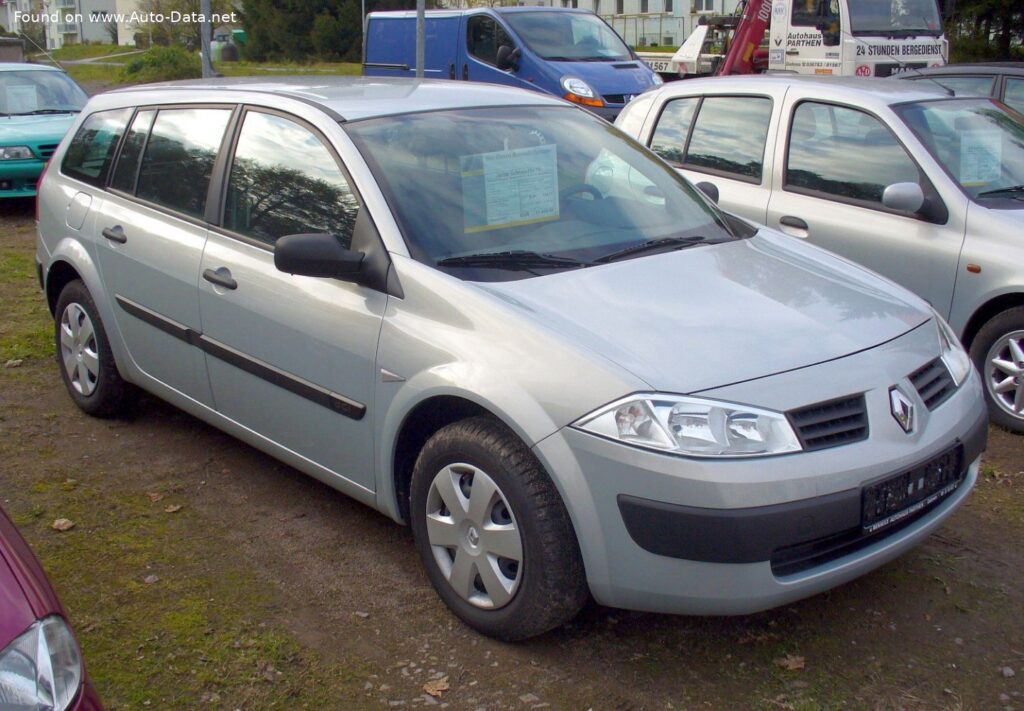
The Renault Megane II Grandtour 1.6 16V (112 Hp) Automatic: A European Family Hauler
The Renault Megane II Grandtour 1.6 16V (112 Hp) Automatic represents a significant offering within the compact segment, specifically tailored for the European market’s demand for practical and versatile family vehicles. Introduced as part of the second generation Megane lineup, the Grandtour, or estate/station wagon variant, debuted in 2003, following the successful launch of the distinctive Megane II hatchback in 2002. The specific 1.6 16V (112 Hp) Automatic configuration, offered for the 2005 model year, combined a reliable powertrain with the enhanced cargo capacity that made the Grandtour a popular choice among families and professionals requiring ample space.
During its production run, the Megane II Grandtour was celebrated for its blend of innovative design, comfort, and safety, characteristics that Renault had increasingly prioritized. While never officially sold in the United States, the Megane II Grandtour played a crucial role in Europe, competing in a fiercely contested segment dominated by homegrown and international brands. This particular variant, with its 112 horsepower engine and automatic transmission, aimed to provide a comfortable and unpretentious driving experience, emphasizing ease of use and practicality over outright performance. It embodied Renault’s vision for a modern, accessible family car, packed with features designed for everyday utility.
Engine and Performance of the Renault Megane II Grandtour
At the heart of the Renault Megane II Grandtour 1.6 16V (112 Hp) Automatic lies Renault’s venerable K4M engine, a 1.6-liter (1598 cm³) naturally aspirated inline four-cylinder unit. This engine, featuring a DOHC (Double Overhead Camshaft) valvetrain with four valves per cylinder, was engineered for a balance of efficiency and smooth power delivery. It produced a respectable 112 horsepower at 6000 rpm, which was competitive for its class at the time, offering sufficient grunt for daily driving and highway cruising. Torque output stood at 112.11 lb.-ft. (152 Nm) at 4200 rpm, ensuring decent pulling power, especially when carrying passengers or cargo.
Power was sent to the front wheels via a 4-speed automatic transmission, a common setup for convenience-oriented models in the European compact segment during this era. While not the most advanced transmission by today’s standards, it provided smooth, if not rapid, gear changes, contributing to a relaxed driving experience. Performance figures for this configuration included an acceleration from 0 to 60 mph in 12.5 seconds, with a top speed of 111.85 mph. These numbers underscored the car’s primary role as a practical family vehicle rather than a performance machine.
Fuel economy was a key consideration, and the Megane II Grandtour 1.6 16V Automatic delivered a combined fuel consumption of 30.5 US mpg (7.7 l/100 km), which was respectable for a compact station wagon with an automatic transmission. Its CO2 emissions of 184 g/km met the Euro 4 emission standard, reflecting a commitment to environmental regulations prevalent in Europe. The engine’s multi-port manifold injection system and 10:1 compression ratio further optimized combustion for efficiency and responsiveness.
Design and Features
The Megane II Grandtour adopted the contemporary design language of the second-generation Megane, albeit with a more conventional rear profile compared to the distinctive “bustle-back” hatchback. As a 5-door station wagon, its design prioritized functionality and cargo volume. Measuring 177.17 inches in length, 69.96 inches in width (79.76 inches including mirrors), and 57.76 inches in height, the Grandtour offered a substantial footprint for its class, contributing to a spacious interior. The generous 105.75-inch wheelbase provided ample legroom for five occupants.
Inside, the Megane II Grandtour was designed with practicality and comfort in mind. The minimum trunk space of 18.36 cubic feet (520 liters) expanded to an impressive 56.5 cubic feet (1600 liters) with the rear seats folded down, making it highly versatile for carrying luggage, sports equipment, or even small furniture. The interior materials and ergonomics were typical of Renault at the time, focusing on user-friendliness and a pleasant cabin environment.
Technological features, while not cutting-edge by today’s standards, were comprehensive for a 2005 model year compact car. Standard safety equipment included an Anti-lock Braking System (ABS), which was a crucial active safety feature. The car featured a steering rack and pinion system with electric power steering, offering light and precise control, particularly beneficial for urban maneuvering. Suspension consisted of an independent McPherson strut setup at the front and a torsion beam axle at the rear, a common and cost-effective configuration that provided a comfortable ride quality balanced with stable handling. Braking power came from ventilated discs at the front and solid discs at the rear. The Megane II Grandtour also offered tire size options of 195/65 R15 or 205/55 R16, mounted on 15-inch or 16-inch wheels, respectively.
Technical Specifications
| Category | Specification |
|---|---|
| Brand | Renault |
| Model | Megane II Grandtour |
| Generation | Megane II Grandtour |
| Type (Engine) | 1.6 16V (112 Hp) Automatic |
| Production Year | 2005 |
| Body Type | Station wagon (estate) |
| Seats | 5 |
| Doors | 5 |
| Performance | |
| Fuel Consumption (Urban) | 22 US mpg (10.7 l/100 km) |
| Fuel Consumption (Extra Urban) | 39.2 US mpg (6 l/100 km) |
| Fuel Consumption (Combined) | 30.5 US mpg (7.7 l/100 km) |
| CO2 Emissions | 184 g/km |
| Fuel Type | Petrol (Gasoline) |
| Acceleration 0-60 mph | 12.5 seconds |
| Maximum Speed | 111.85 mph (180 km/h) |
| Emission Standard | Euro 4 |
| Engine Specs | |
| Power | 112 Hp @ 6000 rpm |
| Torque | 112.11 lb.-ft. @ 4200 rpm (152 Nm) |
| Engine Layout | Front, Transverse |
| Engine Model/Code | K4M |
| Engine Displacement | 1.6 liters (1598 cm³ / 97.52 cu. in.) |
| Number of Cylinders | 4, Inline |
| Valves per Cylinder | 4 |
| Compression Ratio | 10:1 |
| Fuel Injection System | Multi-port manifold injection |
| Engine Aspiration | Naturally aspirated |
| Valvetrain | DOHC |
| Engine Oil Capacity | 5.07 US qt (4.8 l) |
| Coolant Capacity | 6.87 US qt (6.5 l) |
| Dimensions, Volume & Weights | |
| Kerb Weight | 2777.82 lbs. (1260 kg) |
| Max. Weight | 4056.51 lbs. (1840 kg) |
| Max Load | 1278.68 lbs. (580 kg) |
| Trunk Space (Min/Max) | 18.36 – 56.5 cu. ft. (520 – 1600 l) |
| Fuel Tank Capacity | 15.85 US gal (60 l) |
| Length | 177.17 in (4500 mm) |
| Width | 69.96 in (1777 mm) |
| Width (incl. mirrors) | 79.76 in (2026 mm) |
| Height | 57.76 in (1467 mm) |
| Wheelbase | 105.75 in (2686 mm) |
| Minimum Turning Circle | 36.09 ft (11 m) |
| Drivetrain, Brakes & Suspension | |
| Drive Wheel | Front-wheel drive |
| Transmission | 4 gears, automatic |
| Front Suspension | Independent type McPherson |
| Rear Suspension | Torsion |
| Front Brakes | Ventilated discs |
| Rear Brakes | Disc |
| Assisting Systems | ABS (Anti-lock braking system) |
| Steering Type | Steering rack and pinion |
| Power Steering | Electric Steering |
| Tire Sizes | 195/65 R15; 205/55 R16 |
| Wheel Rims Sizes | 6.5J x 15; 6.5J x 16 |
Legacy and Market Impact of the Renault Megane II Grandtour
The Renault Megane II generation, including the Grandtour, left a notable legacy in the European compact car market. It was a critical model for Renault, building on the success of its predecessor and pushing boundaries in design and safety. The Megane II Grandtour, in particular, carved out a strong niche as a highly practical and family-friendly station wagon. Its reputation was built on several pillars: exceptional safety, comfortable ride quality, and impressive versatility.
Renault had made a significant commitment to safety during this period, and the Megane II was one of the first cars in its class to achieve a 5-star Euro NCAP safety rating, which was a major selling point. This focus on occupant protection, combined with features like ABS, instilled confidence in buyers. The Grandtour’s extended wheelbase and generous cargo area directly addressed the needs of families and those requiring more utility than a hatchback could offer, making it a compelling alternative to larger, more expensive vehicles.
Competitors in its primary European market were numerous and strong. The Megane II Grandtour contended with established rivals such as the Volkswagen Golf Variant, Ford Focus Estate, Opel Astra Caravan, and the Peugeot 307 SW. Against these formidable opponents, the Megane II Grandtour often stood out for its distinctive styling (even if less radical than the hatchback), its comfort-oriented suspension tuning, and its strong emphasis on passive and active safety.
Historically, the Megane II Grandtour cemented Renault’s position as a leader in the mainstream European automotive sector. It demonstrated that practicality did not have to come at the expense of design appeal or advanced safety features. While the 1.6 16V (112 Hp) Automatic variant might not have been the fastest or most fuel-efficient option in the lineup, it represented a sensible and comfortable choice for a broad segment of the market, offering a reliable, user-friendly, and capacious vehicle for everyday life. Its impact endures in the continued evolution of compact station wagons, where versatility and safety remain paramount.