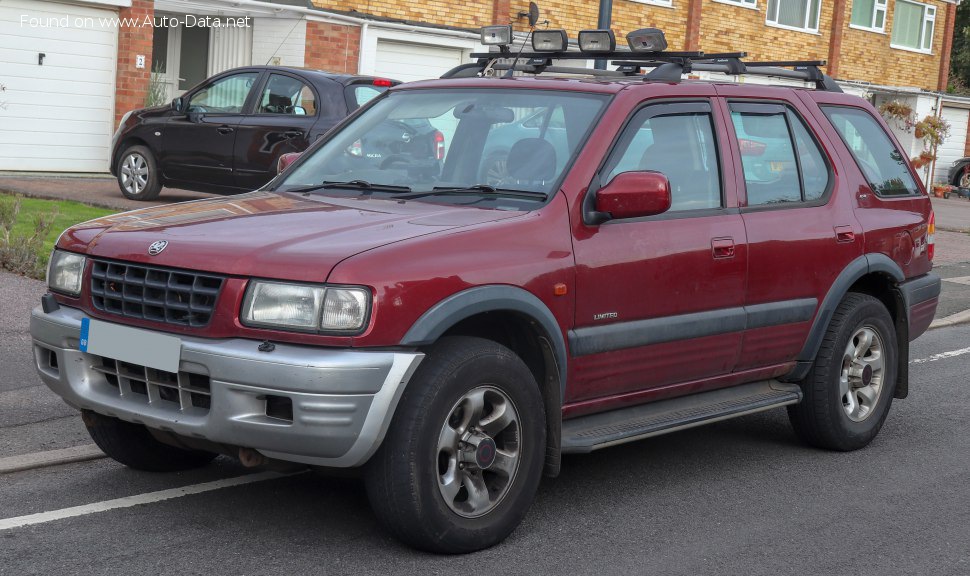
The Vauxhall Frontera Mk II: A European SUV Stalwart (1997-2000)
The Vauxhall Frontera Mk II, specifically the 2.2 DTI (116 Hp) variant, represents the second generation of a rugged and practical sport utility vehicle (SUV) that was a familiar sight on European roads from 1997 to 2000. While never officially sold in the United States under the Vauxhall badge, the Frontera was a rebadged version of the Isuzu MU (Mysterious Utility) or Isuzu Rodeo in other markets, highlighting its international origins and robust design philosophy. In the United Kingdom, where Vauxhall is a prominent brand, the Frontera Mk II carved out a niche as an affordable yet capable 4×4, appealing to families and individuals seeking a versatile vehicle for both daily commuting and light off-road adventures. This particular model, equipped with a diesel engine, aimed to offer a balance of power, torque, and fuel efficiency, a crucial factor in the European market.
Positioned in the increasingly competitive mid-size SUV segment, the Frontera Mk II faced off against a growing number of rivals. It was designed to offer more utility and genuine off-road capability than the emerging “soft-roaders” while being more accessible than traditional, larger luxury SUVs. Its five-door body style and five-seat configuration made it a practical choice for families, offering ample space for passengers and cargo. The 2.2 DTI engine provided a sensible powertrain option, emphasizing longevity and economy, which resonated well with its target demographic across Europe.
Powertrain and Performance of the Vauxhall Frontera Mk II
Engine and Drivetrain
At the heart of the Vauxhall Frontera Mk II 2.2 DTI is a robust 2.2-liter (2171 cm³ or 132.48 cu. in.) inline four-cylinder diesel engine, designated by the code X22DTH. This powerplant features a DOHC (Double Overhead Camshaft) valvetrain with four valves per cylinder, a configuration that was becoming standard for efficient combustion and improved performance in the late 1990s. The engine benefits from a direct injection fuel system and a turbocharger, which significantly boosts its output and torque characteristics.
The engine produces a respectable 116 horsepower (Hp) at 3800 revolutions per minute (rpm), making it a capable performer for its size and era. More importantly for an SUV designed for hauling and off-road use, it delivers a substantial 260 Newton-meters (Nm) of torque, which translates to approximately 191.77 pound-feet (lb.-ft.), available at a low 1900 rpm. This low-end torque is crucial for strong acceleration from a standstill, effortless cruising, and tackling challenging terrain, providing the necessary grunt without having to constantly rev the engine.
Power is channeled to all four wheels through a durable 5-speed manual transmission, offering the driver direct control over the vehicle’s dynamics. The all-wheel-drive (4×4) system, combined with the generous torque, ensures good traction and capability on various surfaces, from paved roads to unpaved tracks. The engine’s compression ratio of 18.5:1 is typical for a direct-injection diesel of its time, contributing to its efficiency.
Driving Dynamics and Fuel Economy
While not a speed demon, the Frontera Mk II 2.2 DTI was designed for utility rather than outright acceleration. It can accelerate from 0 to 60 miles per hour (mph) in approximately 13.3 seconds, and reach a maximum speed of around 97.56 mph (157 km/h). These figures are competitive for a mid-size diesel SUV from the late 1990s, reflecting its focus on practicality and robust performance for everyday tasks.
Fuel economy was a strong suit for the diesel Frontera, especially important in European markets where diesel fuel was often more economical and efficient. The combined fuel consumption is rated at approximately 10.5 liters per 100 kilometers (l/100 km), which translates to an impressive 22.4 US miles per gallon (mpg). In urban driving, it achieved around 20.3 US mpg, improving to about 30.2 US mpg on extra-urban cycles. These figures made the Frontera Mk II an attractive option for drivers covering significant mileage, offering a good balance between performance and running costs. The 75-liter (19.81 US gallons) fuel tank further extended its range between fill-ups.
Design and Features
Exterior and Dimensions
The Vauxhall Frontera Mk II adopted a more refined, yet still unmistakably rugged, exterior design compared to its first generation. As a 5-door SUV, it presented a practical and family-friendly silhouette. Its dimensions—183.39 inches (4658 mm) in length, 70.28 inches (1785 mm) in width, and 68.5 inches (1740 mm) in height—gave it a substantial road presence. The wheelbase measured 106.38 inches (2702 mm), contributing to a stable ride and adequate interior space. The front and rear tracks, at 59.65 inches (1515 mm) and 59.84 inches (1520 mm) respectively, provided a wide stance for stability, especially beneficial during off-road excursions.
The design cues were typical of late 1990s SUVs, featuring a relatively boxy profile with softened edges and a more integrated front fascia compared to its predecessor. Large windows provided good visibility, and the vehicle rode on 245/75 R16 tires mounted on 7J x 16-inch wheel rims, emphasizing its capability to handle diverse terrains.
Interior and Safety
Inside, the Frontera Mk II offered seating for five occupants, with a focus on durability and functionality. While not renowned for luxurious appointments, the interior was designed to withstand the rigors of family life and outdoor activities. Cargo space was generous, with a minimum trunk volume of 13.74 cubic feet (389 liters), expanding to a cavernous 63.21 cubic feet (1790 liters) with the rear seats folded down, making it highly versatile for carrying luggage, sports equipment, or work tools.
In terms of safety and driver aids, the Frontera Mk II included essential features for its time. An Anti-lock Braking System (ABS) was standard, enhancing control during emergency braking situations. The vehicle employed ventilated discs for both front and rear brakes, providing effective stopping power. Steering was managed by a rack and pinion system with hydraulic power steering, offering good feedback and ease of maneuverability, particularly at lower speeds or when navigating challenging off-road conditions.
Technical Specifications: Vauxhall Frontera Mk II 2.2 DTI (116 Hp)
| Specification | Value |
|---|---|
| General Information | |
| Brand | Vauxhall |
| Model | Frontera |
| Generation | Frontera Mk II |
| Type (Engine) | 2.2 DTI (116 Hp) |
| Production Start | 1997 |
| Production End | 2000 |
| Powertrain Architecture | Internal Combustion Engine |
| Body Type | SUV |
| Seats | 5 |
| Doors | 5 |
| Performance Specs | |
| Fuel Consumption (Urban) | 11.6 l/100 km (20.3 US mpg) |
| Fuel Consumption (Extra Urban) | 7.8 l/100 km (30.2 US mpg) |
| Fuel Consumption (Combined) | 10.5 l/100 km (22.4 US mpg) |
| Fuel Type | Diesel |
| Acceleration 0 – 60 mph | 13.3 sec |
| Acceleration 0 – 100 km/h | 14 sec |
| Maximum Speed | 97.56 mph (157 km/h) |
| Weight-to-Power Ratio | 15.3 kg/Hp (65.2 Hp/tonne) |
| Weight-to-Torque Ratio | 6.8 kg/Nm (146.1 Nm/tonne) |
| Engine Specs | |
| Power | 116 Hp @ 3800 rpm |
| Power per Liter | 53.4 Hp/l |
| Torque | 260 Nm (191.77 lb.-ft.) @ 1900 rpm |
| Engine Layout | Front, Longitudinal |
| Engine Model/Code | X22DTH |
| Engine Displacement | 2.2 Liters (2171 cm³, 132.48 cu. in.) |
| Number of Cylinders | 4 |
| Engine Configuration | Inline |
| Cylinder Bore | 3.31 in. (84 mm) |
| Piston Stroke | 3.86 in. (98 mm) |
| Compression Ratio | 18.5:1 |
| Valves per Cylinder | 4 |
| Fuel Injection System | Direct injection |
| Engine Aspiration | Turbocharger |
| Valvetrain | DOHC |
| Engine Oil Capacity | 6.1 Liters (6.45 US qt) |
| Coolant Capacity | 7.9 Liters (8.35 US qt) |
| Space, Volume and Weights | |
| Kerb Weight | 3924.23 lbs. (1780 kg) |
| Max. Weight (GVWR) | 5401.33 lbs. (2450 kg) |
| Max Load | 1477.1 lbs. (670 kg) |
| Trunk Space (Minimum) | 13.74 cu. ft. (389 l) |
| Trunk Space (Maximum) | 63.21 cu. ft. (1790 l) |
| Fuel Tank Capacity | 19.81 US gal (75 l) |
| Dimensions | |
| Length | 183.39 in. (4658 mm) |
| Width | 70.28 in. (1785 mm) |
| Height | 68.5 in. (1740 mm) |
| Wheelbase | 106.38 in. (2702 mm) |
| Front Track | 59.65 in. (1515 mm) |
| Rear (Back) Track | 59.84 in. (1520 mm) |
| Drivetrain, Brakes and Suspension | |
| Drive Wheel | All-wheel drive (4×4) |
| Gearbox Type | 5 gears, Manual Transmission |
| Front Brakes | Ventilated discs |
| Rear Brakes | Ventilated discs |
| Assisting Systems | ABS (Anti-lock braking system) |
| Steering Type | Steering rack and pinion |
| Power Steering | Hydraulic Steering |
| Tire Size | 245/75 R16 |
| Wheel Rims Size | 7J x 16 |
Legacy and Market Impact of the Vauxhall Frontera Mk II
The Vauxhall Frontera Mk II, particularly the 2.2 DTI variant, played a significant role in the European SUV landscape of the late 1990s. As a rebadged Isuzu model, it benefited from a reputation for robustness and reliability, traits that were highly valued by consumers seeking a durable vehicle. While it didn’t boast the premium feel of some European or Japanese rivals, its honest, no-frills approach to SUV motoring resonated with a segment of the market that prioritized utility and capability over luxury.
In its primary market, the Frontera Mk II competed against a diverse range of vehicles. Direct competitors included other mid-size, rugged SUVs like the Land Rover Freelander, Nissan Terrano II, Mitsubishi Shogun Sport, and the SsangYong Musso. Against these, the Frontera often offered a compelling package in terms of pricing and perceived value, especially for those who appreciated its straightforward mechanicals and proven off-road prowess. It stood apart from the burgeoning crossover segment, which was starting to gain traction with models like the Toyota RAV4 and Honda CR-V, by offering a more traditional body-on-frame construction and genuine low-range gearing in some configurations (though not specified for this particular model, it was a common Frontera trait), making it more suited for serious off-road work.
The Frontera’s legacy is that of a workhorse and a practical family vehicle. It wasn’t designed to be revolutionary, but rather evolutionary, building on the established reputation of its Isuzu underpinnings. Its diesel engine option was particularly well-received, offering the kind of torque and fuel economy that made it suitable for towing, long-distance travel, and daily family duties without excessive running costs. The Mk II generation refined the original Frontera’s design and improved its on-road manners, making it a more comfortable and appealing proposition for a broader audience.
Ultimately, the Vauxhall Frontera Mk II served its purpose well. It provided a dependable, capable, and relatively affordable SUV option for consumers in Europe, solidifying Vauxhall’s presence in a rapidly expanding segment. Although production ceased in 2000, its impact as a reliable, go-anywhere vehicle helped shape the expectations for mid-size SUVs in its market, paving the way for future generations of versatile family haulers. It remains a testament to a period when SUVs were often more about utility and adventure than urban sophistication.