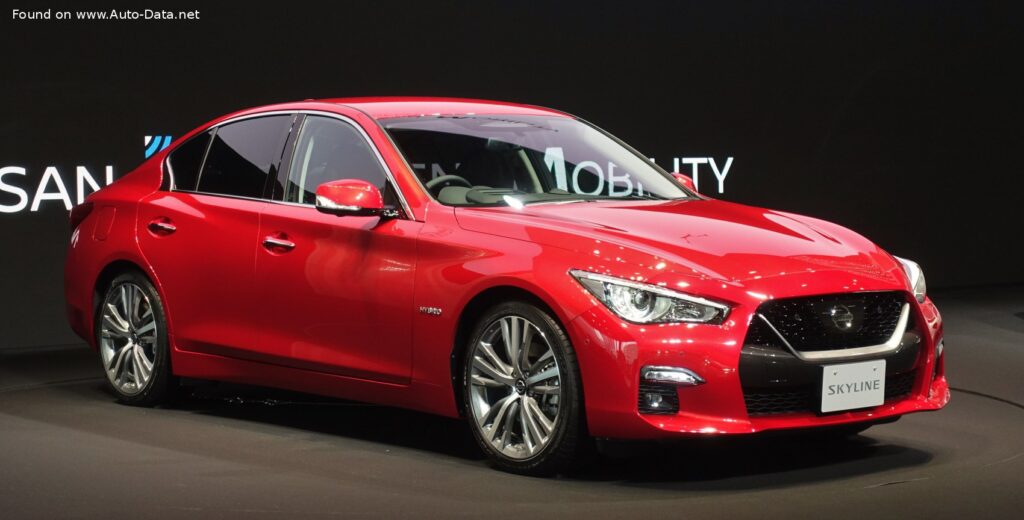
Introduction to the Nissan Skyline XIII (HV37, facelift 2017)
The Nissan Skyline, a name synonymous with performance and technological innovation in the automotive world, continued its storied legacy with the thirteenth generation, internally designated HV37. Specifically, the model under review is the facelifted version introduced in December 2017, featuring a sophisticated 3.5 V6 hybrid powertrain paired with an automatic transmission. This iteration of the Skyline, while known internationally as the Infiniti Q50, retains its iconic Nissan badging and market position as a premium sports sedan in its home market of Japan. It represents a significant step in the Skyline’s evolution, blending traditional V6 power with advanced hybrid electric vehicle (FHEV) technology to deliver a compelling mix of performance, efficiency, and refined luxury.
Produced from December 2017 through 2019, the Nissan Skyline XIII (HV37, facelift 2017) showcased Nissan’s commitment to hybrid powertrains in its luxury and performance segments. As a four-door, five-seat sedan, it aimed to cater to discerning drivers seeking a dynamic driving experience without compromising on fuel economy or environmental considerations. This model was a testament to Nissan’s engineering prowess, integrating a powerful gasoline engine with a robust electric motor to create a seamless and responsive driving character, solidifying its place as a formidable contender in the mid-size luxury sedan segment in Asia.
Engine and Performance: The Heart of the Nissan Skyline XIII (HV37, facelift 2017)
At the core of the Nissan Skyline XIII (HV37, facelift 2017) lies a sophisticated FHEV powertrain, meticulously engineered to deliver both exhilarating performance and impressive fuel efficiency. The internal combustion engine is Nissan’s renowned VQ35HR, a 3.5-liter V6 unit. This naturally aspirated engine, featuring a DOHC valvetrain and multi-port manifold injection, is celebrated for its smooth power delivery and characteristic sound. It produces a robust 306 horsepower at 6800 rpm and 258.15 lb.-ft. of torque at 5000 rpm, offering a spirited driving experience even on its own. The VQ35HR is a front-longitudinal layout, a classic configuration for rear-wheel-drive performance sedans.
Complementing the V6 engine is a potent electric motor, strategically placed between the combustion engine and the transmission. This electric motor contributes an additional 68 horsepower at 1770-2000 rpm and an impressive 213.89 lb.-ft. of torque from as low as 1770 rpm. The synergy between these two power sources is the key to the hybrid system’s effectiveness. The electric motor provides instant torque from a standstill, eliminating turbo lag and enhancing responsiveness, while the V6 takes over at higher speeds and loads. The combined system output is a formidable 364 horsepower at 6500 rpm and a substantial 420.41 lb.-ft. of torque at 2000 rpm. This power is channeled through a precise 7-speed automatic transmission, ensuring smooth shifts and optimal power delivery to the rear wheels.
The hybrid architecture is a full hybrid electric vehicle (FHEV), meaning it can operate on electric power alone, gasoline power alone, or a combination of both. This flexibility contributes to its impressive combined fuel economy of 34.1 US mpg. Power is stored in a compact Lithium-ion (Li-Ion) battery pack. With a curb weight of 4056.51 lbs., the Skyline HV37 achieves a competitive weight-to-power ratio of 5.1 kg/Hp (or 197.8 Hp/tonne), underscoring its performance credentials. The rear-wheel-drive layout further enhances its dynamic character, providing a traditional sports sedan feel with excellent balance and handling.
Design and Features
The Nissan Skyline XIII (HV37, facelift 2017) embodies a sophisticated and athletic design, typical of a premium Japanese sports sedan. As a four-door sedan, it offers practicality for five occupants while maintaining sleek, aerodynamic lines. The 2017 facelift brought subtle yet impactful enhancements, likely focusing on updated front and rear fascias, revised lighting signatures, and new wheel designs to keep its aesthetic fresh and competitive. Its overall length of 189.37 inches, width of 71.65 inches, and height of 56.69 inches give it a substantial road presence, while the 112.2-inch wheelbase ensures a spacious cabin and stable ride.
Inside, the HV37 Skyline offers a cabin focused on driver engagement and passenger comfort. While specific interior features are not detailed in the raw data, as a premium sedan of its era, one can expect high-quality materials, advanced infotainment systems, and a comprehensive suite of convenience features. The five-seat configuration provides ample room for adults, making it suitable for both daily commuting and longer journeys. Technology plays a crucial role, with features like an electric power steering system enhancing driving feel and responsiveness.
Underpinning the Skyline’s refined ride and handling are its advanced chassis components. The front suspension features a double wishbone setup, known for its ability to provide precise steering and excellent road holding. The rear employs an independent multi-link suspension, which further contributes to ride comfort and dynamic stability. Stopping power is handled by ventilated disc brakes on both the front and rear axles, ensuring confident and consistent deceleration, further aided by an Anti-lock Braking System (ABS). The vehicle rides on either 18-inch or 19-inch wheels, shod with performance-oriented tires (225/50 R18; 245/40 R19) that complement its sporty demeanor. The relatively low ground clearance of 5.12 inches hints at its performance-oriented stance and aerodynamic efficiency.
Technical Specifications
| Feature | Value |
|---|---|
| Brand | Nissan |
| Model | Skyline |
| Generation | Skyline XIII (HV37, facelift 2017) |
| Type (Engine) | 3.5 V6 (364 Hp) Hybrid Automatic |
| Start of production | December, 2017 year |
| End of production | 2019 year |
| Powertrain Architecture | FHEV (Full Hybrid Electric Vehicle) |
| Body type | Sedan |
| Seats | 5 |
| Doors | 4 |
| Fuel consumption (economy) – combined | 34.1 US mpg (6.9 l/100 km) |
| Fuel Type | Petrol (Gasoline) |
| Weight-to-power ratio | 5.1 kg/Hp, 197.8 Hp/tonne |
| Weight-to-torque ratio | 3.2 kg/Nm, 309.8 Nm/tonne |
| Battery technology | Lithium-ion (Li-Ion) |
| Electric motor power | 68 Hp @ 1770-2000 rpm |
| Electric motor Torque | 213.89 lb.-ft. @ 1770 rpm (290 Nm) |
| Electric motor location | Between the combustion engine and the transmission |
| System power | 364 Hp @ 6500 rpm |
| System torque | 420.41 lb.-ft. @ 2000 rpm (570 Nm) |
| Internal combustion engine Power | 306 Hp @ 6800 rpm |
| Power per liter | 87.5 Hp/l |
| Internal combustion engine Torque | 258.15 lb.-ft. @ 5000 rpm (350 Nm) |
| Engine layout | Front, Longitudinal |
| Engine Model/Code | VQ35HR |
| Engine displacement | 3.5 l (3498 cm3, 213.46 cu. in.) |
| Number of cylinders | 6 |
| Engine configuration | V-engine |
| Cylinder Bore | 3.76 in. (95.5 mm) |
| Piston Stroke | 3.2 in. (81.4 mm) |
| Compression ratio | 10.6:1 |
| Number of valves per cylinder | 4 |
| Fuel injection system | Multi-port manifold injection |
| Engine aspiration | Naturally aspirated engine |
| Valvetrain | DOHC |
| Engine oil capacity | 5.18 US qt (4.9 l) |
| Engine oil specification | Not available |
| Coolant capacity | 10.36 US qt (9.8 l) |
| Kerb Weight | 4056.51 lbs. (1840 kg) |
| Max. weight | 4662.78 lbs. (2115 kg) |
| Max load | 606.27 lbs. (275 kg) |
| Fuel tank capacity | 18.49 US gal (70 l) |
| Length | 189.37 in. (4810 mm) |
| Width | 71.65 in. (1820 mm) |
| Height | 56.69 in. (1440 mm) |
| Wheelbase | 112.2 in. (2850 mm) |
| Front track | 60.43 – 60.83 in. (1535-1545 mm) |
| Rear (Back) track | 61.42 – 61.81 in. (1560-1570 mm) |
| Ride height (ground clearance) | 5.12 in. (130 mm) |
| Minimum turning circle (turning diameter) | 36.75 ft. (11.2 m) |
| Drivetrain Architecture | The Internal combustion engine (ICE) and electric motor drive the rear wheels of the car with the ability to work in full electric or mixed mode. |
| Drive wheel | Rear wheel drive |
| Number of gears and type of gearbox | 7 gears, automatic transmission |
| Front suspension | Double wishbone |
| Rear suspension | Independent multi-link suspension |
| Front brakes | Ventilated discs |
| Rear brakes | Ventilated discs |
| Assisting systems | ABS (Anti-lock braking system) |
| Steering type | Steering rack and pinion |
| Power steering | Electric Steering |
| Tires size | 225/50 R18; 245/40 R19 |
| Wheel rims size | 18; 19 |
Legacy and Market Impact of the Nissan Skyline XIII (HV37, facelift 2017)
The Nissan Skyline XIII, particularly the HV37 hybrid variant, represents a pivotal chapter in the long and illustrious history of the Skyline nameplate. While globally recognized as the Infiniti Q50, its continuation as the Nissan Skyline in Japan underscored its enduring cultural significance and Nissan’s commitment to offering a premium sports sedan in its home market. This generation marked a decisive shift towards integrating advanced hybrid technology into its performance offerings, a testament to the evolving demands for both power and environmental consciousness in the luxury segment.
In its primary market, Japan, the Nissan Skyline HV37 faced stiff competition from domestic rivals such as the Toyota Crown, Lexus IS, and even some higher-end offerings from Mazda. What set the Skyline apart was its unique blend of Nissan’s traditional VQ-series engine performance, enhanced by the immediate torque and efficiency of its hybrid system. It appealed to buyers who appreciated the Skyline’s heritage of dynamic driving and technological sophistication but also desired the benefits of modern fuel economy. The facelifted 2017 model further solidified its appeal by offering updated styling and potentially refreshed interior tech, ensuring it remained competitive.
The HV37’s legacy is defined by its ability to marry performance with efficiency. The seamless integration of the 3.5-liter V6 and the electric motor, delivering a combined 364 horsepower and impressive fuel economy, showcased Nissan’s engineering prowess in hybrid powertrains. It demonstrated that a performance sedan didn’t have to sacrifice efficiency, a trend that became increasingly important across the automotive industry. The rear-wheel-drive architecture, combined with advanced suspension systems, maintained the Skyline’s reputation for engaging driving dynamics, offering a balanced and responsive ride.
Beyond its technical merits, the Nissan Skyline XIII (HV37, facelift 2017) continued the tradition of its predecessors by serving as a flagship for Nissan’s premium sedan segment in Japan. It offered a sophisticated, technologically advanced, and powerful option for consumers, reinforcing the Skyline’s status as an icon of Japanese automotive engineering. Its impact was in proving that the Skyline name could evolve with changing market demands, embracing electrification without losing its core identity as a driver-focused, luxurious, and technologically forward-thinking vehicle.