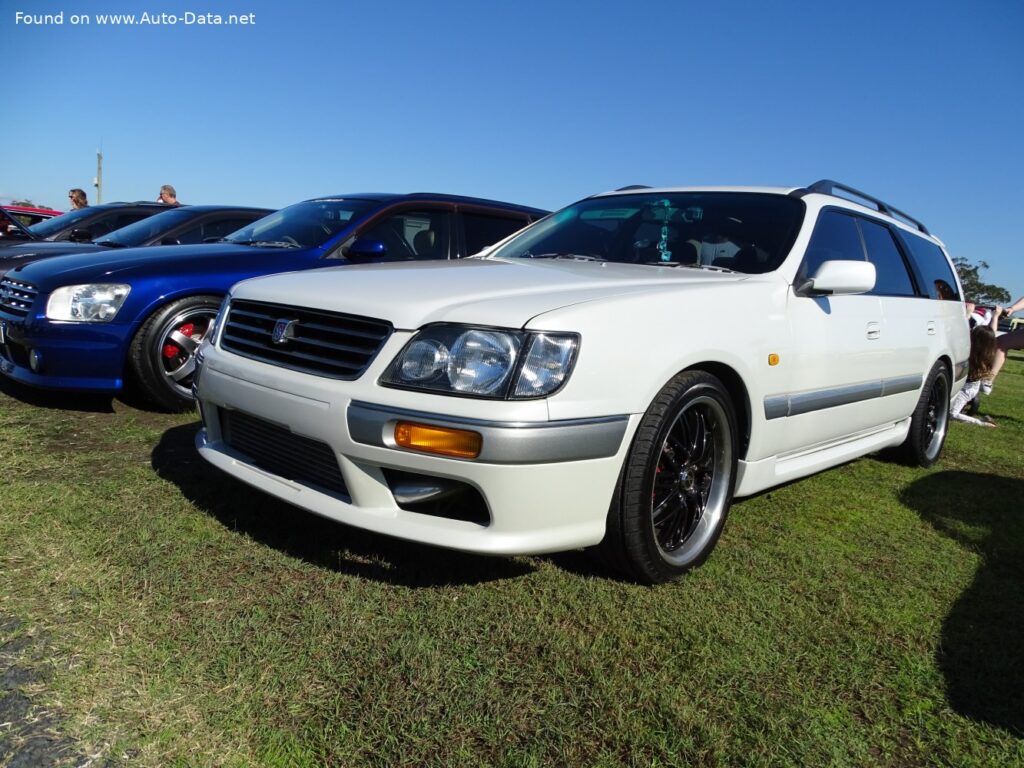
The Nissan Stagea 2.0 (131 Hp): A Practical JDM Icon
The Nissan Stagea, first introduced in 1996, carved out a unique niche in the Japanese domestic market (JDM) as a premium mid-size station wagon. Often referred to as the “Skyline wagon” due to its shared platform with the R33 Skyline, the Stagea offered a compelling blend of practicality, comfort, and performance, wrapped in a distinctive design. This article focuses on the entry-level variant, the Nissan Stagea 2.0 (131 Hp), produced from 1996 to 2001. While never officially sold in North America, the Stagea gained a cult following among enthusiasts worldwide for its robust engineering and versatile nature, embodying Nissan’s commitment to diverse and innovative automotive solutions during the late 20th century.
Engine and Performance: The Heart of the Nissan Stagea
Under the hood, the Nissan Stagea 2.0 (131 Hp) featured the venerable RB20E engine, a naturally aspirated 2.0-liter inline-six. This powerplant, part of Nissan’s highly regarded RB engine family, delivered 131 horsepower at 5600 rpm and a respectable 126.86 lb.-ft. of torque at 4400 rpm. While these figures might seem modest compared to its turbocharged siblings, the RB20E was renowned for its smooth operation, reliability, and characteristic inline-six exhaust note. The engine’s single overhead camshaft (OHC) design with two valves per cylinder emphasized durability and consistent power delivery over peak performance, making it an ideal choice for a daily driver.
Power was sent to the rear wheels via a 5-speed manual transmission, a configuration that appealed to driving enthusiasts seeking a more engaging experience, even in a practical wagon. This rear-wheel-drive architecture, combined with the longitudinally mounted engine, provided balanced handling dynamics. The Stagea 2.0 could achieve a top speed of approximately 118 mph (190 km/h), demonstrating adequate performance for highway cruising and daily commutes within its intended market.
Fuel efficiency for the Nissan Stagea 2.0 (131 Hp) was rated at around 18.1 US mpg in urban conditions and a more economical 29.4 US mpg on extra-urban cycles. These figures, while not groundbreaking by modern standards, were competitive for a 2.0-liter inline-six engine of its era, especially considering the vehicle’s size and weight. The multi-port manifold injection system ensured efficient fuel delivery, contributing to the engine’s overall smooth operation and relatively clean emissions for the time.
Design and Features: Practicality Meets Style
The first-generation Nissan Stagea (WC34) adopted a distinct station wagon body type, offering five doors and comfortable seating for five occupants. Its exterior design shared visual cues with the R33 Skyline, particularly evident in the front fascia, giving it a sporty yet sophisticated appearance. With a length of 188.98 inches, a width of 69.09 inches, and a height of 58.66 inches, the Stagea presented a substantial road presence, emphasizing its role as a spacious family vehicle. The wheelbase of 107.09 inches contributed to a stable ride and generous interior volume.
Inside, the Stagea was designed with practicality and comfort in mind. The large cargo area, a hallmark of station wagons, offered significant versatility for hauling luggage, groceries, or sports equipment. The interior appointments, while not overtly luxurious in the base 2.0-liter model, were well-appointed and durable, reflecting Nissan’s focus on quality materials for the Japanese market.
From a chassis perspective, the Nissan Stagea 2.0 (131 Hp) featured a robust suspension system with coil springs at both the front and rear, providing a comfortable ride quality while maintaining competent handling. Braking duties were handled by ventilated discs at the front and solid discs at the rear, complemented by an Anti-lock Braking System (ABS) for enhanced safety during emergency stops. The hydraulic power steering, utilizing a rack and pinion system, offered precise control and good feedback to the driver, making the Stagea surprisingly engaging to drive for a wagon of its size. Standard 195/65 R15 tires provided a balance of grip and ride comfort.
Technical Specifications: Nissan Stagea 2.0 (131 Hp)
| Category | Specification |
|---|---|
| General Information | |
| Brand | Nissan |
| Model | Stagea |
| Generation | Stagea (WC34) |
| Type (Engine) | 2.0 (131 Hp) |
| Start of Production | 1996 year |
| End of Production | 2001 year |
| Powertrain Architecture | Internal Combustion engine |
| Body type | Station wagon (estate) |
| Seats | 5 |
| Doors | 5 |
| Performance Specs | |
| Fuel consumption (economy) – urban | 18.1 US mpg (13 l/100 km) |
| Fuel consumption (economy) – extra urban | 29.4 US mpg (8 l/100 km) |
| Fuel Type | Petrol (Gasoline) |
| Maximum speed | 118.06 mph (190 km/h) |
| Weight-to-power ratio | 10.9 kg/Hp, 91.6 Hp/tonne |
| Weight-to-torque ratio | 8.3 kg/Nm, 120.3 Nm/tonne |
| Engine Specs | |
| Power | 131 Hp @ 5600 rpm |
| Power per liter | 65.6 Hp/l |
| Torque | 126.86 lb.-ft. @ 4400 rpm (172 Nm) |
| Engine layout | Front, Longitudinal |
| Engine displacement | 2.0 liters (1998 cm³, 121.93 cu. in.) |
| Number of cylinders | 6 |
| Engine configuration | Inline |
| Cylinder Bore | 3.07 in. (78 mm) |
| Piston Stroke | 2.74 in. (69.7 mm) |
| Compression ratio | 9.5:1 |
| Number of valves per cylinder | 2 |
| Fuel injection system | Multi-port manifold injection |
| Engine aspiration | Naturally aspirated engine |
| Valvetrain | OHC |
| Space, Volume and Weights | |
| Kerb Weight | 3152.61 lbs (1430 kg) |
| Fuel tank capacity | 17.96 US gal (68 liters) |
| Dimensions | |
| Length | 188.98 in. (4800 mm) |
| Width | 69.09 in. (1755 mm) |
| Height | 58.66 in. (1490 mm) |
| Wheelbase | 107.09 in. (2720 mm) |
| Front track | 57.48 in. (1460 mm) |
| Rear (Back) track | 59.65 in. (1515 mm) |
| Drivetrain, Brakes and Suspension Specs | |
| Drivetrain Architecture | Rear wheel drive |
| Drive wheel | Rear wheel drive |
| Number of gears and type of gearbox | 5 gears, manual transmission |
| Front suspension | Coil spring |
| Rear suspension | Coil spring |
| Front brakes | Ventilated discs |
| Rear brakes | Disc |
| Assisting systems | ABS (Anti-lock braking system) |
| Steering type | Steering rack and pinion |
| Power steering | Hydraulic Steering |
| Tires size | 195/65 R15 |
Legacy and Market Impact of the Nissan Stagea
The Nissan Stagea, particularly the first generation, left a significant mark on the Japanese automotive landscape. Its primary market was Japan, where it competed against other popular wagons like the Subaru Legacy Wagon and the Toyota Caldina. The Stagea distinguished itself by offering a more upscale and performance-oriented option, especially with its available inline-six engines and rear-wheel-drive or all-wheel-drive configurations. While the 2.0-liter variant was the entry point, it provided an accessible way for consumers to experience the Stagea’s robust platform and smooth RB engine characteristics.
The Stagea’s reputation soared among enthusiasts, who often saw it as a practical counterpart to the legendary Skyline. Its strong aftermarket support, particularly for engine modifications and suspension upgrades, solidified its status as a tuner-friendly platform. Even the naturally aspirated 2.0-liter models benefited from the Stagea’s inherent chassis balance and the reliability of the RB engine, making them popular choices for those seeking a dependable and spacious daily driver with a hint of sportiness.
Its absence from the North American market meant that the Stagea remained an exclusive JDM model, only accessible through parallel imports in other regions, further enhancing its mystique. The Stagea’s blend of comfortable seating for five, substantial cargo capacity, and an engaging driving experience, even in its base powertrain, contributed to its lasting appeal. It stands as a testament to Nissan’s engineering capabilities in the 1990s, showcasing a commitment to producing versatile vehicles that could cater to both family needs and the desires of driving enthusiasts. The Nissan Stagea 2.0 (131 Hp), though not the most powerful variant, played a crucial role in establishing the model’s foundation, offering a reliable, smooth, and practical option within a highly competitive segment.