Mitsubishi Lancer III 1.8 Diesel (58 Hp): A Global Workhorse of the Mid-1980s
The Mitsubishi Lancer III, introduced in 1983, represented a significant evolution for Mitsubishi Motors in the compact car segment. Known internally as the C10 series, this generation of the Lancer moved away from its rear-wheel-drive predecessors, adopting a modern front-wheel-drive architecture. Among its various powertrains, the Mitsubishi Lancer III 1.8 Diesel (58 Hp) variant stood out as a pragmatic choice for markets prioritizing fuel economy and robust reliability over outright performance. Produced from 1984 to 1986, this specific model served as a testament to Mitsubishi’s commitment to offering efficient and durable vehicles, particularly in European and Asian markets where diesel power was a common and valued option for everyday transportation.
Engine & Performance of the Mitsubishi Lancer III 1.8 Diesel (58 Hp)
Under the hood of the Mitsubishi Lancer III 1.8 Diesel (58 Hp) lay Mitsubishi’s 4D65 engine, a naturally aspirated inline four-cylinder diesel powerplant designed for longevity and economical operation. With a displacement of 1,795 cubic centimeters (109.54 cu. in.), this engine generated a modest 58 horsepower at 4,500 rpm. Torque figures were equally focused on usability, peaking at 108 Newton-meters (79.66 lb.-ft.) at a low 2,500 rpm, providing adequate pulling power for daily driving and light loads. The engine’s layout was front, longitudinal, driving the front wheels through a 5-speed manual transmission, a common and reliable setup for the era.
Performance metrics for the Mitsubishi Lancer III 1.8 Diesel (58 Hp) reflected its utilitarian nature. Acceleration from 0 to 60 mph was achieved in a leisurely 14.7 seconds, while the top speed was rated at 90.1 mph (145 km/h). These figures, while not exhilarating by modern standards, were competitive for a naturally aspirated diesel compact sedan of the mid-1980s. The true strength of this powertrain lay in its fuel efficiency. The Lancer III 1.8 Diesel boasted impressive economy figures, with an urban consumption of approximately 34.1 US mpg (6.9 l/100 km) and an even more remarkable extra-urban consumption of 51.1 US mpg (4.6 l/100 km). This made it a highly attractive option for commuters and families looking to minimize running costs in an era of fluctuating fuel prices.
Further technical details of the 4D65 engine included a high compression ratio of 21.5:1, typical for a diesel engine, and a precombustion chamber injection system, which was standard technology for non-direct injection diesels of the time, contributing to smoother, albeit less efficient, combustion compared to later direct injection systems. The valvetrain was a Single Overhead Camshaft (SOHC) design. Notably, the engine featured 5 valves per cylinder, an advanced and unusual configuration for a naturally aspirated diesel of its time, typically associated with higher-revving gasoline engines, suggesting an early attempt at optimizing airflow for efficiency.
Design & Features
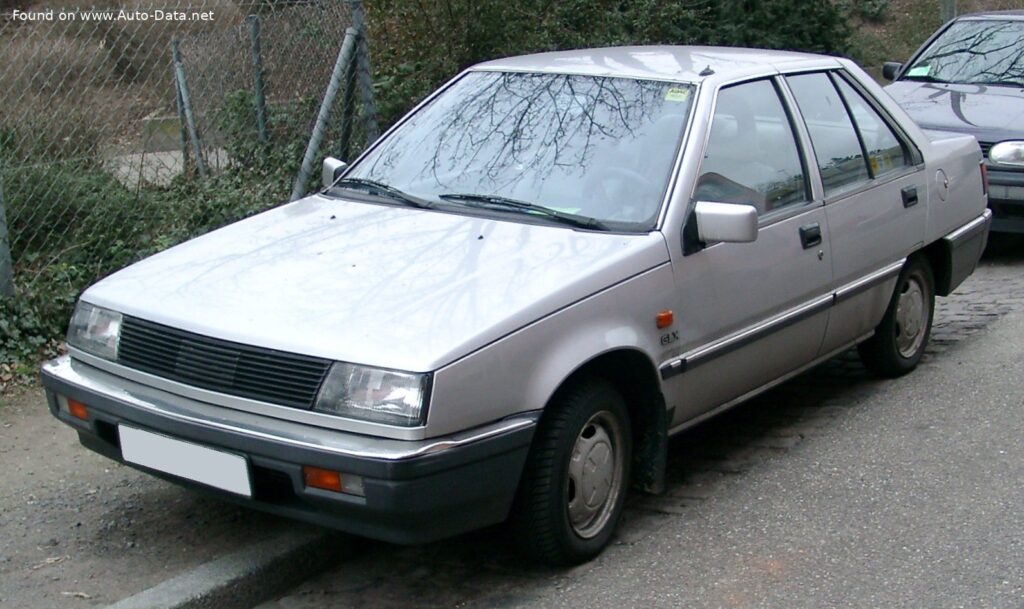
The Mitsubishi Lancer III adopted a clean, contemporary sedan body style that was characteristic of 1980s automotive design. Its four-door, five-seat configuration made it a practical family car. With a length of 162.4 inches (4125 mm), a width of 64.37 inches (1635 mm), and a height of 53.54 inches (1360 mm), the Lancer III was a compact yet spacious vehicle for its segment. The wheelbase measured 93.7 inches (2380 mm), contributing to a stable ride and reasonable interior room for passengers.
Aesthetically, the Lancer III featured a relatively aerodynamic profile for its time, evidenced by a drag coefficient (Cd) of 0.38. While not groundbreaking, this contributed to its fuel efficiency. The design was functional and understated, prioritizing practicality and ease of manufacture. Standard features for a car of its class and era would have included basic cloth upholstery, manual window winders, and a straightforward dashboard layout. Safety features were rudimentary by today’s standards, typically encompassing seatbelts and a robust body structure. The suspension system featured an independent McPherson strut setup with coil springs and an anti-roll bar at the front, paired with an independent coil spring, transverse stabilizer, and trailing arm arrangement at the rear, providing a comfortable and predictable ride. Braking was handled by ventilated discs at the front and drum brakes at the rear, an adequate setup for the vehicle’s performance capabilities. Steering was a rack and pinion system, offering direct feel.
Technical Specifications
| Category | Specification | US Equivalent |
|---|---|---|
| General Information | ||
| Brand | Mitsubishi | Mitsubishi |
| Model | Lancer | Lancer |
| Generation | Lancer III | Lancer III |
| Type (Engine) | 1.8 Diesel (58 Hp) | 1.8 Diesel (58 Hp) |
| Start of Production | 1984 year | 1984 |
| End of Production | 1986 year | 1986 |
| Powertrain Architecture | Internal Combustion engine | Internal Combustion Engine |
| Body Type | Sedan | Sedan |
| Seats | 5 | 5 |
| Doors | 4 | 4 |
| Performance Specs | ||
| Fuel Consumption (Urban) | 6.9 l/100 km | 34.1 US mpg |
| Fuel Consumption (Extra Urban) | 4.6 l/100 km | 51.1 US mpg |
| Fuel Type | Diesel | Diesel |
| Acceleration 0 – 62 mph (0-100 km/h) | 15.5 sec | 15.5 sec |
| Acceleration 0 – 60 mph (Calculated) | 14.7 sec | 14.7 sec |
| Maximum Speed | 145 km/h | 90.1 mph |
| Weight-to-Power Ratio | 16 kg/Hp | 35.27 lbs/Hp |
| Weight-to-Torque Ratio | 8.6 kg/Nm | 19.01 lbs/Nm |
| Engine Specs | ||
| Power | 58 Hp @ 4500 rpm | 58 Hp @ 4500 rpm |
| Power per Liter | 32.3 Hp/l | 32.3 Hp/l |
| Torque | 108 Nm @ 2500 rpm | 79.66 lb.-ft. @ 2500 rpm |
| Engine Layout | Front, Longitudinal | Front, Longitudinal |
| Engine Model/Code | 4D65 | 4D65 |
| Engine Displacement | 1795 cm³ | 1.8 liters (109.54 cu. in.) |
| Number of Cylinders | 4 | 4 |
| Engine Configuration | Inline | Inline |
| Cylinder Bore | 80.6 mm | 3.17 in. |
| Piston Stroke | 88 mm | 3.46 in. |
| Compression Ratio | 21.5:1 | 21.5:1 |
| Number of Valves per Cylinder | 5 | 5 |
| Fuel Injection System | Precombustion chamber injection | Precombustion chamber injection |
| Engine Aspiration | Naturally aspirated engine | Naturally Aspirated |
| Valvetrain | SOHC | SOHC |
| Engine Oil Capacity | 5.6 l | 5.92 US qt |
| Coolant Capacity | 6 l | 6.34 US qt |
| Space, Volume and Weights | ||
| Kerb Weight | 930 kg | 2050.3 lbs |
| Max. Weight | 1400 kg | 3086.47 lbs |
| Max Load | 470 kg | 1036.17 lbs |
| Fuel Tank Capacity | 45 l | 11.89 US gal |
| Permitted Trailer Load with Brakes (12%) | 1000 kg | 2204.62 lbs |
| Permitted Trailer Load without Brakes | 400 kg | 881.85 lbs |
| Dimensions | ||
| Length | 4125 mm | 162.4 in. |
| Width | 1635 mm | 64.37 in. |
| Height | 1360 mm | 53.54 in. |
| Wheelbase | 2380 mm | 93.7 in. |
| Front Track | 1390 mm | 54.72 in. |
| Rear (Back) Track | 1340 mm | 52.76 in. |
| Drag Coefficient (Cd) | 0.38 | 0.38 |
| Drivetrain, Brakes and Suspension Specs | ||
| Drivetrain Architecture | The Internal combustion engine (ICE) drives the front wheels of the vehicle. | Front-wheel drive |
| Drive Wheel | Front wheel drive | Front-wheel drive |
| Number of Gears and Type of Gearbox | 5 gears, manual transmission | 5-speed manual |
| Front Suspension | Independent, type McPherson with coil spring and anti-roll bar | Independent McPherson strut with coil spring and anti-roll bar |
| Rear Suspension | Independent coil spring, Transverse stabilizer, Trailing arm | Independent coil spring, transverse stabilizer, trailing arm |
| Front Brakes | Ventilated discs | Ventilated disc brakes |
| Rear Brakes | Drum | Drum brakes |
| Steering Type | Steering rack and pinion | Rack and pinion |
| Wheel Rims Size | 5J x 13 | 13-inch wheels |
Legacy & Market Impact
The Mitsubishi Lancer III, and particularly its diesel variants like the Mitsubishi Lancer III 1.8 Diesel (58 Hp), played a crucial role in Mitsubishi’s global strategy during the mid-1980s. While not a high-volume seller in North America, where gasoline engines dominated the compact market, this model was a popular and practical choice in Europe, Asia, and other regions where diesel fuel was more affordable and its efficiency highly valued. It competed effectively against other compact sedans of the era, such as the Opel Kadett, Ford Escort, Toyota Corolla, and Nissan Sunny (Sentra), especially those offering diesel engine options.
Its reputation was built on reliability, low running costs, and straightforward mechanics. For many families and small businesses, the Lancer III 1.8 Diesel represented an economical and durable mode of transport. Its robust construction and simple, easy-to-maintain engine made it a favorite in markets where vehicle longevity and repairability were paramount. The car helped solidify Mitsubishi’s image as a manufacturer of dependable and value-for-money vehicles, contributing to its growing international presence.
Today, the Mitsubishi Lancer III 1.8 Diesel (58 Hp) is remembered as a workhorse rather than a performance icon. It embodies the automotive philosophy of its time: practical, efficient, and built to last. Its technological contributions, such as the early adoption of a 5-valve-per-cylinder head in a diesel, even if naturally aspirated, hint at Mitsubishi’s forward-thinking engineering, even in its more modest offerings. The Lancer III diesel’s legacy is one of quiet competence, serving as a reliable backbone for countless drivers and reinforcing Mitsubishi’s position in the competitive global compact car market.