The Renault Megane II Grandtour: A Practical European Family Wagon (2004-2005)
The Renault Megane II Grandtour 1.6 16V (113 Hp) Automatic represents a specific variant of the second-generation Renault Megane, a compact family car produced by the French automaker Renault. Launched in 2004 and continuing through 2005 for this particular powertrain configuration, the Grandtour model was the station wagon (or “estate” in European parlance) iteration, designed to offer enhanced practicality and cargo capacity over its hatchback and sedan siblings. While the Renault Megane was a significant player in the European C-segment, it was not officially sold in the United States market, making its role primarily focused on meeting the diverse needs of European families and businesses seeking a versatile and efficient vehicle.
The Megane II generation, which debuted in 2002, was renowned for its distinctive and often polarizing styling, particularly the “bustle-back” design of the hatchback. The Grandtour variant, however, adopted a more conventional yet still modern aesthetic for its extended rear section, maximizing utility without sacrificing the contemporary look of the Megane line. This specific 1.6-liter automatic model was positioned as an accessible and comfortable option for daily driving, prioritizing ease of use and reasonable fuel economy for its target audience.
Engine and Performance of the Renault Megane II Grandtour
Powering the Renault Megane II Grandtour 1.6 16V (113 Hp) Automatic was Renault’s widely used K4M engine, a naturally aspirated 1.6-liter (1598 cm³ or 97.52 cu. in.) inline-four petrol engine. This powerplant featured a DOHC (Double Overhead Camshaft) valvetrain with 4 valves per cylinder, contributing to its smooth operation and efficiency for its displacement. It delivered a respectable 113 horsepower at 6000 rpm, which for a compact family wagon of its era, provided adequate motivation for both city commuting and longer journeys.
Torque output stood at 152 Nm, or approximately 112.11 lb.-ft., peaking at 4200 rpm. This torque curve was well-suited for everyday driving, offering sufficient pull for typical loads without needing to constantly rev the engine to its redline. The engine’s layout was front, transverse, driving the front wheels, a standard configuration for compact cars that optimizes interior space and manufacturing cost.
Mated to this engine was a 4-speed automatic transmission, a common offering in the early 2000s that prioritized convenience over outright performance or cutting-edge efficiency. While a manual transmission would have offered more direct engagement, the automatic provided a relaxed driving experience, particularly in urban traffic. Performance figures reflect this focus on practicality: the Megane II Grandtour 1.6 16V Automatic could accelerate from 0 to 60 mph in a calculated 12.5 seconds, with a top speed of 111.85 mph (180 km/h). These numbers placed it firmly in the mainstream compact family car segment, providing sufficient performance for most European road conditions without being a sports wagon.
Fuel economy was a key consideration for European buyers. The combined fuel consumption for this model was rated at 7.7 liters per 100 kilometers, translating to an estimated 30.5 US miles per gallon. Urban consumption was 10.7 l/100 km (22 US mpg), and extra-urban consumption was 6 l/100 km (39.2 US mpg). With CO2 emissions of 184 g/km, the vehicle met the Euro 4 emission standard, reflecting the environmental regulations pertinent at the time of its production.
Design and Features
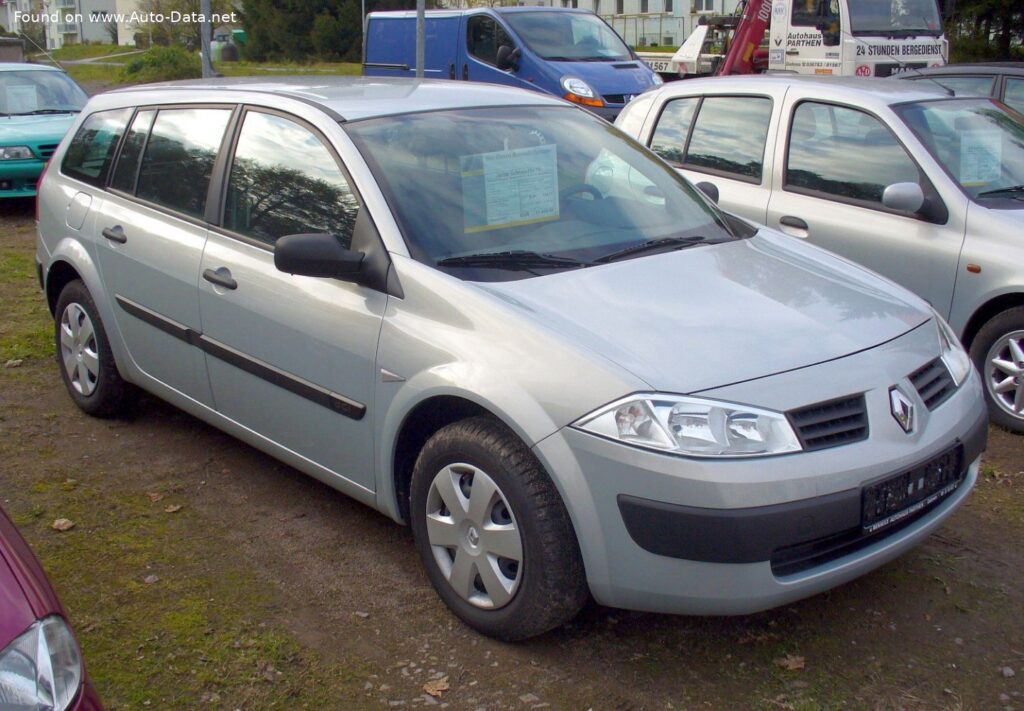
The Renault Megane II Grandtour distinguished itself with its spacious and practical station wagon body type. Measuring 177.17 inches (4500 mm) in length, 69.96 inches (1777 mm) in width (79.76 inches or 2026 mm including mirrors), and 57.76 inches (1467 mm) in height, it offered a substantial footprint for a compact vehicle. The wheelbase of 105.75 inches (2686 mm) contributed to a stable ride and generous interior room for five occupants across its five doors.
The design ethos of the Megane II generation carried over to the Grandtour, featuring clean lines and a modern, albeit sometimes unconventional, aesthetic. The extended roofline and large rear cargo area were the defining characteristics of the Grandtour, prioritizing utility. The minimum trunk space was an impressive 18.36 cubic feet (520 liters), expanding significantly to a cavernous 56.5 cubic feet (1600 liters) with the rear seats folded down. This made it an ideal choice for families, small businesses, or anyone needing substantial cargo flexibility for luggage, sports equipment, or everyday hauling.
In terms of features, the Megane II Grandtour was equipped with standard safety and convenience technologies appropriate for its time. An Anti-lock Braking System (ABS) was included to enhance braking control, while electric power steering made maneuvering easier, especially in tight urban environments. The steering system utilized a rack and pinion setup, offering a direct feel. The front suspension employed an independent McPherson strut design, known for its balance of comfort and handling, while the rear featured a torsion beam setup, a space-efficient solution for optimizing cargo volume. Braking was handled by ventilated discs at the front and solid discs at the rear, providing reliable stopping power. Tire sizes varied, with options including 195/65 R15 and 205/55 R16, mounted on 6.5J x 15 or 6.5J x 16 wheel rims, respectively.
Technical Specifications
| Category | Specification | US Equivalent / Notes |
|---|---|---|
| Brand | Renault | |
| Model | Megane II Grandtour | Station Wagon (Estate) |
| Type (Engine) | 1.6 16V (113 Hp) Automatic | |
| Production Years | 2004 – 2005 | |
| Powertrain Architecture | Internal Combustion Engine | Front-wheel drive |
| Body Type | Station wagon (estate) | 5 Doors, 5 Seats |
| Fuel Type | Petrol (Gasoline) | |
| Performance Specs | ||
| Power | 113 Hp @ 6000 rpm | |
| Torque | 152 Nm @ 4200 rpm | 112.11 lb.-ft. @ 4200 rpm |
| Acceleration 0-60 mph | 12.5 sec (Calculated) | 0-100 km/h: 13.2 sec |
| Maximum Speed | 180 km/h | 111.85 mph |
| Fuel Consumption (Combined) | 7.7 l/100 km | 30.5 US mpg |
| Fuel Consumption (Urban) | 10.7 l/100 km | 22 US mpg |
| Fuel Consumption (Extra Urban) | 6 l/100 km | 39.2 US mpg |
| CO2 Emissions | 184 g/km | Euro 4 Emission Standard |
| Engine Specs | ||
| Engine Displacement | 1598 cm³ | 1.6 Liters (97.52 cu. in.) |
| Number of Cylinders | 4, Inline | |
| Valvetrain | DOHC, 4 valves per cylinder | |
| Compression Ratio | 10:1 | |
| Fuel Injection System | Multi-port manifold injection | |
| Engine Aspiration | Naturally aspirated | |
| Engine Oil Capacity | 4.8 l | 5.07 US qt |
| Coolant Capacity | 6.5 l | 6.87 US qt |
| Dimensions, Space & Weights | ||
| Length | 4500 mm | 177.17 in. |
| Width | 1777 mm | 69.96 in. (2026 mm / 79.76 in. including mirrors) |
| Height | 1467 mm | 57.76 in. |
| Wheelbase | 2686 mm | 105.75 in. |
| Kerb Weight | 1260 kg | 2777.82 lbs. |
| Max. Weight | 1840 kg | 4056.51 lbs. |
| Trunk Space (Min/Max) | 520 l / 1600 l | 18.36 cu. ft. / 56.5 cu. ft. |
| Fuel Tank Capacity | 60 l | 15.85 US gal |
| Permitted Trailer Load (with brakes) | 1350 kg | 2976.24 lbs. |
| Minimum Turning Circle | 11 m | 36.09 ft. |
| Drivetrain, Brakes & Suspension | ||
| Drive Wheel | Front-wheel drive | |
| Gearbox Type | 4 gears, automatic transmission | |
| Front Suspension | Independent type McPherson | |
| Rear Suspension | Torsion beam | |
| Front Brakes | Ventilated discs | |
| Rear Brakes | Disc | |
| Assisting Systems | ABS (Anti-lock braking system) | |
| Steering Type | Steering rack and pinion, Electric Power Steering | |
| Tire Sizes | 195/65 R15; 205/55 R16 | |
Legacy and Market Impact
The Renault Megane II Grandtour, particularly the 1.6 16V Automatic variant, carved out a significant niche in the highly competitive European compact segment during its production run from 2004 to 2005. Its primary market was Europe, where station wagons are a popular choice for families due to their versatility and practicality. The Megane II series as a whole was instrumental in cementing Renault’s reputation for innovative design, robust safety features (it was one of the first cars to achieve a full 5-star Euro NCAP safety rating for adult occupant protection), and a focus on comfort.
Within its segment, the Megane II Grandtour faced stiff competition from established rivals such as the Volkswagen Golf Variant, Opel Astra Caravan (known as the Saturn Astra in limited US markets later), Ford Focus Estate, and the Peugeot 307 SW. What set the Megane II Grandtour apart was its distinctively French approach to design, offering a more avant-garde aesthetic compared to its often more conservative German and British counterparts. Its interior, while perhaps not as premium in materials as some competitors, was praised for its ergonomic layout and thoughtful storage solutions, reflecting Renault’s understanding of family needs.
The 1.6-liter automatic model, specifically, was valued for its ease of driving and reasonable running costs. While not a performance leader, its 113 horsepower engine provided adequate power for most situations, and the automatic transmission offered a smooth, albeit not lightning-fast, driving experience that appealed to a broad demographic, including those who frequently drove in congested urban environments. Its combined fuel economy of around 30.5 US mpg was competitive for a non-diesel automatic vehicle of its size and era, contributing to its appeal as an economical family car.
The Megane II Grandtour’s legacy lies in its contribution to making station wagons both stylish and immensely practical. It demonstrated that a family-oriented vehicle could still possess a strong design identity. Its success underscored Renault’s ability to create vehicles that resonated with European consumers’ desires for functionality, safety, and unique styling. While never officially crossing the Atlantic to the US market, the Renault Megane II Grandtour remains a testament to European automotive engineering and design philosophy, continuing to serve as a reliable and versatile compact family vehicle in its original markets.