
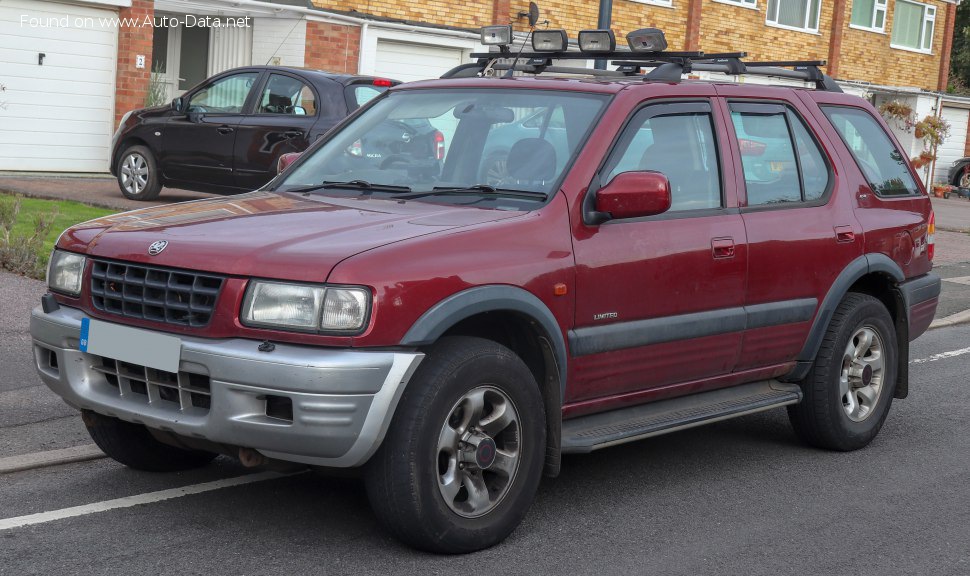
As an international automotive expert, I present a detailed analysis of the Vauxhall Frontera Mk II 2.2i (136 Hp), a prominent sport utility vehicle (SUV) in the European and UK markets during the late 1990s.
Introduction to the Vauxhall Frontera Mk II 2.2i (136 Hp)
The Vauxhall Frontera Mk II 2.2i (136 Hp) represents the second generation of Vauxhall’s mid-size SUV offering, produced from 1997 to 2000. Marketed primarily in the United Kingdom, the Frontera was a rebadged version of the Opel Frontera, which itself was based on the Isuzu Rodeo (also known as the Isuzu MU in some markets). This strategic rebadging allowed General Motors to offer a competitive and rugged SUV in the burgeoning European utility vehicle segment without significant independent development costs. The Mk II, or second generation, brought a host of refinements over its predecessor, aiming to enhance both on-road comfort and off-road capability, positioning it as a versatile choice for families and adventurers alike. Its powertrain architecture relied on a traditional internal combustion engine, coupled with a robust all-wheel-drive system, making it a pragmatic option for those seeking a blend of practicality and utility in a five-door, five-seat SUV.
Engine & Performance of the Vauxhall Frontera Mk II
At the heart of the Vauxhall Frontera Mk II 2.2i (136 Hp) lies a naturally aspirated 2.2-liter (2198 cm³, or 134.13 cu. in.) inline-four gasoline engine, designated with the model code X22SE. This engine was designed for a balance of durability and accessible power, delivering 136 horsepower at 5200 rpm. Its multi-port manifold injection system and Double Overhead Camshaft (DOHC) valvetrain, featuring four valves per cylinder, contributed to efficient combustion and respectable power output for its class. Torque figures stood at 202 Nm (148.99 lb.-ft.) available at a relatively low 2600 rpm, which was crucial for its intended SUV role, providing ample grunt for off-road excursions or towing. The engine’s compression ratio was 10.5:1, typical for a gasoline engine of its era.
Power was delivered to all four wheels via a durable 5-speed manual transmission, offering the driver direct control over the vehicle’s dynamics. This all-wheel-drive (4×4) setup underscored its utility and capability beyond paved roads. In terms of outright performance, the Frontera Mk II 2.2i was not designed for speed, but rather for steady progress. It achieved a 0-60 mph acceleration in a measured 12.7 seconds, with a top speed of 100.04 mph (161 km/h). Fuel economy, while not a primary selling point for SUVs of this period, was rated at 15.9 US mpg in urban driving conditions and improved to 26.1 US mpg on the extra-urban cycle, reflecting its more efficient cruising capabilities.
Design & Features
The design of the Vauxhall Frontera Mk II retained much of the rugged, utilitarian aesthetic characteristic of its predecessor, yet with updated styling cues that brought it in line with late 1990s automotive trends. As a five-door SUV, it offered practical access for passengers and cargo. Its dimensions, measuring 183.39 inches (4658 mm) in length, 70.28 inches (1785 mm) in width, and 68.5 inches (1740 mm) in height, provided a commanding presence on the road. A wheelbase of 106.38 inches (2702 mm) contributed to a stable ride and a spacious cabin for its five occupants.
Inside, the Frontera Mk II focused on functionality and durability. The five-seat configuration made it suitable for families, while the cargo area was impressively versatile. With the rear seats in place, it offered a minimum trunk space of 13.74 cu. ft. (389 liters), expanding significantly to a generous 63.21 cu. ft. (1790 liters) with the rear seats folded down, making it highly practical for hauling gear, groceries, or luggage. The kerb weight of the vehicle was 3796.36 lbs (1722 kg), with a maximum permissible weight of 5291.09 lbs (2400 kg), indicating a robust chassis capable of handling substantial loads.
Safety and driving dynamics were addressed with features such as ventilated disc brakes at the front and disc brakes at the rear, complemented by an Anti-lock Braking System (ABS) as standard. The steering system utilized a hydraulic rack and pinion setup, providing predictable and assisted steering, essential for a vehicle of this size and weight. The 235/75 R15 tires mounted on 6.5J x 15 wheel rims provided a good balance of on-road grip and off-road capability, absorbing road imperfections effectively. While not laden with the advanced electronic driver aids common in modern SUVs, the Frontera Mk II offered a solid, dependable package for its time.
Technical Specifications
| Category | Specification |
|---|---|
General Information |
|
| Brand | Vauxhall |
| Model | Frontera |
| Generation | Frontera Mk II |
| Type (Engine) | 2.2i (136 Hp) |
| Start of Production | 1997 year |
| End of Production | 2000 year |
| Powertrain Architecture | Internal Combustion Engine |
| Body Type | SUV |
| Seats | 5 |
| Doors | 5 |
Performance Specifications |
|
| Fuel Consumption (Urban) | 14.8 l/100 km (15.9 US mpg) |
| Fuel Consumption (Extra Urban) | 9 l/100 km (26.1 US mpg) |
| Fuel Type | Petrol (Gasoline) |
| Acceleration 0 – 60 mph | 12.7 sec |
| Maximum Speed | 100.04 mph (161 km/h) |
| Weight-to-Power Ratio | 12.7 kg/Hp, 79 Hp/tonne |
| Weight-to-Torque Ratio | 8.5 kg/Nm, 117.3 Nm/tonne |
Engine Specifications |
|
| Power | 136 Hp @ 5200 rpm |
| Power per Liter | 61.9 Hp/l |
| Torque | 202 Nm (148.99 lb.-ft.) @ 2600 rpm |
| Engine Layout | Front, Longitudinal |
| Engine Model/Code | X22SE |
| Engine Displacement | 2198 cm³ (134.13 cu. in.) |
| Number of Cylinders | 4 |
| Engine Configuration | Inline |
| Cylinder Bore | 86 mm (3.39 in.) |
| Piston Stroke | 94.6 mm (3.72 in.) |
| Compression Ratio | 10.5:1 |
| Number of Valves per Cylinder | 4 |
| Fuel Injection System | Multi-port manifold injection |
| Engine Aspiration | Naturally aspirated engine |
| Valvetrain | DOHC |
| Engine Oil Capacity | 4.5 l (4.76 US qt) |
| Engine Oil Specification | Not specified |
| Coolant Capacity | 7.2 l (7.61 US qt) |
Space, Volume and Weights |
|
| Kerb Weight | 1722 kg (3796.36 lbs) |
| Max. Weight | 2400 kg (5291.09 lbs) |
| Max Load | 678 kg (1494.73 lbs) |
| Trunk (Boot) Space – Minimum | 389 l (13.74 cu. ft.) |
| Trunk (Boot) Space – Maximum | 1790 l (63.21 cu. ft.) |
| Fuel Tank Capacity | 75 l (19.81 US gal) |
Dimensions |
|
| Length | 4658 mm (183.39 in.) |
| Width | 1785 mm (70.28 in.) |
| Height | 1740 mm (68.5 in.) |
| Wheelbase | 2702 mm (106.38 in.) |
| Front Track | 1515 mm (59.65 in.) |
| Rear (Back) Track | 1520 mm (59.84 in.) |
Drivetrain, Brakes and Suspension Specifications |
|
| Drive Wheel | All-wheel drive (4×4) |
| Number of Gears and Type of Gearbox | 5 gears, manual transmission |
| Front Brakes | Ventilated discs |
| Rear Brakes | Disc |
| Assisting Systems | ABS (Anti-lock braking system) |
| Steering Type | Steering rack and pinion |
| Power Steering | Hydraulic Steering |
| Tires Size | 235/75 R15 |
| Wheel Rims Size | 6.5J x 15 |
Legacy & Market Impact
The Vauxhall Frontera Mk II 2.2i (136 Hp) carved out a significant niche in the European and UK SUV market during its production run. While it never achieved the iconic status of some of its Japanese rivals, it provided Vauxhall with a robust and relatively affordable entry into a rapidly expanding segment. Its reputation was built on its utilitarian nature, offering a blend of practical family transport and genuine off-road capability, particularly when compared to the growing number of “soft-roaders” emerging at the time. Its all-wheel-drive system and sturdy construction made it a popular choice for those living in rural areas or requiring a vehicle capable of light-to-moderate off-road excursions.
In its primary markets, the Frontera Mk II faced competition from a diverse range of SUVs. Direct rivals included the Land Rover Freelander, which offered a more premium domestic British badge, and Japanese imports such as the Honda CR-V and Toyota RAV4, which emphasized reliability and a car-like driving experience. The Frontera distinguished itself with its more rugged, truck-like chassis derived from its Isuzu origins, often appealing to buyers who prioritized durability and towing capacity over refined on-road manners. It was generally perceived as a more traditional SUV than its crossover-oriented competitors.
Despite its capabilities, the Frontera’s rebadged origins meant it sometimes struggled to establish a strong, unique identity compared to purpose-built European SUVs. However, its value proposition and robust mechanics ensured a steady demand. The Mk II generation saw improvements in ride quality and interior ergonomics, addressing some criticisms of the original model. Ultimately, the Vauxhall Frontera series concluded its production in 2004, succeeded by more modern, car-based SUVs like the Antara (another rebadged GM product, the Chevrolet Captiva). The Frontera’s legacy is that of a dependable workhorse, a pragmatic choice that served its purpose effectively, providing Vauxhall with a competitive presence in the burgeoning SUV market of the late 20th century, and laying groundwork for the brand’s future endeavors in the utility vehicle segment.

