The Volkswagen Multivan (T6.1, Facelift 2019) 2.0 TDI (110 Hp): A European Icon of Versatility
The Volkswagen Multivan, particularly the T6.1 generation with its 2019 facelift, represents the pinnacle of Volkswagen’s long-standing tradition in the multi-purpose vehicle (MPV) segment. While not a common sight on American roads, the Multivan is a revered and highly successful model in Europe and other international markets, celebrated for its unparalleled blend of passenger comfort, cargo versatility, and robust engineering. The specific variant under review, the Volkswagen Multivan (T6.1, facelift 2019) 2.0 TDI (110 Hp), embodies the practical workhorse ethos of the lineup, offering a fuel-efficient diesel powertrain tailored for long-distance travel and demanding family or business use. This iteration of the Multivan, produced from 2019 to 2021, continued to build upon the T6’s foundation, introducing significant updates in technology, design, and efficiency to maintain its competitive edge in a segment where practicality reigns supreme.
Originating from Volkswagen Commercial Vehicles’ esteemed Transporter line, which traces its lineage back to the iconic Type 2 “Bus,” the Multivan has evolved into a sophisticated people mover. The T6.1 facelift was more than just a cosmetic refresh; it incorporated substantial technological advancements, particularly in driver assistance systems and connectivity, aligning it with modern automotive standards. This 2.0 TDI (110 Hp) model, with its front-wheel-drive architecture and internal combustion engine, stands as a testament to Volkswagen’s commitment to delivering reliable, spacious, and economical transport solutions for diverse needs, ranging from large families to shuttle services and adventure enthusiasts.
Engine and Performance: The Practicality of the Volkswagen Multivan (T6.1, Facelift 2019) 2.0 TDI (110 Hp)
At the heart of this particular Multivan T6.1 variant is a 2.0-liter (1968 cm3 or 120.09 cu. in.) inline four-cylinder TDI (Turbocharged Direct Injection) diesel engine. Codenamed CXHC, this powerplant is a prime example of Volkswagen’s expertise in diesel technology, designed for efficiency and durability rather than outright speed. It delivers a respectable 110 horsepower at 3100-4250 rpm, providing sufficient motivation for a vehicle of its size and intended purpose. More crucial for a people mover is torque, and the 2.0 TDI excels here, generating 250 Nm (184.39 lb.-ft.) of torque across a broad and accessible rev range, from 1350 to 3100 rpm. This low-end torque is vital for confident acceleration with a full load of passengers or cargo, making it feel surprisingly responsive in urban traffic and capable on highways.
Power is channeled to the front wheels via a robust 5-speed manual transmission, a choice that emphasizes driver engagement and control while also contributing to the vehicle’s overall fuel economy. While its acceleration figures—16.3 seconds from 0 to 62 mph (0-100 km/h) and a top speed of 101.9 mph (164 km/h)—might not impress enthusiasts of sports cars, they are entirely adequate for a vehicle designed for comfortable cruising and utility. The Multivan’s performance is optimized for practical, real-world driving scenarios, where smooth power delivery and fuel efficiency take precedence over blistering sprints.
Fuel Efficiency and Environmental Footprint
One of the key selling points of the 2.0 TDI engine is its impressive fuel economy, especially for a large minivan. The combined cycle fuel consumption is rated at 6 liters per 100 km, translating to approximately 39.2 US miles per gallon. Urban driving sees consumption at 7.2 l/100 km (32.7 US mpg), while extra-urban figures drop to an excellent 5.3 l/100 km (44.4 US mpg). These numbers underscore the diesel engine’s inherent efficiency, particularly on longer journeys. Furthermore, the engine complies with the stringent Euro 6d-ISC-FCM emission standard, demonstrating Volkswagen’s commitment to reducing environmental impact. This is achieved through sophisticated systems like a Diesel Particulate Filter (DPF) and an AdBlue tank (22 liters or 5.81 US gallons), which injects urea to neutralize harmful nitrogen oxides (NOx) emissions, alongside a standard Start & Stop system that conserves fuel in traffic.
Design and Features: Form Meets Function in the Multivan T6.1
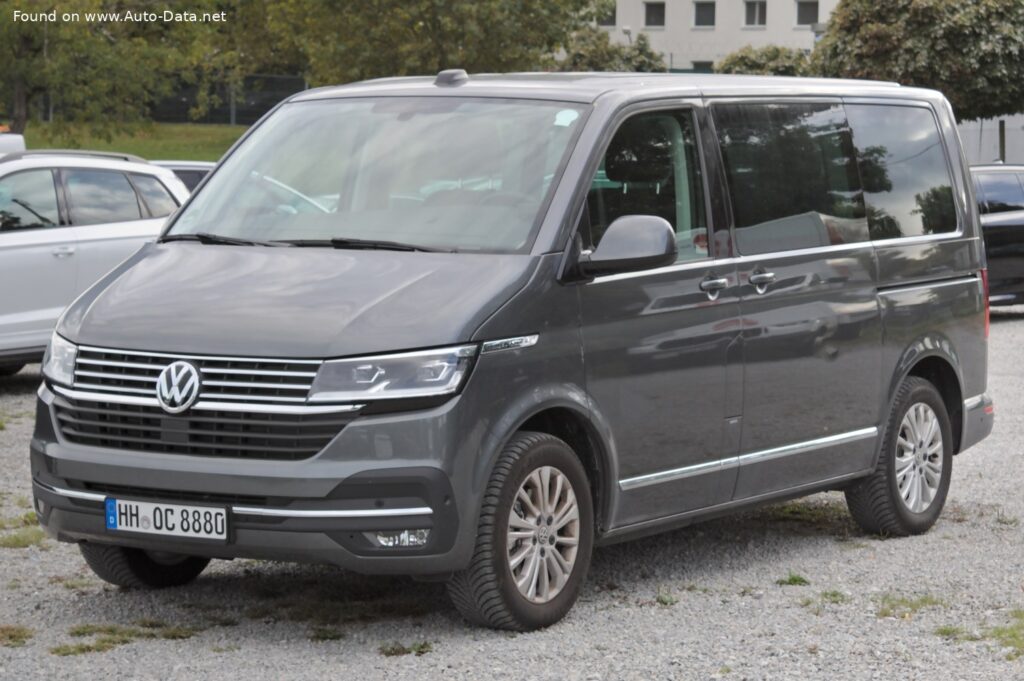
The Volkswagen Multivan (T6.1, facelift 2019) retains its distinctive, boxy minivan silhouette, a design choice dictated by its primary function: maximizing interior space and versatility. The facelift introduced subtle yet effective updates, including a redesigned front fascia with a larger grille, new LED headlights, and updated bumper designs, giving it a more modern and assertive presence. The body type is unmistakably a minivan, offering five doors and configurable seating for 5 to 7 occupants, making it exceptionally adaptable for various passenger and cargo requirements.
Inside, the Multivan is a masterclass in modularity and clever packaging. While the specific data doesn’t detail every interior feature, the T6.1 facelift brought significant enhancements to the cabin. Expect a contemporary dashboard layout, improved infotainment systems with touchscreen displays, and enhanced connectivity options that were standard for vehicles of its era. The true genius lies in its flexible seating arrangement, allowing seats to be slid, folded, or even removed entirely to create a vast, cavernous cargo area. With a maximum trunk (boot) space of 4300 liters (151.85 cu. ft.), the Multivan can swallow an incredible amount of gear, making it ideal for everything from family vacations to professional transport or even as a mobile office.
Dimensions are substantial, with a length of 193.07 inches (4904 mm), a width of 74.96 inches (1904 mm), and a height ranging from 77.56 to 78.35 inches (1970-1990 mm). A generous wheelbase of 118.11 inches (3000 mm) contributes to a stable ride and ample interior room. The vehicle’s practical nature is further highlighted by its impressive payload capacity of 827-935 kg (1823.22 – 2061.32 lbs.) and a permitted trailer load with brakes of 2200 kg (4850.17 lbs.), cementing its status as a highly capable hauler.
Safety and driver assistance systems were significantly upgraded in the T6.1. While the provided data only explicitly mentions ABS (Anti-lock Braking System), the facelifted Multivan typically featured a comprehensive suite of modern safety technologies for its time, including electronic stability control, multiple airbags, and potentially advanced driver aids like adaptive cruise control, lane-keeping assist, and parking assist systems, depending on the trim level. The robust chassis, independent McPherson strut front suspension, and wishbone rear suspension, along with ventilated disc brakes at the front and disc brakes at the rear, ensure a secure and comfortable driving experience.
Technical Specifications: Volkswagen Multivan (T6.1, Facelift 2019) 2.0 TDI (110 Hp)
| Category | Specification | US Equivalent / Notes |
|---|---|---|
General Information |
||
| Brand | Volkswagen | |
| Model | Multivan (T6.1, facelift 2019) | |
| Engine Type | 2.0 TDI (110 Hp) | |
| Production Years | 2019 – 2021 | |
| Powertrain Architecture | Internal Combustion Engine | |
| Body Type | Minivan | |
| Seats | 5-7 | |
| Doors | 5 | |
Performance Specifications |
||
| Fuel Consumption (Urban) | 7.2 l/100 km | 32.7 US mpg |
| Fuel Consumption (Extra Urban) | 5.3 l/100 km | 44.4 US mpg |
| Fuel Consumption (Combined) | 6 l/100 km | 39.2 US mpg |
| CO2 Emissions | 157-158 g/km | |
| Fuel Type | Diesel | |
| Acceleration 0 – 62 mph (0-100 km/h) | 16.3 sec | |
| Acceleration 0 – 60 mph | 15.5 sec | Calculated |
| Maximum Speed | 164 km/h | 101.9 mph |
| Emission Standard | Euro 6d-ISC-FCM | |
| Weight-to-Power Ratio | 19.5 kg/Hp | 51.3 Hp/tonne |
| Weight-to-Torque Ratio | 8.6 kg/Nm | 116.6 Nm/tonne |
Engine Specifications |
||
| Power | 110 Hp @ 3100-4250 rpm | |
| Power per liter | 55.9 Hp/l | |
| Torque | 250 Nm @ 1350-3100 rpm | 184.39 lb.-ft. |
| Engine Layout | Front, Transverse | |
| Engine Model/Code | CXHC | |
| Engine Displacement | 1968 cm3 | 2.0 Liters / 120.09 cu. in. |
| Number of Cylinders | 4 | Inline configuration |
| Valves per Cylinder | 4 | |
| Fuel Injection System | Diesel Commonrail | |
| Engine Aspiration | Turbocharger, Intercooler | |
| Valvetrain | DOHC | |
| Engine Oil Capacity | 7.4 l | 7.82 US qt |
| Engine Systems | Start & Stop System, Particulate filter | |
Space, Volume, and Weights |
||
| Kerb Weight | 2145-2253 kg | 4728.92 – 4967.01 lbs. |
| Max. Weight (GVWR) | 3080 kg | 6790.24 lbs. |
| Max Load | 827-935 kg | 1823.22 – 2061.32 lbs. |
| Trunk (Boot) Space – Maximum | 4300 l | 151.85 cu. ft. |
| Fuel Tank Capacity | 70 l | 18.49 US gal |
| AdBlue Tank | 22 l | 5.81 US gal |
| Max. Roof Load | 100 kg | 220.46 lbs. |
| Permitted Trailer Load with Brakes (12%) | 2200 kg | 4850.17 lbs. |
| Permitted Trailer Load without Brakes | 750 kg | 1653.47 lbs. |
| Permitted Towbar Download | 100 kg | 220.46 lbs. |
Dimensions |
||
| Length | 4904 mm | 193.07 in. |
| Width | 1904 mm | 74.96 in. |
| Width Including Mirrors | 2297 mm | 90.43 in. |
| Height | 1970-1990 mm | 77.56 – 78.35 in. |
| Wheelbase | 3000 mm | 118.11 in. |
| Front Overhang | 906 mm | 35.67 in. |
| Rear Overhang | 998 mm | 39.29 in. |
| Ride Height (Ground Clearance) | 193-209 mm | 7.6 – 8.23 in. |
| Minimum Turning Circle | 11.9 m | 39.04 ft. |
| Approach Angle | 21.7-21.8° | |
| Departure Angle | 16.7° | |
| Ramp-over (Brakeover) Angle | 12.7-14.3° | |
Drivetrain, Brakes, and Suspension |
||
| Drivetrain Architecture | Internal Combustion engine (ICE) drives front wheels | |
| Drive Wheel | Front-wheel drive | |
| Gearbox | 5 gears, manual transmission | |
| Front Suspension | Independent, McPherson with coil spring and anti-roll bar | |
| Rear Suspension | Wishbone, Transverse stabilizer | |
| Front Brakes | Ventilated discs | |
| Rear Brakes | Disc | |
| Assisting Systems | ABS (Anti-lock braking system) | |
| Steering Type | Steering rack and pinion | |
| Power Steering | Electric Steering | |
| Tire Sizes | 205/65 R16; 215/60 R16; 215/65 R16; 215/60 R17; 235/55 R17; 255/45 R18 | |
| Wheel Rim Sizes | 6.5J x 16; 7J x 17; 8J x 18 | |
Legacy and Market Impact
The Volkswagen Multivan (T6.1, facelift 2019) 2.0 TDI (110 Hp) is a significant chapter in a storied lineage that began with the original Type 2 Transporter in 1950. In its primary markets, particularly across Europe, the Multivan holds an iconic status, revered for its blend of passenger car comfort and commercial vehicle robustness. It’s not just a minivan; it’s a lifestyle vehicle, a family workhorse, and a reliable partner for businesses. Its reputation is built on versatility, exceptional interior space, and Volkswagen’s renowned build quality and reliability.
In the European market, the Multivan competes with a diverse range of large MPVs and passenger vans, including the Mercedes-Benz V-Class, Ford Transit Custom (Tourneo Custom in passenger guise), and to a lesser extent, models like the Renault Trafic Combi and Opel Vivaro Combi. What sets the Multivan apart is its premium positioning, offering a more refined driving experience and a higher level of interior sophistication than many of its direct commercial-van-derived rivals. Its modular interior, combined with a strong resale value, makes it a highly desirable vehicle.
The T6.1 facelift ensured the Multivan remained competitive in an evolving automotive landscape, integrating modern connectivity, advanced driver assistance systems, and more efficient powertrains. The 2.0 TDI (110 Hp) variant, while not the most powerful in the lineup, was crucial for offering an entry-level diesel option that prioritized economy and long-term running costs, appealing to a broad segment of buyers who needed maximum utility without excessive expenditure on fuel. Its Euro 6d-ISC-FCM compliance further solidified its position as an environmentally conscious choice in the diesel segment during its production run.
For the American market, the Multivan remains a niche, almost exotic vehicle. The US automotive landscape has largely shifted away from traditional minivans towards SUVs, and the segment for large, premium passenger vans is dominated by models like the Mercedes-Benz Metris (a variant of the European Vito/V-Class) and larger domestic offerings. Factors such as differing consumer preferences, regulatory hurdles, and the infamous “chicken tax” on imported light trucks and vans have historically prevented the Multivan from being widely available in the United States. Consequently, the Multivan’s enduring legacy is primarily cemented in its role as a versatile and beloved European icon, a symbol of practical family transport and a testament to Volkswagen’s continuous innovation in the MPV segment.