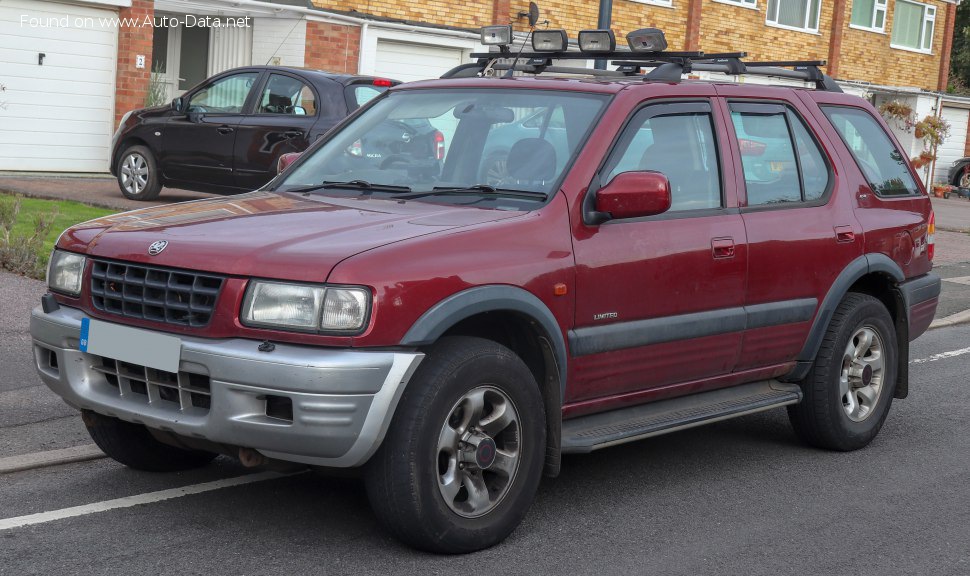
The Vauxhall Frontera Mk II 3.2i V6 (205 Hp) Automatic: A European Off-Roader’s Evolution
The Vauxhall Frontera Mk II 3.2i V6 (205 Hp) Automatic represents a significant iteration of Vauxhall’s entry into the burgeoning sport utility vehicle (SUV) market in Europe during the late 1990s. Produced from 1997 to 2000, this second-generation Frontera was, like its predecessor, a rebadged version of the Isuzu MU (Mysterious Utility) / Rodeo / Amigo, adapted for the European market by General Motors’ Vauxhall division in the United Kingdom and Opel division across mainland Europe. While never sold under the Vauxhall badge in the United States, its Isuzu counterparts were well-known, establishing a reputation for ruggedness and utility. The Mk II Frontera aimed to build on this foundation, offering improved refinement, enhanced safety features, and more potent powertrains to compete in an increasingly competitive segment. The 3.2i V6 automatic variant, in particular, stood out as the range-topping model, providing a blend of robust performance and convenience for both on-road cruising and light off-road adventures.
Engine and Performance of the Vauxhall Frontera Mk II
Under the hood, the Vauxhall Frontera Mk II 3.2i V6 (205 Hp) Automatic was powered by a longitudinally mounted 3.2-liter (3165 cm³ or 193.14 cu. in.) V6 gasoline engine, identified by the engine code 6VD1-W. This naturally aspirated, multi-port manifold injected engine featured a Double Overhead Camshaft (DOHC) valvetrain with four valves per cylinder, a sophisticated setup for an SUV of its era, especially one rooted in a more utilitarian design. It delivered a respectable 205 horsepower at 5400 rpm, providing ample power for highway merges and towing. Torque figures were equally impressive, peaking at 213.89 lb.-ft. at a relatively low 3000 rpm, which was crucial for off-road capability and strong acceleration from a standstill.
Mated to this potent V6 was a smooth-shifting 4-speed automatic transmission, designed to offer a comfortable driving experience while effectively managing the engine’s power. The drivetrain was an all-wheel-drive (4×4) system, allowing drivers to engage four-wheel drive when conditions demanded, enhancing traction on slippery surfaces or during mild off-road excursions.
Performance metrics for this 1997-2000 model were competitive for its class. The Frontera Mk II 3.2i V6 could accelerate from 0 to 60 mph in approximately 10.1 seconds, with a top speed reaching 116.2 mph. While not a performance SUV in the modern sense, these figures were more than adequate for typical family use and long-distance travel across Europe. Fuel economy, as expected for a V6 SUV of the late 1990s, reflected its size and power. Urban consumption was rated at around 11.9 US mpg, while extra-urban driving could achieve approximately 21 US mpg, translating to a combined average that was typical for vehicles in this segment at the time. The substantial 19.81 US gallon fuel tank ensured a decent cruising range between fill-ups.
Design and Features of the Frontera Mk II
The Vauxhall Frontera Mk II adopted a more contemporary design compared to its first-generation predecessor, aligning with evolving SUV aesthetics of the late 1990s. It retained its robust, five-door SUV body type, offering seating for five occupants. With a length of 183.39 inches, a width of 70.28 inches, and a height of 68.5 inches, the Frontera Mk II presented a substantial and commanding road presence. Its wheelbase of 106.38 inches contributed to a stable ride, while the front track of 59.65 inches and rear track of 59.84 inches provided a solid stance.
The exterior design featured smoother lines and more integrated styling than many of its more utilitarian rivals, yet it still conveyed a sense of rugged capability. Standard equipment included 245/70 R16 tires mounted on 7J x 16 alloy wheels, providing a good balance of road comfort and grip.
Inside, the Frontera Mk II offered a practical and spacious cabin. The trunk (boot) space was versatile, offering a minimum of 13.74 cubic feet with all seats in place, which could expand significantly to a generous 63.21 cubic feet when the rear seats were folded down, making it highly capable for cargo transport, whether for family vacations or outdoor equipment.
In terms of chassis and safety, the Frontera Mk II was equipped with ventilated disc brakes at the front and solid disc brakes at the rear, complemented by an Anti-lock Braking System (ABS) as standard. This provided improved stopping power and control, especially under emergency braking conditions. The steering system utilized a hydraulic power steering setup with a worm-reduction unit, offering a traditional, robust feel that was well-suited to an SUV designed for various terrains. Its kerb weight of 3935.25 lbs. and a maximum gross weight of 5401.33 lbs. underscored its sturdy construction, with a maximum payload capacity of 1466.07 lbs.
Technical Specifications
| Category | Specification |
|---|---|
| General Information | |
| Brand | Vauxhall |
| Model | Frontera Mk II |
| Type (Engine) | 3.2i V6 (205 Hp) Automatic |
| Production Start | 1997 |
| Production End | 2000 |
| Powertrain Architecture | Internal Combustion Engine |
| Body Type | SUV |
| Seats | 5 |
| Doors | 5 |
| Performance Specs | |
| Fuel Consumption (Urban) | 11.9 US mpg (19.8 l/100 km) |
| Fuel Consumption (Extra Urban) | 21 US mpg (11.2 l/100 km) |
| Fuel Type | Petrol (Gasoline) |
| Acceleration 0-60 mph | 10.1 seconds |
| Maximum Speed | 116.2 mph (187 km/h) |
| Weight-to-Power Ratio | 8.7 kg/Hp, 114.8 Hp/tonne |
| Weight-to-Torque Ratio | 6.2 kg/Nm, 162.5 Nm/tonne |
| Engine Specs | |
| Power | 205 Hp @ 5400 rpm |
| Power per Liter | 64.8 Hp/l |
| Torque | 213.89 lb.-ft. @ 3000 rpm (290 Nm) |
| Engine Layout | Front, Longitudinal |
| Engine Model/Code | 6VD1-W |
| Engine Displacement | 3.2 liters (3165 cm³, 193.14 cu. in.) |
| Number of Cylinders | 6 |
| Engine Configuration | V-engine |
| Cylinder Bore | 3.68 inches (93.4 mm) |
| Piston Stroke | 3.03 inches (77 mm) |
| Compression Ratio | 9.4:1 |
| Valves per Cylinder | 4 |
| Fuel Injection System | Multi-port manifold injection |
| Engine Aspiration | Naturally aspirated |
| Valvetrain | DOHC |
| Engine Oil Capacity | 5.6 US quarts (5.3 l) |
| Engine Oil Specification | Not specified |
| Coolant Capacity | 11.73 US quarts (11.1 l) |
| Space, Volume and Weights | |
| Kerb Weight | 3935.25 lbs. (1785 kg) |
| Max. Weight | 5401.33 lbs. (2450 kg) |
| Max Load | 1466.07 lbs. (665 kg) |
| Trunk (Boot) Space – Minimum | 13.74 cu. ft. (389 l) |
| Trunk (Boot) Space – Maximum | 63.21 cu. ft. (1790 l) |
| Fuel Tank Capacity | 19.81 US gallons (75 l) |
| Dimensions | |
| Length | 183.39 inches (4658 mm) |
| Width | 70.28 inches (1785 mm) |
| Height | 68.5 inches (1740 mm) |
| Wheelbase | 106.38 inches (2702 mm) |
| Front Track | 59.65 inches (1515 mm) |
| Rear Track | 59.84 inches (1520 mm) |
| Drivetrain, Brakes and Suspension Specs | |
| Drive Wheel | All-wheel drive (4×4) |
| Number of Gears & Type | 4 gears, automatic transmission |
| Front Brakes | Ventilated discs |
| Rear Brakes | Disc |
| Assisting Systems | ABS (Anti-lock braking system) |
| Steering Type | Worm-reduction unit |
| Power Steering | Hydraulic Steering |
| Tires Size | 245/70 R16 |
| Wheel Rims Size | 7J x 16 |
Legacy and Market Impact
The Vauxhall Frontera Mk II, particularly the 3.2i V6 (205 Hp) Automatic variant, played a notable role in the European SUV market during its production run. As a rebadged Isuzu, it leveraged GM’s global platform strategy, offering a robust and capable vehicle without the heavy investment of designing an entirely new model from the ground up. In the UK, where Vauxhall was a household name, the Frontera provided a compelling alternative to more premium European and Japanese SUVs.
Its primary competitors in the European market included vehicles like the Land Rover Freelander, Toyota RAV4, Honda CR-V, and the Mitsubishi Shogun Sport (Pajero Sport in other markets). While the RAV4 and CR-V leaned more towards car-like comfort and urban utility, the Frontera, with its body-on-frame construction (inherited from its Isuzu roots), offered a more traditional and rugged SUV experience, appealing to buyers who needed genuine off-road capability or a robust towing vehicle. The 3.2-liter V6 engine provided a performance edge over many of its four-cylinder rivals, enhancing its appeal for long-distance travel and hauling.
Despite its strengths, the Frontera faced challenges. The European market was rapidly evolving, with a growing demand for more refined, car-like SUVs (crossovers) that prioritized on-road handling and fuel efficiency. The Frontera, with its truck-based chassis and relatively high fuel consumption for the region, started to feel somewhat dated towards the end of its production. However, it maintained a reputation for reliability and durability, attributes that resonated with a segment of the market.
The Frontera’s legacy is one of a capable and honest SUV that served its purpose well within Vauxhall’s lineup. It demonstrated Vauxhall’s commitment to offering a full range of vehicles, including those for more adventurous lifestyles. Its discontinuation in 2004 (after the Mk II’s run) marked the end of an era for Vauxhall’s direct reliance on Isuzu for its SUV offerings, paving the way for future GM-derived SUVs and crossovers that would better align with the changing tastes of the European consumer. Today, the Frontera Mk II is remembered as a sturdy, no-nonsense SUV that offered good value and genuine utility in its segment.