Skoda Octavia III Combi (facelift 2017) 1.6 MPI (110 Hp) Automatic: A European Mainstay
The Skoda Octavia, a cornerstone of the Czech automaker’s lineup, represents a compelling blend of practicality, value, and sophisticated engineering, particularly within the European market. The third generation, known as the Octavia III, received a significant facelift in 2017, introducing updated styling and enhanced technology. The variant under review, the Skoda Octavia III Combi (facelift 2017) 1.6 MPI (110 Hp) Automatic, specifically refers to the station wagon (or “estate” in European parlance) model produced between 2018 and 2019. This particular iteration, equipped with a naturally aspirated 1.6-liter Multi-Point Injection (MPI) engine and a smooth automatic transmission, epitomized Skoda’s commitment to delivering a spacious, reliable, and efficient family vehicle that resonated strongly with a broad segment of European consumers. While never officially sold in the United States, the Octavia Combi’s success in its primary markets underscores Skoda’s integral role within the Volkswagen Group and its prowess in crafting highly competitive vehicles for the global stage.
Engine and Performance: The 1.6 MPI Powerplant
Under the hood of the Skoda Octavia III Combi (facelift 2017) 1.6 MPI (110 Hp) Automatic lies a robust and proven 1.6-liter (1598 cm³ or 97.52 cubic inches) naturally aspirated inline-four engine, designated with the model code CWVA. This powerplant is engineered for dependability and economical operation rather than outright blistering speed. It delivers a respectable 110 horsepower (Hp) at 5800 revolutions per minute (rpm), making it a suitable choice for everyday driving and comfortable highway cruising. The engine’s power output per liter stands at 68.8 Hp/l, a characteristic typical of naturally aspirated units designed for longevity and predictable performance.
Torque figures for this engine are equally pragmatic, peaking at 155 Newton-meters (Nm), or 114.32 lb.-ft., available across a useful rev range of 3800-4000 rpm. This broad torque band contributes to the car’s tractable nature, allowing for confident acceleration in urban environments and maintaining momentum on open roads. Power is transmitted to the front wheels via a 6-speed automatic transmission, a configuration chosen for its smooth shifts and ease of use, particularly in congested city driving conditions.
In terms of acceleration, the Octavia Combi 1.6 MPI Automatic reaches 60 mph from a standstill in an estimated 11.6 seconds, and 0 to 62 mph (100 km/h) in 12.2 seconds. While not a performance-oriented vehicle, these figures are perfectly adequate for a family station wagon. The maximum speed is rated at 116.82 mph (188 km/h), demonstrating its capability for sustained high-speed travel on European autobahns or highways. The engine utilizes a multi-port manifold injection system and is equipped with a particulate filter, reflecting its adherence to modern European emissions standards even for gasoline engines. Its front, transverse engine layout is standard for front-wheel-drive vehicles, optimizing cabin space and handling dynamics.
Design and Features: Practicality Meets Refinement
The Skoda Octavia III Combi (facelift 2017) Aesthetic
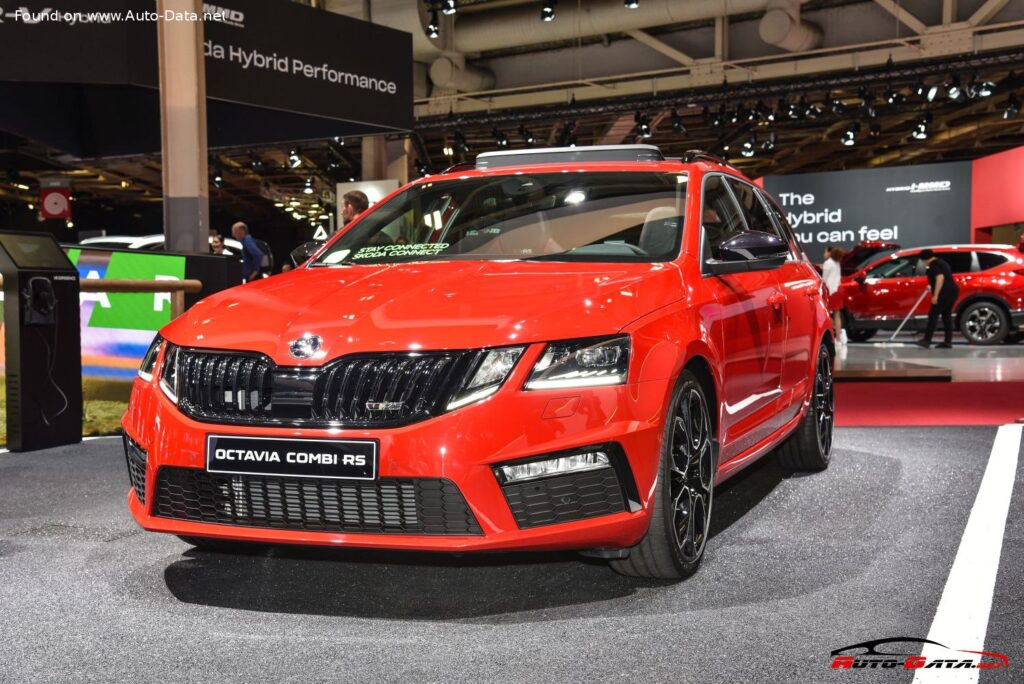
The 2017 facelift brought subtle yet impactful changes to the Octavia’s design, enhancing its contemporary appeal. The most noticeable update was the revised front fascia, featuring distinctive split headlights that gave the car a more assertive and modern look. The Combi, or station wagon, body type is a hallmark of the Octavia’s practicality. With five doors and seating for five occupants, it offers exceptional versatility. Its dimensions – a length of 183.74 inches (4667 mm), a width of 71.42 inches (1814 mm, or 79.41 inches including mirrors), and a height of 57.68 inches (1465 mm) – position it firmly within the compact to mid-size station wagon segment. The generous wheelbase of 105.75 inches (2686 mm) contributes significantly to both ride comfort and interior roominess.
Interior Space and Practicality
One of the Octavia Combi’s strongest selling points is its cavernous cargo capacity. It boasts a minimum trunk space of 21.54 cubic feet (610 liters) with all seats in place, which expands to an impressive 61.45 cubic feet (1740 liters) when the rear seats are folded down. This class-leading volume makes it an ideal choice for families, active individuals, or anyone needing substantial hauling capability. The kerb weight of 2832.94 lbs (1285 kg) reflects its solid build quality without being overly heavy, contributing to decent fuel efficiency. The 13.21 US gallon (50-liter) fuel tank provides a practical driving range.
Chassis, Brakes, and Driver Aids
The Octavia III Combi features a front-wheel-drive architecture, which is typical for its segment, offering predictable handling and efficiency. The braking system consists of ventilated discs at the front and solid discs at the rear, complemented by an Anti-lock Braking System (ABS) to ensure stable stopping power. The steering system is a rack and pinion type with electric power steering, providing precise control and reduced effort, especially during low-speed maneuvers. The car rides on 205/55 R16 tires mounted on 16-inch wheel rims, a common size that balances ride comfort with handling responsiveness.
Other practical considerations include a minimum turning circle of 34.78 feet (10.6 m), making it relatively agile in urban settings, and a ground clearance of 5.55 inches (141 mm), which is standard for a passenger car of this type. The approach and departure angles (14.0° and 12.4° respectively) indicate its suitability for paved roads and light urban obstacles.
Technical Specifications: Skoda Octavia III Combi (facelift 2017) 1.6 MPI (110 Hp) Automatic
| Category | Specification | US Equivalent (where applicable) |
|---|---|---|
| General Information | ||
| Brand | Skoda | |
| Model | Octavia | |
| Generation | Octavia III Combi (facelift 2017) | |
| Type (Engine) | 1.6 MPI (110 Hp) Automatic | |
| Start of Production | 2018 year | |
| End of Production | 2019 year | |
| Powertrain Architecture | Internal Combustion engine | |
| Body Type | Station wagon (estate) | |
| Seats | 5 | |
| Doors | 5 | |
| Performance Specifications | ||
| Fuel Type | Petrol (Gasoline) | |
| Acceleration 0 – 60 mph | 11.6 sec | |
| Acceleration 0 – 62 mph (100 km/h) | 12.2 sec | |
| Maximum Speed | 188 km/h | 116.82 mph |
| Weight-to-Power Ratio | 11.7 kg/Hp | 85.6 Hp/tonne |
| Weight-to-Torque Ratio | 8.3 kg/Nm | 120.6 Nm/tonne |
| Engine Specifications | ||
| Power | 110 Hp @ 5800 rpm | |
| Power per Liter | 68.8 Hp/l | |
| Torque | 155 Nm @ 3800-4000 rpm | 114.32 lb.-ft. @ 3800-4000 rpm |
| Engine Layout | Front, Transverse | |
| Engine Model/Code | CWVA | |
| Engine Displacement | 1598 cm³ | 97.52 cu. in. |
| Number of Cylinders | 4 | |
| Engine Configuration | Inline | |
| Number of Valves per Cylinder | 4 | |
| Fuel Injection System | Multi-port manifold injection | |
| Engine Aspiration | Naturally aspirated engine | |
| Engine Oil Capacity | 4 l | 4.23 US qt |
| Engine Oil Specification | Not specified | |
| Engine Systems | Particulate filter | |
| Space, Volume, and Weights | ||
| Kerb Weight | 1285 kg | 2832.94 lbs |
| Trunk (boot) Space – Minimum | 610 l | 21.54 cu. ft. |
| Trunk (boot) Space – Maximum | 1740 l | 61.45 cu. ft. |
| Fuel Tank Capacity | 50 l | 13.21 US gal |
| Dimensions | ||
| Length | 4667 mm | 183.74 in. |
| Width | 1814 mm | 71.42 in. |
| Width including Mirrors | 2017 mm | 79.41 in. |
| Height | 1465 mm | 57.68 in. |
| Wheelbase | 2686 mm | 105.75 in. |
| Front Track | 1549 mm | 60.98 in. |
| Rear (Back) Track | 1540 mm | 60.63 in. |
| Ride Height (Ground Clearance) | 141 mm | 5.55 in. |
| Minimum Turning Circle (Turning Diameter) | 10.6 m | 34.78 ft. |
| Approach Angle | 14.0° | |
| Departure Angle | 12.4° | |
| Drivetrain, Brakes, and Suspension Specs | ||
| Drivetrain Architecture | The Internal combustion engine (ICE) drives the front wheels of the vehicle. | |
| Drive Wheel | Front wheel drive | |
| Number of Gears and Type of Gearbox | 6 gears, automatic transmission | |
| Front Brakes | Ventilated discs | |
| Rear Brakes | Disc | |
| Assisting Systems | ABS (Anti-lock braking system) | |
| Steering Type | Steering rack and pinion | |
| Power Steering | Electric Steering | |
| Tires Size | 205/55 R16 | |
| Wheel Rims Size | 16 inches | |
Legacy and Market Impact: The Octavia’s European Dominance
The Skoda Octavia has consistently been a best-seller for the brand in Europe, and the third-generation Combi, especially after its 2017 facelift, continued this legacy. Its primary market impact was centered on offering exceptional value, space, and robust build quality, hallmarks of the Skoda brand under Volkswagen Group ownership. In its segment, the Octavia Combi competed fiercely with other established European players such as the Volkswagen Golf Variant (Estate), Ford Focus Estate, Opel Astra Sports Tourer, and Renault Mégane Estate. What set the Octavia apart was its ability to offer near-mid-size vehicle space and refinement at a price point often more aligned with compact cars.
The 1.6 MPI engine variant, while not the most powerful or technologically advanced in the Octavia lineup (which also included turbocharged TSI gasoline and TDI diesel engines), played a crucial role. It offered a reliable, naturally aspirated option for buyers prioritizing lower purchase costs, proven mechanics, and predictable maintenance. This made it particularly popular in markets where fuel efficiency and long-term durability were key considerations, and where the simplicity of a non-turbo engine was appealing. The automatic transmission further enhanced its appeal for urban commuters and those seeking a relaxed driving experience.
Historically, the Octavia has been praised for democratizing practical, high-quality family transport. Its design, while conservative, was universally appealing, emphasizing functionality and clean lines. Its reputation for being a “smart choice” – offering more car for the money without sacrificing quality – solidified its position as a segment leader. The third generation, with its refined MQB platform (shared with the VW Golf), brought advancements in safety, connectivity, and driving dynamics, further cementing its appeal.
The absence of the Skoda brand, and thus the Octavia, from the North American market is primarily due to Volkswagen’s strategic decision to focus its core VW brand and its luxury marques (Audi, Porsche, etc.) in the USA. Skoda fills a specific niche within the VW Group’s global strategy, offering a more value-oriented, practical alternative to Volkswagen models in Europe and other international markets. The Skoda Octavia III Combi (facelift 2017) 1.6 MPI (110 Hp) Automatic, though unfamiliar to American consumers, stands as a testament to Skoda’s engineering prowess and its consistent ability to deliver highly competent and successful vehicles in its target markets, leaving a significant mark on the European automotive landscape during its production run from 2018 to 2019. Its legacy is one of unwavering practicality, reliability, and an intelligent approach to family transportation.