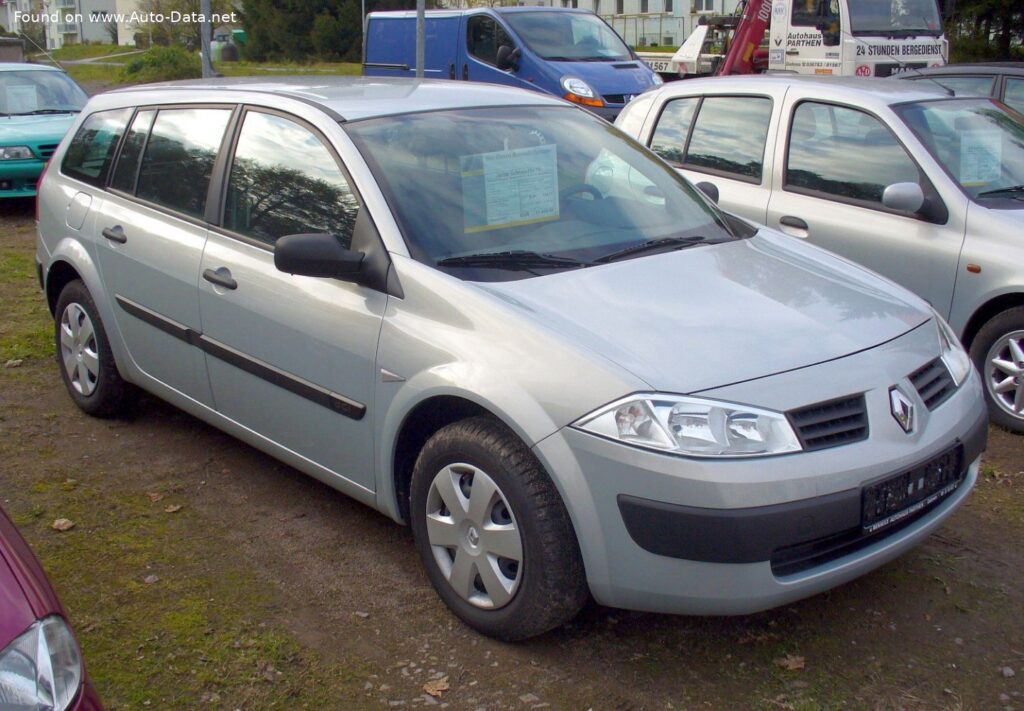
The Renault Megane II Grandtour 1.9 dCi (130 Hp) FAP: A European Family Workhorse
The Renault Megane II Grandtour 1.9 dCi (130 Hp) FAP represents a significant iteration of Renault’s popular compact car, specifically designed for the European market’s discerning family and fleet buyers. Introduced in 2005, this particular model belongs to the second generation of the Megane, which garnered considerable attention for its distinctive styling and advanced features for its class. The “Grandtour” designation indicates its station wagon (estate) body style, emphasizing practicality and cargo capacity, a highly valued attribute in regions where sedans and hatchbacks dominate, but versatility is paramount. Powered by a robust 1.9-liter dCi turbodiesel engine, this variant was specifically engineered to offer a compelling blend of performance, fuel efficiency, and reduced emissions, aligning with the increasingly stringent Euro 4 standards of the mid-2000s. While not officially sold in the United States, the Megane II Grandtour played a pivotal role in solidifying Renault’s position as a leader in the European compact segment, showcasing the brand’s commitment to innovation in design and powertrain technology.
Engine and Performance of the Renault Megane II Grandtour
At the heart of the 2005 Renault Megane II Grandtour 1.9 dCi (130 Hp) FAP lies a sophisticated 1.9-liter (1870 cm3 or 114.11 cu. in.) F9Q inline-four turbodiesel engine. This powertrain delivered a respectable 130 horsepower at 4000 rpm, demonstrating a strong output for a compact family vehicle of its era. More importantly for daily driving and cargo hauling, the engine produced a substantial 221.27 lb.-ft. (300 Nm) of torque, available at a low 2000 rpm. This ample low-end torque was crucial for effortless acceleration, particularly when loaded with passengers or luggage, making it well-suited for both urban commuting and long-distance highway travel.
The F9Q engine utilized a common rail direct fuel injection system, a technology that was becoming standard for modern diesels, allowing for precise fuel delivery and improved combustion efficiency. Complementing this was a turbocharger with an intercooler, which further boosted power and torque output while maintaining reasonable fuel consumption. The inclusion of a Particulate Filter (FAP) was a key environmental feature for its time, designed to capture and reduce harmful soot emissions, enabling the vehicle to meet the Euro 4 emission standard. Power was channeled to the front wheels through a smooth-shifting 6-speed manual transmission, offering drivers greater control over the engine’s power band and contributing to both performance and fuel economy.
In terms of performance, the Megane II Grandtour 1.9 dCi was capable of accelerating from 0 to 60 mph in a brisk 8.8 seconds, or 0 to 100 km/h in 9.3 seconds, an impressive figure for a diesel station wagon. Its maximum speed reached 124.27 mph (200 km/h), making it perfectly capable of handling European autobahns. Fuel efficiency was a major selling point, with a combined fuel economy rating of 40.6 US mpg (5.8 l/100 km). Urban driving yielded 31.8 US mpg (7.4 l/100 km), while extra-urban (highway) driving could achieve an impressive 48 US mpg (4.9 l/100 km). These figures, combined with a 15.85 US gallon (60 liter) fuel tank, provided a significant cruising range, a desirable trait for families and business travelers alike.
Design and Features
The Renault Megane II Grandtour’s design language was a direct extension of the second-generation Megane’s distinctive and somewhat controversial styling, characterized by its bold, angular lines and a prominent, almost architectural rear end. The station wagon variant, however, cleverly integrated these design cues into a more practical and elongated body. Measuring 177.17 inches (4500 mm) in length, 69.96 inches (1777 mm) in width (79.76 inches or 2026 mm including mirrors), and 57.76 inches (1467 mm) in height, the Grandtour offered a substantial footprint for its class.
With a wheelbase of 105.75 inches (2686 mm), the interior provided comfortable seating for five occupants across its five doors. The true highlight of the Grandtour, however, was its cargo capacity. With the rear seats in place, it boasted a generous 18.36 cubic feet (520 liters) of trunk space, which could be expanded to a cavernous 56.5 cubic feet (1600 liters) with the rear seats folded down. This flexibility made it an ideal vehicle for family vacations, grocery runs, or transporting bulky items.
Beyond its spacious interior, the Megane II Grandtour incorporated a range of features aimed at enhancing comfort, convenience, and safety. Standard safety equipment for the era included ABS (Anti-lock Braking System), a crucial feature for maintaining control during emergency braking. The vehicle featured independent McPherson strut front suspension and a torsion beam rear suspension, providing a balanced ride quality suitable for various road conditions. Steering was managed by an electric power steering system, offering light and precise control, particularly beneficial in urban environments. Braking duties were handled by ventilated discs at the front and disc brakes at the rear, ensuring effective stopping power. The car rode on 205/50 R17 tires mounted on 6.5J x 17 wheel rims, contributing to both its stable handling and visual appeal.
Technical Specifications
| Category | Specification | US Equivalent / Notes |
|---|---|---|
| General Information | ||
| Brand | Renault | |
| Model | Megane | |
| Generation | Megane II Grandtour | |
| Type (Engine) | 1.9 dCi (130 Hp) FAP | |
| Production Start/End | 2005 – 2005 | |
| Powertrain Architecture | Internal Combustion Engine | |
| Body Type | Station Wagon (Estate) | |
| Seats / Doors | 5 / 5 | |
| Performance Specifications | ||
| Fuel Consumption (Urban) | 7.4 l/100 km | 31.8 US mpg |
| Fuel Consumption (Extra Urban) | 4.9 l/100 km | 48 US mpg |
| Fuel Consumption (Combined) | 5.8 l/100 km | 40.6 US mpg |
| CO2 Emissions | 154 g/km | |
| Fuel Type | Diesel | |
| Acceleration 0-60 mph | 8.8 sec | Calculated by Auto-Data.net |
| Acceleration 0-100 km/h | 9.3 sec | |
| Maximum Speed | 200 km/h | 124.27 mph |
| Emission Standard | Euro 4 | |
| Weight-to-Power Ratio | 10.1 kg/Hp | 99.2 Hp/tonne |
| Weight-to-Torque Ratio | 4.4 kg/Nm | 229 Nm/tonne |
| Engine Specifications | ||
| Power | 130 Hp @ 4000 rpm | |
| Power per Liter | 69.5 Hp/l | |
| Torque | 300 Nm @ 2000 rpm | 221.27 lb.-ft. @ 2000 rpm |
| Engine Layout | Front, Transverse | |
| Engine Model/Code | F9Q | |
| Engine Displacement | 1870 cm3 | 1.9 Liters (114.11 cu. in.) |
| Number of Cylinders | 4 | Inline configuration |
| Cylinder Bore | 80 mm | 3.15 in. |
| Piston Stroke | 93 mm | 3.66 in. |
| Compression Ratio | 19:1 | |
| Valves per Cylinder | 2 | |
| Fuel Injection System | Diesel Commonrail | |
| Engine Aspiration | Turbocharger, Intercooler | |
| Valvetrain | OHC | Overhead Camshaft |
| Engine Oil Capacity | 4.5 l | 4.76 US qt |
| Coolant Capacity | 7.6 l | 8.03 US qt |
| Engine Systems | Particulate filter (FAP) | |
| Space, Volume, and Weights | ||
| Kerb Weight | 1310 kg | 2888.06 lbs. |
| Max. Weight | 1890 kg | 4166.74 lbs. |
| Max Load | 580 kg | 1278.68 lbs. |
| Trunk Space (Min/Max) | 520 l / 1600 l | 18.36 cu. ft. / 56.5 cu. ft. |
| Fuel Tank Capacity | 60 l | 15.85 US gal |
| Max. Roof Load | 80 kg | 176.37 lbs. |
| Permitted Trailer Load (with brakes) | 1350 kg | 2976.24 lbs. |
| Permitted Trailer Load (without brakes) | 650 kg | 1433 lbs. |
| Permitted Towbar Download | 75 kg | 165.35 lbs. |
| Dimensions | ||
| Length | 4500 mm | 177.17 in. |
| Width | 1777 mm | 69.96 in. |
| Width (incl. mirrors) | 2026 mm | 79.76 in. |
| Height | 1467 mm | 57.76 in. |
| Wheelbase | 2686 mm | 105.75 in. |
| Front Track | 1518 mm | 59.76 in. |
| Rear Track | 1514 mm | 59.61 in. |
| Front Overhang | 842 mm | 33.15 in. |
| Rear Overhang | 972 mm | 38.27 in. |
| Minimum Turning Circle | 11 m | 36.09 ft. |
| Drivetrain, Brakes, and Suspension | ||
| Drivetrain Architecture | Front-wheel drive, Internal Combustion Engine | |
| Drive Wheel | Front wheel drive | |
| Gearbox | 6 gears, manual transmission | |
| Front Suspension | Independent type McPherson | |
| Rear Suspension | Torsion beam | |
| Front Brakes | Ventilated discs | |
| Rear Brakes | Disc | |
| Assisting Systems | ABS (Anti-lock braking system) | |
| Steering Type | Steering rack and pinion | |
| Power Steering | Electric Steering | |
| Tires Size | 205/50 R17 | |
| Wheel Rims Size | 6.5J x 17 | |
Legacy and Market Impact
The Renault Megane II Grandtour, particularly in its 1.9 dCi (130 Hp) FAP configuration, carved out a strong niche for itself in the highly competitive European compact segment during the mid-2000s. Its distinctive styling, a hallmark of the Megane II generation, set it apart from more conventionally designed rivals. However, it was the combination of its practical station wagon body, potent yet economical diesel engine, and advanced features that cemented its reputation as a highly capable family car.
In Europe, where diesel powertrains were immensely popular due to their fuel efficiency and lower running costs, the 1.9 dCi engine was a particularly attractive option. The inclusion of a Particulate Filter (FAP) was forward-thinking for 2005, addressing growing environmental concerns and positioning the Megane II as a responsible choice for consumers. Its Euro 4 compliance further ensured its relevance in a market increasingly focused on emissions standards.
Competitors in its region included a wide array of established players, such as the Volkswagen Golf Variant, Opel Astra Caravan, Ford Focus Estate, and Peugeot 307 SW. The Megane II Grandtour stood out with its emphasis on unique design, a comfortable and well-appointed interior, and a strong focus on passive safety, having achieved excellent crash test ratings. Its generous cargo capacity and comfortable ride made it a favorite among families who needed space and versatility without moving up to a larger, more expensive vehicle class.
The historical significance of the Megane II Grandtour lies in its contribution to popularizing compact station wagons with efficient diesel engines in Europe. It demonstrated that a family car could be both practical and stylish, offering a compelling alternative to larger SUVs or minivans. While its unique styling might have been polarizing, its underlying mechanical package and commitment to fuel efficiency and emissions reduction were undeniable strengths. The 1.9 dCi (130 Hp) FAP variant of the Renault Megane II Grandtour remains a testament to Renault’s engineering prowess and its understanding of the European automotive market’s specific demands during a transitional period for powertrain technology.