Ford Mustang V (facelift 2009) Boss 302 5.0 V8 (444 Hp)
The Ford Mustang V (facelift 2009) Boss 302 5.0 V8 (444 Hp) represents a highly specialized and revered variant of the fifth-generation Ford Mustang, an icon of American muscle and performance. Introduced for the 2011 and 2012 model years, this limited-production model paid homage to the legendary 1969-1970 Boss 302 Mustang, a car built to dominate SCCA Trans-Am racing. Ford engineers meticulously re-engineered the standard Mustang GT to create a street-legal track weapon, blending classic American styling with modern performance technology. The Boss 302 was designed to bridge the gap between the standard Mustang GT and the more extreme Shelby GT500, offering a naturally aspirated, high-revving alternative focused on handling prowess and driver engagement rather than outright horsepower. It quickly carved out its niche as a highly desirable collector’s item and a formidable competitor on both the street and the racetrack.
Engine and Performance of the Ford Mustang Boss 302
At the heart of the Ford Mustang V (facelift 2009) Boss 302 5.0 V8 (444 Hp) lies a specially modified version of Ford’s 5.0-liter “Coyote” V8 engine. While the standard Mustang GT of the era produced 412 horsepower, the Boss 302’s engine was significantly upgraded to deliver 444 horsepower at a soaring 7400 rpm and 380 lb-ft of torque at 4500 rpm. This power increase was achieved through a series of meticulous enhancements, including CNC ported cylinder heads, revised camshafts with more aggressive lift and duration, a high-flow “runners-in-box” composite intake manifold, and a unique engine calibration. These modifications pushed the redline to an exhilarating 7500 rpm, giving the Boss 302 a distinct, high-revving character not typically associated with American V8s of the era.
Power is channeled to the rear wheels through a robust six-speed manual transmission, providing a direct and engaging driving experience. The powertrain architecture is a classic front-engine, rear-wheel-drive setup, fundamental to the Mustang’s identity. The naturally aspirated engine boasts a high 11:1 compression ratio and utilizes a multi-port manifold injection system, complemented by a sophisticated DOHC (Dual Overhead Camshaft) valvetrain with Ti-VCT (Twin Independent Variable Cam Timing) for optimal power delivery across the rev range. This combination resulted in a highly responsive and potent engine, capable of delivering exhilarating acceleration and a visceral soundtrack, further amplified by a unique quad-exhaust system featuring side-exit pipes that could be uncorked for track use. The weight-to-power ratio stands at an impressive 3.7 kg/Hp (8.16 lbs/Hp), translating to 269.6 Hp per tonne (244.5 Hp per US ton), underscoring its performance credentials.
Design and Features
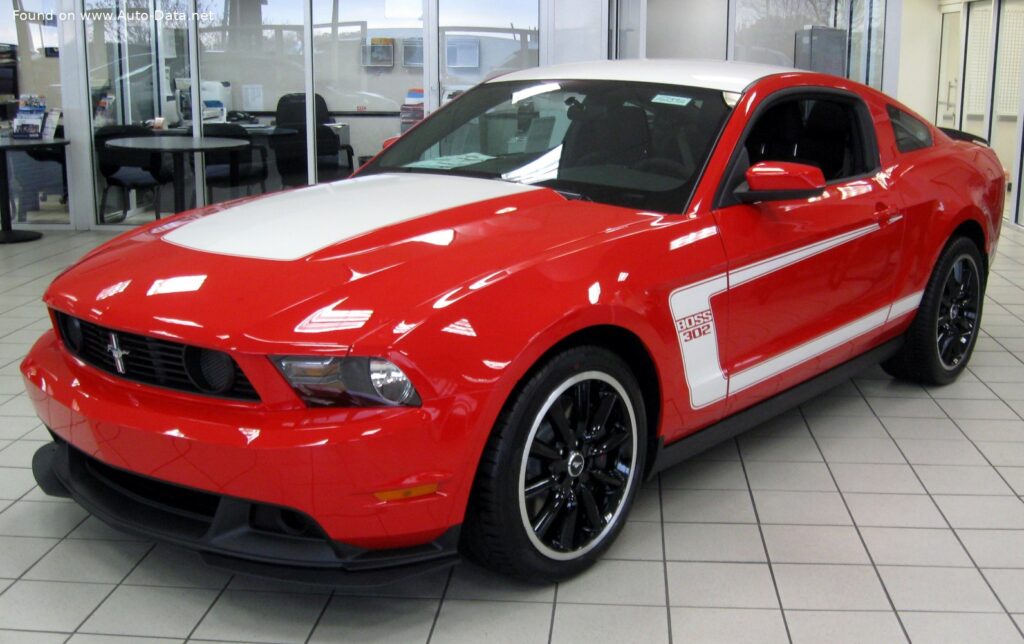
The design of the Ford Mustang V (facelift 2009) Boss 302 is a masterful blend of retro-inspired aesthetics and contemporary performance cues. Based on the facelifted S197 generation Mustang coupe, it retains the iconic long hood, short deck proportions. However, the Boss 302 distinguishes itself with a unique front fascia featuring a more aggressive splitter, a blocked-off grille with an offset pony badge, and a distinct front air dam. Bold C-stripe graphics, reminiscent of the original Boss 302, adorn the sides, while a prominent rear spoiler and a unique rear diffuser complete the performance-oriented exterior. The car rides on specific 19-inch alloy wheels, 9J wide at the front and 9.5J at the rear, wrapped in high-performance Pirelli PZero tires (255/40 R19 front, 285/35 R19 rear) for maximum grip.
Beyond aesthetics, the Boss 302 received significant chassis enhancements. The suspension was thoroughly revised with stiffer springs, larger diameter anti-roll bars, and manually adjustable dampers (requiring a flat-head screwdriver to adjust on the car). The steering system, an electric power steering unit, was recalibrated for improved feel and precision. Braking performance was drastically improved with 14-inch (355mm) ventilated discs up front and 11.8-inch (300mm) ventilated discs at the rear, both equipped with ABS. The interior featured unique Boss 302 badging, a suede-wrapped steering wheel, and an optional set of Recaro sport seats, providing superior lateral support for spirited driving. A particularly unique feature was the “Trunk Key” which, when used, unlocked a more aggressive engine calibration, increasing throttle response and modifying idle characteristics for track use – a subtle nod to its dual-purpose nature.
Technical Specifications
| Category | Specification |
|---|---|
| General Information | |
| Brand | Ford |
| Model | Mustang |
| Generation | Mustang V (facelift 2009) |
| Engine Type | Boss 302 5.0 V8 |
| Production Start | 2011 |
| Production End | 2012 |
| Powertrain Architecture | Internal Combustion Engine |
| Body Type | Coupe |
| Seats | 4 |
| Doors | 2 |
| Performance Specs | |
| Fuel Consumption (Urban) | 17 US mpg (13.8 l/100 km) |
| Fuel Consumption (Extra Urban) | 26.1 US mpg (9 l/100 km) |
| Fuel Consumption (Combined) | 19.9 US mpg (11.8 l/100 km) |
| Fuel Type | Petrol (Gasoline) |
| Weight-to-Power Ratio | 8.16 lbs/Hp (3.7 kg/Hp) |
| Power per Tonne | 269.6 Hp/tonne |
| Weight-to-Torque Ratio | 7.05 lbs/lb.-ft. (3.2 kg/Nm) |
| Torque per Tonne | 312.7 Nm/tonne |
| Engine Specs | |
| Power | 444 Hp @ 7400 rpm |
| Power per Liter | 89.7 Hp/l |
| Torque | 379.84 lb.-ft. @ 4500 rpm (515 Nm) |
| Maximum Engine Speed | 7500 rpm |
| Engine Layout | Front, Longitudinal |
| Engine Displacement | 302.13 cu. in. (4951 cm3) |
| Number of Cylinders | 8 |
| Engine Configuration | V-engine |
| Cylinder Bore | 3.63 in. (92.2 mm) |
| Piston Stroke | 3.65 in. (92.7 mm) |
| Compression Ratio | 11:1 |
| Valves per Cylinder | 4 |
| Fuel Injection System | Multi-port manifold injection |
| Engine Aspiration | Naturally aspirated |
| Valvetrain | DOHC, Ti-VCT |
| Engine Oil Capacity | 8.45 US qt (8 l) |
| Space, Volume and Weights | |
| Kerb Weight | 3631.01 lbs (1647 kg) |
| Trunk Space (Minimum) | 13.38 cu. ft. (379 l) |
| Fuel Tank Capacity | 16.11 US gal (61 l) |
| Dimensions | |
| Length | 188.11 in. (4778 mm) |
| Width | 73.9 in. (1877 mm) |
| Height | 55.12 in. (1400 mm) |
| Wheelbase | 107.09 in. (2720 mm) |
| Front Track | 61.89 in. (1572 mm) |
| Rear Track | 62.52 in. (1588 mm) |
| Minimum Turning Circle | 39.37 ft. (12 m) |
| Drivetrain, Brakes and Suspension Specs | |
| Drivetrain Architecture | Rear-wheel drive (ICE drives rear wheels) |
| Drive Wheel | Rear wheel drive |
| Gearbox Type | 6 gears, manual transmission |
| Front Suspension | Independent type McPherson, Transverse stabilizer |
| Rear Suspension | Rigid axle suspension, Transverse stabilizer, Coil spring |
| Front Brakes | Ventilated discs, 13.98 x 1.26 in. (355×32 mm) |
| Rear Brakes | Ventilated discs, 11.81 x 0.75 in. (300×19 mm) |
| Assisting Systems | ABS (Anti-lock braking system) |
| Steering Type | Steering rack and pinion |
| Power Steering | Electric Steering |
| Front Wheel Tires | 255/40 R19 |
| Rear Wheel Tires | 285/35 R19 |
| Front Wheel Rims | 9J x 19 |
| Rear Wheel Rims | 9.5J x 19 |
Legacy and Market Impact
The Ford Mustang V (facelift 2009) Boss 302 5.0 V8 (444 Hp) quickly established itself as one of the most significant and desirable performance Mustangs of its era. Its limited production run—approximately 3,250 units for the 2012 model year (including Laguna Seca edition) and a similar number for 2013—ensured its exclusivity. The Boss 302’s focus on balanced performance, combining a high-revving naturally aspirated engine with a track-tuned chassis, set it apart from its contemporaries. In the highly competitive American muscle car market, it faced formidable rivals such as the Chevrolet Camaro SS 1LE and the Dodge Challenger SRT8. While the Challenger offered brute force and the Camaro a more modern IRS, the Boss 302 distinguished itself with its direct, analog feel, exceptional handling for a live-axle car, and a direct lineage to its racing heritage.
The Boss 302 was lauded by automotive journalists and enthusiasts alike for its engaging driving dynamics, aggressive styling, and the intoxicating sound of its modified Coyote V8. Its ability to excel on track days while remaining a capable street car cemented its reputation. Ford’s decision to revive the Boss 302 nameplate resonated deeply with Mustang aficionados, celebrating a golden era of American performance. The car’s influence extended beyond its two-year production run, inspiring future performance variants and showcasing the potential of the 5.0-liter Coyote engine. Today, the Ford Mustang Boss 302 remains a highly sought-after collector’s car, appreciating in value due to its rarity, performance pedigree, and its enduring status as a true modern classic that perfectly encapsulates the spirit of the original Boss. It stands as a testament to Ford’s commitment to performance and its ability to blend heritage with cutting-edge engineering.