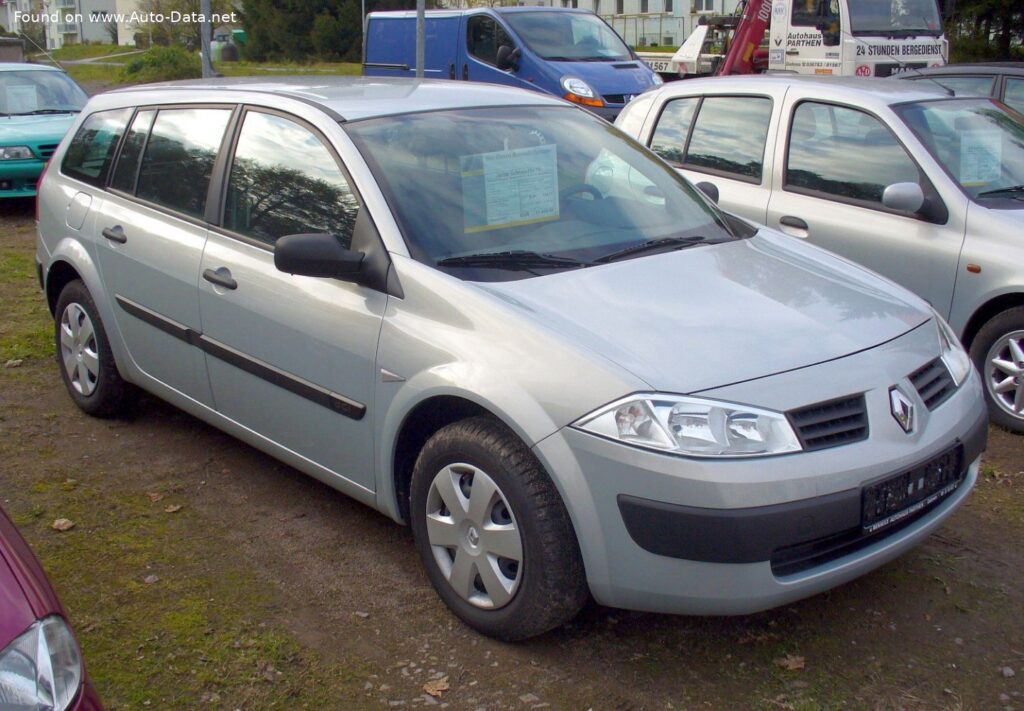
The Renault Megane II Grandtour 1.9 dCi (90 Hp): A European Workhorse
The Renault Megane II Grandtour 1.9 dCi (90 Hp) represents a significant chapter in the history of compact family vehicles, particularly within the competitive European market. Launched in 2004 as part of the second generation of the Renault Megane lineup, the Grandtour variant—known stateside as a station wagon—was designed to offer enhanced practicality and cargo capacity compared to its hatchback and sedan siblings. This specific model, powered by a 1.9-liter dCi diesel engine, quickly became a popular choice for families and businesses across the continent, balancing efficient performance with Renault’s distinctive design philosophy and commitment to safety. Although never officially sold in the United States, the Megane II Grandtour played a crucial role in defining the compact segment’s expectations for versatility and economy in its primary markets.
The Megane II generation itself was a bold statement from Renault, characterized by its unconventional styling, particularly the distinctive “bustle-back” rear of the hatchback models. The Grandtour, however, adopted a more conventional yet still modern aesthetic, extending the roofline to maximize interior space. Produced between 2004 and 2005 for this particular engine configuration, the Renault Megane II Grandtour 1.9 dCi (90 Hp) was a testament to the burgeoning appeal of diesel powertrains in Europe, offering a compelling blend of torque, fuel efficiency, and a comfortable ride, all wrapped in a practical, five-door, five-seat package.
Engine & Performance of the Renault Megane II Grandtour 1.9 dCi (90 Hp)
Under the hood, the Renault Megane II Grandtour 1.9 dCi (90 Hp) featured a robust 1.9-liter (1870 cm3 or 114.11 cu. in.) F9Q inline-four diesel engine. This powertrain was a cornerstone of Renault’s diesel offerings, known for its reliability and efficiency. Equipped with a common rail fuel injection system, a turbocharger, and an intercooler, the engine produced a modest but highly usable 90 horsepower at 4000 rpm. More importantly for a vehicle of its type, it delivered a substantial 230 Nm (169.64 lb.-ft.) of torque at a low 2000 rpm, providing excellent low-end grunt ideal for hauling cargo or navigating city traffic.
Power was sent to the front wheels via a six-speed manual transmission, a choice that underscored the vehicle’s focus on driver engagement and fuel economy. The manual gearbox allowed drivers to optimize the engine’s torque band, contributing to its impressive fuel consumption figures. The Megane II Grandtour 1.9 dCi achieved an urban economy of 7.3 l/100 km (32.2 US mpg), an extra-urban figure of 4.4 l/100 km (53.5 US mpg), and a combined rating of 5.4 l/100 km (43.6 US mpg). These numbers were highly competitive for its era and segment, making it an economical choice for long-distance travel and daily commuting.
In terms of acceleration, the 1.9 dCi (90 Hp) Grandtour was not built for speed but offered adequate performance for its segment. It could accelerate from 0 to 60 mph in a calculated 12.5 seconds, with a top speed of 172 km/h (106.88 mph). Its weight-to-power ratio stood at 14.6 kg/Hp (68.7 Hp/tonne), while the weight-to-torque ratio was 5.7 kg/Nm (175.6 Nm/tonne), indicating a well-balanced setup for practical driving. The vehicle also met the Euro 3 emission standard, reflecting its environmental considerations for the early 2000s. The 60-liter (15.85 US gal) fuel tank provided a significant cruising range, further enhancing its appeal as a long-distance family hauler.
Design and Features of the Megane II Grandtour
The Megane II Grandtour’s design was a practical extension of the Megane II’s overall aesthetic, albeit with a more conventional rear profile than its hatchback counterpart. Measuring 4500 mm (177.17 in.) in length, 1777 mm (69.96 in.) in width (2026 mm or 79.76 in. including mirrors), and 1467 mm (57.76 in.) in height, the Grandtour provided a spacious cabin and a generous cargo area. Its 2686 mm (105.75 in.) wheelbase contributed to a stable ride and ample legroom for passengers.
The primary draw of the Grandtour was its versatility as a station wagon. It offered a substantial minimum trunk space of 520 liters (18.36 cu. ft.), which could be expanded to an impressive 1600 liters (56.5 cu. ft.) with the rear seats folded down. This made it an ideal vehicle for families, tradespeople, or anyone requiring significant hauling capacity. The maximum load capacity was 580 kg (1278.68 lbs.), and it boasted a permitted trailer load with brakes of 1350 kg (2976.24 lbs.), further underscoring its utility.
In terms of features, the Megane II Grandtour incorporated technology typical of the era, with a focus on safety and comfort. Standard safety equipment included an Anti-lock Braking System (ABS), which was becoming increasingly common. The vehicle featured ventilated disc brakes at the front and disc brakes at the rear, ensuring reliable stopping power. The steering system utilized a rack and pinion setup with electric power steering, offering a light and responsive feel for urban maneuvering. Suspension consisted of an independent McPherson type at the front and a torsion beam setup at the rear, providing a comfortable ride quality suitable for varied European road conditions. The car rode on 205/50 R17 tires mounted on 6.5J X 17-inch wheel rims, contributing to both its handling and appearance.
Technical Specifications: Renault Megane II Grandtour 1.9 dCi (90 Hp)
| Category | Specification | US Equivalent |
|---|---|---|
General Information |
||
| Brand | Renault | |
| Model | Megane | |
| Generation | Megane II Grandtour | |
| Engine Type | 1.9 dCi (90 Hp) | |
| Production Start | 2004 | |
| Production End | 2005 | |
| Powertrain Architecture | Internal Combustion Engine | |
| Body Type | Station wagon (estate) | |
| Seats | 5 | |
| Doors | 5 | |
Performance Specifications |
||
| Fuel Economy – Urban | 7.3 l/100 km | 32.2 US mpg |
| Fuel Economy – Extra Urban | 4.4 l/100 km | 53.5 US mpg |
| Fuel Economy – Combined | 5.4 l/100 km | 43.6 US mpg |
| CO2 Emissions | 145 g/km | |
| Fuel Type | Diesel | |
| Acceleration 0-60 mph | 12.5 sec | |
| Maximum Speed | 172 km/h | 106.88 mph |
| Emission Standard | Euro 3 | |
| Weight-to-Power Ratio | 14.6 kg/Hp | |
| Weight-to-Torque Ratio | 5.7 kg/Nm | |
Engine Specifications |
||
| Power | 90 Hp @ 4000 rpm | |
| Power per liter | 48.1 Hp/l | |
| Torque | 230 Nm @ 2000 rpm | 169.64 lb.-ft. @ 2000 rpm |
| Engine Layout | Front, Transverse | |
| Engine Model/Code | F9Q | |
| Engine Displacement | 1870 cm3 | 114.11 cu. in. |
| Number of Cylinders | 4 | |
| Engine Configuration | Inline | |
| Cylinder Bore | 80 mm | 3.15 in. |
| Piston Stroke | 93 mm | 3.66 in. |
| Compression Ratio | 19:1 | |
| Valves per Cylinder | 2 | |
| Fuel Injection System | Diesel Commonrail | |
| Engine Aspiration | Turbocharger, Intercooler | |
| Engine Oil Capacity | 4.6 l | 4.86 US qt |
| Coolant Capacity | 7.2 l | 7.61 US qt |
Space, Volume and Weights |
||
| Kerb Weight | 1310 kg | 2888.06 lbs. |
| Max. Weight (GVWR) | 1890 kg | 4166.74 lbs. |
| Max Load | 580 kg | 1278.68 lbs. |
| Trunk Space – Minimum | 520 l | 18.36 cu. ft. |
| Trunk Space – Maximum | 1600 l | 56.5 cu. ft. |
| Fuel Tank Capacity | 60 l | 15.85 US gal |
| Max. Roof Load | 80 kg | 176.37 lbs. |
| Permitted Trailer Load with Brakes (12%) | 1350 kg | 2976.24 lbs. |
| Permitted Trailer Load without Brakes | 650 kg | 1433 lbs. |
| Permitted Towbar Download | 75 kg | 165.35 lbs. |
Dimensions |
||
| Length | 4500 mm | 177.17 in. |
| Width | 1777 mm | 69.96 in. |
| Width Including Mirrors | 2026 mm | 79.76 in. |
| Height | 1467 mm | 57.76 in. |
| Wheelbase | 2686 mm | 105.75 in. |
| Front Track | 1518 mm | 59.76 in. |
| Rear Track | 1514 mm | 59.61 in. |
| Front Overhang | 842 mm | 33.15 in. |
| Rear Overhang | 972 mm | 38.27 in. |
| Minimum Turning Circle | 11 m | 36.09 ft. |
Drivetrain, Brakes and Suspension |
||
| Drivetrain Architecture | Front-wheel drive, Internal Combustion Engine | |
| Drive Wheel | Front-wheel drive | |
| Number of Gears/Gearbox Type | 6 gears, manual transmission | |
| Front Suspension | Independent type McPherson | |
| Rear Suspension | Torsion | |
| Front Brakes | Ventilated discs | |
| Rear Brakes | Disc | |
| Assisting Systems | ABS (Anti-lock braking system) | |
| Steering Type | Steering rack and pinion | |
| Power Steering | Electric Steering | |
| Tires Size | 205/50 R17 | |
| Wheel Rims Size | 6.5J X 17 | |
Legacy and Market Impact of the Renault Megane II Grandtour
The Renault Megane II Grandtour, particularly with its 1.9 dCi (90 Hp) engine, carved out a significant niche for itself in the highly competitive European C-segment. Its reputation was built on a foundation of practicality, safety, and economical operation, qualities highly valued by European consumers. The Megane II generation, in general, was a critical success for Renault, earning the prestigious European Car of the Year award in 2003, largely due to its innovative design, comprehensive safety features, and a wide array of engine options. The Grandtour extended this appeal to those requiring more space, providing a compelling alternative to SUVs that were just beginning to gain traction.
In its primary markets, the Megane II Grandtour faced stiff competition from established players such as the Volkswagen Golf Variant, Opel Astra Caravan, Ford Focus Estate, and the Peugeot 307 SW. Despite this formidable lineup, the Megane II Grandtour distinguished itself with its distinctive styling, a strong emphasis on passenger safety (it was one of the first cars in its class to achieve a 5-star Euro NCAP crash test rating), and the widespread availability of efficient diesel engines like the 1.9 dCi. This focus on safety and fuel economy made it a particularly attractive option for families and fleet buyers across Europe where fuel prices and environmental regulations were increasingly influential.
The historical significance of the Megane II Grandtour lies in several key areas. Firstly, it reinforced Renault’s position as a leader in innovative design, even if some elements were polarizing. It showed that practical family cars didn’t have to be bland. Secondly, it was instrumental in popularizing diesel technology in mainstream compact cars. The common rail dCi engines offered a smooth, torquey, and remarkably fuel-efficient driving experience that significantly contributed to the widespread adoption of diesel vehicles in Europe during the 2000s. This specific 90 Hp variant, while not the most powerful, represented an accessible entry point into diesel ownership, offering a perfect balance of performance and running costs for many.
Furthermore, the Megane II Grandtour’s emphasis on modularity and cargo space set a benchmark for practicality in its class. Features such as ample trunk volume and the ability to fold seats flat were crucial for its target audience. Its comfortable ride and competent handling made it a pleasant vehicle for both long highway journeys and daily urban commutes. While its presence was limited to markets outside the United States, the Renault Megane II Grandtour 1.9 dCi (90 Hp) remains a significant model in the evolution of European compact vehicles, embodying a period where efficiency, versatility, and safety were paramount in automotive design. It stands as a testament to Renault’s engineering prowess and understanding of the needs of its core customer base.