The Peugeot 3008 I (Phase II, 2013) 1.6 BlueHDI (120 Hp) Automatic FAP: A European Crossover’s Refinement
The Peugeot 3008, first introduced in 2008, marked a significant foray for the French automaker into the burgeoning crossover segment. The variant under review, the Peugeot 3008 I (Phase II, 2013) 1.6 BlueHDI (120 Hp) Automatic FAP, represents the updated iteration of the first generation, specifically produced between 2015 and 2016. Positioned as a compact crossover SUV, this model aimed to blend the practicality of an MPV with the raised driving position and rugged aesthetics of an SUV, catering primarily to the European market where it was a strong contender in its class. Though never officially sold in the United States, its design and engineering principles reflect global automotive trends towards fuel efficiency, versatility, and urban-friendly dimensions. This particular configuration, featuring Peugeot’s advanced BlueHDI diesel engine and an automatic transmission, underscored its commitment to economical performance and driving comfort.
Engine and Performance of the Peugeot 3008 I (Phase II, 2013)
At the heart of this Peugeot 3008 I (Phase II, 2013) variant is the 1.6-liter BlueHDI diesel engine, designated with the internal code BHZ DV6FC. This four-cylinder, inline engine, with a displacement of 1560 cubic centimeters (95.2 cubic inches), utilized a diesel common rail fuel injection system, augmented by a turbocharger and intercooler. These technologies were crucial for delivering a robust performance envelope while adhering to stringent European emission standards.
The powertrain produced a respectable 120 horsepower at 3500 rpm, translating to a power-per-liter output of 76.9 Hp/l. More notably for a diesel engine, it generated a substantial 300 Nm (221.27 lb.-ft.) of torque available from a low 1750 rpm. This ample torque, delivered early in the rev range, was instrumental in providing brisk acceleration and confident overtaking capabilities, particularly beneficial for a vehicle of its size and intended family-oriented use.
Power was transmitted to the front wheels via a smooth 6-speed automatic transmission, ensuring a relaxed driving experience in both urban and highway conditions. Performance figures indicated a 0 to 60 mph acceleration time of 11.8 seconds, with a maximum speed of 114.33 mph (184 km/h). While not a performance-oriented vehicle, these figures were competitive within its segment, offering sufficient dynamism for daily driving needs.
A key highlight of the 1.6 BlueHDI engine was its exceptional fuel efficiency and environmental credentials. The engine incorporated a Diesel Particulate Filter (FAP) system, integral to its “BlueHDI” designation, which significantly reduced nitrogen oxide (NOx) and particulate emissions. This allowed the 3008 to meet the Euro 6 emission standard, a critical factor for market acceptance in Europe. Fuel consumption was remarkably low: 4.7 l/100 km (50 US mpg) in urban settings, 4.1 l/100 km (57.4 US mpg) for extra-urban driving, and a combined average of 4.3 l/100 km (54.7 US mpg). CO2 emissions were rated at a mere 112 g/km, underscoring its eco-friendly design for its time.
Design and Features
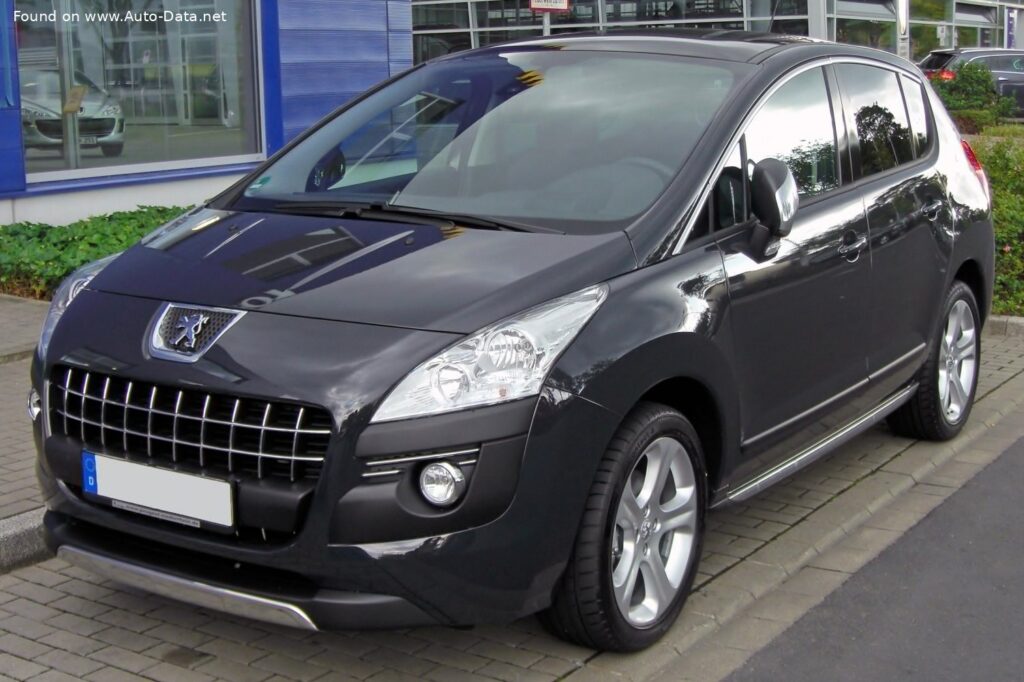
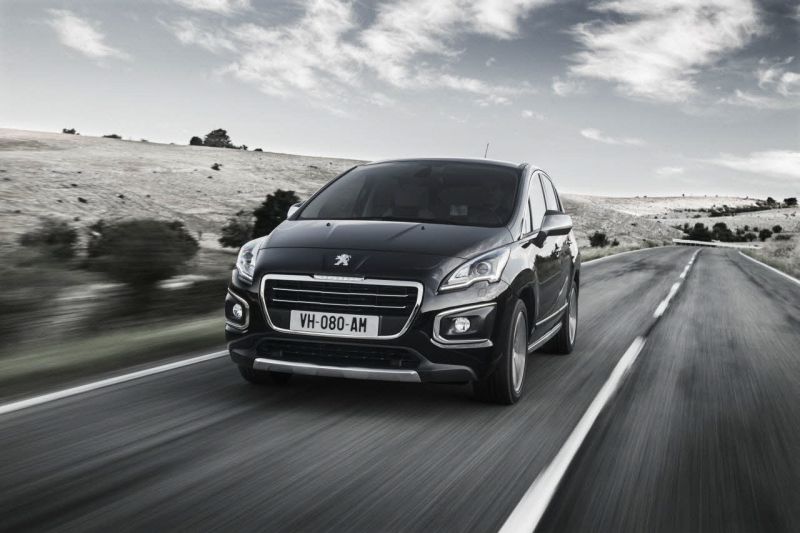
The Peugeot 3008 I (Phase II, 2013) maintained the distinctive crossover styling that characterized the first generation, albeit with subtle refinements introduced during its mid-cycle refresh. It presented as a 5-door, 5-seat SUV, though its initial design blurred the lines between a traditional SUV and a compact MPV, emphasizing practicality and a commanding view of the road. The exterior design featured a prominent grille, sculpted lines, and a relatively tall stance, contributing to its robust yet sophisticated appearance.
Measuring 171.85 inches (4365 mm) in length, 72.32 inches (1837 mm) in width (83.19 inches or 2113 mm including mirrors), and 64.53 inches (1639 mm) in height, the 3008 offered a compact footprint suitable for urban environments while providing ample interior space. Its wheelbase of 102.87 inches (2613 mm) contributed to a stable ride and generous cabin room. The minimum turning circle of 38.58 feet (11.76 m) further enhanced its maneuverability in tight city spaces.
Inside, the 3008 was designed with occupant comfort and versatility in mind. The 5-seat configuration provided a comfortable environment for families, complemented by a substantial trunk capacity. With the rear seats in place, it offered 512 liters (18.08 cu. ft.) of cargo volume, expanding to an impressive 1604 liters (56.64 cu. ft.) with the rear seats folded down. This flexibility made it highly practical for diverse needs, from daily commutes to family vacations.
The chassis featured an independent McPherson strut setup with coil springs and an anti-roll bar at the front, paired with a semi-independent rear suspension with coil springs. This configuration aimed to strike a balance between ride comfort and handling stability. Braking duties were handled by ventilated discs at the front and solid discs at the rear, supported by an Anti-lock Braking System (ABS) for enhanced safety. The electric power steering system, with a rack and pinion setup, offered light and responsive steering, making parking and low-speed maneuvers effortless. Various tire and wheel options were available, ranging from 215/60 R16 to 235/45 R18, allowing for customization of ride and aesthetics.
Technical Specifications
| General Information | |
| Brand | Peugeot |
| Model | 3008 |
| Generation | 3008 I (Phase II, 2013) |
| Type (Engine) | 1.6 BlueHDI (120 Hp) Automatic FAP |
| Start of production | 2015 year |
| End of production | 2016 year |
| Powertrain Architecture | Internal Combustion engine |
| Body type | SUV |
| Seats | 5 |
| Doors | 5 |
| Performance Specs | |
| Fuel consumption (economy) – urban | 4.7 l/100 km (50 US mpg) |
| Fuel consumption (economy) – extra urban | 4.1 l/100 km (57.4 US mpg) |
| Fuel consumption (economy) – combined | 4.3 l/100 km (54.7 US mpg) |
| CO2 emissions | 112 g/km |
| Fuel Type | Diesel |
| Acceleration 0 – 60 mph | 11.8 sec |
| Maximum speed | 184 km/h (114.33 mph) |
| Emission standard | Euro 6 |
| Weight-to-power ratio | 12.3 kg/Hp (81.6 Hp/tonne) |
| Weight-to-torque ratio | 4.9 kg/Nm (204.1 Nm/tonne) |
| Engine Specs | |
| Power | 120 Hp @ 3500 rpm |
| Power per liter | 76.9 Hp/l |
| Torque | 300 Nm (221.27 lb.-ft.) @ 1750 rpm |
| Engine layout | Front, Transverse |
| Engine Model/Code | BHZ DV6FC |
| Engine displacement | 1560 cm3 (1.6 liters, 95.2 cu. in.) |
| Number of cylinders | 4 |
| Engine configuration | Inline |
| Fuel injection system | Diesel Commonrail |
| Engine aspiration | Turbocharger, Intercooler |
| Engine oil capacity | 3.8 l (4.02 US qt) |
| Coolant | 6 l (6.34 US qt) |
| Engine systems | Particulate filter |
| Space, Volume, and Weights | |
| Kerb Weight | 1470-1582 kg (3240.8 – 3487.71 lbs.) |
| Max. weight | 2040 kg (4497.43 lbs.) |
| Max load | 458-570 kg (1009.72 – 1256.63 lbs.) |
| Trunk (boot) space – minimum | 512 l (18.08 cu. ft.) |
| Trunk (boot) space – maximum | 1604 l (56.64 cu. ft.) |
| Fuel tank capacity | 60 l (15.85 US gal) |
| Max. roof load | 75 kg (165.35 lbs.) |
| Permitted trailer load with brakes (12%) | 1300 kg (2866.01 lbs.) |
| Permitted trailer load without brakes | 740 kg (1631.42 lbs.) |
| Permitted towbar download | 70 kg (154.32 lbs.) |
| Dimensions | |
| Length | 4365 mm (171.85 in.) |
| Width | 1837 mm (72.32 in.) |
| Width with mirrors folded | 1910 mm (75.2 in.) |
| Width including mirrors | 2113 mm (83.19 in.) |
| Height | 1639 mm (64.53 in.) |
| Wheelbase | 2613 mm (102.87 in.) |
| Front track | 1532 mm (60.31 in.) |
| Rear (Back) track | 1527 mm (60.12 in.) |
| Front overhang | 916 mm (36.06 in.) |
| Rear overhang | 836 mm (32.91 in.) |
| Minimum turning circle (turning diameter) | 11.76 m (38.58 ft.) |
| Drivetrain, Brakes, and Suspension Specs | |
| Drivetrain Architecture | The Internal combustion engine (ICE) drives the front wheels of the vehicle. |
| Drive wheel | Front wheel drive |
| Number of gears and type of gearbox | 6 gears, automatic transmission |
| Front suspension | Independent, type McPherson with coil spring and anti-roll bar |
| Rear suspension | Semi-independent, coil spring |
| Front brakes | Ventilated discs |
| Rear brakes | Disc |
| Assisting systems | ABS (Anti-lock braking system) |
| Steering type | Steering rack and pinion |
| Power steering | Electric Steering |
| Tires size | 215/60 R16; 225/50 R17; 235/45 R18 |
| Wheel rims size | 16; 17; 18 |
Legacy and Market Impact
The Peugeot 3008 I, particularly in its Phase II iteration with the 1.6 BlueHDI automatic powertrain, played a crucial role in Peugeot’s strategy to capture a significant share of the booming European crossover market. While its initial design was sometimes criticized for being somewhat ambiguous – blending MPV practicality with SUV styling cues – the Phase II refresh helped solidify its position. It competed fiercely with established rivals like the Nissan Qashqai, Volkswagen Tiguan, Renault Kadjar, Hyundai Tucson, and Kia Sportage.
The model earned a reputation for its robust build quality, comfortable ride, and exceptional fuel economy, especially with the BlueHDI diesel engines. For European consumers facing rising fuel costs and stricter emission regulations, the 1.6 BlueHDI (120 Hp) variant offered an appealing balance of performance, efficiency, and environmental responsibility. Its Euro 6 compliance was a testament to Peugeot’s engineering prowess in developing clean diesel technology.
The 3008’s spacious interior and versatile cargo capacity made it a popular choice among families seeking a practical and comfortable vehicle for both urban commutes and longer journeys. The automatic transmission further enhanced its appeal, offering ease of use in congested traffic and a relaxed driving experience.
Ultimately, the first-generation 3008, and specifically this refined Phase II variant, served as a foundational stepping stone for Peugeot. It allowed the brand to experiment with the crossover concept before fully committing to the more distinctly SUV-styled second-generation 3008, which went on to win numerous accolades, including European Car of the Year. The lessons learned and the technological advancements, particularly in powertrain efficiency and design refinement, from models like the Peugeot 3008 I (Phase II, 2013) were instrumental in shaping Peugeot’s future success in the highly competitive global automotive landscape. It remains a testament to European engineering’s focus on efficiency and practicality, a vehicle that, despite its regional focus, embodies universal automotive excellence.