The Toyota Corona Premio (T21): A Refined Japanese Sedan of the Late 1990s
The Toyota Corona Premio (T21) represents a significant chapter in the storied history of Toyota’s Corona line, a nameplate that had been a cornerstone of the Japanese automotive landscape for decades. Launched in 1997, the T21 generation, specifically the Premio variant, positioned itself as a more upscale and refined offering within the compact to mid-size sedan segment. While the Corona name itself enjoyed a long and illustrious global presence, the Premio (T21) was primarily tailored for the Japanese domestic market (JDM) and select Asian regions, embodying Toyota’s commitment to comfort, efficiency, and advanced technology for its home consumers during the late 1990s. This particular iteration, featuring the 2.0 i 16V D-4 engine, showcased Toyota’s pioneering direct injection technology, setting it apart from many contemporaries. The Toyota Corona Premio (T21) offered a blend of practicality, understated elegance, and the bulletproof reliability for which Toyota is renowned, making it a popular choice for families and professionals in its target markets until the end of its production run in 2001.
Engine and Performance: The Advanced 3S-FSE D4 Powertrain
At the heart of the Toyota Corona Premio (T21) 2.0 i 16V D-4 lies a sophisticated 2.0-liter, inline four-cylinder engine, designated as the 3S-FSE D4. This powertrain was a testament to Toyota’s engineering prowess, particularly its early adoption of direct injection technology, which was still relatively novel in mass-market vehicles during the late 1990s. The “D-4” in its nomenclature stands for “Direct injection four-stroke gasoline engine,” highlighting its most distinctive feature. This system precisely injects fuel directly into the combustion chamber, allowing for more efficient combustion, improved fuel economy, and reduced emissions compared to conventional port fuel injection systems of the era.
The naturally aspirated 3S-FSE D4 engine delivers a respectable 145 horsepower at 6000 rpm, providing ample power for daily driving and highway cruising. Torque output stands at 196 Nm, or 144.56 pound-feet, peaking at a accessible 4400 rpm. This torque delivery ensures a smooth and responsive driving experience, particularly when paired with the car’s standard 4-speed automatic transmission. The engine’s displacement of 1998 cubic centimeters (approximately 2.0 liters or 121.93 cubic inches) is achieved through a square bore and stroke configuration of 86 mm (3.39 inches) by 86 mm (3.39 inches), contributing to its balanced performance characteristics. With a compression ratio of 10:1 and a DOHC (Double Overhead Camshaft) valvetrain with four valves per cylinder, the engine was designed for optimal breathing and efficiency.
The powertrain architecture is a front, transverse engine layout, driving the front wheels (Front Wheel Drive). This configuration is typical for sedans in this segment, optimizing interior space and manufacturing efficiency. The weight-to-power ratio of 8.3 kg/Hp (120.8 Hp/tonne) and a weight-to-torque ratio of 6.1 kg/Nm (163.3 Nm/tonne) indicate a well-balanced vehicle, capable of offering a sprightly performance despite its family-sedan demeanor. The 3.9-liter (4.12 US quarts) engine oil capacity and 6.6-liter (6.97 US quarts) coolant capacity reflect standard maintenance requirements for an engine of its size. The advanced direct injection system was a key technological differentiator, showcasing Toyota’s commitment to pushing the boundaries of gasoline engine efficiency and performance in a practical package.
Design and Features of the Toyota Corona Premio (T21)
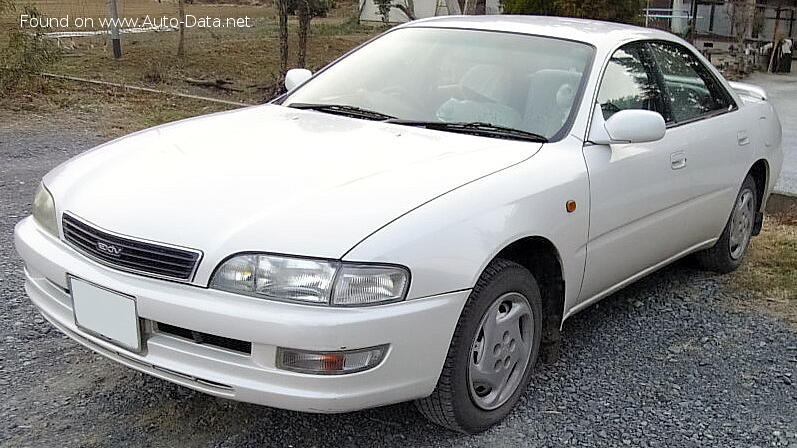
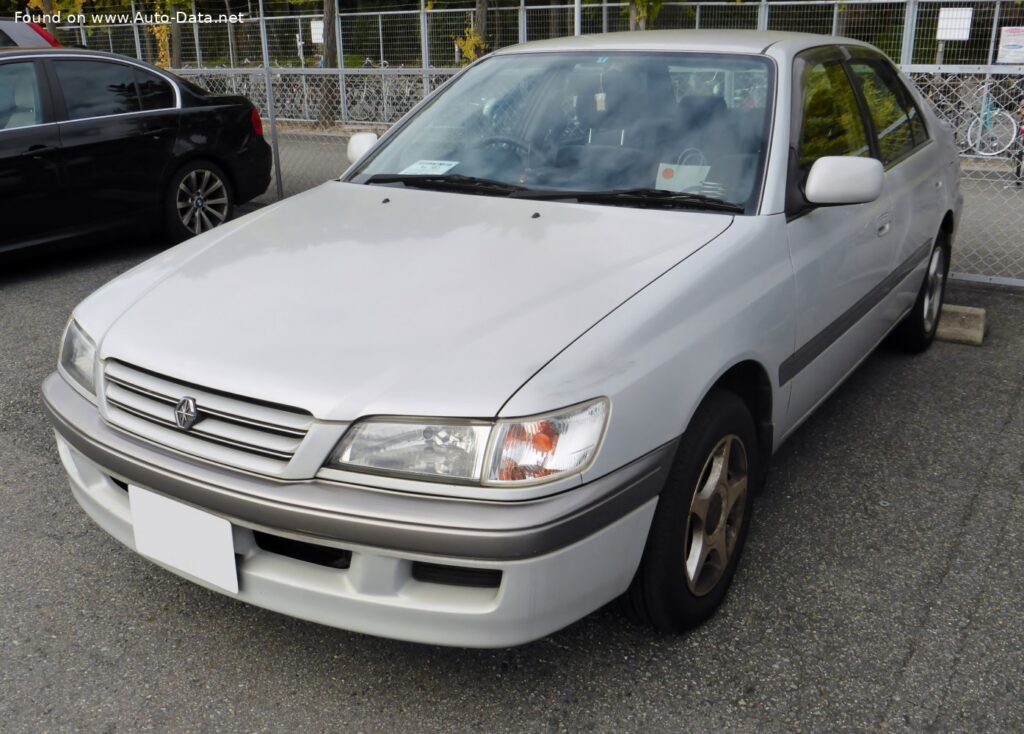
The Toyota Corona Premio (T21) was offered exclusively as a four-door sedan, a body style that resonated strongly with its target demographic in Japan and other Asian markets. Its design philosophy was one of understated elegance and functional simplicity, a common theme for mainstream Japanese sedans of the late 1990s. The exterior lines were clean and aerodynamic, devoid of unnecessary embellishments, which contributed to a timeless aesthetic and likely aided in fuel efficiency. At 181.1 inches long, 66.73 inches wide, and 55.51 inches tall, with a wheelbase of 101.57 inches, the Corona Premio (T21) occupied a sweet spot in its segment, offering a spacious interior without being overly cumbersome for urban environments.
Inside, the Premio designation implied a step up in refinement and appointments compared to the standard Corona. While specific luxury features might have varied by trim level, the focus was on comfort, ergonomics, and durability. The cabin was designed to comfortably accommodate five occupants, with thoughtful touches aimed at enhancing the driving and passenger experience. The trunk space was generous for its class, offering 17.3 cubic feet (490 liters) of cargo volume, making it practical for family use, shopping, or longer journeys.
From a chassis and safety perspective, the Toyota Corona Premio (T21) was engineered to deliver a comfortable and secure ride. It featured a wishbone front suspension, a design known for its ability to provide good ride quality and handling stability. The rear suspension utilized coil springs, further contributing to occupant comfort. Stopping power came from ventilated disc brakes at the front, offering superior heat dissipation, and reliable drum brakes at the rear. An Anti-lock Braking System (ABS) was a significant safety feature for its time, providing enhanced control during emergency braking. Steering was handled by a hydraulic rack and pinion system, delivering direct and predictable feedback to the driver. The vehicle rode on 185/65 R14 S tires, a common size for compact sedans, balancing ride comfort with adequate grip. The 15.85 US gallon fuel tank capacity provided a good cruising range, complementing the engine’s efficiency.
Technical Specifications
| Category | Specification |
|---|---|
| Brand | Toyota |
| Model | Corona |
| Generation | Corona Premio (T21) |
| Type (Engine) | 2.0 i 16V D-4 (145 Hp) |
| Start of Production | 1997 year |
| End of Production | 2001 year |
| Powertrain Architecture | Internal Combustion engine |
| Body Type | Sedan |
| Seats | 5 |
| Doors | 4 |
| Performance Specs | |
| Fuel Type | Petrol (Gasoline) |
| Weight-to-Power Ratio | 8.3 kg/Hp, 120.8 Hp/tonne |
| Weight-to-Torque Ratio | 6.1 kg/Nm, 163.3 Nm/tonne |
| Engine Specs | |
| Power | 145 Hp @ 6000 rpm |
| Power per Liter | 72.6 Hp/l |
| Torque | 196 Nm @ 4400 rpm (144.56 lb.-ft. @ 4400 rpm) |
| Engine Layout | Front, Transverse |
| Engine Model/Code | 3S-FSE D4 |
| Engine Displacement | 1998 cm³ (2.0 l, 121.93 cu. in.) |
| Number of Cylinders | 4 |
| Engine Configuration | Inline |
| Cylinder Bore | 86 mm (3.39 in.) |
| Piston Stroke | 86 mm (3.39 in.) |
| Compression Ratio | 10:1 |
| Number of Valves per Cylinder | 4 |
| Fuel Injection System | Direct injection |
| Engine Aspiration | Naturally aspirated engine |
| Valvetrain | DOHC |
| Engine Oil Capacity | 3.9 l (4.12 US qt) |
| Coolant Capacity | 6.6 l (6.97 US qt) |
| Space, Volume and Weights | |
| Kerb Weight | 1200 kg (2645.55 lbs.) |
| Max. Weight | 1475 kg (3251.82 lbs.) |
| Max Load | 275 kg (606.27 lbs.) |
| Trunk (Boot) Space – Minimum | 490 l (17.3 cu. ft.) |
| Fuel Tank Capacity | 60 l (15.85 US gal) |
| Dimensions | |
| Length | 4600 mm (181.1 in.) |
| Width | 1695 mm (66.73 in.) |
| Height | 1410 mm (55.51 in.) |
| Wheelbase | 2580 mm (101.57 in.) |
| Front Track | 1465 mm (57.68 in.) |
| Rear (Back) Track | 1450 mm (57.09 in.) |
| Drivetrain, Brakes and Suspension Specs | |
| Drivetrain Architecture | The Internal combustion engine (ICE) drives the front wheels of the vehicle. |
| Drive Wheel | Front wheel drive |
| Number of Gears and Type of Gearbox | 4 gears, automatic transmission |
| Front Suspension | Wishbone |
| Rear Suspension | Coil spring |
| Front Brakes | Ventilated discs |
| Rear Brakes | Drum |
| Assisting Systems | ABS (Anti-lock braking system) |
| Steering Type | Steering rack and pinion |
| Power Steering | Hydraulic Steering |
| Tires Size | 185/65 R14 S |
Legacy and Market Impact of the Toyota Corona Premio (T21)
The Toyota Corona Premio (T21) carved out a reputation for itself as a highly reliable, efficient, and comfortable sedan within its primary markets, particularly Japan. It was a testament to Toyota’s philosophy of continuous improvement and delivering practical, high-quality vehicles to its customers. The “Premio” designation, meaning “premium” in Spanish, underscored its slightly elevated position within the Corona family, offering a more refined interior and a smoother ride compared to its more utilitarian counterparts. This focus on refinement, combined with Toyota’s legendary build quality, ensured strong customer loyalty.
In the competitive Japanese market of the late 1990s, the Corona Premio (T21) faced rivals from other domestic manufacturers, including the Nissan Primera, Honda Civic (sedan variants), Mitsubishi Lancer, and Mazda Capella (also known as Mazda 626 in some markets). What allowed the Corona Premio to hold its own was its formidable combination of the advanced D-4 direct injection engine, which offered a compelling blend of power and fuel efficiency, and its unwavering reputation for dependability. While not a flashy or overtly sporty car, its strengths lay in its sensible engineering and long-term value.
The T21 generation marked one of the final chapters for the long-running Corona nameplate, which concluded its production in Japan in 2001 after an impressive 11 generations spanning over 40 years. The Corona Premio (T21) directly paved the way for its successors, the Toyota Allion and Toyota Premio, which continued the tradition of offering a comfortable, reliable, and well-appointed compact sedan for the Japanese market. These subsequent models further refined the concept of an accessible yet premium compact sedan, carrying forward the legacy of the Corona Premio.
Beyond its immediate sales figures, the Corona Premio (T21) played a crucial role in showcasing Toyota’s technological leadership, particularly with the widespread application of direct injection. This technology would later become a cornerstone of many modern engines, demonstrating Toyota’s foresight. The car’s enduring presence on the roads of Japan and other Asian countries, even decades after its production, speaks volumes about its robust construction and the care taken in its design and manufacturing. It remains a quiet but significant contributor to Toyota’s global reputation for engineering excellence and reliability.