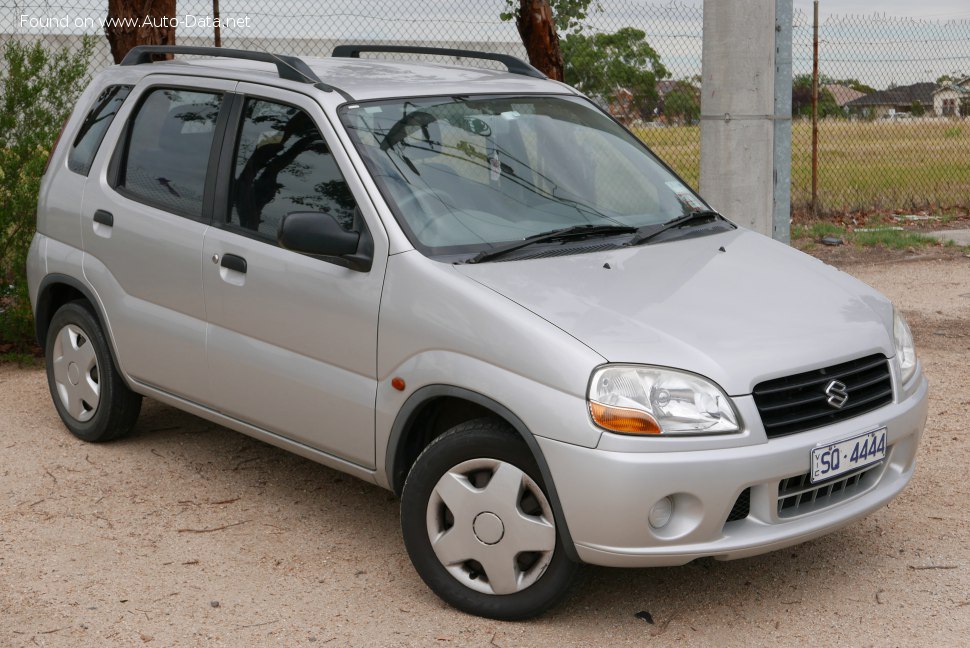
The Suzuki Ignis Hatchback I FH: A Global Urban Contender (2000-2003)
The Suzuki Ignis, specifically the first-generation Hatchback I FH produced between 2000 and 2003, represents Suzuki’s entry into the burgeoning global subcompact segment. While not a familiar sight on American roads, the Ignis played a crucial role in Suzuki’s international lineup, particularly in European and Asian markets where demand for small, efficient, and versatile vehicles is consistently high. This particular variant, the 1.0 i (3 dr) (53 Hp) Automatic, was designed to offer an economical and practical solution for urban commuters, combining a compact footprint with surprising interior space for its class. It embodied Suzuki’s reputation for building reliable, no-nonsense vehicles that delivered on their promise of affordability and ease of ownership.
The Suzuki Ignis Hatchback I FH was conceived during an era when manufacturers were increasingly focusing on global platforms and diversified vehicle offerings. Its design ethos was rooted in maximizing utility within a compact package, a common theme for vehicles destined for crowded city environments. Despite its modest power output and basic features by contemporary American standards, the Ignis carved out a niche in its target markets by offering a compelling blend of low running costs, maneuverability, and practical design. Its brief but significant production run established the Ignis nameplate as a capable and accessible option for drivers seeking an unpretentious daily driver.
Engine and Performance: The Heart of the Suzuki Ignis Hatchback I FH
At the core of the Suzuki Ignis Hatchback I FH 1.0 i (3 dr) Automatic lies a compact and efficient powertrain designed for urban efficiency rather than outright speed. The vehicle is propelled by a 1.0-liter (993 cm3), naturally aspirated, inline three-cylinder engine. This diminutive powerplant, configured for front, transverse mounting, was engineered to deliver adequate performance for city driving while maintaining excellent fuel economy. With two valves per cylinder and an OHC (Overhead Camshaft) valvetrain, the engine utilized a single-point injection system, a common and cost-effective fuel delivery method for entry-level vehicles of its time.
The engine produces a modest 53 horsepower at 5700 rpm, translating to a power-per-liter rating of 53.4 horsepower per liter. Torque output stands at 56.05 lb.-ft. (76 Nm) at a relatively low 3300 rpm, which helps in providing usable thrust from a standstill and during low-speed maneuvers. Power is delivered to the front wheels via a 3-speed automatic transmission. While a 3-speed automatic might seem rudimentary by today’s standards, it was a practical and durable choice for a vehicle in this segment, prioritizing simplicity and reliability.
In terms of performance, the Ignis 1.0 i Automatic was decidedly geared towards economical daily use. Acceleration from 0 to 60 mph was achieved in approximately 15.2 seconds, with a top speed of 86.99 mph (140 km/h). These figures clearly indicate that the vehicle was not designed for spirited driving on highways but rather for navigating congested city streets and maintaining reasonable speeds on secondary roads. The weight-to-power ratio of 13.8 kg/Hp (72.6 Hp/tonne) further underscores its focus on lightweight construction to compensate for the modest engine output.
Fuel efficiency was a key selling point for the Suzuki Ignis Hatchback I FH in its primary markets. The official combined fuel consumption rating stood at 34.1 US mpg (6.9 l/100 km). In urban driving, it achieved 27.4 US mpg (8.6 l/100 km), while extra-urban driving saw figures improve to 39.9 US mpg (5.9 l/100 km). These numbers were competitive for its class at the turn of the millennium, offering significant cost savings for drivers in regions with high fuel prices. The 10.57 US gallon (40 liter) fuel tank provided a decent range for its intended use.
Design and Features: Practicality in a Compact Package
The design of the Suzuki Ignis Hatchback I FH was characterized by its functional and unpretentious aesthetic. As a 3-door hatchback, it featured a compact and somewhat tall stance, maximizing interior volume within a small footprint. Its overall length measured 147.44 inches, with a width of 62.6 inches and a height of 53.15 inches. This compact size, combined with a tight minimum turning circle of 31.5 feet, made the Ignis exceptionally maneuverable in urban environments, allowing for easy parking and navigation through narrow streets.
Despite its exterior dimensions, the Ignis offered seating for five occupants, a testament to clever interior packaging. The wheelbase of 89.17 inches contributed to a surprisingly stable ride for a car of its size. The interior was designed with practicality in mind, featuring durable materials and a straightforward layout. Cargo versatility was a notable strength; the trunk offered a minimum capacity of 9.89 cubic feet (280 liters), which could be expanded significantly to 21.9 cubic feet (620 liters) by folding down the rear seats, providing ample space for groceries or small luggage.
The chassis of the Ignis was