The Renault Megane II Grandtour 2.0 16V (135 Hp): A European Family Workhorse
The Renault Megane II Grandtour 2.0 16V (135 Hp) represents a significant offering within the C-segment (compact car) market in Europe during its production run from 2004 to 2005. As the station wagon variant of the second-generation Megane, it was engineered by the French automaker Renault to combine distinctive styling, practical versatility, and a comfortable driving experience. While not officially sold in the United States, the Megane II Grandtour was a ubiquitous sight on European roads, serving as a popular choice for families and individuals requiring ample cargo space without sacrificing the maneuverability and fuel efficiency of a compact vehicle. This particular iteration, powered by a robust 2.0-liter 16-valve engine, offered a compelling blend of performance and economy for its class, solidifying its role as a competitive contender against rivals from other European manufacturers.
Engine and Performance of the Renault Megane II Grandtour
At the heart of the Renault Megane II Grandtour 2.0 16V (135 Hp) lies Renault’s F4R series engine, a naturally aspirated 2.0-liter (1998 cm³ or 121.93 cu. in.) inline four-cylinder powerplant. This DOHC (Double Overhead Camshaft) engine, featuring 16 valves (4 per cylinder) and multi-port manifold injection, was designed to deliver a smooth and responsive power delivery characteristic of many European engines of the era. It produced a respectable 135 horsepower at 5500 rpm, translating to a power-per-liter output of 67.6 horsepower per liter. Torque was rated at 140.87 lb-ft (191 Nm) at 3750 rpm, providing adequate pulling power for both city driving and highway cruising, even when fully loaded.
Power was channeled to the front wheels via a six-speed manual transmission, a common and desirable feature in European compacts, offering greater control and potentially better fuel economy than a five-speed unit. This powertrain configuration allowed the Megane II Grandtour to achieve a 0-60 mph acceleration time of 9.8 seconds, with 0-100 km/h completed in 10.3 seconds. Its maximum speed was a respectable 123.03 mph (198 km/h). The vehicle’s weight-to-power ratio stood at 9.6 kg/Hp (104.7 Hp/tonne), indicating a balanced approach to performance for its segment.
Fuel efficiency for the 2.0 16V variant was competitive for the early 2000s. The combined fuel consumption was rated at 29.4 US mpg (8 l/100 km), with urban driving yielding 21.6 US mpg (10.9 l/100 km) and extra-urban figures reaching an impressive 36.8 US mpg (6.4 l/100 km). With CO2 emissions of 191 g/km, the vehicle met the Euro 4 emission standard, reflecting its compliance with the environmental regulations prevalent in its primary market at the time.
Design and Features of the Renault Megane II Grandtour
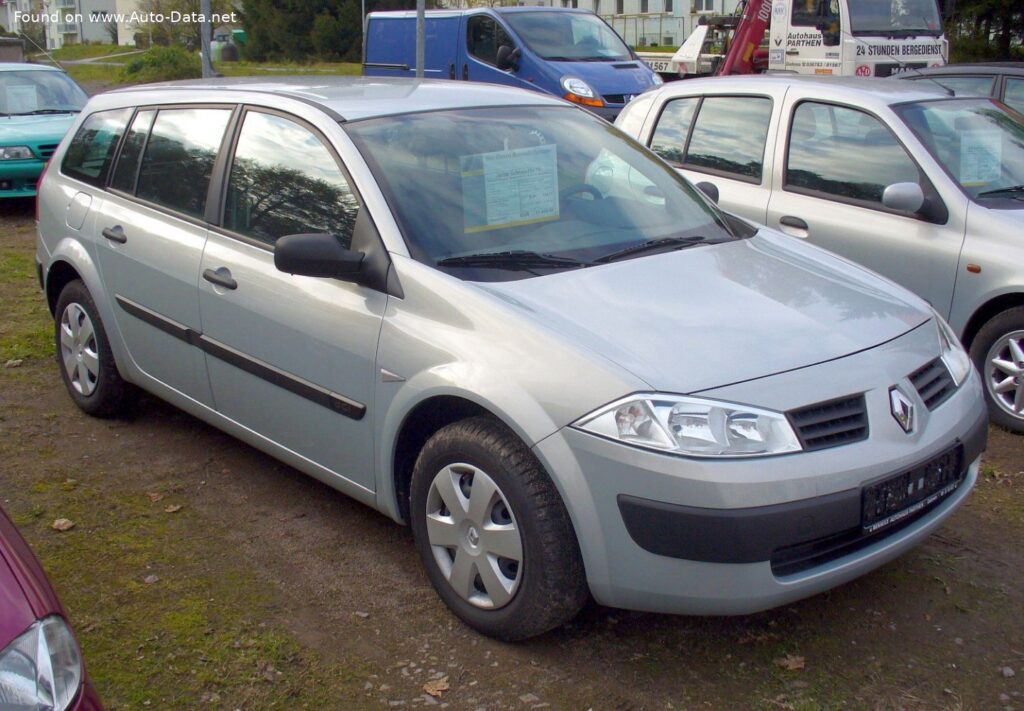
The Megane II Grandtour, produced from 2004 to 2005, was built on the distinctive design language established by the second-generation Megane hatchback, which famously featured a unique “bustle-back” rear. The Grandtour adapted this aesthetic into a more conventional yet still stylish station wagon form. Its five-door body type offered practical access for both passengers and cargo, while the five-seat configuration ensured comfortable accommodation for a family. Dimensionally, the vehicle measured 177.17 inches (4500 mm) in length, 69.96 inches (1777 mm) in width (79.76 inches or 2026 mm including mirrors), and 57.76 inches (1467 mm) in height. The wheelbase of 105.75 inches (2686 mm) contributed to a stable ride and generous interior space.
The true highlight of the Grandtour was its cargo capacity. With the rear seats in place, it offered a substantial 18.36 cu. ft. (520 liters) of trunk space. This could be expanded dramatically to a cavernous 56.5 cu. ft. (1600 liters) with the rear seats folded down, making it an incredibly versatile vehicle for hauling luggage, sports equipment, or even small furniture. The maximum load capacity was 1278.68 lbs (580 kg), and it could tow a braked trailer up to 2976.24 lbs (1350 kg), further underscoring its utility.
Underneath, the Megane II Grandtour featured an independent McPherson strut front suspension and a torsion beam rear suspension, a common and cost-effective setup for compact cars that provided a good balance of ride comfort and handling. Stopping power came from ventilated disc brakes at the front and solid disc brakes at the rear, augmented by an Anti-lock Braking System (ABS) for enhanced safety. Steering was managed by an electric power-assisted rack and pinion system, offering ease of maneuverability, particularly in urban environments with a minimum turning circle of 36.09 ft (11 meters). Standard tire sizes included 195/65 R15 or 205/55 R16, mounted on 6.5J x 15 or 6.5J x 16 wheel rims, respectively.
Technical Specifications: Renault Megane II Grandtour 2.0 16V (135 Hp)
| Category | Specification | US Equivalent |
|---|---|---|
| General Information | ||
| Brand | Renault | |
| Model | Megane II Grandtour | |
| Type (Engine) | 2.0 16V (135 Hp) | |
| Production Start | 2004 year | |
| Production End | 2005 year | |
| Powertrain Architecture | Internal Combustion engine | |
| Body type | Station wagon (estate) | |
| Seats | 5 | |
| Doors | 5 | |
| Performance Specs | ||
| Fuel consumption (urban) | 10.9 l/100 km | 21.6 US mpg |
| Fuel consumption (extra urban) | 6.4 l/100 km | 36.8 US mpg |
| Fuel consumption (combined) | 8 l/100 km | 29.4 US mpg |
| CO2 emissions | 191 g/km | |
| Fuel Type | Petrol (Gasoline) | |
| Acceleration 0 – 60 mph | 9.8 sec | |
| Acceleration 0 – 100 km/h | 10.3 sec | |
| Maximum speed | 198 km/h | 123.03 mph |
| Emission standard | Euro 4 | |
| Weight-to-power ratio | 9.6 kg/Hp | 104.7 Hp/tonne |
| Weight-to-torque ratio | 6.8 kg/Nm | 148.1 Nm/tonne |
| Engine Specs | ||
| Power | 135 Hp @ 5500 rpm | |
| Power per liter | 67.6 Hp/l | |
| Torque | 191 Nm @ 3750 rpm | 140.87 lb.-ft. @ 3750 rpm |
| Engine layout | Front, Transverse | |
| Engine Model/Code | F4R | |
| Engine displacement | 1998 cm³ | 121.93 cu. in. |
| Number of cylinders | 4 | |
| Engine configuration | Inline | |
| Cylinder Bore | 82.7 mm | 3.26 in. |
| Piston Stroke | 93 mm | 3.66 in. |
| Compression ratio | 9.8:1 | |
| Number of valves per cylinder | 4 | |
| Fuel injection system | Multi-port manifold injection | |
| Engine aspiration | Naturally aspirated engine | |
| Valvetrain | DOHC | |
| Engine oil capacity | 5.4 l | 5.71 US qt |
| Coolant capacity | 6 l | 6.34 US qt |
| Space, Volume and Weights | ||
| Kerb Weight | 1290 kg | 2843.96 lbs. |
| Max. weight | 1870 kg | 4122.64 lbs. |
| Max load | 580 kg | 1278.68 lbs. |
| Trunk (boot) space – minimum | 520 l | 18.36 cu. ft. |
| Trunk (boot) space – maximum | 1600 l | 56.5 cu. ft. |
| Fuel tank capacity | 60 l | 15.85 US gal |
| Max. roof load | 80 kg | 176.37 lbs. |
| Permitted trailer load with brakes (12%) | 1350 kg | 2976.24 lbs. |
| Permitted trailer load without brakes | 650 kg | 1433 lbs. |
| Permitted towbar download | 75 kg | 165.35 lbs. |
| Dimensions | ||
| Length | 4500 mm | 177.17 in. |
| Width | 1777 mm | 69.96 in. |
| Width including mirrors | 2026 mm | 79.76 in. |
| Height | 1467 mm | 57.76 in. |
| Wheelbase | 2686 mm | 105.75 in. |
| Front track | 1518 mm | 59.76 in. |
| Rear (Back) track | 1514 mm | 59.61 in. |
| Front overhang | 842 mm | 33.15 in. |
| Rear overhang | 972 mm | 38.27 in. |
| Minimum turning circle (turning diameter) | 11 m | 36.09 ft. |
| Drivetrain, Brakes and Suspension Specs | ||
| Drivetrain Architecture | Front wheel drive, Internal Combustion engine | |
| Drive wheel | Front wheel drive | |
| Number of gears and type of gearbox | 6 gears, manual transmission | |
| Front suspension | Independent type McPherson | |
| Rear suspension | Torsion | |
| Front brakes | Ventilated discs | |
| Rear brakes | Disc | |
| Assisting systems | ABS (Anti-lock braking system) | |
| Steering type | Steering rack and pinion | |
| Power steering | Electric Steering | |
| Tires size | 195/65 R15; 205/55 R16 | |
| Wheel rims size | 6.5J x 15; 6.5J x 16 | |
Legacy and Market Impact of the Megane II Grandtour
The Renault Megane II, and particularly its Grandtour variant, played a crucial role in Renault’s strategy to dominate the European compact car segment during the early to mid-2000s. Its distinctive styling, which earned it the European Car of the Year award in 2003 (for the hatchback), helped it stand out in a crowded market. The Grandtour capitalized on this design appeal while offering the practicality that European families highly valued. It was positioned as a sensible yet stylish alternative to competitors such as the Ford Focus Wagon, Opel Astra Caravan (Vauxhall Astra Estate in the UK), Peugeot 307 SW, and the Volkswagen Golf Variant.
The 2.0 16V (135 Hp) engine option was particularly well-regarded for providing a good balance between everyday usability and occasional spirited driving, making it suitable for a wide range of buyers, from young families to empty nesters. Its comprehensive feature set for the time, including electric power steering and ABS as standard, contributed to its reputation as a safe and comfortable family vehicle. The ample trunk space, combined with its ability to handle significant loads and tow trailers, solidified its position as a highly functional and versatile vehicle in its class.
Despite its absence from the North American market, the Renault Megane II Grandtour left a lasting legacy in Europe. It showcased Renault’s capability to blend innovative design with practical engineering, offering a compelling package that met the diverse needs of European consumers. Its success helped reinforce Renault’s image as a leading manufacturer of accessible, well-designed, and adaptable vehicles, influencing subsequent generations of compact family cars and demonstrating the enduring appeal of the station wagon body style in its home market.