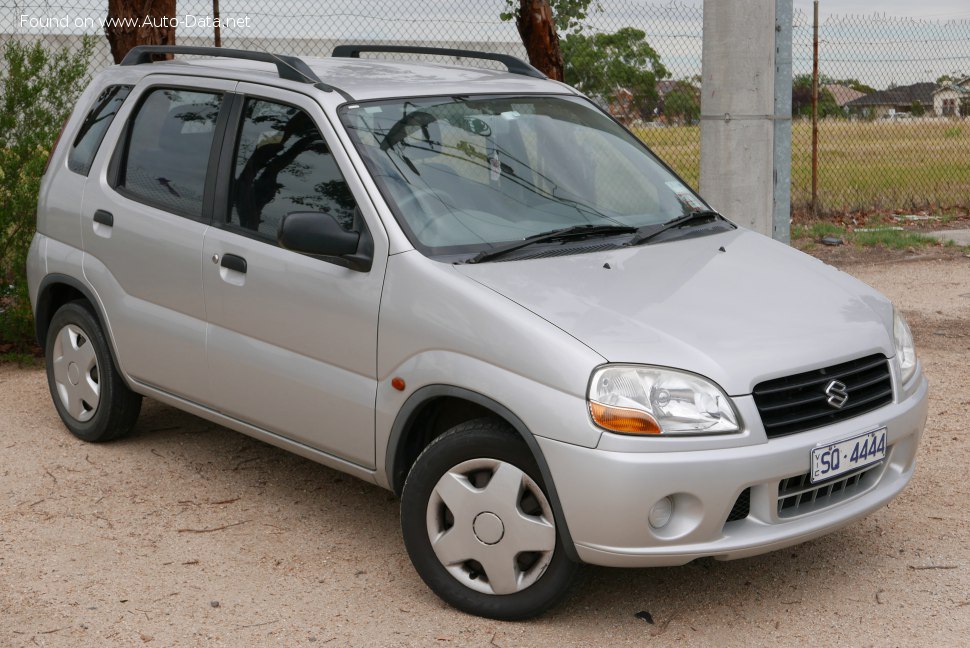
The Suzuki Ignis Hatchback I FH 1.0 i (5 dr) (53 Hp): A Global City Car Pioneer
The Suzuki Ignis, specifically the first-generation (FH) model produced between 2000 and 2003, represented Suzuki’s entry into the competitive global subcompact segment, particularly thriving in European and Asian markets. While never officially sold in the United States, this versatile little hatchback carved out a niche as a practical, economical, and surprisingly robust vehicle for its class. The variant under review, the Suzuki Ignis Hatchback I FH 1.0 i (5 dr) (53 Hp), was a cornerstone of the Ignis lineup, embodying the brand’s commitment to efficiency and utility in a compact, urban-friendly package. It served as a testament to Suzuki’s expertise in designing small cars that offered ample interior space and a nimble driving experience, making it an ideal choice for city dwellers and those seeking an affordable, no-frills mode of transport.
The first-generation Ignis was more than just a simple hatchback; its slightly raised stance hinted at the crossover trend that would later dominate the automotive landscape. However, the 1.0-liter, front-wheel-drive model firmly remained in the hatchback category, offering a compelling blend of low running costs and everyday usability. Its design language was functional and unpretentious, prioritizing practicality over flamboyant styling, a characteristic that resonated well with its target audience across various international markets.
Engine and Performance: The Heart of the Suzuki Ignis Hatchback I FH 1.0 i (5 dr) (53 Hp)
Powering the Suzuki Ignis Hatchback I FH 1.0 i was a modest yet highly efficient 1.0-liter (993 cm³) inline three-cylinder engine. This naturally aspirated unit, utilizing a Single Overhead Cam (OHC) valvetrain with two valves per cylinder and a single-point fuel injection system, was engineered for fuel economy and reliability rather than outright speed. It produced a respectable 53 horsepower at 5700 rpm, delivering its peak torque of 56.05 lb.-ft. (76 Nm) at a relatively low 3300 rpm. This torque delivery profile ensured adequate responsiveness for city driving, allowing the lightweight Ignis to navigate urban traffic with ease.
The engine’s compact design and aluminum construction contributed to the vehicle’s remarkably low curb weight of just 1653.47 lbs. (750 kg). This featherlight mass, combined with the eager three-cylinder powerplant, resulted in a weight-to-power ratio of 14.2 kg/Hp, which, for a car of its class and era, was quite competitive. Power was sent to the front wheels via a smooth-shifting 5-speed manual transmission, a common and reliable setup for economic vehicles.
While not a performance car by any stretch, the Ignis 1.0 i offered sufficient acceleration for its intended purpose. It could sprint from 0 to 60 mph in a calculated 15.2 seconds, reaching a top speed of 90.1 mph (145 km/h). These figures underscored its role as a practical commuter. Where the Ignis truly shone was in its fuel efficiency. With a combined fuel economy rating of an impressive 48 US mpg (4.9 l/100 km), it was an economical choice, especially in regions where fuel prices were a significant concern. Urban consumption stood at 34.6 US mpg (6.8 l/100 km), while extra-urban driving could yield up to 52.3 US mpg (4.5 l/100 km), making it a cost-effective vehicle to operate daily.
Design and Features
The Suzuki Ignis Hatchback I FH adopted a straightforward and practical design philosophy. As a 5-door hatchback, it prioritized accessibility and cargo versatility. Its compact dimensions – a length of 151.38 inches, a width of 62.6 inches, and a height of 54.33 inches – made it exceptionally maneuverable in tight urban environments, boasting a minimum turning circle of just 31.5 feet. Despite its small footprint, the Ignis offered seating for five occupants, a testament to Suzuki’s clever interior packaging.
The exterior styling was clean and unfussy, characterized by a relatively tall greenhouse and a short hood, maximizing interior volume. The large windows provided excellent visibility, a crucial safety and convenience feature for city driving. The vehicle’s architecture, with a front, transverse engine layout and front-wheel drive, was typical for the segment, optimizing interior space and manufacturing efficiency.
Inside, the Ignis was designed with durability and functionality in mind. While materials were generally hard plastics, they were robust and easy to clean, suitable for a vehicle often subjected to daily family use. Cargo space was a significant advantage; the rear hatch opened to reveal 9.89 cubic feet (280 liters) of trunk space, which could expand to a generous 21.9 cubic feet (620 liters) with the rear seats folded down. This flexibility made the Ignis surprisingly capable of handling grocery runs or weekend trips.
The chassis featured a wishbone front suspension and a coil spring rear suspension, providing a comfortable ride for its class while maintaining predictable handling. Braking duties were handled by ventilated discs at the front and traditional drum brakes at the rear, a cost-effective and adequate setup for a lightweight vehicle with modest performance. The steering system was a responsive rack-and-pinion type, contributing to the Ignis’s agile feel. Standard tires were 155/70 R13, mounted on 13-inch wheel rims, emphasizing efficiency and low rolling resistance.
Technical Specifications
| Category | Specification |
|---|---|
| Brand | Suzuki |
| Model | Ignis |